Sarne
The road down from the ridge was paved, and it was full of people.
Lio had walked on old paving deep in the forest, where the stones heaved up through the leaf-mold and nobody had swept them since before his grandmother's grandmother was born. These stones had been swept this morning. Carts came up empty and went down full of hay and meal and firewood. One carried a load of new barrel staves, and the smell of the oak took him home so suddenly that he missed his step. The carters shouted at their mules in Western, which sounded to Lio like the common tongue spoken very fast by a man with a cold.
Nobody stared. Four people had come down off the ridge with moss on their packs and old smoke in their clothes, and the carters only pulled their mules aside and let them by.
"They think we're road-menders," said Sil. She had put her hood up on the ridge and had not lowered it since. "Off the returning road. Everyone who comes down that way looks like a hedge."
"I am a hedge," said Rupert happily. "I am a hedge that has walked across the world." Every little way he turned round to make sure the sea had not gone anywhere.
The gate in the city wall stood open. A man in a gray coat beneath it, eating an apple, looked at Sil's hood and Brannoc's bow and Lio's axe, and last at Rupert, who beamed at him. He waved them through with the apple.
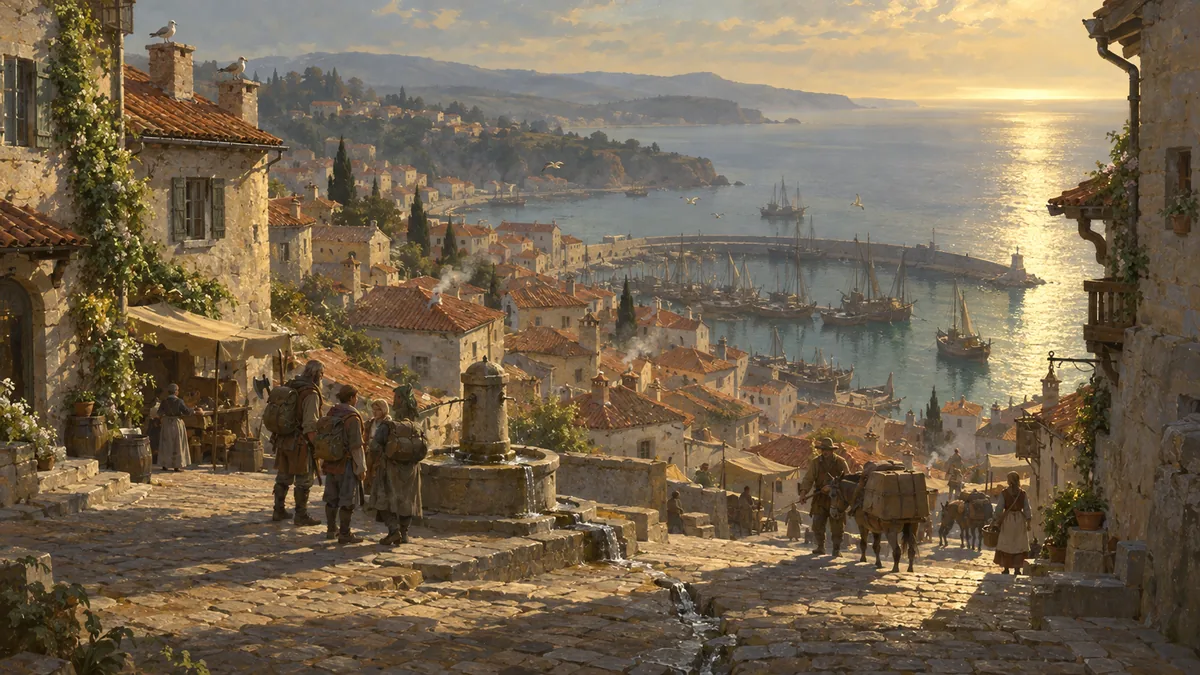
Then the noise had them. Iron wheels rang on the stones, hawkers sang their wares, and over all of it the gulls stood on the chimneys and shrieked from roof to roof. The streets went down in steps and in long curving ramps, and sometimes a street simply stopped at a wall and became a stair. None of these people had ever heard of Thornby. If he told one of them he was Lio Ashby, Owen's son, from the mill end, they would smile at him politely and walk on.
At the corner of a little square with a fountain in it, the homesickness came on him all at once, so sharp it was almost funny. He had walked across the world to get here, and now that he had arrived he wanted the knock of the mill wheel and a field with nobody in it.
"Lio," said Brannoc quietly.
"I'm all right."
"So am I." Brannoc looked up at the gulls. "Noisy, aren't they."
The fountain ran over the lip of its basin and away down a gutter in the middle of the street. It ran downhill toward the harbor, which meant it ran west. Every gutter in the square was running that way. At home every water he knew ran east to the Lenn.
"Which way is the Archive?" he said.
The Archive stood on the upper square, larger than the chapel and the reeve's hall at Wexley set end to end. It had a front of tall columns and doors twice the height of a man, with pigeons nesting on every ledge. Inside it was cool and dim and smelled of dust and leather and lamp oil. Men and women bent over books at long tables between the pillars, and the scratch of their pens was the loudest sound in the room.
Sil went to a clerk at a desk by the door and spoke to him low and short, with her hood up. He shook his head and answered at some length, pointing with his pen toward the sea.
"The Archivist isn't here," she said when she came back. "He went down the coast yesterday to Tollmouth, to a festival where they read the old deeds aloud in the square. He took the easterner with him." She paused. "Your brother. They come back on the morning boat."
Lio stood in the dim hall with the dust of the gray still in his hair.
"Of course he isn't," Lio said.
It came out louder than he meant, and several people at the tables looked up. Brannoc put a hand on his shoulder and took it away again.
"One night," Brannoc said. "You've waited longer than that."
Behind them, Rupert made a small high sound in his throat. He had stopped at a glass case under one of the tall windows, where coins lay in rows on green cloth, and he was holding one of his own against the glass beside one of theirs. Each showed a tower standing over three wavy lines, worn to the same blur.
A tall stooped old man with spectacles on his forehead came down the hall to see who was breathing on his case. He took the coin out of Rupert's fingers, turned it to the window, and said something short in Western.
"A Sarne penny," said Sil. "A very old one. He says you'd better sit down."
His name was Ansel, and he kept the coins. In slow old speech learned out of books, he asked on which day they had come to the great oaks. Rupert opened his notebook from the back and read out the sixth of March with his chest thrown out, and the bridge, and the well. Lio watched Rupert's thumb on the back pages.
"Rupert," said Lio. "That's enough. The rest's a muddle."
"The rest's a muddle," Rupert agreed, and shut the book, and put it inside his coat.
Lio nearly asked. But Rupert was happier than Lio had seen him since Wexley, with a scholar writing down every word he said. Not tonight, he thought.
Ansel sent word down the coast by the evening boat, and gave Rupert a bed under the roof among the scholars. Rupert sat on with both hands round his bag of coins.
Sil went down to find her mother before the lamps were lit. She would meet them at the foot of Cooper's Steep, she said, and went with her hood still up.
Sil's mother lived on Cooper's Steep in the lower town, where the streets leveled out among the boatyards and the ropewalks. Corren Tull lived three streets from her.
Rupert had stayed behind at the Archive and promised to come down in the morning. Brannoc walked down the last steep lane in the dusk as he always walked, easy and quiet, with the smell of tar and wood shavings rising round him. Only his hands gave him away. At the top of the lane he had drawn the compass out on its cord from under his shirt, and he was holding it shut in his fist.
Corren's house was narrow and tall, with a green door and a step scrubbed white. On the step sat a boy of seven or so with scabbed knees and a wooden boat in his lap. When Sil spoke to him he looked past her at the three strangers, and his eyes went round, and he jumped up and ran inside yelling.
Brannoc stopped in the lane a few yards from the step.
A woman came to the door first, round-faced and fair, with flour on her forearms. She said Sil's name with pleasure. Then she saw Brannoc, and the pleasure went out of her face, and she turned her head and called back into the house.
Boots came down the narrow stair. A man stepped into the lit doorway with shavings on his shirt and a plane in one hand.
He was young. On the long nights at the fires Brannoc had told them about Corren Tull, a man of twenty-seven who laughed too loudly and could carry a deer on his shoulders. Lio had heard twenty years in every word of it, and without knowing it he had pictured a man of Brannoc's age, gray at the temples and thick at the waist.
The man in the doorway was perhaps thirty-five, brown-haired, with no gray in it anywhere. He saw Brannoc, and the plane fell out of his hand and clattered on the step.
"Bran," he said.
Brannoc did not move. Lio, beside him, could hear him breathing.
"Bran," said Corren again, in the eastern tongue, with the Bridge Street vowels of Wexley in it, and Lio had not heard those since March. "Oh, Bran. Look at you. You're old."
"One of us had to be," said Brannoc.
Corren came down off the step and took hold of him, and Brannoc's arms came up and held on. They stood in the lane in the dusk with Corren's face pressed into Brannoc's shoulder. Brannoc looked over it at the green door, with his hand spread on the back of his friend's head, holding it there.
Lio looked away, and found Sil looking away too.
The woman was Petra, Corren's wife, and the boy was Bran.
Corren said the name at supper without thinking, when he told his son to stop kicking the bench. Then he heard himself, and looked across at Brannoc, and went red to the roots of his hair.
"I thought you were dead," he said. "I came out on the western side with my boots gone and no notion of the year. They told me it was eleven years since we'd set out, and I'd been walking four months. So when the boy came," he said, and shrugged. "He had to be called something."
The boy looked up from his bowl at the gray-haired stranger who shared his name. Brannoc looked back at him gravely, and reached out and moved the boy's cup in from the edge of the table, where an elbow was about to knock it off.
"Watch your cup, Bran," he said.
Petra had a few words of the eastern tongue, which Corren had taught her, and she used them with great determination. "Eat," she said, and "You are thin," and once, standing over Brannoc with her hands on her hips, "You. Sit." Their daughter Wren, who was four and fair like her mother, spoke to nobody. Halfway through the stew she climbed onto the bench and leaned on Brannoc's arm, and he let her stay.
Corren talked and talked, as if he had saved it for nine years. He asked whether the Mill Arms still sold that sour ale, and whether Annet Cobb had ever married the drover. She had married the drover, Brannoc told him, and buried him and married his brother. Corren laughed at all of it and asked for more, and Brannoc answered each time a little slower.
Anyone coming in would have taken them for father and son. Corren tipped his chair back on two legs like a young man. Brannoc sat square to the table, with deep lines beside his mouth, and reached for the jug slowly, with the arm Mara's staff had cut. He had spent twenty years becoming that, and his friend had spent nine.
Late, when the children had been carried up and the fire was down to a red glow, Brannoc lifted the cord over his head and set the compass on the table between them.
Corren looked at it. He did not reach for it.
"I gave you that," said Brannoc. "The night before we went."
"In the yard behind the Mill Arms. You said, so you don't walk in circles, you great ox." Corren smiled a little. "I walked in circles anyway."
"And it came back to me this winter, out of the forest, next to the knife of a boy who was gone." Brannoc turned it face down with one finger. "Did you know what they would do with it?"
The fire ticked in the grate.
"Yes," said Corren. "An old man came down to the yard before midwinter. A scholar from up the hill, a kind man. He asked about the twelve of us, and about you, and I told him everything, because I'd never had anyone to tell. Then he asked if I still had anything of yours." He swallowed. "He said a boy had come out of the east, and there might be a chance to bring someone after him, but only someone who could live through the forest. And I said, I know a man who's lived through it once."
"You knew it would be me."
"I hoped it would be you. I hoped it every day. And then I lay awake every night after, thinking, you've killed him. You've sent him back into that place for your own sake, and he'll go, because he's a fool too."
Brannoc's hand closed over the compass so hard that the knuckles went pale.
"You might have asked me," he said.
"How? Write you a letter?" Corren pushed his bowl away. "I'm sorry. I'm not sorry. I don't know. You're here."
Brannoc looked down at his fist on the table.
"I woke by a river," he said. "On our side, with my name and not much else. And I went home. Eleven of you still in there, and I went home and cut hedges." He did not lift his eyes. "Twenty years I've not known if I walked away from you."
Corren reached across the table and put his hand over Brannoc's fist, compass and all.
"You didn't leave us, Bran. I left you."
Brannoc looked up.
"The fifth night out," said Corren. "There was a light off in the trees, west of the fire, low down, like the one Garrow went after. You were asleep with your boots on. I thought, I'll just go and see, and be back before he wakes." His mouth twisted. "I never found the fire again. Whatever happened to the rest of you, it happened after I'd gone. I walked off first. I've known it every day for nine years."
Brannoc turned his hand over under Corren's and held on to it, hard, and let it go.
He hung the compass round his neck again and put it away under his shirt.
"Your boy," he said. "He's got your ears. Heaven help him."
Corren laughed, and the bench shook with it.
It was past midnight when Lio left for the loft at Sil's mother's. Brannoc was to sleep by Corren's fire, because Corren would not hear of anything else.
Corren came with him to the door. The lane was dark, with one lantern at the corner and the stars thick above the roofs. Somewhere below, the sea came in against the harbor wall, and drew back, and came in again. High on the hill above the town a single window was lit, small and yellow, over every red roof in Sarne.
"You're Owen Ashby's boy," said Corren. "I worked it out halfway through the stew. He built the footbridge at Hatchley, the year before we went. Good bridge."
"It's standing yet."
"I'd have bet on it." Corren leaned on the doorframe. "I've met your brother. He's living with the old man who came to me for the compass."
"The Archivist."
Corren nodded, and looked down the lane toward the corner. When he looked back, his young face was serious. "I'll tell you something, and then I'll go in, because I'm a coward and you're tired. That old man is the kindest man in Sarne. I've never known a kinder."
He stepped back over the white step, into the dark of the house, and put his hand to the green door.
"Be careful of that kindness," he said, and shut it.