High Summer
On the last night in the gray, Lio dreamed of the harbor at Sarne.
He was at the window seat in the children's room of the Lorne house, high on the hill, with the casement open and the salt coming in. Below him the roofs went down red and steep to the water. The ships lay in the harbor with their masts all leaning one way, and the gulls went over crying. One ship was going out. He watched it clear the harbor wall and lift to the first of the open sea. In the dream he wanted, more than he had ever wanted anything at home, to be standing on its deck and not to know where it was going.
He woke in the gray with the taste of salt in his mouth. The fire was low. Taren slept beside him with his mouth open. The wanting went on a little while after Lio was awake, and he lay and let it, and told nobody.
On the ninth morning off the road, Mara's knees folded when they stood her up, and they put her back on the litter.
She was not asleep. She lay with her bound hands on the blanket and watched the branches, and when Sil held the water-skin to her mouth she drank. While Brannoc tried the cord at her wrists, Sil sat back on her heels beside her.
"Your father's place," Sil said. "Above the harbor. You told me about it once, on the road, the year I was sixteen. He had a sow, you said, the one good year, and the landlord had her at Martinmas."
"Did I tell you that?" Mara smiled up into the leaves. "I'll tell you again when we get there."
"Get where?"
Mara opened her mouth to answer. Her eyes went east along the path, and back, and up into the branches, and stayed there.
Sil got up and brushed the moss off her knees. "I'll ask you tomorrow," she said.
Brannoc took up the head of the litter, and Taren the foot. Lio walked first with his father's axe on his shoulder, and Sil came behind with Garrow.
They walked out of the gray that morning.
It came on by degrees, with no edge to it. The trees grew smaller by degrees, until they were only giants, and then only very large. The light took on color again, a faint green-gold coming down through leaves. Lio began to hear birds he knew by name: a wren, scolding from a stump; a wood pigeon, somewhere above, saying the same tired thing it always said. The ground under the leaves turned to soil, brown and crumbling, with beech-mast in it. He breathed in leaf-mold and wild garlic gone to seed.
Behind him Taren was laughing at something Sil had said. He laughed more since the fallen wall, at small things. He was thin and hollow-eyed yet, but the quickness had come back into his hands. That morning, before breakfast, he had wanted to know what bird that was, scolding, and why beeches kept their dead leaves all winter when oaks did not, and how far it was now. Lio had answered the first two and refused the last.
Lio held the path. He held it more lightly now, because it seemed to hold itself, and because the country under his feet was beginning to be country he could have walked in his sleep. This was his side of the forest now, the thin country inside the Margin. He knew it in his skin before he knew it with his eyes. The air was warmer than it should have been. That puzzled him a little, and he put it away.
Toward noon they came down a long slope through hazel and out into a clearing, and Lio stopped dead.
At the far side of it, on a low bank, stood a huge old oak. Lightning had split it from the crown nearly to the ground long ago, so that it stood in two halves leaning apart, with the sky between them. Each half was alive. Each half was green to the tips.
He had seen it last under a white sky, in October, with the stream gone dry at its foot. His father had been there, and Kit Hay, the big freckled lad who worked their timber, and the others. He looked for the stream bed at the foot of the bank and found nothing but beech-mast where the stones had been.
"Lio?" said Taren.
"I know this tree."
He walked across the clearing and put his hand on the bark of the left-hand half. It was warm from the sun. Under his palm he could feel the ridges of it, deep and dry and rough, and he remembered them wet.
Will Snape's crow's foot, the old trapper's mark, was there, at the height of his eyes. The cut had greened over at the edges, and the brown teardrop of sap below it had weathered nearly away. So we know it coming back, Will had said, and gone home, and not come back to see.
"This is where Father turned us back," Lio said. "Looking for you. We came round to it twice, and that night he said, We go home in the morning." He took his hand away. "It's the split oak."
Home had been a day's walk from here in October.
Taren came and stood beside him and looked up at the two halves of the tree, at the blue between them.
"He turned back here," he said.
"He'd no choice. Nobody knew which way was west any more. He'd have lost all of us."
"I know." Taren was quiet. "I know he had no choice." He touched the bark where Lio's palm had been, and walked on.
Brannoc had set the litter down at the edge of the clearing. He put out a thick finger and touched the crow's foot, and shook his head, and went back to the poles.
The Margin took them in.
For a long mile below the split oak there was nothing underfoot but leaf and root, and then a timber track. Lio knew it: the old Coldharbour haul road, cut deep into the hillside by a hundred years of carts, with holly and bracken on the banks. He walked down it with his heart beating hard and kept his eyes on the ruts.
A little below the old horse-trough the haul road came out above the stacking ground.
The stack the storm had thrown down was long gone. Lio had brought it down to the yard himself in November, behind Captain, and it had been sold at Wexley before midwinter. Its bed was a square of bare ground with nettles coming up through the bark. Beside it was the ground where he and his father had felled after midwinter. He had left the trunks lying there in March. Somebody had seen to them. In their place stood a new stack, square and neat, with the cut ends still pale. On the end of every log someone had struck the Ashby mark with a marking-iron, a single slanting stroke like a falling tree. Owen's iron. Lio put his thumb on one of the marks. The stack had been built carefully, every log laid true, and it was a stack for two men's work, not one.
Taren had stopped beside him and looked at the stack for a time without speaking.
"He did that on his own," he said.
"He would have."
"All of it. With Captain." Taren put out his hand and touched the cut end of a log, over the mark. "He'll have been up here every day he could stand."
Lio saw then what he had missed at first. The top course was only half laid. Three logs lay ready on the skids beside it with the bark still on. A cant-hook, the iron-jawed lever for rolling logs, leaned against them where somebody had set it down, meaning to come back.
"He stopped," Lio said.
"Something called him down." Taren looked along the track toward the valley, which they could not see yet. "Mother, or the weather, or a cow in the ditch." He took his hand off the mark. "He'd have hated leaving it half done."
The bracken told him first.
In March, when he left, the bracken had been dead and brown and flat. In May it would be coming up in green croziers, knee-high. This bracken was over his head, full-grown and dark and coarse, standing in tall ranks with its fronds wide open, and the foxgloves among it had gone over. Their tall stems were all seed-pods, with only a few last purple bells left at the tips.
Lio walked on faster, because he could not help it. The haul road came down out of the high wood to meet the Thornby timber track at the fork above the charcoal clearing. He came down to it almost running, with the others strung out behind him. He did not look down the left-hand way.
The charcoal clearing was full of smoke.
Two of the turf mounds were burning, sending up thin blue threads from their vents, and the air was thick with the sour, sweet reek of charring wood. There was a burner's hut at the edge of the clearing with a kettle hung over a dead fire and a shirt drying on a bush. Nobody was there. The burner would be down at the village for his dinner, or asleep somewhere in the shade with his hat over his face, trusting the mounds to mind themselves.
Lio kept going. He crossed the clearing and went on down the track to the shoulder of the hill, where the trees opened, and came out into the sun.
The valley lay below him.
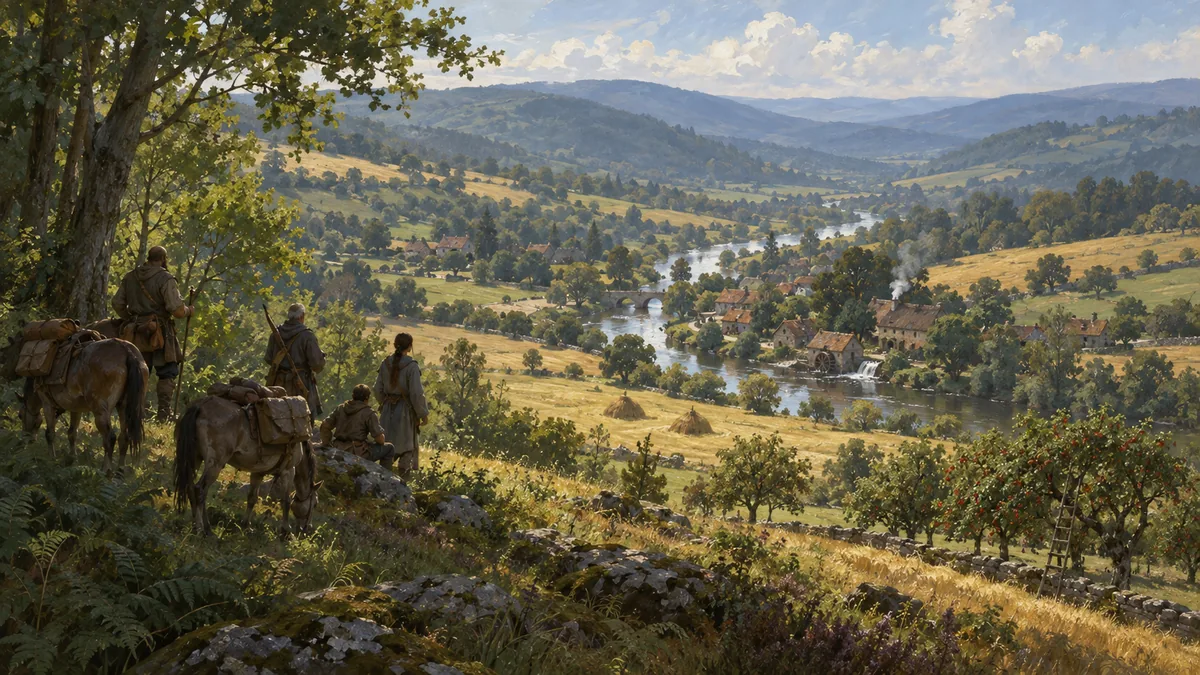
It lay as he had seen it all his life, and as he had held it in his mind through the gray, through the nameless farms and the fallen wall: the long green floor of Lenndale with the river shining down the middle of it. The roofs of Thornby were below him, and the chapel, and the mill. A thread of smoke rose from the chimney of the Wheatsheaf, the village inn. Beyond the river the land went up in fields and hedges to the eastern hills, and away to the south, small and blue, he could see the tower of Wexley church.
It was all there, every roof and field and hedge of it, all where he had left it.
And it was all wrong.
The Long Meadow by the river was cut. It lay pale and shorn in the sun, and down at its lower end stood two great ricks, thatched and finished, with the rakes leaning against them. The hay was in. All the meadows were cut, all down the valley, pale gold where they should have been green. On the slopes above them the wheat was turning. It had gone from green to a dull yellow-green, and in the stillness he could hear, far off, the dry whisper of it moving.
He looked down past the roofs of home and Father's bridge, to the Pennock orchard running down to the valley road. The apple trees stood in their rows, heavy and dark with leaf. Among the leaves he could see the apples, small and hard and green, the size of walnuts. Nearer, below him, the cherry trees along the Pennocks' top pasture wall were red. They were thick with fruit, red and dark red and nearly black, and there was a ladder against one of them.
The sun stood high and white over the valley, the heavy sun of full summer. He felt it on the back of his neck, hot as a hand. He had left in March, with the hawthorn not yet in bud.
The others came out of the trees behind him and stopped. He heard Taren draw breath. He heard Brannoc say something under his breath that he did not catch. Garrow came out slowly on Sil's arm and stood blinking in the light, with his hand up to shade his eyes.
Sil came and stood beside Lio and looked down at the cut meadows and the ricks, and at the red cherries on the pasture wall. She put her hand on his arm and kept it there.
"What's the day?" Taren said. He had come up on Lio's other side. He was very pale.
Sil did it aloud, as she did everything, a surveyor closing a traverse. "We stepped off the road on the twenty-ninth of May. Nine days in the gray, by my notches. Hay in and cherries ripe." She looked at the ricks. "It's the middle of July. Seven weeks gone, outside, while we walked nine days."
"And the crossing's the start of September."
"Six weeks," said Sil. "Seven, if the weather's foul in the hills. That's in Dane's hand and it's in mine."
Taren looked down at the wheat turning on the slopes, and did not ask anything more.
Nobody spoke after that. They stood on the shoulder of the hill in the hot sun, the six of them, looking down at the valley. Bees were working in the bramble flowers that were left, and somewhere below a dog was barking, and down by the house the mill wheel was turning in its millrace.
Owen had cut the Long Meadow without either of them this year, and somebody had helped him rick it. Even from here Lio could see that the near rick leaned west.
"Coldharbour," said Garrow.
They turned to him. Garrow had let go of Sil's arm. He was standing a little apart from them, at the edge of the trees, and he was looking north up the valley. His hand was raised against the sun. His face had changed. The blankness of the gray country had gone out of it, and it was puzzled and intent, the face of a man making out a sign across a field.
"That's Coldharbour," he said. "Up there. Where the hill is." He lowered his hand slowly. "I know that hill."
Brannoc went to him without a word. He put his arm across Garrow's shoulders, and the two of them looked north up the valley together at the hill above Coldharbour, blue in the heat.
"Your mother's up there," Brannoc said, low. "Agnes. If she's living."
Garrow said it carefully, as he had said his name at the stream, turning it over to see what was on the other side. "Agnes." Then he went quiet again under Brannoc's arm, and did not take his eyes off the hill.
Sil hitched the pack higher on her back, with the book from Sarne in it, and turned to Lio.
"Wexley," she said. "Today. Every day we lose now is a day they don't."
"Home first. My mother has thought Taren dead since the autumn, and me since the spring. I'm not walking past her door to see a reeve." He met her eyes. "Tomorrow at first light I'll take you to Reeve Crane at Wexley myself, and we'll put that book on his table."
Sil looked down at the roofs of Thornby, and the smoke from the chimneys, and let her breath go.
"And her?" said Brannoc. Mara lay on the litter where they had set it down at the edge of the trees, with her bound hands on the blanket, gazing up at the hot white sky as if it were a ceiling she was trying to place.
"She comes down with us," Lio said. "We'll find her a roof."
"Whose?"
Lio looked down past the roofs of home at the orchard beyond them, at the long rows of apple trees going down toward the valley road. Then he started down.
They went down by the timber track.
Lio led them, with Taren at his elbow and Sil at the foot of the litter. The track came down under the last trees beside the Pennocks' top pasture, with the cherry trees leaning out over the wall.
Through the leaves he could see the chimney of Edda's cottage. Smoke was coming from it, a thin gray thread. She would have the kettle on.
He stopped by the pasture stile with his hand on the top bar and could not, for a moment, make his legs go on.
Taren came up beside him and looked down at the roofs, the bridge, the smoke. Then he looked at Lio.
"Go on, then," Taren said gently. He put his hand between Lio's shoulder blades and pushed.
Lio went on.
The track was hot and loud with bees. Beyond the wall the pasture had been grazed short, and it smelled of clover and sun. Under the cherry trees the track was splashed dark red with fallen fruit, and the wasps were at it. The ladder he had seen from the shoulder stood against the third tree, on the pasture side. A basket sat at its foot, half full of cherries. High in the branches above it, among the leaves, somebody was singing.
It was a child's voice, thin and tuneless and happy, singing a counting-out rhyme that every child in Thornby knew. It got the words wrong and started again.
The leaves parted and a face looked down. It was a girl's face, brown and freckled, with a smear of cherry juice across one cheek and a cherry stalk hanging from each ear, like earrings. She had a basket hooked over one arm. She looked down at Lio for a moment with her mouth open.
"Lio Ashby," said Rose Pennock, Ambrose's granddaughter from over the bridge. "You're dead."
"Not yet," said Lio.
"Everybody said." She stared past him at Taren, and her eyes went round. "And him. He's dead too. He's been dead since the storm." She leaned so far out of the branches that the whole tree shook. "Grandad! Grandad, it's the Ashbys! They're not dead!"
From somewhere across the pasture, an old man's voice called back something cross and incredulous. Rose was already moving. She came down out of the tree hand over hand, cherries bouncing out of her basket, and dropped the last six feet over the wall onto the track, and stood staring up at them both with her fists clenched.
The others had come down the track behind them. Garrow had stopped by the wall. At the stile they had got Mara off the litter and onto her feet, and this time she had stood. She stood now with her bound hands resting on the top bar, in her torn gray cloak, with her dark hair loose about her face. Brannoc had the end of her cord in his fist. She watched the child. Across the pasture old Ambrose Pennock was coming, leaning on his stick, white-haired and red in the face from shouting.
Rose had not noticed any of them. She was too busy staring at the Ashbys, with the red juice on her cheek and the cherry stalks swinging from her ears, ten, eleven at Michaelmas, and furious with joy.
"Your mother had the bell tolled," she said accusingly. "For both of you. I had to wear my black."
Behind him Lio heard Taren laugh, once. Rose rounded on him with her fists up.
"It's not funny," she said. "I wore my black, and you weren't even dead!"