Merrowby on the Lenn
On the first morning Hollis took Lio up to the third floor, to a room with a great sloping table under the window, scarred with knife cuts and stained with ink.
"Our father drew his charts at this," Hollis said. "When I bought the house back it was a sail-loft, and I found this under a heap of rotten canvas, and knew it at once by that." He touched a small gouge near the corner, shaped like a crescent moon. "My sister did that with a fish-knife. She was trying to carve a gull, and she was most indignant, for a week, that nobody else could see it."
Lio looked at the gouge. It was nothing like a gull.
"Taren carved his initials in the rail of Father's bridge when he was nine," he said. "It runs in the family, I suppose."
Hollis laughed his quick young laugh. Then he asked about Elin, for that was Edda's name in this house. Lio told him: the cottage across the yard with the geraniums in the window, her tea black and scalding with honey, the day she told the Wexley reeve to his face that he had the manners of a goose. Hollis listened with his hands folded on his stick. Once he said, "Yes. Yes, she would."
"She hums," said Lio. "There's one tune she comes back to."
"Our mother's walking song. She sang it going down the Gull Stair to the harbor, to keep our feet going." Hollis looked at the gouge. "I remember Elin's hand on that stair better than I remember her face. She held mine the whole way down, very hard, because she was always frightened I would fall, and I was always trying to."
He ran his finger round the little crescent.
"I have sat at this table every morning for ten years," he said, "and talked to that gull. You will think me a foolish old man."
"No," said Lio. "My father talks to Captain."
"Captain?"
"Our horse. He's twenty and he's never once answered."
"Then your father and I are both in good company," said Hollis.
Taren was out most days at the survey office down by the quays, and he had grown very good at changing the subject. On the fourth night Lio came down late for water and found him at the kitchen table, inking a sheet of fells and becks with his tongue between his teeth.
"Coldharbour," said Taren. "For Dane, at the survey office. I promised him." He wiped his fingers on a rag. "Listen. I've been trying to think how to tell you, and every time I—"
The door opened, and Hollis came in in a dressing gown with a candle.
"I came down in hope of burglars," he said, "and it is only the Ashbys, which is a great deal better and a little disappointing. Bed, both of you. Lio, on Thursday you are coming with me to a wedding. The bride keeps the school on the upper square, and her children are to sing, and you shall hear what we have kept of your side of the Wood."
On the stair, with Hollis's candle going away above them, Lio caught his brother's arm.
"Tell me now."
"There's a map," Taren said. "At the office, on the wall." The candle went round the turn above them, and they stood in the dark. "It's mine," he said. "Most of it."
He pulled his arm free and went up two stairs at a time, and his door had shut before Lio reached the landing.
Sil had not been up the hill once since they came.
Lio found her one morning on her mother's white step on Cooper's Steep, darning a stocking, with her hood up. In the boatyard below, Brannoc sat on a baulk of timber with Corren's boy between his knees and a length of cord in their four hands.
"He's there every morning," said Sil, without looking up. "Corren says the boy will tie the cat to the table leg before the week's out."
"You could put that hood down. The whole lane's at its dinner."
"Dane's clerks drink at the Anchor, at the foot of this lane." She bit the thread. "I left my post in November without a word to anyone. Dane doesn't forgive. He waits. He'll let me be while I sit still. It's when I move he'll want me."
"And when we go home?"
"Then I'll move." Sil looked down the lane to where the masts stood thick above the boatyard roofs. "I came east once to be believed, and nobody's believed me yet. I'm coming east again, Ashby, and I'm coming by the quay, if Dane stands on it himself."
Down in the yard Brannoc pulled the hitch tight, and the boy let out a whoop and ran with it to show his father.
On the sixth night Lio could not sleep, and went down through the city to the harbor and out along the Mole.
A ship lay at the end of it under the light, loading by lantern. Her master stood at the head of the gangway in a sheepskin, with a slate, calling marks to the men on the hold-ladder. She went out on the morning tide. Half the boys on these ships worked their passage, Sil had said. Lio could haul a line as well as any of them.
He went and stood at the foot of the gangway. The master looked down at him and lifted his chin.
Lio opened his mouth.
Down in the hold a cow lowed, long and complaining, a beast shipped for the voyage and three hours past her milking. She lowed again. He could hear the full bag in it.
Lio shut his mouth, and shook his head at the master, and walked back along the Mole with his hands in his pockets.
That evening, coming up onto the terrace in the last of the light, Lio saw what he had walked under every day for a week.
The heron over the door was scarred. Short deep bites had been driven into the stone all round the ring of waves, and across the bird's breast, and along the line of its neck. None had gone through. They were chisel bites, driven hard and at a bad angle by somebody in a hurry who had never cut stone before. Above and below the carving ran a row of small square holes plugged with old mortar, where boards had once been nailed across it.
Somebody had tried to cut the bird off the house. They had tried for a long time, and given up, and covered it.
Hollis had come out onto the step behind him with his stick.
"I was four, and in bed upstairs, and I thought it was a woodpecker," he said. "My mother let me think so. I believed it until I was nine."
He went back inside. Lio waited a while longer under the fig tree, with his fingers in one of the bites. He had cut his first mortise at eight, under his father's eye, and botched it. He knew what a man's arm felt like at the end of a long day of bad cuts. Somebody had stood here on a ladder and gone on hitting until his arm would not lift, and then fetched boards.
Rupert had been given a room under the roof of the Archive, and Lio found him on the floor among shells. He had been down to the strand at low water, and he held up two spiral sea-horns, creamy outside and pink within, alike as two eggs. One he had picked up that morning. The other had been plowed up in a field above Coldharbour when he was nine, and he had carried it ever since. "The commonest shell on this coast," he said, delighted. "The children throw them at each other." There were new blue notebooks on his table, and Ansel wanted him to speak to the scholars on the coins of the eastern country. The stained green one was not among them. Lio left the question where it lay.
Mara Vey, the road-walker they had lost in the gray, was in Hollis's kitchen when Lio came in from the Archive. She sat at the end of the table with a bowl of the housekeeper's broth, and her staff leaned on the dresser behind her, dark wood with an iron shoe.
She lifted her head. She was thin as a rake handle. The bones of her face stood up under the weathered skin, and her wrists came out of her sleeves like a child's. The braid was the same. Her eyes were older, and the lines round them were deeper than at Wending.
"Lio Ashby," she said, in the old speech.
He stood in the doorway with his hand on the latch. The housekeeper looked from one of them to the other, picked up the pail and went out to the yard.
"We lost you," he said. "Behind a tree."
"You did." Mara tore a crust into the broth and ate it slowly, as the starved learn to. "I walked in that country a long while by my reckoning. I forced a passage out in April, on the hills above the city. A shepherd found me in the gorse and ran for his father." She wiped the bowl with the next crust. "I heard you call me in. I walked toward it for days, and it was the wrong way."
"Sil's here. On Cooper's Steep."
"I know where Sil is."
She put her hand to her cloak, where a small square lay against her ribs, and took it away again.
"Old Pell at Wending told me what you burned," she said. "Your friend's book, so I'd not have your road. Mine you left me."
"We're going home. When Taren's ready."
"Then I'll go when you go." She lifted the bowl in both hands and drank off the last of it. "I'll be behind you, as before. Sing low. Keep your voice in your chest, Lio Ashby, where I can't get at it."
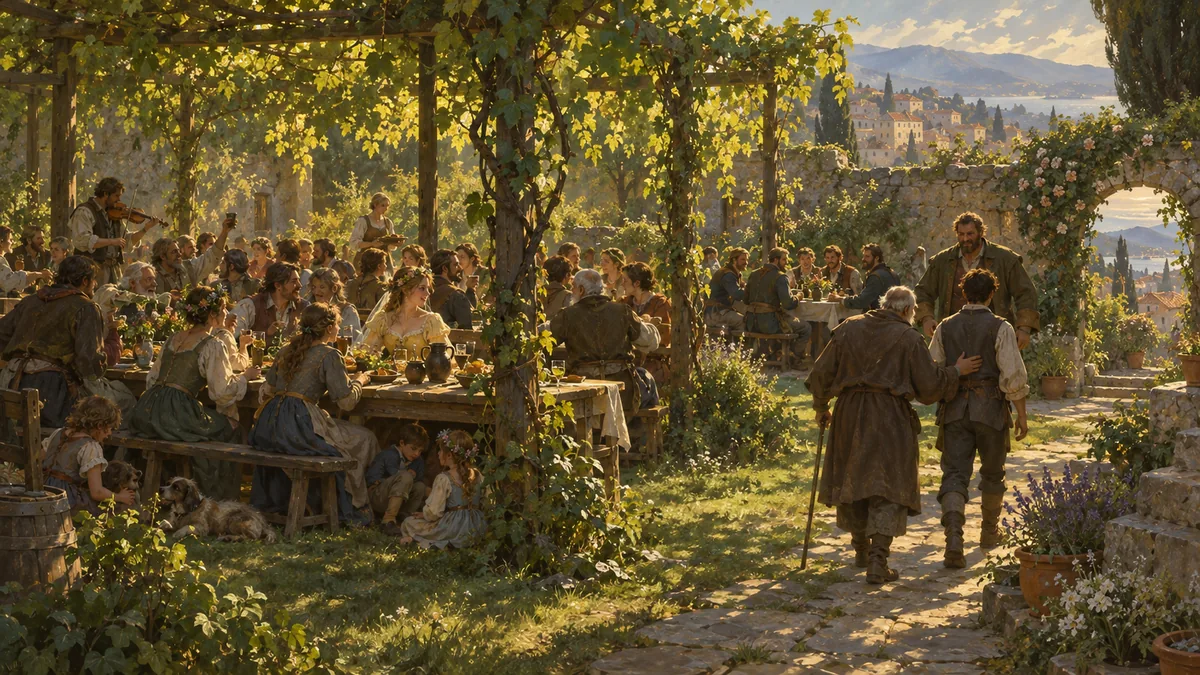
The wedding was in the walled garden behind the school, where long tables had been set out under a vine. Taren would not come. He had sheets to finish, he said, and was out of the house before breakfast.
There were sixty people at least, and a fiddler, and children under the tables. The bride was a young woman in a yellow dress with chalk still on one cuff. Hollis took Lio's arm and steered him down the garden toward a tall man who was coming to meet them.
"Aldous," said Hollis, "this is my sister's grandson."
"The young man who walked through the Heart singing." The tall man took Lio's hand. He was about fifty, broad-shouldered, with silver at his temples and a dark coat that had cost more than Owen's horse. He spoke the eastern tongue in the old way, slowly, as if he had learned it out of a book and liked the book. "Aldous Stroud. The bride is my niece. Sit by me, Master Ashby, and tell me what a beech log fetches at Wexley."
Lio told him. Stroud listened with his elbows on the table and asked short, sharp questions, about the haul from the wood and the price of a saw, and whether the dairy paid, and how many cows it took to keep it. They were a buyer's questions. Lio found himself answering them honestly, because they were good ones.
At the far end of the garden a score of young men sat together at a table apart, big-handed and sunburned, in good coats that did not sit easily on them.
"My lads," said Stroud, following Lio's eyes. "From the hill farms above the city. Their fathers' fathers held land in the east." He nodded at the nearest, a fair boy of seventeen or so with a raw new collar, who went red to the ears at being looked at. "That one's mine. My younger. Tobin." He turned back. "Come up to the hills while you're with us. You've seen the city. Come and see the farms."
"Why?"
"Because you'll go home and tell your father about us," said Stroud. "I'd like you to tell it right."
When the cheese had gone round, the fiddler stopped. An old woman in black brought a leather case to Stroud, and he took out a roll of yellowed parchment with a seal hanging from it on a faded cord. The garden went quiet, the children too.
Stroud read it in the old speech, slowly, so that Lio could follow every word.
"The house tract whole," Stroud read, "a house of stone under the trees of the wood's edge, with a yard before it and a lesser house across the yard. A stream behind, taken off the river, and over the stream a bridge. An orchard beyond the bridge, and the road beyond the orchard, and the ford below the road. Held by the house of Stroud of old right, and to be held, while any of the name remember it."
The old woman in black said the last words with him, under her breath. The place lay on the far side of the Wood, and half the garden knew it by heart.
Stroud rolled the deed and came back to the bench and sat a while with his hands on the case.
"I mean to stand in it before I die," he said. "I mean to put my hand on that bridge." He laughed, short, at himself. "Amberlow, the deed calls the country. Things that are remembered come back."
A yard before it, and a lesser house across the yard. A stream behind, taken off the river. Lio told himself that half the farms at the wood's edge had a yard, and a cottage across it for the old folk, and a millrace behind. He drank his wine.
The bride stood up, and clapped her hands, and her pupils came out from under the tables.
There were forty of them, more or less, scrubbed and combed for the day. She lined them up on the grass under the vine and beat time on her palm. They sang for her in high clear rough voices, all together, with a lilt in it that made Lio's feet want to move. Something in the turn at the end of each verse was like Edda's tune. Not the same. A cousin.
"A barge song," said Hollis, low, at his shoulder. He had come to stand behind Lio's bench. "It comes from your side of the Wood, and we have kept it in the Archive since before the Wood was there. The children learn it in Western now, but the tune is the old tune. It goes down a great river through the eastern country, naming the towns." He listened, and began to translate under the children's voices. "And down by the river at Merrowby fair, the barges are waiting to carry us there."
Lio turned his head.
"Where?"
"Merrowby. On the Lenn. It's the fourth verse."
Lio knew every town on the Lenn: Coldharbour under the fells, then Thornby with the mill and the ford, and six miles on, Wexley with the stone bridge. Between Thornby and Wexley there was nothing but the Long Meadow, the parish farms and the river. He had driven geese along every yard of it, and carried a drowned ewe up out of it, and once, at fourteen, walked it in the dark with a lantern looking for Taren.
The children came round to the verse again, because the second row had come in late. Down the garden Stroud was singing it under his breath with them. So was the old woman in black, and the bride's mother, and a fair boy of seventeen with a raw new collar. Merrowby on the Lenn went up under the vine in sixty voices, as easy and as certain as the stone bridge at Wexley.
Lio turned round on the bench and looked up at Hollis.
"There's no such place."