The Heron Over the Door
Lio woke to his brother's voice.
For a moment he was nowhere he knew. There was a sloping ceiling a foot above his face, and gray light through a round window no bigger than a plate, and a gull walking on the roof. Below him, through the boards of the loft, somebody was talking very fast in Western. A woman was answering in the sharp voice of someone woken before dawn who does not care for it.
He would have known Taren's voice from his grave.
He came down the loft ladder so fast that he missed the last three rungs. Sil's mother stood in the middle of her dark kitchen in her nightgown, with a candle in one hand and a poker in the other. Sil was halfway down the inner stair with her hair over her face. And in the open street door, with the dawn behind him and the dust of a long road to the knees, stood Taren.
He was thinner. His face had gone sharp at the cheekbones, and his dark hair was longer than their mother would ever have allowed, tied back with a bit of string. He wore a western coat of blue wool with horn buttons. He was apologizing to Sil's mother with both hands, and then he looked past her and saw Lio at the foot of the ladder, and his hands stopped in the air.
Lio had made a great many speeches for this moment since the end of October, some of them very angry. Now he stood in a stranger's kitchen in his shirt and bare feet, and all the speeches had gone out of him.
Taren's whole face changed. "Lio!"
He came across the kitchen past the poker, and Lio met him halfway, and they took hold of each other so hard that Lio felt his brother's ribs give. Taren smelled of road dust and the sea, and under it, faintly, of something that was only Taren and had been Taren all Lio's life.
"You came," Taren said into his shoulder. "Old Ansel sent a note down on the evening boat, and I read it on the quay at Tollmouth. Three easterners and a surveyor, it said, and one of them a young man with an axe. And I thought, it can't be. Not Lio. Not in a hundred years."
"I walked," said Lio.
"You what?" Taren held him off by the shoulders, laughing. "There's a coast road, twenty miles and half of it cliff. I couldn't sit on a boat. I'd have jumped off and swum." He shook him. "Through the middle of the Wood."
"There's a song," said Lio. "Gran's song. It goes all the way."
Taren pulled him in again. Over his shoulder Lio saw Sil's mother put down the poker, sigh, and go to light the fire.
They sat on the scrubbed white step in the dawn, with bowls of something hot and salty that might have been fish broth, and the city waking below them roof by roof.
Taren wanted everything at once. Had the cart shed been thatched again? Had Kit Hay married the miller's girl, or lost his nerve again? How were Mother's cheeses, and Father's back, and old Captain, the carthorse? Lio answered as well as he could. Every answer was two months old, and as he gave each one he found himself wondering whether it was still true.
It lasted almost a quarter of an hour. Then Lio gave him back his own words.
"It'll be gone in a week," said Lio. "I want a look first."
Taren stopped chewing.
"That's what you said at supper, waving your knife at the west window." Lio looked at the street. "Mother set your place at table all November. Father built a new Long Meadow gate in December, and there was nothing wrong with the old one."
Taren's face was white under the dust. Lio wanted to take him by the collar of his fine blue coat and shake him until his teeth rattled, and to hold on to him and never let go.
"There wasn't any way back," Taren said quietly. "We went along the stream for days, and Mara went first, singing, and behind us the water went. I looked back on the third morning and there was only moss where it had run. I said my family will think I'm dead. And she said, there's nothing to turn round on."
"So you waited."
"What else could I do? You've been in there. You know what it is."
Lio did know. He thought of the gray light, and the woman in the ruined garden who had smiled at him and did not know her name.
"I sent the knife," said Taren. "Did it come? I gave it to the old man, and he said a walker going east would leave it by the wreck. I wrote a note to go with it, in Western. I'd been learning six weeks and I was proud of it."
"Gran read one word. Sarne." Lio put his hand in his pocket and brought out the knife, horn-handled, worn shiny by his thumb. "I said to Brannoc nobody cleans a dead man's knife."
Taren took it and closed his hand on it hard, and shut his eyes.
"I minded you all on the third morning, when the water went," he said. "After that I let myself stop. Sarne's very good at letting you stop." He opened his eyes and looked at the knife, and not at Lio. "I'll not say sorry on a doorstep with fish on my chin. I'll say it to Mother."
"Say it to me first."
Taren turned his head. Lio had watched through the hayloft boards when he was beaten for the bridge rail, and seen him grinning before the belt was hung back up, and this face was new to him.
"I'm sorry, Lio," he said.
Lio nodded. He could not have spoken then for any money. A gull came down on the step below them and eyed the bowls, and Taren tore a crust and threw it, as he had thrown crusts across the kitchen at home, and missed, and neither of them laughed.
They walked up through the city in the full morning, and everyone knew Taren. A baker called to him from her doorway. Children shouted his name. A woman selling eels from a tub held one up and waggled it at him. He answered her in Western, fast and easy, with a way of tipping his head to listen that Lio had never seen him use in the valley.
"I mean to take you home," said Lio, on the long stairs. "As soon as you've slept. We go back up to the ridge and sing Gran's song backward, the stair of roots first and the oaks last. In six weeks you're in Mother's kitchen getting your ear clipped."
Taren walked on a few steps before he answered.
"It's not so simple," he said. "There are people here who've been good to me. There's work I promised a man at the survey office, and I mean to finish it." He glanced at Lio and away. "And I don't know yet that I'm coming. That's the truth. I'd sooner you had it on these stairs than on the ridge."
Lio looked at his brother's sharp new face and the string in his hair. He had carried the knife across the world in his pocket. He could carry this up a flight of stairs.
"Then you'll tell me when you know," he said, and went on climbing.
The streets grew quieter as they climbed. The houses stood back behind walls, with trees in their gardens, and the stairs went up between them wide and shallow, without end. At the top the lane came out onto a little paved terrace high above the city, with a stunted fig tree in a corner and every roof in Sarne below it. On the far side stood a house, tall and narrow and very old, darker than its neighbors, with blue shutters and geraniums on the sills.
Over the door, cut deep into a block of stone set into the wall, was a heron in its ring of waves.
Lio stopped walking. He had last seen that bird in the lamplight on his mother's kitchen table, with his grandmother's hand on its back. Before that he had seen it on the prow of a ship in the trees above the charcoal clearing, with the weed hanging over it and the water running west.
"I know," said Taren beside him, very quietly. "Wait till you meet him."
The Archivist was not back. The Tollmouth boat was beating up the coast against a north wind, the housekeeper said, and would be lucky to make the harbor by dark.
Taren saw Lio to a room at the back of the house before he went up to sleep the day away on the top landing, as Lio had known he would.
"It was the children's room," Taren said at the door, yawning. "Long ago. The little girl slept under the window." He went up the stair without saying whose.
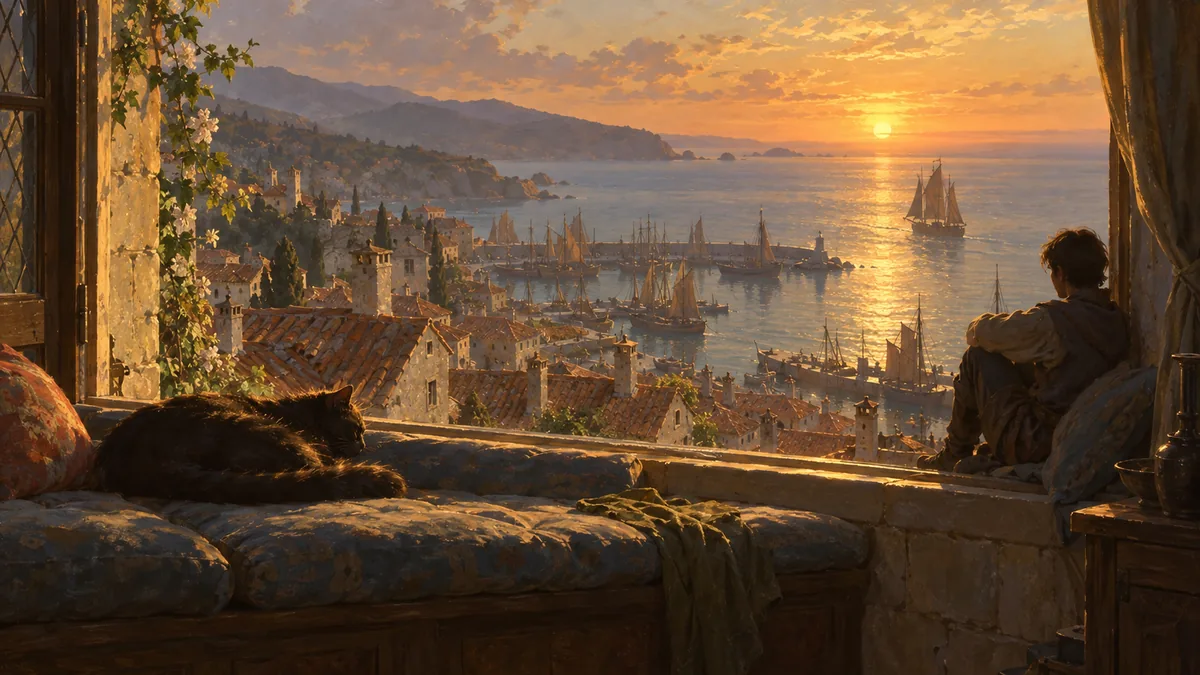
The room had a tall window looking straight down over the roofs to the harbor, so steep that he felt the drop in his stomach. Below the window was a seat with faded blue cushions, where a large black cat lay in a square of sun. She opened one yellow eye at him, considered him, and shut it again.
He sat down at the other end of the seat, and stayed there.
He had meant to sleep too. Instead he watched the ships. They came in round the end of the Mole all afternoon with the wind behind them, one after another, their brown sails dropping as they passed the light. Others went out. He watched a big one warp off the quay with men hauling on her lines, and turn, and stand away past the tower with her canvas filling. He watched her until she was a white chip on the blue, and then until she was nothing, and he found that his hands had gone tight on his knees.
He thought of Taren at the top of the timber track at home, every autumn of his life, looking west. Lio had called it restlessness and laughed at it. Out past the Mole there were other harbors, and other cities on other hills, and people who had never heard of Sarne either. A ship could take Lio to them in a week, if he let it.
He let himself want it for as long as the light lasted.
The sun went down into the sea. The harbor turned gold, and then gray, and the riding-lights came out on the anchored ships one by one. The tower at the end of the Mole was lit, and laid a long road of light across the water toward the open sea. Lio sat with his knees drawn up and the cat a warm weight against his foot and watched that road, and thought how easy it would be to walk out along it.
Then a ship came in round the Mole with a lantern at her masthead, late and slow against the wind. He watched her lights all the way to the quay. A long while after, he heard the housekeeper's step in the hall below, and her voice raised in welcome.
He heard slow steps on the stone, and a stick. The cat poured herself off the cushions and walked out of the room without hurry. Lio got up. The door opened, and the housekeeper came in first with a lamp, and set it down, and stood aside.
The man who came in after her was elderly, a little stooped, with white hair cut short and a pair of spectacles folded into the breast pocket of a dark coat. He was not tall. His face was thin and clever and deeply lined, and the lines had been made by a great deal of smiling. In the lamplight Lio saw a small white seam of old scar on the point of his chin.
The old man stopped inside the door. He read Lio's face slowly, a word at a time, and smiled.
"There you are," he said.
He spoke the eastern tongue. He spoke it the way Mara had in Wending, with that old swinging cadence like a song spoken aloud.
"I'm Hollis," he said. "Hollis Lorne. Forgive me if I speak it strangely. Your brother has been teaching me the new way of it, and the old words come up first when I am moved." He came forward and held out his hand, and Lio took it. It was thin and dry and warm. "And forgive me the wind. I have been on that boat since dawn, knowing you were in my house, and I have never so wanted to get out and push."
He sat down in the big chair by the hearth with a little sigh. The housekeeper brought wine and small hard biscuits with seeds in them, and he did not take his eyes from Lio's face.
"Taren tells me you are the sensible one," he said.
"Taren says that when he wants something carried."
Hollis laughed, quick and delighted, and it made his whole face young.
"He said you would say one thing and I would laugh for a week. You came by the song?"
"All the way. There were three of us. And then Sil."
"Arden's girl. Osric Dane has not forgiven her, and Osric is mine, in a manner of speaking. The Survey answers to the Archive, so on paper I am his master, which neither of us says aloud." He folded his hands in his lap. "I hope she has been a great gain to you."
The lamp was on the old man's left, and it caught the little white seam on the point of his chin, and Lio found he could look at nothing else.
Far below, the riding-lights rocked on the black water.
"My grandmother asked me something," said Lio. "On the last night, by her fire. She said, if it costs you nothing, find out whether there was a boy in that house above the sea with a scar on his chin."
Hollis put up his hand to his chin before he could prevent it, and touched the white seam there. Then he propped his stick against the arm of his chair, and leaned forward, and held out both his hands.
Lio did not remember deciding to take them. He found that he was kneeling on the floor by the chair with his hands in those thin dry hands, and Hollis was holding on hard, harder than Lio would have thought he could.
"Is she well?" said Hollis, hardly above a whisper. "Does Elin still hum when she's thinking?"