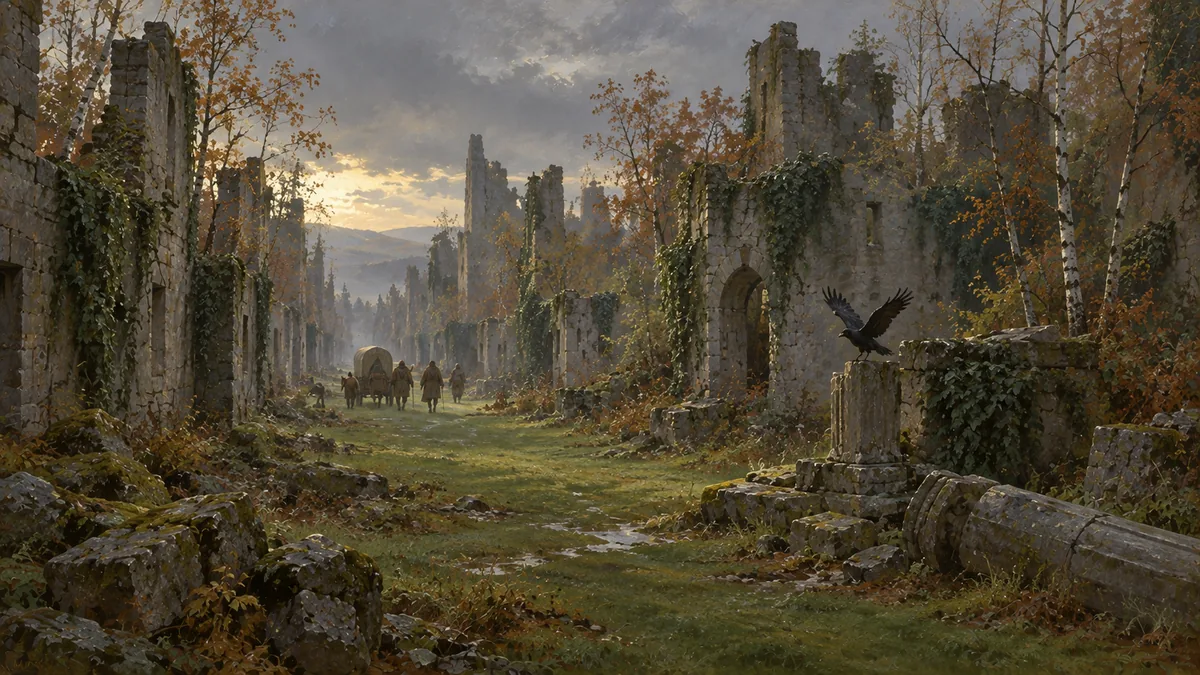
The Town of Grass
Lio had the first watch, on the worn doorstep of the inn with the axe across his knees. Nothing came out of the trees. The stars came over the clearing a few at a time, and the dew settled, and the only sound was a drip far down the shaft of the well, which he could hear if he held his breath. Behind him Rupert talked once in his sleep, a whole sentence about cheese. At midnight Lio woke him, gave him the axe, and lay down in the lee of the hearthstone.
In the morning, before the others were up, he went out to fill the kettle. The dew had been heavy, and the grass of the clearing was gray with it. His track from the evening before ran across it, a dark line from the gate to the well where his boots had pressed the grass flat.
Halfway to the well he pulled up short. A single boot-print lay in his track, pressed down on top of his own. It was smaller than his and narrower, with a close-nailed sole, and each nail had left a pit in the soft earth. It pointed toward the inn.
No other track crossed the grass, coming or going. Only his dark line ran there, with the one small print set down in it and its toes toward the door where they had slept. Lio put the kettle down in the wet and went back for Brannoc, walking in his own track.
Brannoc crouched over the print and did not touch it.
"Light on their feet," he said at last. "Narrow in the foot. They came out of the trees over there in the dark, and walked to your track and stood in it, looking at the inn. Then they went back the way they came, stepping in their own marks."
He followed the line with his eyes to the edge of the clearing, then on foot. Lio went with him. Under the first oaks, in the angle of a fallen wall, lay a square of turf that looked like any other turf. Brannoc put his fingers under its edge and lifted it, and it came up in one piece, cut clean on four sides with a blade. Under it was a small fire's worth of gray ash, with the ends of sticks in it and a rabbit's leg-bone scorched at one end. Brannoc pushed his fingers into the ash and held them there.
"Warm," he said. "They lay here and watched our fire, and cooked their supper, and buried it after." He laid the turf back in its place and trod it down. "Then they came to look closer. That's somebody who wants to see and not be seen."
Rupert had come up behind them in his shirt, with his braces hanging. "Why not walk up to the fire and say good evening?" he said. "Out here, of all places. We'd have given them tea."
Brannoc gave him a long gray stare, and Rupert stopped.
Lio said, "There were prints like it at the wreck. Beside Taren's."
Both of them turned.
"Smaller than his. Narrow. Nails set close in the sole, like these." Lio looked back across the clearing at the print. "I can't swear it's the same. I didn't measure the other. But it's like."
Brannoc's eyes came up to his. It was the look he had given him on the ferry stairs, long and level, measuring.
"We can wait here and see if they come again," he said. "I can go into the trees after them now, while the track's fresh. Or we can go on and keep our eyes open."
Lio looked at the trees. They were very tall and very quiet, and the morning light went into them a short way and no farther.
"They've had nights enough to hurt us," he said. "And they haven't. We go on. If they want us, they know where we are."
Brannoc nodded, and went to put Clover in the shafts.
Late on a gray afternoon they came to the town.
They came to its wall first. It rose out of the forest across the line of the road, very suddenly, a gray rampart higher than a house. Trees grew along its top, and ivy hung off it in great dark curtains. The road ran straight at it and went in through a gateway between two round towers. The towers had lost their tops. Their stumps stood up into the trees, ragged, with ferns growing out of the arrow-slits.
The gates were gone, or nearly. They had been oak; a few black planks still lay in the grass of the gateway, rotten through. The iron that had held them remained. Each hinge was as long as Lio's arm and as thick as his wrist, bolted into the stone of the towers, and their pins stood up empty and red with rust. The iron straps that had bound the planks lay in the grass where they had fallen, still in the shape of the gate.
Lio walked in under the arch, and the town was grass.
He had expected forest. Everywhere else the forest had come in over the old country, over the fields and the walls and the road itself. Here it had not. The streets ran away from the gate in long straight lanes of short green turf, smooth and close, with the gray walls of the houses standing up on either side. The houses had no roofs. Their walls stood shoulder-high, with square holes where the windows had been. The floors had rotted and the trees had come up through them, birches and rowans and young oaks, so that every house was a room of trees with gray stone walls round it.
"It's the paving," said Rupert. He had gone down on his knees in the middle of the first street and was digging at the turf with his fingers. "There's stone under it, a hand down. The trees can't root. Only grass." He looked up, and his face was shining. "The whole town's paved. Every street."
Clover's hooves made no sound on the turf, and the cart's wheels made none. The three of them walked up the long grass street without speaking, and the trees stood in the houses on either side like people at their windows.
The street opened at last into a square. Lio stood at the edge of it and tried to fit the Wexley market in, with the sheep pens and the pie-man and the reeve's hall, and it went into one corner and left the rest empty. Round the square stood buildings that had been bigger than houses, with tall doorways and rows of pillars, some standing and some lying in pieces in the grass. In the middle rose the stump of a market cross on a great stepped plinth. Figures had been carved on it once, worn nearly smooth now: small people standing in a row, holding baskets, perhaps, or sheaves.
A crow went up off one of the fallen pillars and flapped away, complaining. Nothing else moved.
They camped that night in a house on the square, with the walls round them and the trees overhead. Lio found the hearth under the ivy against the back wall, a wide stone fireplace with a hood, and in the back of it an iron pot-hook, fat with rust, that somebody had hung a pot on every morning of her life.
He made the fire in that hearth. When it was burning and the kettle was on, Rupert sat down on the floor against the wall and rubbed his face hard with both hands, as if to wake it.
"There must have been thousands," he said. "A town bigger than Harrow, and nobody's ever heard of it. Not in a story, not in a song. Where did they go?"
Brannoc sat by the door with his bow across his knees and gave him no answer.
Rupert had been all over the town before dusk, and he could not keep it in. He had found a bakehouse with its domed oven whole, and in another square a well with a lion carved on it instead of a heron.
"A lion," he said. "Nobody's ever seen a lion. And somebody here carved one on his well as if it were a cat."
"Was it a good lion?" said Lio.
"It was a magnificent lion. It had a face like a disappointed bishop."
Lio laughed. He had not expected to, in that place, and Rupert looked so pleased with himself that Lio laughed again.
Outside, the wind got up. It went down the long grass streets and in at the empty windows, and in every roofless room the trees moved their branches and whispered.
They left the town in the morning by the west gate, the twin of the east, with the same broken towers and the same black planks in the grass.
Just outside it, on the verge at the foot of the wall, stood two stones.
Rupert saw them first. He gave a cry and got down from the cart, and Lio and Brannoc came back to see. The stones stood a yard apart, waist-high, square-cut with rounded tops, of the same gray stone. The same gray-green lichen grew on both, with the same bright orange spots, and the moss lay on their tops the same depth. Both were cut with letters on the side that faced the road.
Rupert knelt in front of the left-hand stone and rubbed at the letters with his thumb. They were old letters, square and plain, like the letters on the oldest graves in Thornby chapel yard.
"The bounds of Callow," he spelled out.
He shuffled across on his knees to the right-hand stone, and cleaned it, and read it.
"The bounds of Merrowby."
He sat back on his heels. "Two names for the one town. Set up together, by the look of them. Same lichen, same hand."
"A place ought to know its name," said Brannoc. He stood over the stones with his arms folded, and he did not like them. He turned and walked back to the road.
Lio put his hand on the left stone, Callow, and then on the right, Merrowby. Both were cold under the moss, and both felt the same. Thornby was Thornby, and the river ran one way.
Rupert wrote both names in his notebook, one under the other, and looked up from the page at the gray town behind them.
"Which shall I call it?" he said.
No one could tell him. In the end he wrote something else, and shut the book, and got back up on the cart.
All that day and into the next they followed the road west from the town of two names. It ran straight and broad, mostly above ground now, gray stone with moss in its joints and grass along its verges. Brannoc walked last instead of first, and turned round often. Once he stood in the road with his head up, listening, before he walked on. Lio did not ask him what he had heard.
They camped that night on the road itself, on a dry stretch of paving under a holly, because Brannoc wanted stone under them and nothing a foot could fall on quietly.
Over supper Rupert asked about Lio's brother. He asked carefully, and Lio found that he did not mind.
"He blazes a tree backhanded," Lio said. "He was told not to, and he always has. He never cleaned that knife in his life. He talks with his hands full, so you're stood there with the axe up waiting for him to finish." He turned the bread in his fingers. "He'd have had that market cross climbed before you were through the gate, and he'd not have said sorry for it after."
"I'd have liked him," said Rupert.
"You'll like him," said Lio. "You'll talk each other deaf before you're over the bridge, and I'll walk behind with Brannoc and be glad of the peace."
Across the fire Brannoc made a sound in his nose that might have been a laugh. Rupert looked at Lio, and then down at his supper, and when he spoke again it was about something else.
When the fire was low, Lio sang the next line to it, very low, as he had every night since Brannoc asked him to.
Take the left-hand road where the old road broke.
The line after that was the one that went into the gray. He sat with it in his mouth and did not sing it.
"That's the last she has pictures for," he said.
Rupert looked up from his notebook. "And after?"
"Words." Lio thought of his grandmother in her chair with her eyes shut, and her fingers spread on the carved heron of Maud's chest to keep her place. "Only the words."
"Get us to the fork, then," said Brannoc across the fire. "The words can wait till we're there."
Above Lio, when he lay down, the holly leaves shone in the last of the firelight, hard and dark and pointed. He tried to picture a white ring of stones, and a mill with no water, and could not, and slept.
The next day, before noon, the road broke.
It came to a place where the ground rose, and on the rise it divided. One branch went on straight and west, as broad as before, level between its walls of trees. The other turned off to the left, south and a little west, and went away down a gentle slope in a long curve until it was lost.
At the fork, on the verge of each branch, stood a milestone.
They were tall stones, slim and round-topped, as high as Lio's shoulder. He cleared the lichen off the right-hand one. The letters were cut deep, in the same old square hand. They said TO SARNE.
It was the word his grandmother had said in the kitchen with her hand on the heron, and the word on Taren's scrap. Here it was, cut into stone at the side of a road in the middle of the Great Wood.
The left-hand stone said TO SARNE as well, in the same hand, under the same lichen. Below the word on each there had been a second line, worn now to a few marks he could not read.
"Like the gate," said Rupert softly.
Lio stood in the middle of the fork and looked down each road in turn. He had sung the line last night, and all three of them knew what it said.
Brannoc came up from the back of the cart. He walked a short way along each branch to crouch over the ground, and came back.
"I'll tell you what I see," he said. "The right-hand road's the better road. It's wider and straighter, and it's going west, and every bone I have says take it. That one bends south and goes downhill. If I'd no song and no grandmother and nothing but my feet, I'd take the right and not think about it."
"The song says left," said Lio.
"I know what the song says." Brannoc looked at him. "I'm telling you what my feet say so you'll know I heard them. Her song's been right since the oaks, even when we doubted it, and my feet have been wrong in this country before. Lead on."
Lio led them onto the left-hand road.
It curved away south and down through the trees, gray and broad between its walls. After a while it leveled and turned and began to climb again, gently, westward. The forest closed in behind them, and soon the fork was lost.
At the top of the climb the road came out of a dip, and the trees thinned on the right-hand side. From there, if Lio turned round, he could see back down the long curve the way they had come, all the way to the fork.
He turned round. Brannoc had taught him that.
Someone was standing at the fork.
He stood fast. Behind him the cart halted, and Rupert said, "What?" and then, "Oh," and was silent. Brannoc came up beside Lio without a sound.
A figure in a gray cloak stood on the rise where the road divided, small with distance, between the two milestones. As they watched, it went to the right-hand stone and leaned close, as Lio had, with a hand up to its face. It crossed the road to the left-hand stone, looked at that, and went back to the right.
The hood had fallen back. Lio could see dark hair, and a face browned by weather, and the way the figure stood with its weight on one foot, light and ready. It was a woman.
She stood in the middle of the fork a long time, looking along the right-hand road, the straight one, the wide one, that went west. Then she turned her head and looked along the left. Up the long curve. Up the slope. Up to the rise where the three of them stood against the sky.
She looked at them. Lio was sure she looked at them.
Then she put up her hood, and turned her back on the right-hand road, and took the left.