The Sea
Sil would not walk on the road.
"They know my face," she said. "Every mender on this stretch has had a stake from my hand. If one of them sees me, the office knows by dark." She looked at the bright raw gravel running away west between its rows of stumps. "We go by the trees, and keep it in hearing."
So they went by the trees. They walked west through the woods on the north side of the road, a long bowshot off, where the hazel and birch of the cutting gave way to old oak again. They kept the road on their left all that day and the next, and heard it the whole time. In the mornings they heard picks, and the scrape of shovels, and the ring of a hammer on iron. In the afternoons they heard wheels. Once a whole line of carts went by, laden with gravel, and the drivers were singing. The song came through the trees to Lio very clear, a slow swinging tune in a tongue he did not know. He stood behind an oak and listened to it go by, with his hand gone to the axe at his belt.
"Road-menders' song," said Sil. "It's about a girl who won't marry a mender because he's never home."
"Is that all?"
"It has a great many verses," said Sil.
It was a working forest now, with rides cut through it wide enough for a timber cart and hazel coppiced in the hollows. On the second day they passed a charcoal burner's clearing, the mounds turfed over in the same overlapping way as the mounds above the Pennock orchard. An old man black with soot gave them buttermilk, sour and cold, and talked at Sil with his rake waving south toward the road. It was Western, and the shape of it was nearly Lio's speech, but every word was turned, and the turns went by too fast for him.
"He says the Survey takes the best oak for the road bed and leaves him the brash," said Sil. "He says it's a fine thing, a road to the old country. He says they could have built it somewhere else."
Old Ambrose Pennock, leaning on his orchard fence at home, had said much the same about the new bridge at Wexley, every market day for a year.
On the morning of the fourth day the forest ended, and there were orchards.
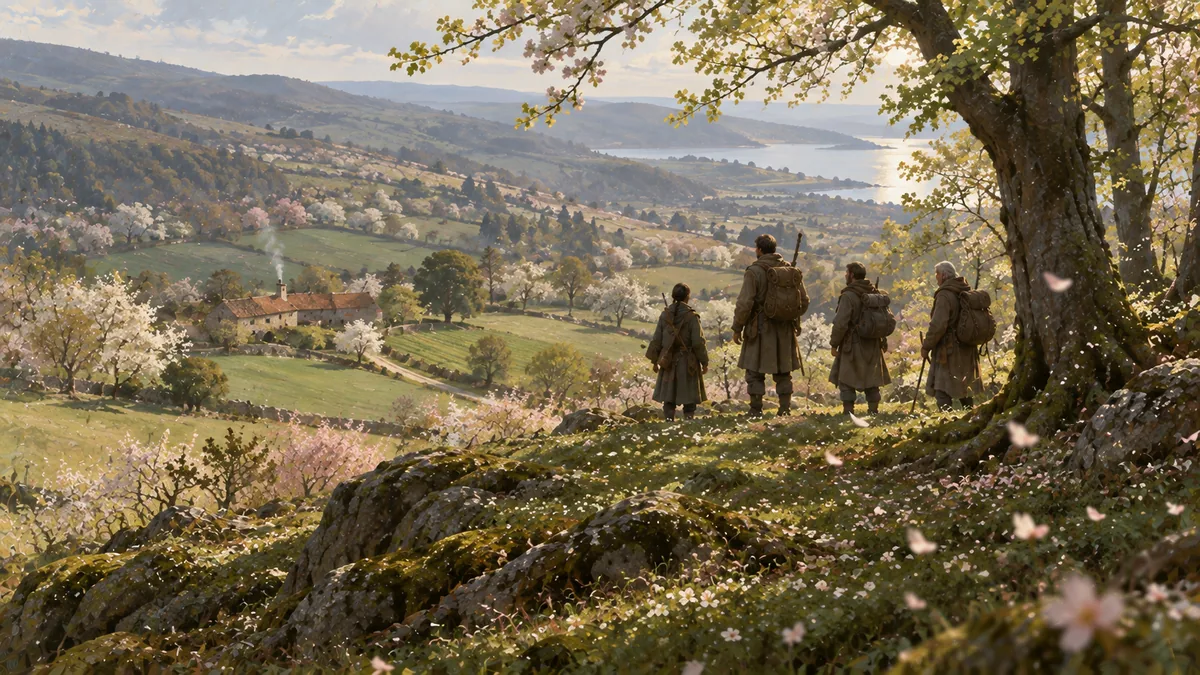
They came out of the last of the oaks onto the top of a slope, and below them the land fell away in long gentle folds to the west. All of it was farmed: hedges, fields green with young corn, a white track winding between them, a farmhouse with a red-tiled roof and smoke going up. And there were orchards on every slope, apple and pear and cherry, rank after rank of old trees on the southward faces of the folds.
They were in flower, and past full flower. The blossom was going over, and the wind that came up the slope from the west was taking it off the trees in drifts. It blew across the grass. It blew past Lio's face and caught in his hair and on the shoulders of his coat, white and pink.
Lio stood at the edge of the trees with the petals blowing past him. Rupert had his hat off to catch them in. Brannoc, who never stopped for anything, had stopped, with blossom on his shoulders and in his gray hair.
"Come on," said Sil at last. "You'll see better from the top."
Lio went last down the first slope, through the orchards, with the white going past him. One petal had caught in the wool of his cuff. He left it there.
The orchards ran out into hill country, and the hill country rose.
Open land, sheep land: a long climb up over heath and short turf with the gorse in full yellow flower on every bank. The gorse smelled of honey, warm and thick, so that the whole hillside seemed to hum with it. Larks went up out of the heather as they walked. The sky opened. After so long under trees, Lio kept ducking his head, as if the sky were a low branch.
They went by sheep tracks, well away from the road. Sil said the road went over the ridge at a gap to the south, and that there would be carts on it now, and people. She had grown more silent the farther west they went. She walked with her eyes on the skyline and her hand never far from the crossbow on her pack.
Toward evening the wind changed. It had been blowing in their faces all day, out of the west, soft and steady. Now it grew stronger and cooler, and there was something in it.
Lio smelled it and stopped. The wreck had smelled of this. He had smelled it first on the stream by the beech trees, the day after the storm, sharp and clean and strange, like the brine-tub in his mother's dairy. He had smelled it again in the timbers of the broken ship, and on his hands after he had touched the barnacles. Now it came to him on the wind across the heath, very faint, so faint he could not have said where it began. Salt.
"That's it," said Sil, watching him. "That's the sea. You'll smell it from here on."
They camped that night in a fold of the hill, among gorse, below the last long rise. Sil would not let them go up it in the dark.
"You'll want to see it in the light," she said. "The first time. You'll want the light." She heard herself, and frowned, and went to see to the fire.
Lio lay awake a long time in Brannoc's spare coat with the gorse round him and the stars thick overhead. The smell of salt came and went on the wind. Under the wind there was a sound. He had been hearing it since dusk without knowing that he heard it. Low and long and steady, it rose and fell and rose again and never stopped, like breathing, far off.
"Sil," he said quietly. "Are you awake?"
"Yes."
"What's that? That sound."
She was silent a moment. "That's the sea too," she said. "It's on the shore below the city. Waves. It never stops. Not ever, all night, all your life." She turned over in her blanket. "You stop hearing it. Then you go away and come back and hear it again."
Lio lay and listened to it. Of all the sounds in that country, it was the first to put him in mind of the mill.
He woke before dawn to gulls. He knew gulls. The floods in the Long Meadow brought them up the valley most winters, a few at a time, small and gray and quarrelsome. These were different. They were bigger and louder, and their cries were long and harsh and wild, and there were a great many of them. They went over the fold of the hill in the half-dark, high up, crying to each other, all going the same way. They were going west.
The others were waking around him. Rupert sat up in his blanket and listened with his mouth open. Brannoc was already up, standing at the lip of the fold, looking at the sky. Sil was rolling her blanket, tight and fast, with her eyes down.
They ate nothing, and nobody suggested it. They packed in the gray light and went up the last rise together, by a sheep track that went up through the gorse in long slants, and nobody spoke at all. Rupert, who could talk his way up any hill in Lenndale, climbed with his mouth shut and his breath loud. The sky lightened behind them in the east. Lio kept his back to it. He kept his eyes on the crest of the ridge above him, a long dark line against a sky going from gray to pale.
Near the top, Sil stopped on the track. She took the hood of her coat and pulled it up over her short dark hair, and drew it forward so that it shadowed her face. Then she went on.
The sun came up behind them as they climbed. Lio felt it on his back before he saw it, a sudden warmth between his shoulders. Then the light came past him. It went up the slope ahead in a long gold rush, over the gorse and the heather and the gray stones, and lit the crest of the ridge with fire, and Lio's shadow went up the hill in front of him, long and thin, pointing the way.
He came over the top.
He had thought the ridge was a hill like other hills, with another hill beyond it. It was the end of the land. The ground went down from his feet in a long steep fall of heath and rock and fields, down and down. And beyond the fall, filling all the west from the edge of the land to the edge of the sky, was the sea.
He had thought of blue as the color of a jay's feather, or of the bowl on his mother's dresser. Far out this was darker than either, and nearer the land it paled to green, and where the sun came over the ridge behind him it lay on the water in a long bright track. He could not find where it met the sky.
And it moved. That was the thing he had not imagined. All of it moved, everywhere, as far as he could see, covered with small bright lines of light that came and went. Far below it broke white along the foot of the cliffs, line after line, and the sound came up to him on the wind, that long low breathing he had listened to all night.
He had sat down without knowing it, on a stone at the crest of the ridge, with his pack still on his back and his hands slack in his lap.
Then he saw the city. It lay below him to the south, built down the steep shoulders of the ridge to the water in steps and tiers, so steep that the roofs of one row stood level with the doorsteps of the row above. The houses were of a pale stone that took the early sun and turned gold with it, and every roof was red. At the bottom of the hills was the harbor, a curved bay of green water held in by a long stone arm with a tower at its end. Inside the arm the masts stood up thick as a coppice. One ship was going out past the tower, slowly, with its sails filling, out onto the shining blue.
Gulls went over the city in clouds. Under their crying, faint and far, a bell was ringing.
Steep streets, and gulls, and a house above the sea.
Lio sat on the stone and looked at it, at the white sails and the red roofs and the long pale streets going down. He saw his grandmother there at seven years old, small, holding someone's hand on one of those steep streets. Someone had taken her away from all of this, east, into the forest. She had lost every bit of it but a tune and a handful of pictures, and kept those for sixty years in a kitchen in Thornby, and hummed them over the bread.
Along the crest, Rupert had his hat off and held it against his chest in both fists, crushing the brim. He stood there with the wind in his hair and looked at the sea and the city, and every so often he made a small sound, half a laugh, and shook his head.
"I said there was a sea," Rupert said.
Brannoc had come up last. He stood on the crest of the ridge apart from the rest of them, with his bow on his back and his hands hanging at his sides, and looked at the sea. The wind blew his gray hair back from his face. He did not move and he did not speak, and Lio, watching him, could not tell what he was thinking. His face was the face he wore on the ferry when the river was in flood, watching the water.
The ship with the white sails went out past the tower and onto the open sea.
"Well," said Brannoc at last. "I'd not want to ferry that."
Rupert let out a great shout of laughter. Even Sil, standing hooded at the edge of the crest with her arms folded, snorted, and turned her face away.
"That's Sarne," she said. She said it to the wind, not to any of them. "That's the harbor. That long arm's the Mole, and the tower at the end of it's the light. The tall roof up the hill there, with the pillars, that's the Archive. The survey office is down by the water." She was quiet. "There's the upper town, and the lower town. My mother's down there somewhere, by the boatyards."
Lio looked where she pointed. As he lifted his hand to shade his eyes he saw the petal, still caught in his cuff, white with a pink edge, browning now.
"What month is it?" he said.
"May," said Sil.
The Pennock orchard had been bare when they left, every bud shut tight. Now the Long Meadow would be shut up for hay.
"It'll cost more, going home," said Brannoc. "I went in after harvest and came out with the lambs in the fields, and I'd have sworn it was a fortnight."
Lio picked the petal off his cuff and let the wind have it, and looked again where Sil had pointed. He found the tall roof with its pillars, high on the hill, pale in the sun. His brother was down there in one of those red-roofed streets, eating breakfast perhaps, or standing at a window looking out at that sea. He had walked out of the Wood in the autumn and come over some ridge like this one, and seen it first, as he saw everything first. And he had not come home.
He had been angry half a year. He looked for it now and could not find it.
He thought of Edda in the kitchen at home, with her hand on the carved heron, and the small clear voice that had come out of her, a child's voice in an old woman's throat. He said it quietly, to himself, so that nobody else could hear.
"There's the sea," he said. "There's the sea at the end of the forest."
Sil was already on the path down, with her hood drawn forward. Rupert went after her, and Brannoc said Lio's name once, from below. Lio heard him, and knew he should go, and stayed a moment longer than he should have. The first ship had not yet reached the edge of the world, and he wanted to see what it did there.
Far out on the shining water the white ship leaned to the wind, and grew small, and kept on.