The Ford Road
Ambrose Pennock reached them at the pasture wall, out of breath and leaning on his stick, and stood looking from one brother to the other with his mouth working.
"I said so," he said at last. "I said to your father, they'll be back. Didn't I, Rose?"
"No," said Rose.
"I thought it, then." The old man reached out and gripped Taren's arm above the elbow, hard, to make sure of it. He let go and looked past them, at Brannoc and Sil and Garrow, and last at the woman in a torn gray cloak standing at his stile with her bound hands on the top bar. "And who's this you've brought me?"
"Somebody who needs a roof," said Lio. "Ambrose, I'll come back and tell you all of it. But I have to go down."
"She'll have mine, then. There's the cider-house loft." Ambrose flapped his hand at them. "Go on. Go on, the pair of you. What are you standing here for?"
Afterward the last of the pasture wall and the saw-pit were gone from him. He kept the smell of the hens, and Taren's shoulder against his.
Then they were in the yard.
It was hot and quiet. The hens were dusting themselves under the cart shed, which had new thatch. The old pear tree had lost its broken branch, and the stump had been sawn clean and tarred.
Their mother, Bet, was in the dairy door.
She had a full pail in her hand and her sleeves rolled to the elbow, and she was turning to go in. She saw them. She stood in the doorway in the sun, with the pail hanging from her hand, and looked at her two sons standing by the pump in the middle of the yard.
She bent and set the pail down on the step. She did it slowly, both hands on the handle, so as not to spill a drop. She straightened up.
Her eyes were dark. Lio saw them across the yard.
She came down off the step and across the cobbles at a walk, straight at him through the hens, wiping her hands down her apron, and the hens got out of her road. She took his face between her two palms, which were cold from the pail and smelled of milk, and held it hard, and looked at him from no farther off than a kiss. Close to, her eyes were brown, not black, with a lighter ring round the middle. In the gray he had found a fleck, and thought it the ring.
"Lio," she said.
She let go of him and took Taren's face the same way, and held it longer. Taren bent his head to her and shut his eyes. Bet looked from one of them to the other, and her mouth shook, and she pressed it shut.
"There's a pail on that step," she said. "It wants carrying in."
Lio went and carried it in.
The rest of that day came to him afterward in pieces, and he never put them all back in order.
His father came up from the saw-pit with sawdust in his hair and halted at the corner of the house. He walked across the yard and put one arm round each of them, and held them against his chest so hard that Lio's face was pressed into his shirt. Owen said not one word. When he let them go, his face was wet. He wiped it with the back of his wrist and went to see to Captain, who had come to the paddock gate and was blowing through his nose.
Across the yard the blue door of Edda's cottage opened. She stood on the step in her old blue dress, small and white-haired, with one hand on the frame. She looked from Lio to Taren and back again, checking the one against the other.
"Both of you," she said. "Well. You took your time."
She sat down on her step rather suddenly, and Bet ran to her, and Taren got there first.
Later, in the kitchen, there were too many people and not enough chairs. Sil sat on the settle with her book on her knees, a squat field book bound in gray board, still in its oilcloth. It was the only thing she had got out of Sarne. Bet put a bowl of broth into her hands without asking who she was, and stood over her until she ate it. Sil had faced down the Survey's chief on a quay, and she ate it. Taren went round and round the table touching things, the shelf, the dresser, the back of Edda's chair.
Somebody had to tell it, and in the end it was Lio, badly and in the wrong order, with Taren putting in what he left out. The sea. The city on its hills, and the road the West was cutting east to meet them, and the walkers who would come down it at the start of September. Sil said the date, once, from the settle. When Lio came to the map in Sarne with their yard drawn on it, and a stranger's name written across the house, Bet put down the bread knife.
"Across this house," she said.
"A man called Stroud has a deed to it. He says it's older than the Wood." Lio kept back, for now, the wall in the hills above Sarne, and the sum the man had asked him to name.
Owen sat at the head of the table with his big hands round his cup and looked up at the black beam over the dresser, where it ran into the stone.
"Then he's been a long while not coming to look at it," he said, and drank his tea.
Edda held Lio's hand in both of hers all evening.
"Tell me," she said, low, under the noise. "Is it there?"
"It's there, Gran. Sarne. The steep streets and the gulls. The house above the sea, with the heron over the door."
"And the boy?"
"He's an old man now. He asked me if you still hum when you're thinking." Lio looked up at her. "His name's Hollis. Hollis Lorne. And yours was Elin."
"Hollis," said Edda. She said it slowly, a word in a tongue she was learning. "Elin. Say them again, so I can keep hold of them."
Later, in the cottage, he sat on the floor by her chair and said them again, and she said them after him until she had them.
The next morning, by the pump, she asked him with a wry, embarrassed smile what her brother's name had been.
They went down to Wexley that same morning, Lio and Sil on the seat of the cart and Bet behind them among the butter, because it was market day and the butter would not wait for the West. Brannoc stayed at the Wheatsheaf with Garrow. He said Garrow had had enough of strangers for one week, and so had he.
Sil held her book on her knees all the six miles, in its oilcloth. She kept her eyes off the river and on the road ahead, as if it might turn off somewhere without her.
The reeve's hall stood on the far side of the market cross with its doors open to the heat. Master Pryor, the reeve's clerk, came out to them on the steps, neat as ever in his good boots, before they had got to the top. He looked at Lio, and at Sil's cropped hair and her Western boots, and he kept his book in his pocket.
"The reeve is engaged," he said.
"He'll want to hear this," said Lio. "There's a road coming out of the Wood. There's men coming down it in September, with deeds to the valley."
"Ashby, I'm glad about your brother. Everybody is." Pryor stood in the doorway with his hand on the door. "But the reeve doesn't sit for a runaway from a foreign office and a farm boy who's been in the forest since March. Go home. Rest."
"I'm a surveyor," said Sil.
"You're a deserter," said Pryor, "by your own account." And he began to shut the door.
Bet had come up the steps behind them with a pail of butter in each hand, packed in dock leaves against the heat. She set one of them down on the top step, square in front of the door, so that Pryor would have had to kick it to shut it.
"That's for Mistress Crane," she said. "She's had my butter every Saturday for nineteen years. I'll carry it in to her myself."
She picked up the other pail and went past him into the hall. Pryor said "Mistress Ashby—" to her back. Lio picked up the first pail and went after her, and Sil came behind him with her book.
Arlen Crane, the reeve of Wexley, was at a table under the window with his coat off and a plate of bread and cheese at his elbow. He was a big, gray, heavy-shouldered man, and he looked up at the three of them and at his clerk in the doorway behind them, and put down his knife.
"Bet Ashby," he said.
"Arlen." Bet set the butter on his table, beside the cheese. "My boys walked out of that wood yesterday, both of them, that all Thornby had buried. The younger went in after the elder and fetched him back. Now he's walked six miles to tell you something, and your clerk has called him a farm boy on your steps. You'll hear him." She folded her arms. "Or you'll hear me, every market day till Michaelmas."
Crane looked at her a while. Then he pushed his plate away.
"Sit down, lad," he said. "Pryor, shut the door."
He heard Lio out. He heard Sil. He asked short questions and wrote nothing down. When Sil began to unwrap her book he put his hand out over it.
"Not here," he said. "If it's what you say, it's to be opened before the parish, where they can all see what's in it. Not to me alone in my shirtsleeves." He looked at the window, at the hill above the town, brown and bare under the sun. "A road out of the Wood. Coming out where?"
"Our gully," said Lio. "By the wreck."
"My father fired that hill," said Crane. "The winter I was seven. The wolves came down out of the Margin and took sheep in the fold at Coldharbour, and he had the heath fired from the sheep-walk to the rock. I stood at this window and watched it go up." He was still looking at it. "The wolves never came back. Nothing much else did either. Bracken, and adders. My mother mourned her blackberries." He turned back to them. "But there's been no wolf in Lenndale since."
Sil looked at Lio, wanting something said, and he had nothing to give her.
"The bench sits on Saturday, the first," said Crane. "Bring your book. Bring anyone who'll stand up beside it." He picked up his knife. "Thank you for the butter, Bet."
Sil split kindling for an hour when they got home, hard, though nobody had asked her to. Then she went down to Ambrose's cider house, where Mara sat in the loft and thanked whoever brought her food, and climbed the ladder, and stayed.
She went every evening after. Lio heard her once, going past with the milk. She was sitting on the ladder, talking up into the dark of the loft in Western, low and steady, and he caught a word he knew. It was the name of a hill farm above Sarne. Sil had walked six years at Mara's side, and she knew the farm, and the father with one good year, and the sow that went for the rent at Martinmas. She was telling it all back to her, a piece at a time. She came home each evening with her mouth shut tight, and Lio left her to it.
On the second morning Rose came over the orchard wall with a stake in her fist.
It was a peeled ash rod a yard long, sharpened at one end, with the top hand-span painted red. She had pulled it out of the bottom of her grandfather's long field, down by the ditch, where she went for watercress. Nobody in Thornby had put it there. Ambrose had never seen it before, and he had walked that field every day for seventy years.
Sil took it out of the child's hand and turned it over, and Lio watched her face go still.
"It's a tract mark," she said. "The Survey's. I've cut a hundred of them." She ran her thumb down the paint. "They don't stake ground they don't mean to have."
"Who put it in?" said Owen.
Sil looked up past the orchard at the dark line of the Margin above the pasture. "Somebody who came through ahead," she said, "and went back to say the ground was where the deed said it was."
Ambrose wanted it burned. Lio would not let him. He carried it down to the house and stood it in the corner of the kitchen by the dresser, red end up, where everybody who came in at the door would have to look at it. Bet did not like it there. She left it.
On the third evening Brannoc took Garrow up to Coldharbour, and Lio drove.
They went in the cart, with Captain in the shafts, because Garrow could not have walked it. Captain went up the valley road as if he had never been away, and Lio caught himself listening for Rupert's old mule behind, slower and more put-upon.
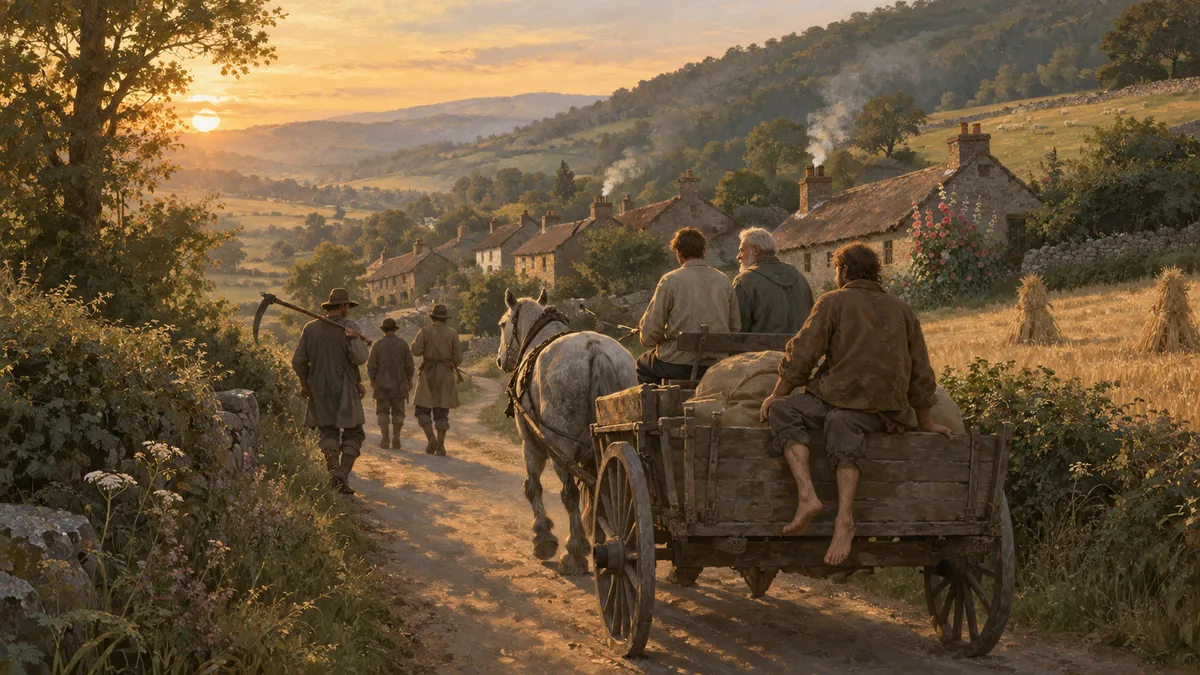
The road ran north through the long gold evening, past men coming home with scythes on their shoulders. Garrow sat in the back on a sack with his bare feet hanging over the tail-board and watched the hedges go by. Once he said, "Foxgloves," pleased.
Garrow's mother, Agnes Lisle, lived in the last house in the row before the sheep-walk, with a bench by the door and hollyhocks taller than the window. The bees were going home over the hollyhocks in the low sun. An old woman sat on the bench with her hands in her lap, brown and folded, and her eyes were milky.
"Who's that?" she said. "Is that you, Mary? You're late with the milk."
Brannoc got down and helped Garrow after him. Lio stayed on the seat. Getting down was for family.
"It's Brannoc Hay, Agnes," Brannoc said. "From Wexley."
"Brannoc Hay." The old woman's face worked. "You went with my lad. Into the forest. You came back."
"I did."
"And he didn't."
"He has now." Brannoc cleared his throat. "Agnes. I've brought him."
Agnes Lisle put out both her hands into the air in front of her.
Brannoc brought Garrow up the path and stood him before the bench. Her hands found his coat, and went up it to his shoulders and his face, over his forehead and his eyes and his beard.
"You've a beard," she said. "You never had a beard."
"Haven't I?" said Garrow.
Her hands went no farther. She had heard his voice. All the years went out of her face at once and left it bare.
"Garrow," she said.
"Yes," said Garrow, pleased. "That's my name."
She pulled him down. He went on his knees in front of the bench with her arms round his neck. She held his head against her and rocked him, and made a sound Lio would remember for the rest of his life. After a while Garrow lifted one hand and rested it on her back, gently, trying it.
"Agnes," he said. "You're Agnes."
A woman came out of the next cottage, wiping her hands on her apron. She was perhaps forty-five, with gray in her red hair, and two tall boys came after her and hung back in the doorway. She came to the low wall between the gardens. Lio saw her know Garrow. It went through her from her face down to her hands, which went still on the apron.
"Jenny Brook, that was," Brannoc said, very low, without turning round. "Jenny Rudd, she is now. Married Davy Rudd the wheelwright, sixteen years back. She's sat with Agnes since the old lady's eyes went."
Garrow looked up from his mother's arms and saw the woman at the wall. His face was friendly, with nothing behind it.
"Good evening," he said.
Jenny held the top of the wall with both hands. After a little she let go of it and said, "Good evening, Garrow," in a steady voice. She turned and went back into her house, and her boys looked at each other and followed.
Brannoc sat down on the end of Agnes's bench, with Garrow on the step at her feet, and began to tell her where her son had been, slowly, leaving out the worst. Lio left them to it.
He walked up the lane behind the cottages, past the last of the pigsties, to the top field.
He had never been in it, but he knew it from Rupert Fenwick, who had told it in Brannoc's cottage the night they met, with the shell going from hand to hand. A field above Coldharbour, the highest one, with the sheep-walk at its back. A boy of nine walking the furrows behind his father's plow, picking stones at a penny a basket. A shell in the turned earth, the size of a fist, creamy, twisted like a horn. That one I found myself.
The field had been plowed out of stubble for turnips. The furrows ran away up the slope in long brown ribs, dry on their tops and dark in their bottoms. A pair of rooks walked down the far end, looking for worms they would not find in July.
Lio took Rupert's sea-horn, the twisted shell, out of his pack. It was warm from lying against his back all the way from Sarne, and worn so smooth that the ridges on it were only a feeling under the thumb. He went down into the nearest furrow and crouched and laid it in the bottom, on the dark earth, with its open mouth to the sky. He did not bury it. Rupert had not found it buried.
Rupert would have said something over it, a great deal, with his hands going, about the sea and the Wood and the one world broken in two, and Lio would have cut him short. Lio crouched in the furrow and could only hear Rupert in the little room under the leads, holding the shell up to the window. It's been on the wrong side of the Wood all my life.
"There," Lio said. "Somebody else can find it now."
He got up and dusted his knees and went down the lane. When he looked back from the pigsties the rooks had come up the field to see what he had left, and one of them was standing beside the furrow with its head on one side.
They left Garrow there. Agnes would not let him go. On the road home, in the dusk, Brannoc sat with his big hands hanging loose.
"She held his face," he said. "He didn't know her from the milk-woman."
"He knew her name by the end."
"He did." The cart creaked. "I'll come up Sundays and tell him again." The smell of cut hay came off the fields in the warm dark. "Did you put the shell back?"
"I did."
"Daft old stick," said Brannoc, and Lio did not ask which of them he meant.
Lio left Brannoc at the Wheatsheaf and walked the cart up the lane alone. At the bottom of it, where the cart track met the Thornby road, he pulled Captain up and sat looking at the fence.
It had been mended. Somebody had taken out two of the old ash rails and put in new ones, and done it badly. One sagged in the middle. The other was nailed to the post at an angle, with the nails bent over, and a third driven in beside them where the first two had not been trusted.
His father came down the lane behind him with a lantern and stood beside the cart.
"April," Owen said, after a while. "Cow." He looked at the rails. "Wouldn't sit."
Lio did not trust himself to speak. Owen reached up and gripped Lio's knee, briefly, and went back up toward the house.