Mara
Brannoc had gone to the brow of the slope at first light.
Lio did not see him go. When he lifted his head at last from his brother's shoulder, Brannoc was standing at the top of the fern, a dark shape against the thinning gray, looking down toward the river. He stood there a good while. When he came back he walked quietly, and halted by the wall and took in the two brothers sitting on it, Taren's arm, Taren's face.
Brannoc's shoulders eased.
"Morning," said Brannoc.
Taren looked up at him and cleared his throat, and his voice came out hoarse. "Brannoc. You look terrible."
"So do you." Brannoc glanced at Garrow, asleep by the fire with his hands folded on his chest, and spoke lower, so as not to wake him. "There's someone down there. By the river, in the bottom. Her track's in the fern below the brow. She went past us in the night, near enough to hear you talking." He looked down the slope. "She's walking in circles."
They went down to the river in the first gray of the morning, all five of them, because none of them would be left behind now.
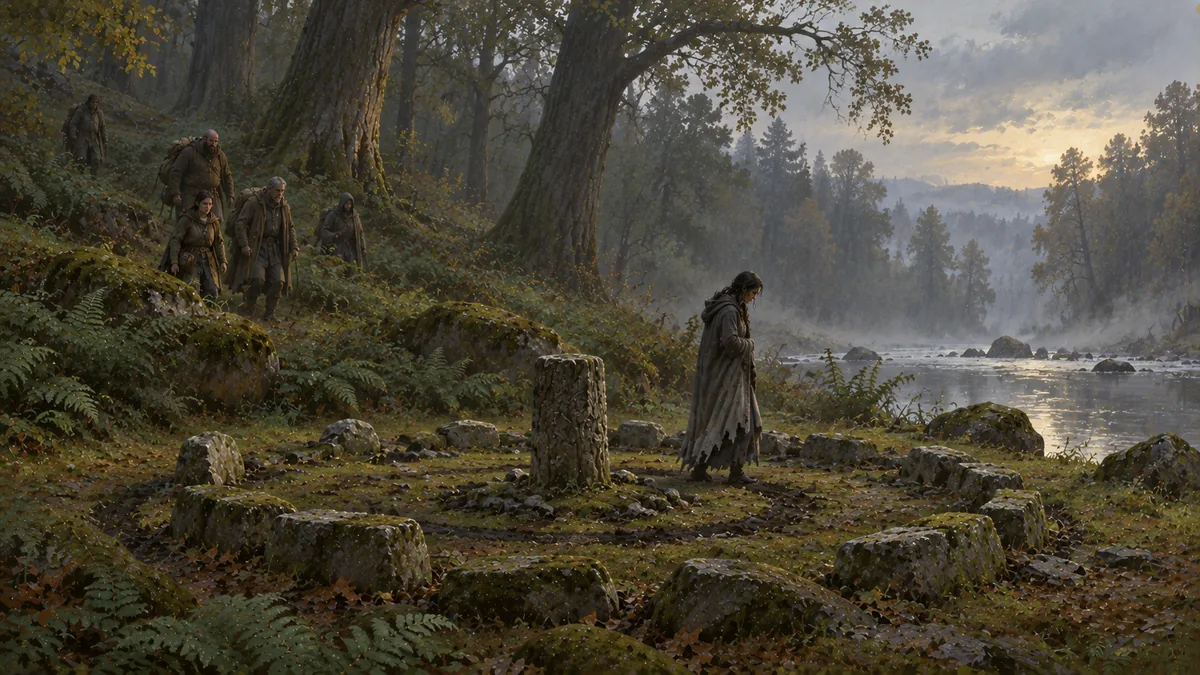
The slope fell away below the fallen wall in long terraces of fern, and at the bottom the river ran broad and quiet between banks of roots. Beside the water lay a flat place where something had once stood, a shrine or a well-house. All that was left was a ring of worn stones in the moss and a stump of carved pillar in the middle. Round the pillar, round and round, a woman was walking.
She walked with her head bowed, in a gray cloak torn at the hem. The moss under her feet was trodden into a dark ring, and Lio could see from the depth of it that she had been walking there for more than a night. As she walked she spoke, very low, in the old speech, in a voice that rose and fell like water over stones. When she came round past them, Lio caught the words.
"Stone to my foot and the way before me, the way before me and home at the end."
She went on round the pillar and came back.
"Stone to my foot and the way before me, the way."
Sil stopped short at the edge of the flat.
"That's a holding-chant," she said. "The first one they teach you. You say it when you're lost and you need the road to stay where you left it." She swallowed. "It's going out of her. Listen to it. Every time round."
Mara came past them again. "Stone to my foot," she said, and walked on. Her lips went on moving round the place where the rest of it had been.
Brannoc came up on Lio's other side and watched her go round.
"She took your brother," he said.
"She did," said Taren, before Lio could answer. His face was set. "And she was good to me the whole way, did I tell you that? I had a fever the third night and she sat up with me. She wrung a cloth out in the stream and kept it on my head, and sang to me in the old speech. And every mile of it she was walking me to a map with her name on our orchard." He drew a breath. "I don't know which one to be angry about."
Lio went forward into the flat.
Mara did not stop when he stepped into her path. She walked into him and stood with her bowed head against his chest. Then she lifted her face. It was weathered and fine-boned and very tired, with dark hair coming loose from its braid. Her eyes were gray, and sharp, and they knew him.
"Lio Ashby," she said, in the old speech. Even now her voice was beautiful. "And that's Sil Arden behind you, with a face on her like a shut gate." She looked past him at Taren, and her mouth moved. "And the brother. Well. You found him."
"We found him."
"I'd have brought him back to you in the end." She looked round at the ring of stones, at the river, at the trees, turning her head slowly from one to the next, like a hound casting on cold ground. "I was going somewhere," she said. "I had it at the ford. I had it as clear as the hand in front of me." She turned to him again, bewildered. "Which way was I going, Lio Ashby? You'll know. You always know."
They sat her down on the stump of the pillar and Brannoc built a fire.
She let them. She let Sil put a blanket round her, and she took the bread Taren gave her and thanked him by name. But she did not eat it. Every little while she got up and set off one way, and stood, and turned to set off another, and Lio put his hand on her shoulder and she sat again.
Her pack lay where she had dropped it, at the edge of the trodden ring, and Brannoc opened it. There was little in it, a water-skin gone dry, a heel of black bread, a flint, and a book. It was a road-walker's book, bound in gray leather, worn soft, and closed with a cord. Brannoc untied the cord and turned the pages with his thick fingers, and Lio leaned over his shoulder.
The first pages were Edda's road. He knew them at once, though the writing was Western. Here were the three oaks, drawn small and neat in the margin with a date beside them. Here was the stone bridge, and the well, with no bird on it. Page after page followed them west in a fine, even hand. Then there were pages about Sarne that Lio could not read, and after them the hand began again, fresh, and he saw a beech tree with a fallen wall about its roots. He saw a mill with water in its race.
"She's been writing us," Brannoc said. "All the way."
He turned the pages, and the writing went on, neat, for two pages more. After that it began to slope. The letters grew larger and looser. On the next page a single line was written over and over, down the length of the page, in a hand that wandered and grew faint. On the page after that there were only the first two words of it, and a long pencil stroke going off the edge of the paper. The rest of the book was blank.
"It's all in there," Brannoc said. "Every turn. She'll have it to Sarne inside a month, if she lives. They'll have walkers on it by the autumn."
Lio held out his hand, and Brannoc gave him the book. He opened it to the beech and the fallen wall. He tore out that page, and the next, and every page after, down to the long pencil stroke going off the edge of the paper. He knelt and fed them into the fire one at a time and watched them catch. The ink went brown, then bright.
Mara leaned to watch. When the little drawing of the mill curled up in the flame, she nodded at it.
"I drew that," she said. "On my knee, by the race, with the wheel going round." She watched it go to ash. "I can't think now where I was taking it."
They went on east along the river with Mara among them, because Lio would not do otherwise, and it was slow. Taren had her by one arm and Sil by the other. She walked willingly, and talked to Sil in snatches as she walked, about the rope-walk in Harl Street and a dog that used to sleep at its door. But at every bend of the river she stopped and turned, and her face came round west, then north, then back, and her feet started to follow wherever it pointed.
At the halt Brannoc came and walked beside Lio, a little ahead of the others.
"She's not ours to carry," he said, low. "You've burned her book, but you can't burn what's in her head, and that's the way to your mother's dairy. If we keep her, then tie her. Wrists in front, so she can eat. She'll go in the night."
"I'll not tie her like a heifer going to market," Lio said. "She walks between Sil and Taren, and one of us sits up with her."
Brannoc held his eye a moment longer, and fell back to walk behind.
That evening, while Brannoc was building up the fire, Lio found Taren sitting beside Mara.
She sat on a root with her hands in her lap, looking at the river. Taren sat beside her without touching her. He was singing under his breath, very low, a tune Lio had never heard, with words in the old speech that rose and fell. It was slow and sad and it went round on itself, coming back each time to the same falling line.
At the second verse Mara's voice came in under his, true and low. She knew every word. When Taren lost the third verse she went on alone and finished it for him, and let the last line fall, and was quiet.
"My mother sang that," she said, "when the snow came down off the tops, above Sarne. Cold it was, that winter." She turned to Taren. "Which way is Sarne from here?"
Taren pointed back along the river, west.
Mara looked along his arm for a long time, into the gray.
"West," she said, trying the word, and shook her head.
Taren let his hand fall. He sat on beside her until Brannoc called them to the fire, and neither of them spoke again.
Taren took the first watch.
He would not hear otherwise. Lio had not slept the night before, on the fallen wall, and Taren had, by his account, slept for most of a week in broad daylight. "Let me do something," he said. "I've been carried far enough. Let me sit up with her."
Lio let him. He lay down by the fire with his father's axe beside him and meant to stay awake anyway, and found that he could not keep his eyes open. The last thing he saw was his brother sitting against a root, with Mara rolled in Sil's spare blanket an arm's length from his boots.
He woke to Brannoc's hand on his shoulder and the gray light of morning in the trees. The fire was ash. Sil's blanket lay on the moss, thrown back, and empty.
Taren was asleep against the root where Lio had left him, with his chin on his chest.
"She's gone," Brannoc said.
Taren jerked awake at the sound. He looked at the empty blanket, and at Brannoc, and at Lio, and his face went slack and young and dreadful.
"I was awake," he said. "I was. I only shut my eyes to hear the river better."
Brannoc was already at the edge of the camp, bent over the moss.
They lost most of the day finding her.
Her track went west. Brannoc found it at the edge of the camp, a pressed stem and a scuffed root and a long smear in the moss where she had gone down on one knee. It went back the way they had come, along the river, and then it left the river and wandered. It went up a slope and down again, and round a fallen trunk three times. The moss took her footprints and gave them back, and Brannoc read them more by where they had been than where they were, bent close to the ground, going slowly.
Lio walked behind him with Garrow on his arm and held home in his mind. It was harder than it had ever been. They were off their path now, following hers, and hers went nowhere. He kept the yard and the pump and the wheel in front of him and did not dare put them down. Sil came last. She had put her knife away days since.
At noon they lost the track entirely in a stretch of bare gray ground, and stood there while Brannoc cast about in widening rings. Taren sat on a stone with his head in his hands. Garrow stood where he was put and looked at a beetle.
They found her in the middle of the afternoon, and Lio smelled the place before he saw it.
Windfalls. Wet apple wood, and the sweet brown rot in the long grass of an October evening. He stopped with his hand on Garrow's arm. Behind him Taren had his head up.
"That's—" Taren said, and broke off.
They came over a rise, and the slope lay below them, and the slope was an orchard. The old trees had gone wild and grown as tall as oaks, with their trunks leaning and split and their branches tangled into a roof. But they stood in their rows, if you knew to look. A tumbled wall ran along the top of the slope, and it bent where Ambrose's wall bent. At the far end a gap showed where the gate would be.
"That's the Pennocks' slope," Taren said. "It can't be. We're a month from home."
Lower down, the trees were young. They stood in the same rows with smooth green bark and their first fruit spurs, and the grass under them was tight and bright, brighter than anything in the gray had a right to be. It smelled of October in what Lio still thought of as May. Across the foot of the slope ran an older wall of rough stones without mortar, gray-green with lichen, built at its own angle and paying no heed to the rows. The young trees had come down to it and gone over it. Where they stood, the lowest courses were already under the turf.
Lio knew it then, standing at the top of the rows. Nobody had planted this. Nobody had kept it. He had walked toward the Pennock orchard across the gray with everything in him, and the gray had given it to him, here, on top of somebody else's farm. And it was still growing.
Mara was down among the young trees. She had found one standing a little apart and was going round it, slowly, with her head bowed, as she had gone round the pillar. Her lips moved, but the words had gone out of the chant, and what came from her was its rise and its fall, breathed out on the air.
Below her, where the old wall met the lane, a gate stood in the orchard grass. Its posts leaned, and the turf had climbed them to the height of the latch. The gate hung shut between them, with no lane beyond it and no field behind, only more of the young trees.
Lio made himself think of Ambrose's gate. He did it on purpose, to be sure. He thought of the top bar gone silver, the latch you had to lift and shove, and the nettles at the foot of the hanging post.
The hanging post went down a finger's breadth into the turf. The grass closed over the place with a small sound, like somebody drawing breath through their teeth. The empty gate dropped with it, and the latch rattled once against its catch.
Lio let go of Ambrose's gate. He let go of the orchard and the windfalls and October, all of it, and stood in the cold of the gray with nothing in his head at all. The gatepost stopped. Nothing in the orchard moved.
Far off behind the trees the mill in the gray was knocking, and at every turn the split paddle hitched against its frame. He knew that hitch. Owen had been meaning to mend that paddle for two years.
He saw Pell, the eldest of the road-keepers, by the hearth-stone at Wending, not looking up. Keeping a road was what they did there, the old man had said. Making one was the thing nobody might do.
"Lio," said Sil. She had her chain off her shoulder, and she was watching his face.
"Don't chain anything," he said. "Don't mark anything. And don't any of you think about home in here. Leave that to me." He looked at the gate standing in the grass. "I made this. Out of our orchard. From here on I'll think of what's there, and nothing else."
Sil looked at the gate, and at the young trees standing over the old wall, and she let her chain hang. They had come down into the orchard in the middle of the afternoon, and the light on the grass had already gone long and yellow, the light of some other evening.
Brannoc took a length of cord from his pack. He asked no leave. He went down between the rows to Mara and caught her going round her tree. She looked at the cord in his hands and held out her wrists to him, crossed.
"In front," she said. "Wenna always tied them in front, the ones she brought out. So they could eat."
Brannoc tied them in front, with a soft knot. Lio watched him do it, and let him. When Brannoc came back up the rows with Mara walking at the end of the cord, Lio stood aside to let them pass.
A mile past the orchard, as the light went, Mara lay down.
She had been walking well on her cord between Brannoc and Sil. At the top of a bank above the river she sat down on the moss and lay down on her side, with her cheek to the ground.
Sil was on her knees beside her at once. She put her ear to Mara's mouth, and then her fingers to her neck.
"She's breathing," Sil said. "She's cold. Lio, she's so cold." She looked up, her narrow face frightened. "I don't think she's eaten in days. She's been walking that ring with nothing in her, and now there's nothing holding her up."
They could not wake her. Lio cut two poles from an ash tree with his father's axe, and they lashed a blanket between them and carried her along the bank as the light went. She was not heavy.
They made camp in a hollow out of the wind. Taren got a fire going, high and hot, and they heaped her with blankets beside it. When the broth was hot, Sil lifted Mara's head into her lap and got some of it between her lips with a spoon. Mara swallowed, and opened her eyes.
"Talk to her, Sil," Taren said from across the fire. "Tell her who she is. Like Lio did me."
"She knows who she is." Sil set the spoon down. She bent over the face in her lap. "What's your name?"
"Mara Vey," said Mara, as if Sil were a fool.
"Who taught you?"
"Wenna Sloe. You know that."
"Where were you going?"
Mara's eyes went to the flames, and past them to the dark, and round the hollow, from tree to tree, and came back to Sil's face with nothing in them.
"Somewhere," she said. "I'd a reason. I had a good reason." She closed her eyes.
Sil sat back on her heels. Her mouth was tight.
"There," she said. "That's what's gone. Not her. Her road. I can't give her a road in here without losing mine, and I'm too angry with her yet to do it well." She looked down at the sleeping face. "I was fifteen when I met her. My mother's gone gray since. And look at her. She's barely older, for all that." She drew a breath. "Get her out of the trees. Then ask me."
Lio sat up that night himself, with the axe across his knees and the cord from Mara's wrists tied off round his own. Taren sat up with him unasked, and toward midnight he fell asleep against Lio's shoulder.
Lio kept home in front of him, because it was the only road they had, and he kept it small. He kept the kitchen as it stood, and the wheel as it turned. When his mind went reaching past them for more, for the smell of the orchard or the millrace in flood, he called it back. Somewhere far behind them the mill he had made was turning in the dark. He would not let himself listen for it.
Across the fire Mara's eyes were open. She was watching him, as she had watched him on the road before Wending, every move of his head. After a while she closed them again.
In the morning the country was changing round them.
The trees were smaller, and the gray was thinner, and there were birds again, real birds with songs he half knew. Lio walked first. He went carefully now, and reached for nothing he could not name. Behind him he heard the creak of the litter poles and the slow slap of Garrow's bare feet, and Taren talking to Garrow about the Coldharbour fair, and Garrow saying, "Yes," and once, "Did I?"
In the middle of the afternoon the river bent away south, and the path went on east without it, up a shallow valley between beech trees. Lio stopped at the bend to be sure. He reached for the yard, the pump, the smell of the millstream, and found them ahead of him, up the valley, close.
Mara was awake on the litter. She lay with her head turned, looking up the valley between the beech trees, and her lips were moving.
"There'll be a stone at the top," she said. "On the left. White, with a holly behind it. And past it the ground goes down, to a stream with a plank across." She spoke slowly, as if she were reading the words off something only she could see. "Isn't there?"
Lio did not know. He had never seen this valley in his life, and neither had she. They carried her up it, and at the top, on the left, there was a white stone with a holly growing out from behind it. Past it the ground went down again. At the bottom a little stream ran east, and across it lay an old gray plank, green with moss.
They set the litter down at the plank. Mara turned her head on the blanket and looked east, along the line of the stream, into the thinning gray where the path went on toward Thornby. Her eyes were clear.
"I know this road now," she said.
Brannoc stood at the head of the litter. His hand had gone to the knife at his belt. Lio shook his head, once, across her, and after a moment Brannoc took the hand away. Below them the little stream slid east under its plank, toward the valley, and the cord lay slack across her wrists.