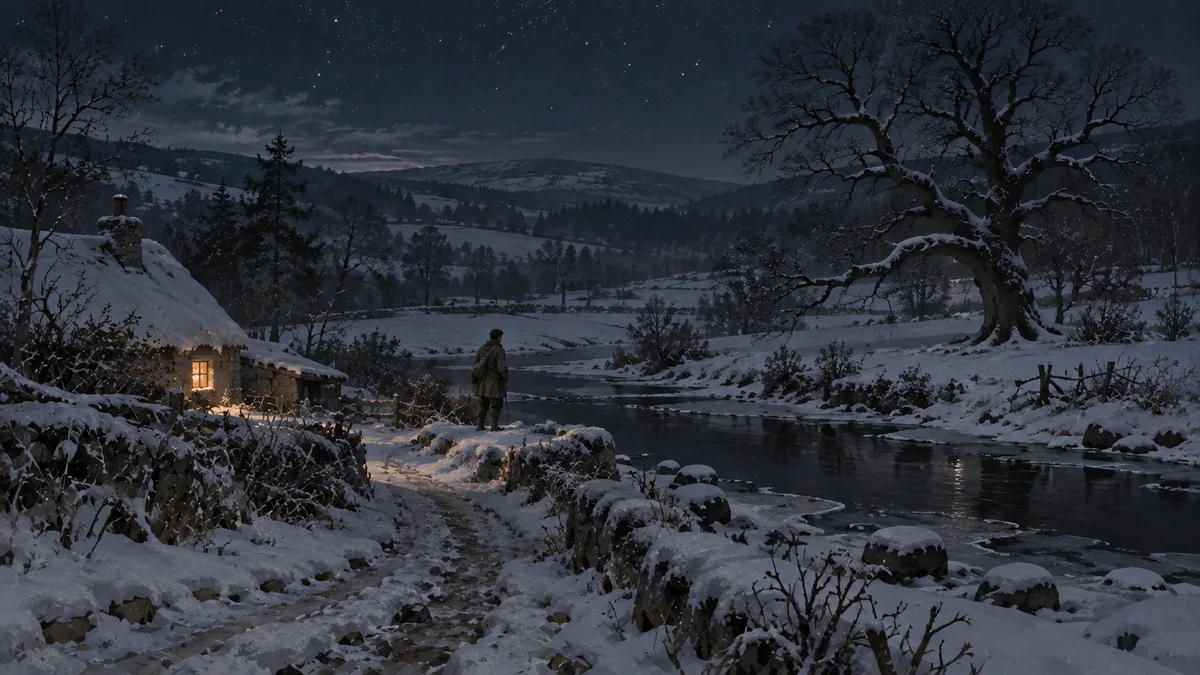
Winter
The stack of felled beech logs above the charcoal clearing had gone over in the storm, and somebody had to bring it down.
It had always been Taren's work. Owen felled, and Lio sawed and split and stacked, and Taren took Captain up the track with the chains and snigged the logs down to the yard, dragging them on the chain behind the horse. He was good at it. He talked to the horse the whole way, nonsense mostly, and Captain would lean into the collar for him on a slope where he would stand and sulk for anyone else. In the second week of November Lio took the chains off their hook in the cart shed and went up with Captain himself.
The morning was cold and gray, with no wind. The track was hard with frost, and the ruts had skinned over with ice that cracked under the old horse's hooves with a sound like breaking plates. The spilled logs lay down the slope where they had rolled, half buried in bracken. Lio found the first one and cleared round it with the billhook and got the chain under it, and stood at Captain's head.
"Come on, then," he said.
Captain planted his feet.
"Come on, old man."
The horse's ears went forward, and then back, and then forward again. He turned his long gray head and looked past Lio up the track, toward the trees. Lio had called him old man without thinking. It was what Taren called him.
He stood with his hand on the horse's neck until he could trust his voice.
"Walk on, Captain," he said, in his father's voice, quiet and level. The horse sighed and leaned into the collar, and the log came grinding up out of the bracken.
It took them the rest of the month to bring the stack down. Lio did it in the mornings and his own work in the afternoons, and in the evenings he mended what had broken in the day. More than once he fell asleep at the supper table and woke with his mother's hand on his shoulder. He minded none of it. While he worked he had no room to think, and when he stopped he slept.
His mother set five places at supper until the end of November.
She did not seem to know she was doing it. She would lay the cloth and go to the dresser and take down the brown plates with the cracked glaze that had come from her mother. She set them round the table. The last went on the right, across from Lio, where Taren had always sat so that he could kick his brother under the table and pretend it was the dog. She would put the bread on the board and the stew in the middle and call them in.
None of them ever said anything about the plate. Owen sat down and ate. Edda sat down and ate. Lio sat across from it and ate, and the plate sat there with nothing on it. After supper his mother washed it with the others and dried it and put it back on the dresser.
Every morning before he went up the track he walked down to the Long Meadow to look at the frost.
The Long Meadow lay along the river below the village, and it held frost longer than any field in the valley. Lio had known that since before he could remember knowing it. There was a dip at the downstream end, by the alder trees, where the cold air came off the water at night and lay in a pool. In the mornings that corner stayed white long after the rest of the grass had gone dark and wet. On still days a mist lay there too, knee-deep, and the sheep came out of it with no legs at all. As the sun got up over the eastern hills, the thaw crossed the meadow in a long line, slowly, from the top hedge down. By noon there was only a white stripe left along the foot of the hedge on the river side, where the shadow lay all day. Some winters that stripe stayed white from the first hard frost to the turn of the year.
In November it went every day by noon. Lio watched it go, and was glad of it. The frost lay where it ought to lie, and it went when it ought to go.
On the last evening of the month Lio came in from the yard and found his mother standing at the table with the fifth plate in her hand.
The others were laid. The bread was on the board. She looked at the plate, and turned it over, and looked at the crack in the glaze on its underside. Then she went back to the dresser and put it on the shelf and stood with her hand flat on it.
Lio crossed to her side. He could find nothing to say, so he said nothing. At last she took her hand off the plate and put it on his arm instead. She gave his arm a hard little shake, as though he had done something foolish and she forgave him for it.
"Fetch your grandmother," she said. "And take her arm."
In December his father built a gate.
The Long Meadow gate was sound. Owen had hung it when Lio was small, and it had never given trouble, except that the top rail had a lean to it where Taren and Lio had swung on it as boys. Owen came out of the cart shed one morning with a length of seasoned oak on his shoulder and went down to the saw-pit, and Lio put down his work and followed.
They made it over a week. Owen worked without a word about why, and Lio worked beside him. They sawed the rails and the stiles and the brace, and Owen cut the mortises with his chisel, slowly, taking the oak out in clean curls. Each tenon went into its mortise so tight that Lio had to drive it home with the mallet, and Owen pinned each joint with a peg he had whittled by the fire. Then they planed it, all of it, until the oak was smooth under the hand. Nobody planed a field gate. Lio planed it.
On a morning of fog they carried it down and took the old one off its hangings. The new gate went on. Owen swung it, and it swung true and shut with a soft clack against the post, and the latch dropped.
His father leaned on it. Lio leaned beside him. The fog lay over the Long Meadow so thick that the river was only a sound. The alders by the water were gray shapes, and the sheep were nowhere at all. Somewhere upstream a heron called, harsh and sudden.
"Good gate," Lio said.
"It is."
They leaned on it. The fog smelled of river and wet grass and the woodsmoke of Thornby behind them.
"Your brother never shut a gate in his life," said Owen.
He pushed himself off the rail and went back up the meadow toward the house. Lio stayed. After a while he set his boot on the bottom rail, as the two of them had done when they were small, and pushed off. The gate carried him out over the wet grass, slow and true, without dropping an inch. He rode it back, got down, and heard the latch fall.
In the week before midwinter Lio took the beech logs down to Wexley on the wain and sold it to Gideon Marrable, the timber-master. Taren had always done the selling. Marrable, a short thick old man with sawdust in his eyebrows, rapped one log with his stick, squinted at the end grain of another, and named a price rather better than fair. Lio began to thank him.
"Don't," said Gideon Marrable. "It's good beech wood, and I'll not be thanked for paying what it's worth. Next year I'll argue."
The village began to speak of Taren in the past tense before midwinter.
Nobody did it on purpose. It came in at the edges. The parson prayed at chapel for all those lost to their families, and the whole chapel looked at the Ashby pew. Ambrose Pennock, the old orchard-man over the bridge, leaning on the orchard fence to watch Lio prune, said Taren had been a fine hand with a horse. The men at the Wheatsheaf, the village inn, stopped asking Owen whether there was any word.
On Midwinter Eve all Thornby went to the Wheatsheaf, as it always did. The Ashbys went too. Bet said they would, and so they did. The long low room was hot and loud and smelled of wet wool and mulled ale and the yule log, which was ash wood, and spat. There was a fiddler from Wexley, and the Pennock boys were dancing with each other because the girls would not have them. Edda sat in the chimney corner with a cup of hot ale and a ring of children round her. She was telling them the story of the miller's cat that went to sea in a sieve, as she had told it to the children of Thornby for forty years. The children knew every word and shouted the best ones with her.
Lio stood by the door with Kit Hay. Kit was in love with the miller's daughter and wanted Lio's opinion about whether she was in love with him, and Lio was giving it, and it was not good news.
Then Ned Cotter stood up on a bench.
The smith was a little drunk and very serious. He knocked his cup on a beam until the fiddler stopped, and the room turned to look at him.
"Midwinter," Ned said. "We drink to them that aren't with us. That's the custom, and it's a good custom." He looked across the room at the Ashbys, and his big red face was kind. "So here's to Taren Ashby. He was a good lad, and he'd have liked this."
The room lifted its cups. "Taren," it said.
Lio put his cup down on the windowsill and went out.
It had snowed at dusk, and then the snow had passed over. The sky had cleared, and the stars were out hard and many over snow that lay blue and unbroken on everything. The cold took his breath. He stood in the lane outside the Wheatsheaf with the noise coming through the shutters behind him. When the fiddle started up again, he walked away from it.
He went home the long way, down the village street, past the dark smithy and the chapel, to the valley road, and down the road toward the ford.
He wanted no light. He could have walked it with his eyes shut, and for a stretch, to see, he did. The road went down between its hedges with the snow muffling his boots. His feet found the dip by the Pennocks' field gate, and the rise after it. Where the hawthorn leaned out on the right, low enough to take your hat off a cart, he ducked with his eyes still shut. He opened his eyes at the bottom, and the ford was where he had known it would be.
Joss Hobb's cottage stood back from the road on the near bank, low under its snow. A lantern burned in the window. Joss kept one there on winter nights for as long as Lio could remember, for anyone caught at the crossing after dark. Lio stood in the edge of its light at the top of the bank. A shape crossed behind the glass and stood there. The door stayed shut.
The Lenn was low and black between its white banks, with thin gray ice along both edges and the water talking under it. Lio stood at the top of the stony bank and listened. He knew the ford by its voice: the quick shallow chatter of the riffle, where the gravel came up near the surface and a cart could cross in summer without wetting its axles, and below it the deeper, slower sound of the pool under the far bank. On the far side, the old ash tree stood up black and bare against the stars, with snow lying along its great low limb. He had climbed that limb a hundred times. He had fallen off it once, at eight, and broken his wrist. Taren had carried him home on his back, telling him all the way that he was a fool and a baby and that a wrist was nothing, and white to the lips himself.
He went down the bank. Even under snow his boots chose the stones that would hold. The big flat stone near the top rocked, and always had, and his foot found the one beside it. At the water's edge he crouched and put his bare hand in the river under the ice, and the cold of it went up his arm to the shoulder.
Out there, in the Wood, his brother had none of this. Wherever Taren was, if he was, he was in country where nothing kept its word. The brooks came back. The oaks came back. No frost lay where frost should lie, and no stone rocked where you expected it. He had nothing to put his foot on.
The anger came up in him then, hot, from nowhere he knew. He saw Taren at the supper table, waving his knife at the west window and wanting a look first. Taren, who had never shut a gate in his life, walking off in the dark with half the loaf and leaving the rest of them to set his plate.
"You and your look," Lio said aloud to the river.
The ford went on talking under the ice. Across the water the ash stood black against the stars. Lio's face burned in the cold, and he looked up at Joss's window and was glad of the shut door.
Lio took his hand out of the river and dried it on his coat, and went back up the bank. The lantern was still in Joss's window, and the door was still shut. He went on along the road and turned in at the orchard path.
The Pennock orchard was dark and full of snow, the trees standing in their rows with their arms out. He went through it quickly. He passed the old russet apple that Ambrose had bound with iron, and the tall pear tree that gave nothing and that Ambrose would not cut down because his wife had planted it. Smoke from the Pennocks' apple-log fire lay sweet and heavy under the branches.
He came out of the orchard at the footbridge. The snow lay on the planks unmarked, and on the rails an inch thick. Lio brushed the left-hand rail clear and kept his palm on the worn wood a while. Under him the millstream ran black and quick, smoking in the cold. He crossed.
The kitchen was dark and the fire banked. His parents had come home before him. Lio took off his boots, and from habit reached up for the bolt on the back door.
"Leave it," said his father, from the dark at the top of the stairs.
Lio left it. He went up past him in his stockings, and neither of them said goodnight.
In January his grandmother asked him to bring down the chest.
Lio had gone across the yard with an armful of wood, as he did every morning. Edda's cottage was one room below and a loft above, behind a blue door. Its fire smoked when the wind was in the east, and its window was full of geraniums that she kept alive through the winter by talking to them. She was sitting by the hearth with her mending in her lap, humming. She hummed in pieces now. She would take the walking tune a little way and stop in the middle and frown, and go back to the beginning, and try again.
"There are words to it," she said, when Lio had stacked the wood. "Did you know that? I never knew that. All my life, and I never knew there were words."
"What are they?"
"I don't know yet." She smiled at him. "I had one this morning. I woke up with it in my mouth. Oaks."
"What about oaks?"
Edda frowned at her needle. "Something. Something about oaks." She hummed a few notes and stopped. "It's gone again. Never mind. It'll come back, they keep coming back. It's like having mice." She put her mending down. "Lio, love. Will you get the chest down from the loft for me?"
"Maud's chest?"
"There's a bird on it," Edda said. "I've been lying awake thinking. There's a bird carved on the lid, and I think it's the same bird."
He went up the ladder into the loft, low and dusty and full of the things an old woman keeps: a cradle, a spinning wheel with no band, his grandfather's Sunday coat in a bag of lavender. The chest sat at the back under the slope of the thatch, under a moth-eaten blanket, smaller than he remembered, about the length of his arm, and heavy for its size. When he pulled the blanket off, the smell came out at him all at once. Cedar. Dry and sharp and sweet, a smell that belonged to no wood in the valley. He had smelled it once as a child, when he had climbed up here without leave, and he had forgotten it until now.
He brought it down the ladder on his shoulder and set it on the floor in front of the fire.
The lid was carved with the heron in its ring of waves.
Edda got down out of her chair and knelt on the hearthrug in front of it, and Lio let her. She put out her hand and laid it on the heron's back, as she had laid it on the prow, and sat back on her heels.
"It's the same," she said.
Lio crouched beside her and looked from the carved bird to her face. "As the prow, Gran?"
Edda nodded. "Just as the prow."
"Maud kept it at the foot of her bed all the years I knew her. She told me it was my mother's, and I'd know when it was time to open it." Edda looked up at him. Her eyes were bright and, under it, amused. "I think it might be time, and I don't know a thing. Help me, love."
They tried. Lio could find no keyhole, no hasp, no hinge. The lid sat on the box so close that he could not get a fingernail into the join. He tipped it on its side, and there was nothing underneath but the grain. He knocked on all its sides and listened, and it sounded solid everywhere. He took out his knife and ran the point round the edge of the lid, gently, and the point would not go in.
"Press the bird," said Edda.
He pressed the heron. Nothing happened. He pressed the waves, one after another, round the whole ring, while Edda watched over his shoulder and told him he was doing it wrong, though she had no notion what right would be. He pressed the heron's eye. He pressed its foot. He tried to turn the whole carved panel, as you would turn a lid on a jar, and it held fast.
"Perhaps it's to be sat on," he said. "Perhaps that's all it's for."
"Perhaps you have to say something to it."
"Open," Lio said to the chest, sternly.
"Please," said Edda.
"Open, please."
The chest sat there like a stone. Edda began to laugh, kneeling there on the hearthrug, and had to hold on to his arm. Lio laughed with her. The smoky room was full of it, and of the smell of cedar.
"Maud would be laughing at us," she said at last, getting her breath. "She had a laugh like a hen. I'd forgotten that. All these years I'd forgotten it, and there it is." She rapped the lid with her knuckle. "Leave it here, love. By the fire. I'll look at it, and it can look at me."
He left it there. When he came across with the wood the next morning, she had put a cloth over it and her teacup on top, and it had become a table.
The snow went at the beginning of February in a week of rain. The Lenn rose brown and loud and went over the Long Meadow again, though not so far as in October. The ice went out of the millrace in a single night with a long groaning that woke the house, and in the morning the wheel was turning. All down the bank of the millstream behind the house the snowdrops came up in the same places as every year, under the hazels and along the foot of the wall. Lio's mother said the first lamb of the year was always born the week the snowdrops opened, and that year it was.
One evening when the rain had stopped, the smell of the Pennock orchard met Lio at the stile: wet bark, old leaves, and under them the ghost of last autumn's apples. Ambrose Pennock was there with a lantern, looking for a ewe.
"Windfalls," said Ambrose, sniffing. "My wife used to say it was the trees breathing out." He went away down the rows, calling the ewe by her name.
On the evening of the twenty-second it was raining hard. They were sitting at supper, four of them, when the dog barked and somebody knocked at the kitchen door.
It was Will Snape, the old trapper. He stood on the step with the rain running off the brim of his hat, and he stayed there, though Bet asked him in twice. He had something held against his chest under his coat.
"Found this," he said. "Up at the ship. I was going round my traps."
He held out a bundle about the size of a loaf, wrapped in some dark cloth and tied with cord.
"Where?" said Owen.
"In under the bow, out of the wet. Where you cut the bird off." Will looked at the floor. "On a flat stone. Somebody'd set it there, careful. It wasn't there Tuesday."
Owen took it from him. Will touched his hat to Bet and went back out into the rain before anyone could thank him, and they heard his boots go off down the yard.
Owen put the bundle on the table, on the cloth, where the heron had lain in October. For a moment nobody touched it. The cloth it was wrapped in was smooth and dark and gleamed in the lamplight. Lio put out a finger and felt it. It was oilcloth, but finer than any he knew, thin and supple and tight, and it smelled of pine resin and of something sharper that caught at the back of his throat.
He knew that smell. It had come up off the stream in the gully on the day they found the ship.
Owen cut the cord with his knife. He folded back the oilcloth. Inside, wrapped again in a second fold, there were three things.
The first was a clasp-knife with a horn handle. Lio knew it before his father picked it up. Owen had given it to Taren on his fourteenth birthday, and Taren had dropped it on the smithy step the same evening and put a chip in the horn the shape of a fingernail. Owen opened it. The blade was clean. Somebody had sharpened it and oiled it, so that it shone, and the hinge moved sweetly. Taren had never in his life cleaned that knife. He used it for apples, string, splinters, the stones in Captain's hooves, and he shut it up dirty. Lio looked at the bright clean blade and did not know whether that was the best thing he had ever seen or the worst.
His mother came round behind his father's chair. She put her hand on Owen's shoulder, and he reached up without looking and covered it with his.
The second thing was a scrap of paper, folded small, thin and tough and brownish. When Owen opened it out on the table, it was covered in writing in a brown ink. Lio could read. He had read the parson's books and the almanac and the timber-buyers' letters since he was small. He could not read this. Some of the letters were letters he knew, or nearly, and the rest leaned and curled and joined in ways that meant nothing to him at all.
"Can anyone—" said Bet.
Edda had come round the table. She leaned over it with her hand on Lio's shoulder for balance and looked down at the paper. Her finger came out and moved along a line of the writing, slowly, as it had followed the waves round the heron. It stopped.
"Sarne," she said.
She said it quietly, but in the kitchen it was loud. Her finger stayed on the word. It was a short word, near the middle of the page, and it looked like nothing.
"You can read it?" said Owen.
"No," said Edda. "Not a word of it. Only that." She took her finger off the paper and closed her hand. "That's how it's written. I know how it's written. I don't know how I know."
"What is it?" said Lio.
"A city by the sea." She looked at the word again. "I was born by it. I'm sure of that much."
The third thing was a compass.
The case was old brass, heavy, the size of the palm of Lio's hand, worn smooth and dark with handling and dented on one side. When Lio picked it up, the needle swung and shivered and settled, and pointed at the kitchen wall, at the dresser, at the north. He turned it in his fingers. On the side there was a little catch, and when he pressed it the lid sprang up.
Inside the lid, scratched into the brass with the point of a knife, there were two letters. B, and H.
He held it out to his father. Owen took it and looked at the letters, and Lio saw his face change.
"That's Brannoc Hay's," said Owen.
Edda lay awake that night, which at sixty-six was no great hardship. Sleep had been wearing thin on her for years, like the elbows of her husband Jacob's Sunday coat.
She lay with the fire banked and the geraniums black against the window, and took stock.
What she had was this. Steps and gulls and a boy with a white line on his chin; Bet and Taren had heard all that. Maud, who laughed like a hen. And one thing that had come only tonight, while the rain ran down the window: a cold brook, and Maud smacking her legs for dawdling in it, and then kneeling to rub them warm. Most of a song, and now a line more of it, which had walked in that evening while Owen was cutting the cord: Drink at the well with the heron stone. A heron again. On the ship, on the chest, and now in the song, standing on a well. And one line of a lullaby that was no part of the walking tune, Hush now, the tide's turning, in a voice she could not place.
What was missing was a great deal more, and she had only lately begun to notice the shape of it. Her mother's face was missing. She had looked for it all winter and found an apron, and a hand on a banister, and nothing above. The day they left was gone, and the door they left by. And the name. She went back and back for a voice calling her Edda before Maud's, the way your foot goes down in the dark for a stair that ought to be there. Maud on the road, saying Edda, eat your bread. Maud at the inn. And before Maud, nothing; not a different name, not any name, only the place where one should have been.
Somebody had taught her the tune. She was sure of that now. Not Maud, who could not carry a tune in a bucket. Somebody with a lower voice, in a room with that light on the ceiling, singing it slowly over and over to a child who wanted to be outside. The voice came. The face would not.
"Well, Maud," Edda said to the dark. "You might have told me."
Maud, who had never given a straight answer in her life, kept her counsel.
Toward the small hours the tune began by itself, somewhere at the back of her, as it had begun every night of her life without asking her leave. Edda let it run, and listened for the words.
Across the yard the house was dark. Edda turned on her side toward it and began, very quietly, to sing the song to herself from the beginning, to see whether this time she could get it whole.