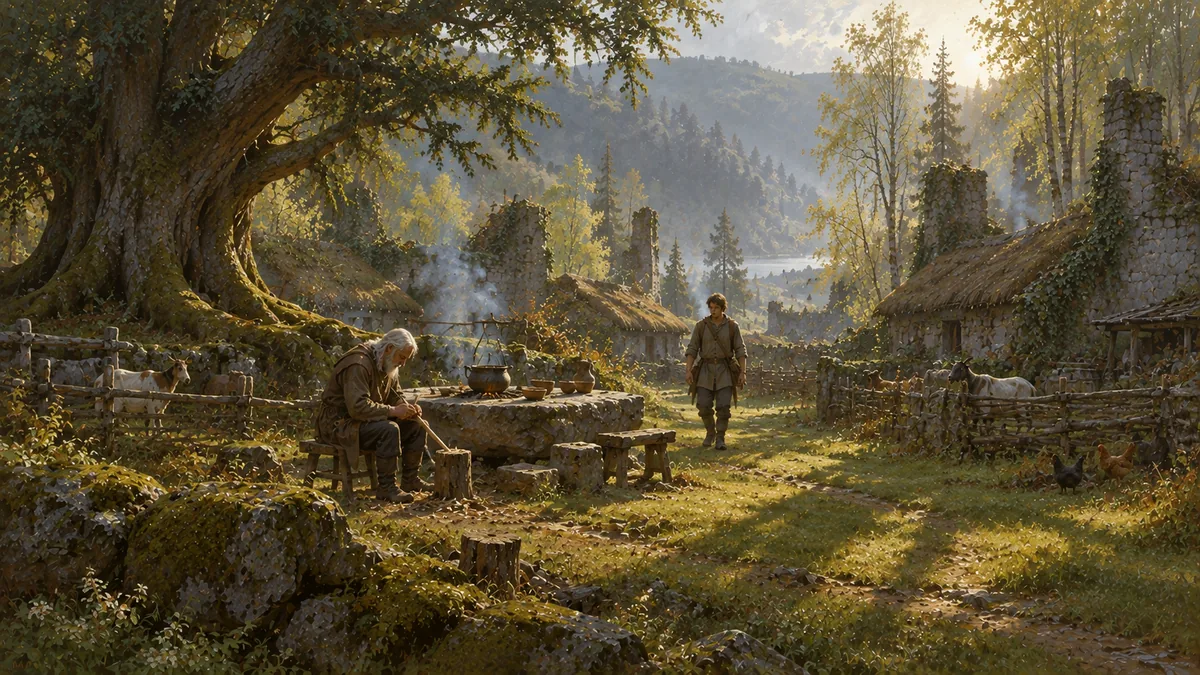
Mara Vey
Lio put the bowl down on the grass beside him. He did it carefully, so that she would not see how near he had come to dropping it.
"You've seen him," he said.
"I have." The woman sat down on the edge of the hearth-stone, across the fire from him, and laid her staff along her knees. "I walked beside him a good many days. He talks a great deal, your brother. By the second night I knew the names of your father's horse and your mother's cows and a goat that once ate his hat."
"Where is he?"
"Alive. Well. West of here, in a city by the sea, eating better than you are." She looked at his bowl. "That was a pottage, I think, before you let it go cold."
Around the fire, the people of Wending sat as they were. Ivy had gone from Lio's side to her mother's, and Ursula held her there with an arm round her chest. Col sat with his spoon halfway to his mouth. On the far side of the hearth-stone, Pell had folded both hands on the head of his stick and was watching the woman with his dark eyes. Brannoc had not sat down again. He stood against the wall at the edge of the firelight, arms folded.
"Who are you?" said Lio.
"My name is Mara Vey." She gave it a little fall at the end, the fall that ends a line in a song. "I walk the roads. Those that are left, and some that are not."
"A road-walker," said Rupert. He had come round the fire on his knees without seeming to know he had done it, and now he knelt at her feet. "There are road-walkers? There's a trade of it? Forgive me, madam, but why do you speak like that? Like a ballad. Like something out of my grandmother's—"
"Rupert," said Lio.
"No, let him ask." Mara looked down at Rupert, amused. "It's a fair question, and he'll not be the last to ask it. I speak as I was taught. Out in the West we kept your speech, the old speech of your country, in our deeds and our road-songs. Every walker learns it, for the roads were made in it and the songs that hold them." She turned her eyes back to Lio. "We never forgot you. We never—" She stopped, and smiled, and began again. "In the West, we never forgot you. It was you that forgot us."
Lio caught at the words. "In the West. Past the forest."
"Past the gray. Where your grandmother was born."
He had known it. He had known it since the night in the kitchen, with Edda's fingers on the carved heron and her voice a child's. But to hear it said aloud by a stranger, at a fire in the middle of the Wood, was a different thing. His hand found the cold grass beside him and pressed it flat.
"Tell me about Taren," he said.
The people of Wending listened with their bowls forgotten on their knees.
"I came with your wreck," Mara said. "Beside it, and on it when the water let me. I came down the ship's road in the flood, singing it from the Sarne end."
"Your grandmother's song?" said Rupert.
"Another. That ship was her people's, and they had a blessing they sang over her when she put out. A cradle-song too, in that house. Your grandmother's mother sang it her at night, when she was small." Mara looked at Lio. "There's one old man in the city who has it yet, and your grandmother. That's all the living. He taught it me." When Rupert opened his mouth again she only looked at him until he dropped his eyes.
When the ship struck, Mara went up into the beech trees and hid there, with the rain coming through, while half the valley came to stare. Then one gray morning a young man came up the timber track alone, with a billhook in his belt.
"I gave him two names," Mara said. "Maud, and Sarne."
Lio heard the first name land. "Maud." Gran's aunt, dead near fifty years. Only the family had cause to know it.
"He sat down on a stone as if his knees had been cut. Then he asked me questions until I was hoarse. I told him the water was falling, and if he'd know the rest he must come now, while it ran, or never."
"And he went," said Lio.
"He went. I took no one, Lio Ashby. He came." She held his eyes across the fire. "The first night under an open sky he laughed aloud at nothing, and asked me the names of the stars. He's whole yet, by all I know."
"And the bundle," said Brannoc, from the wall.
Her eyes stayed on Lio. "I carried it back. In the winter, alone, by a way I'll not walk again if I can help it. It was cold, that way. I left it where the ship lay, where a trapper would find it." She paused. "The boy's knife, so you'd know he lived. The scrap, so you'd know where."
"And the compass," Brannoc said.
Mara inclined her head to him. "That too."
Brannoc came off the wall. He took one step into the firelight, and there he stopped, because Pell had lifted his head and was looking at him. Brannoc hooked his thumbs in his belt. But he stayed where he was, in the light.
Lio found that his hand had gone into his pocket and shut on Taren's clasp-knife, warm from his body.
"How do I know you're not lying?" he said.
Mara took the question gravely. "He carved his letters in the rail of Father's bridge, as he calls it, when he was nine years old. The left-hand rail. Your father beat him for it, and he says it was worth the beating, and he'd do it again." She tilted her head. "He says you hid in the hayloft till dark, and you only five."
Lio looked at the fire.
The fear had been in him longer than he would admit. He had walked a fortnight and more on Edda's song, and he had told himself every morning that Taren was alive. He had made himself believe it by not thinking about it. Now somebody had told him, with that bridge rail in it, and the relief took him by the throat. He got up and walked out of the firelight, into the dark by a goat-pen, and stood facing the hazel. A goat put its nose through the hazel and breathed on his hand.
Then he came back and sat down.
"Go on," he said.
"You've followed us," said Lio. "Since when?"
"Since the oaks." She said it without shame. "I waited at your wreck for whoever would come after him, and you came, and went by me in the Margin, and I lost you there. But the oaks I knew. Every walker's child has them in some old song. I went and sat under them, and you came down the lane. Since then I've been behind you by day, and some nights ahead of you, to see what lay in front." Mara reached into her cloak and drew out a small book bound in gray leather, worn soft as a glove. She held it up, closed, so that he could see it, and put it away again. "I've set down the way you came. The oaks, and the brook, and the bridge with its one arch. The well. I sat on a stone above the inn and heard you singing in the dark, Lio Ashby, and I set that down too."
Lio's skin went cold. He remembered the night at the inn, the dead fire under the turf, and the song's old joke about not sleeping alone.
"You heard the song."
"Some. You sing low. You've a good ear, but you keep your voice down in your chest, where nobody can get at it."
"Who are you setting it down for?" said Brannoc.
"For someone who'll be glad to meet you."
"That's no answer."
"It's the one I have." She turned to him at last. "You'll be Brannoc Hay. The ferryman. The one who came back."
Brannoc came the rest of the way. He came slowly, round the edge of the firelight, until he stood over her. The people of Wending drew their feet in out of his way. He was not a big man, but he had a way of standing that took up room.
"Where did you get Corren Tull's compass?" he said. Corren had gone into the Wood beside him twenty years ago, and never come out.
"That's not mine to tell."
"Is he alive?"
Mara looked up at him. For the first time, Lio thought, she was choosing her words with care.
"That's not mine to tell either," she said.
Brannoc bent and took her by the front of her cloak.
He did it fast and low, without a word, and hauled her half up off the hearth-stone. Mara went with the pull. She came up inside his reach and drove the butt of the staff into his ribs. He grunted and held on. She brought the staff round short and hard in her other hand, and the iron shoe of it cracked against his forearm and laid the skin open, and his grip went. He caught the staff with his good hand instead. For a moment they stood chest to chest at the edge of the fire with both of them wrenching at the dark wood, and her heel came up against the stone. Someone screamed. Col was up with his hay-fork. Lio was up, and moving, with no idea what he meant to do.
"Enough."
Pell had not raised his voice. He had not got up. But it went round the clearing, and it stopped them all. Brannoc stood with one hand still on the staff and his other arm hanging, bleeding. Mara stood with her back to the fire. Between them, sparks went up from a log that had shifted, and drifted, and went out.
"No blood at the hearth-stone," said Pell, slow and dry. "Not in Wending. Not while I keep the words here. You'll both let go of that, or you'll both walk out into the dark this minute, and the dark can have you."
Brannoc's eyes went to the old man, and back to Mara, and Lio saw his jaw work, once, twice.
He let go of the staff. He turned his back on her, which Lio thought was the bravest thing he had seen him do, and walked back to the wall and sat down against it. He was holding his forearm in his other hand.
Mara lowered the staff. She sat back down on the edge of the hearth-stone, and only then did Lio see that she was breathing as hard as Brannoc.
"I'll not tell you what isn't mine," she said, looking into the flames. "But I'll tell you this, Brannoc Hay. Whoever sent the compass sent it for you. Not for any boy's brother. For you."
Brannoc said nothing at all.
Lio found him later behind the byre, at the goats' trough, with his sleeve rolled back and his forearm in the water. The staff had caught him a hand's breadth below the elbow. The cut was short and not deep, and the swelling round it was coming up already, hot and tight under Lio's fingers when he felt along the bone.
"Not broken," Lio said.
"I know it's not broken."
"What would you have done? If Pell hadn't stopped you?"
Brannoc lifted his arm out of the trough and looked at it, and put it back. "Shaken it out of her. Then I'd not have known what to do." Overhead the stars had come out between the trees, very small and bright. "Twenty years I've had him dead. You get used to it. You walk round it. And now some woman out of a song sits by a fire and tells me it's not hers to tell." He breathed out hard through his nose. "If he's alive, he's been alive all this while. And never come home."
Lio had no answer to that. He wrung out a rag in the cold water and bound the arm with it, firmly, and Brannoc let him.
One of the goats began kidding soon after midnight, and it went badly.
Lio heard it from the byre where he lay awake. He heard the nanny's cry, a sound he knew from his mother's yard in March, and after it voices, and a lantern going by the door. He got up and went out. In the next pen, Col was down on his knees in the straw with the lantern hung from a hurdle, and the nanny was lying on her side with her head thrown back. Ursula was holding her. Mara Vey knelt at the beast's hindquarters with her sleeves pushed up past the elbow.
"Leg back," Col said, when he saw Lio. "One of them's turned. My hands are too big."
Lio came in and knelt at the goat's head beside Ursula and held it. He kept his eyes on the goat's rolling eye. Mara worked slowly and quietly, talking to the goat under her breath in the old singing speech, a low unbroken murmur. Her arm went in to the wrist, and farther. Her face was turned aside and her eyes were half shut, and she was frowning as if listening for something through a wall. The nanny heaved and cried. Mara said something to her, gentle, and the beast's breath went out of it in a long shudder.
"Easy," said Mara. "Easy, now. Come, little one."
The kid came out in a rush, wet and dark and folded up like a dropped glove, and lay in the straw. It did not move. Mara picked it up by the hind legs and swung it, once, firmly, and laid it down again and rubbed it hard with a fistful of straw. Then it sneezed. It shook its head and sneezed again, and Ursula laughed out loud.
There was a second one after, which came easily. Mara wiped her arms on the straw and sat back on her heels and watched the nanny turn and begin to lick them. In the lantern light her face was tired and quite unguarded, and Lio saw on it a look he knew. His father wore it when the last log was on the stack and the saw was cleaned and hung.
"You've done that before," he said.
"Many times. Before I was a walker." Her eyes stayed on the kids. "My father had goats, when he had anything. We'd a field by a river, on another man's land, and paid half of what we got for the use of it. Then the man wanted the field, and we had the next one, and he wanted that." She wiped her hands on her cloak. "My father's father had a field, and the one before him. Back and back, always another man's. We've owned no ground in my family for longer than anyone remembers. But we know where it was. It's in the deeds."
"What deeds?"
"In the Archive, in the city. The old deeds, from before the Wood grew." She said it simply, as a thing everybody knew. "My people had land once, good land, a long way east. It was taken from them when the Wood came down and cut the world in two. Every child in my family knows it. My grandmother made me say it over at her knee, the name of the land and the bounds of it."
Lio held the nanny's head. The kids were butting at her belly now, staggering.
"And now?" he said.
Mara answered him straight. "Now, if the road opens, there's a farm for me." Mara met his eyes for the first time since he had come into the pen. "I've walked the roads twenty years for other people. I want to stop. I want a field that's mine and a roof that's mine and goats that are mine, and to sit at my door of an evening and see them. Is that so strange to you?"
"No," said Lio.
"Then don't look at me so. I'm not stealing a home, Lio Ashby. I'm going back to one." She stood, and brushed the straw from her knees. At the gate of the pen she stopped and looked back. "Tell me. Do the apples come early there, by the mill?"
Col was busy with the kids, clearing their noses with his thumb. Lio knelt with his hand on the goat's warm neck, and the warmth went out of his fingers.
"How do you know there's a mill?" he said.
But she had gone out into the dark.
He found Pell in the morning on his stool in the sun, with the dew drying on the grass around him.
"She's been here before," said Lio. "Hasn't she?"
The old man was carving a peg from a stick of ash wood, turning it slowly under the blade. "Once," he said. "Ten winters back. She came in out of the trees alone, and stayed a month. Most evenings she sat on the last wall, looking into the gray, as if she'd set something down in there and was waiting for it to be brought back. Then one morning she went on west. I didn't think to see her again."
Pell blew the shavings off the peg. "I'll tell you a thing that's been sitting with me all night. When she came through, I'd have put her at thirty-five, or near it. I'd put her at thirty-five now." He looked up at Lio with his dark eyes. "Ten winters, by my reckoning, and the years don't touch her. I'm a hard man to fool about the age of a woman."
"Will you stop us going?" said Lio.
"Stop you?" Pell's eyebrows went up. "You're comers. You go where you like. I stop blood at my hearth, and that's all I stop." He went back to his carving. "And I'll not stop her following you, if that's your next question. Nor tell her where you've gone."
Mara was everywhere that day. She helped Ursula scour the milk pails. She sat with Ivy and the other children on the wall by the yew and taught them a clapping game with a rhyme in it, in the old speech, that made them shriek. She mended the hinge on Col's door with a nail out of her pack. She spoke to Brannoc once, in passing, and he turned on his heel and walked away. She spoke to Lio a great deal.
"Walk on with me," she said, in the afternoon, by the spring wall. "I'll bring you to him."
"Through the gray?"
Mara nodded. "And out the other side, and down to the sea." She was leaning on her staff. "It's no place to go alone, and no place for three easterners and a song. Let me walk with you. I know things about that country your grandmother never knew."
"Then why do you need us?"
Mara smiled, wry and tired, and he liked her for it, which he did not want.
"What a walker opens, closes behind her," she said. "I can cross the gray. I've done it. But every time I go, I go by a different way, and it costs me dear, and the way shuts on my heels. I couldn't bring a friend after me if I begged." She looked west, past the yew, toward the trees. "Your grandmother's song is a road. A road stays."
"So you want the song."
"I want you to come to your brother alive," she said. "And yes. I want the song. I won't lie to you about it."
That night, in the byre, with the goats shifting and sighing in their straw, Lio told the others.
"She can't get through without it," he said. "If she could, she'd have come up to us the first night and said, come with me."
"She heard you at the inn," said Brannoc. He was sitting against the wall with his bad arm across his knees. There was a bruise on it the color of a plum, with the cut scabbed black across it. "She's got the start of it."
"Bits. A verse a night, under my breath. Never the gray." Lio had turned it over all day, while she mended doors. "Walk into the gray with her beside us, and I sing every line aloud, and she has it all."
Rupert was sitting on an upturned bucket with his notebook shut in his lap. He had been very quiet since the fire.
"She's not wicked," he said. "I know you don't like her, Brannoc, and I don't blame you. But she isn't. She brought that kid back from the dead. She's spent her life walking the most dangerous country in the world, and she knows things about it I'd give my right hand to know. And all she wants is a farm."
"Whose farm?" said Lio.
Rupert opened his mouth and shut it again.
"She asked me if the apples came early by the mill," Lio said. "Our mill. She knows there's a mill. Taren told her. Taren told her everything, because he tells everybody everything, and now she wants a farm in a country she's never seen." He heard his voice rising and brought it down. "I don't think she's wicked either. I think she's going to walk down the timber track one day with a paper in her hand, and knock on somebody's door."
Brannoc turned his head across the dark byre. His face was hard to see.
"It's your road," Brannoc said. "Your brother. What do you want?"
"I want to go tonight."
"Then we go tonight."
Rupert looked from one of them to the other, and down at the notebook in his lap, and let out a long sigh.
"The cart can't come," he said. "Can it."
"Pell says there's no road past the last wall that a wheel could take," said Lio. "Only roots."
"I know. I know it." Rupert stood up off the bucket. "I knew it when we came in. I just didn't want to know it yet."
"There's one thing more," said Brannoc. He nodded at the notebook. "Every day since Thornby's in that. She'd not need the song." He reached for the candle-end Ursula had given them, and set it on the floor between them. "Burn it, Rupert."
"The page."
"The book."
Rupert looked at Lio. Lio saw again the gray book in Mara's cloak, worn soft as a glove.
"He's right," Lio said.
Rupert sat with the notebook in both hands: a fat brown book with string round it, its covers gone dark and soft with handling. He had read from it at Edda's table, and on the tailboard at every camp, and to the children of Wending that first afternoon.
"Since Michaelmas," he said. "It's all the coins since Michaelmas." He untied the string. "Well. They're only coins."
A book that thick would not take from a candle, so he did it a page at a time. He tore the first out along the stitching, slowly and neatly, as he did everything to his books, and held its corner to the flame. It caught. He held on, turning it in his fingers so the fire went evenly, and as it went his eyes ran along the lines just ahead of it, quick and steady. His lips moved a little. When it reached his fingers he let it fall on the byre floor, and tore out the next.
It took a long while. The byre filled with the smell of it, and the goats shifted and complained. Halfway through he came to the verses he had copied in Edda's kitchen, and Lio saw him slow, and read them to the end, and let them go like the rest. When there were no pages left he put the empty covers to the flame as well, and they curled and stank, and he set his boot on what was left.
"There," he said. "Gone."
His face in the candlelight was calm, and rather pale, and he kept his eyes on the black flakes by his boot. Lio had seen Rupert lose a potsherd off the tailboard and grieve over it for a morning. Rupert had watched this to the end with steady hands.
They went in the small hours, when the fire on the hearth-stone had burned down to a red eye and the village was asleep. The air smelled of goats and cold ash and the green damp of the clearing. Somewhere a baby fretted and was hushed. Lio had not been long in Wending, and already the place had a sound to him: the creak of the yew in the small wind, the goats shifting, the spring trickling away beyond the wall.
Mara was asleep too, or seemed to be. She lay rolled in her gray cloak on the far side of the hearth-stone, with her pack under her head and her staff along her side. Lio stood in the byre door and watched her until his legs ached. She did not stir.
Rupert went to Clover in the dark, and laid his face against her neck, and told her in a whisper that Col would be good to her and she was to be good to Col. He shouldered the pack he had made up from the cart, with his blanket in it and a tinderbox and a cheap green-covered book from the stock he sold at fairs, and came away without looking back.
Pell was waiting by the yew. They were almost on him before Lio made him out, a tall bent shape under the black boughs. The old man lifted his stick and pointed west with it, past the yew and the spring wall. There the old road came up out of the turf again and ran on into the trees. He lowered the stick and stood aside.
"Thank you," said Lio, very low.
"Keep it in mind," said Pell, "and the way holds good." He turned and went back toward the dark houses, slowly, not hurrying for anyone.
They went down the old road. Under the trees it was black, and the paving broken, and they went slowly, feeling for the stones with their feet. Brannoc went first, and Lio after him, and Rupert last. They passed a wall. It was low and broken, like all the walls in that country, but it ran straight across the road from north to south, and the road went through a gap in it where a gate had been. Brannoc stopped at the gap. Lio came up beside him.
On the far side of the wall, it was getting light.
Dawn was hours off yet, and when it came it would come from behind them, from the east. This light had no direction at all. It was gray and even, as if the air itself had been mixed with ash, and it came from nowhere he could point to. It lay on the trunks of the trees beyond the wall and gave them no shadows. And the trees. Lio had thought the oaks at the sunken lane were the biggest trees in the world. These went up out of the gray like the walls of a valley, so broad that four men holding hands could not have ringed them, and their tops were lost somewhere overhead.
Nobody spoke. Lio stood at the gap in the last wall with the dark of Wending at his back and the gray in front of him, and felt for the song.
Then into the gray where the old names sleep,
by the white ring-stones where the ferns grow deep.
He sang it under his breath. He stepped through the gap. The ground on the far side was soft and deep with old leaves, and his foot went into it and found the road.
They had walked perhaps a quarter of an hour when Rupert touched his arm.
"Listen," Rupert whispered.
Lio stopped, and Brannoc stopped ahead of him. Behind them, far off, back toward the wall, there was a voice: a woman's, low and clear and carrying, and singing. The tune was Edda's walking tune, the tune she had hummed at the stove and the washtub all his life, and the voice was feeling its way along it, slowly, a few notes at a time.
Down by the three oaks the lane runs low,
and one of them leans the way you go.
The voice stopped. It began again, and stopped. Then it went on, very faint, finding the next line, and the next.