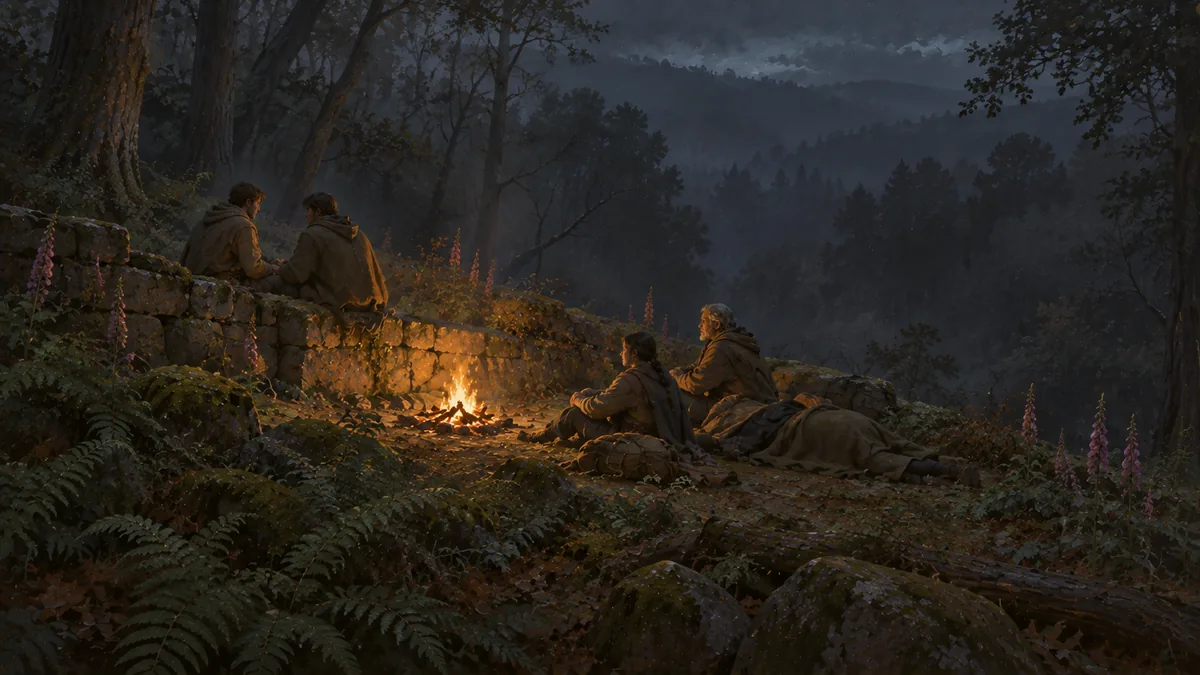
The Fallen Wall
Lio kept hold of his hand.
He had held it out to help his brother up, and Taren had taken it, as you take a stranger's hand at a fair. Now neither of them moved. Taren's fingers were cold. They lay loose in Lio's palm, waiting to be given back.
"My name's Lio," Lio said. "I'm your brother."
"Are you?" Taren studied his face again, looking for a likeness and sorry to come up empty. "I'm sorry," he said. "I don't seem to—" He smiled. "I'm sorry."
Behind them Lio heard the others come up the slope and stop. He heard Sil say something under her breath in Western, and Garrow say, "Yes," and Brannoc's pack go down on the moss.
"We'll camp here," Lio said, without turning round.
"Aye," said Brannoc.
He heard them begin to make the camp. Brannoc broke deadwood off a fallen limb, and Sil scraped a hollow in the moss for the fire in the lee of the wall. Garrow was set down somewhere and told to sit, and sat. Lio stayed where he was, standing over his brother, holding his hand. He could not think what else to do with it.
When the fire was going, Brannoc came over and crouched at the end of the wall with his forearms on his knees. In the new firelight his face was all hollows.
"I can sit with him," he said. "If you'd rather. I've done it the once."
"I know you have."
"It took all night, with Garrow, and I'd known him since we were lads."
Taren nodded to him across the stones, as to a neighbor met on the road.
"You've known this one since you were born," Brannoc said. "It's yours to do, if you'll do it. But I'll spell you, if you want spelling."
"I'll do it."
Brannoc got up, with a hand on the wall. Before he went he put his hand on Lio's shoulder. It was a heavy hand and it did not stay long.
"Then I'll keep the fire," he said.
Lio sat down on the wall beside his brother.
The stones were cold through his trousers, and a foxglove was growing out of a crack between them, and he moved over so as not to crush it. Taren watched him do it and nodded, as if he approved. The fire threw their shadows out long across the fern behind them, down the slope toward the river. Beyond the fire Sil sat with Garrow, wrapping a blanket round Garrow's shoulders. Beyond them there was only the gray, darkening into night.
"You asked Father once," Lio said, "why the river runs brown after rain and clear after a frost."
Taren turned his head toward him.
"You were seven. I was three, so I don't remember it, but Father told it at supper for years after. He said he didn't know, and you asked him why he didn't know, and he said nobody knew. So you said you'd find out. You went down to the ford in your nightshirt in the middle of February, at dawn, because you said that was when the frost would be thickest. Mother found you there with your feet blue, sitting on the bank with a jar of river water on each side of you, one from before sunrise and one from after." He swallowed. "She carried you home under one arm. You were shouting the whole way that you weren't finished."
Taren listened with his hands loose in his lap. Lio went on to the bridge. He told him how Father had built it the year Lio was born, across the millstream behind the house, heavy timber on stone footings, wide enough for a laden barrow. He told him about the rails worn smooth by every hand in the family. And he told him about the left-hand rail. A boy of nine had once spent a Sunday afternoon there with a stolen chisel, carving his initials, deep and crooked.
"Father found you at it," Lio said. "He took the chisel off you and tanned you with his belt, the only time he ever did. Then he went and looked at the letters. And he didn't plane them out. He planed that rail the next spring, every inch of it, and he went round the letters. They're still there. I put my hand on them every morning going over." He looked at his brother. "You told him it was so the bridge would know whose it was."
"That was cheeky," Taren said.
"It was. He laughed about it after, when he thought we couldn't hear."
Taren seemed to think it over. The firelight moved on his face.
"You're very good to tell me all this," he said. "Which one was I?"
Lio sat with that while the fire burned. Out in the gray something moved in the fern, a small thing, and was gone. He put his free hand flat on the cold top of the wall and pressed it there, hard, until the moss was wet under his palm and he could breathe.
Across the fire Brannoc kept his eyes down, on the flames.
"Keep on," he said, to the fire.
Lio kept on. There was nothing else to do with his hands, or his mouth, or the night. In Sarne, at a long table with the windows open and the gulls going over, Taren had drawn the bend in Ambrose's wall from memory without a line wrong. That had been ten days ago, or a month, or a season, depending on whose days you kept. Now the same hand lay in Lio's, cold and willing, and did not know whose bend it was, or whose wall, or whose brother was holding it.
Late in the evening Taren stood up, without any fuss. He took his hand out of Lio's, quite gently, and got to his feet, and began to walk out past the end of the wall into the dark.
Lio was up after him. "Taren. Where are you going?"
"I don't know," Taren said over his shoulder, as if it were a fair question. "Over there, I think."
He kept walking, slow and easy, out of the firelight. The fern swished round his knees. His hands hung loose at his sides with the fingers open, as if he had put something down and forgotten to close them. He walked as a leaf goes down a gutter, because that was the way the ground ran.
Lio caught him at the edge of the light and took him by the arm. Taren made no move to pull away. He only kept walking, with no will in it and no stopping either, and Lio had to set his heels in the moss and haul. They stood braced against each other at the edge of the dark. Lio could feel the gray beyond them drawing, soft and steady, as the millrace draws at your legs when the sluice is up.
"Sit with me," Lio said. "Please. Come back and sit with me."
Taren frowned, puzzled, but he let himself be turned. They walked back to the wall together and sat down. Across the fire Sil was on her feet with her crossbow in her hands, staring into the dark where Taren had been going. Brannoc reached up and pressed her arm down, and she sat.
Lio took his brother's hand again and held it hard. When he could speak, he did not give him the jars again, or the bridge. He gave him the shoulder of the hill.
"The winter you were fourteen," Lio said, "you woke me in the middle of the night and made me put my boots on over my nightshirt, and we went up the timber track in the snow to the shoulder of the hill. Every window in Thornby was lit for the Midwinter feast. You said, Look how small it is. And I said, Look how much of it there is." He looked down at their two hands on the cold stone between them. "Every other time you asked me to come, I said no. I said there was enough to do on this side. I'm still saying it. And look where I've come."
Taren watched the flames and gave him nothing back.
The cold came down out of the trees after that.
The cold of the gray was damp and settling, and it found its way into Lio's back and his knees and the bones of his hands. He stayed on the wall. Brannoc came once and laid a blanket over Lio's shoulders and another over Taren's, and went away again. Garrow slept, curled on his side, with his face as smooth as a child's. Sil sat awake with her crossbow across her knees, and when the fire burned low she was the one who fed it.
Toward midnight the gray came closer.
He never saw it come. For a while he had been listening out past the fern for the mill Garrow had followed, though there was nothing to hear. When he looked up from his brother's hand, the fern beyond the fire had gone, and the slope with it, and the light of the flames ended a yard past Sil's boots against a soft wall of nothing. The far end of the fallen wall had gone into it. He could see the stones running away from him, moss and foxglove and moss, and then he could not see them at all. Sil had drawn her feet in under her.
He had let go. All evening he had been giving his brother the jars and the bridge and the snow, and while he gave them away he had not been standing on any of them. Then he had gone listening after what the gray held out. He shut his eyes and took hold of home again, for himself this time. He took the cold of the race on his thighs on the morning after the storm, and the wheel turning through the bedroom wall at night. He took the third plank of the footbridge, where his foot always found the knot. When he opened his eyes the fern was back at the edge of the light, and the far end of the wall with it, gray and mossed and solid.
Brannoc had not moved from the fire, but Lio heard him let out his breath.
"Both," Brannoc said across the flames, low. "You hold both, or you lose the pair of you."
So he held both, home under his feet and his brother's hand in his, and he did not dare put either of them down. He tried to go on talking. He began on the timber hauling in the Margin, the long winter days with the snow on the stacked beech logs, and nothing came but a croak. His voice had worn down to nothing in the first hour after midnight, and he sat with his brother's hand in his and his throat raw, and could not say another word.
"Captain," Taren said.
Lio turned his head. Taren was gazing at the flames, and his lips were moving, as if he were trying a word out to see if it fitted.
"Father's horse," Taren said. "Old Captain." He frowned harder. "He wouldn't cross the bridge at Wexley." His voice trailed away, unsure whether he had dreamed it or lived it, and his face smoothed over again like a pond after a stone.
Lio could not speak, so he did the only thing left to him, and began to hum.
It was Gran's tune, and it came without his choosing, out of his chest, where it had always been. She had hummed it over his sickbed when he was small, long before he knew it had words. It came out of him tuneless and very quiet. He hummed it through once. Across the fire Brannoc had lifted his head, and in the dark beyond the light Sil was sitting up with her blanket round her.
He started it again from the beginning. It went out from the wall into the dark, thin as it was, and the gray at the edge of the light seemed to lean in toward it and listen. Lio kept on. Halfway through the second line, Taren began to hum with him.
He was flat. He had always been flat. He had been flat in chapel every Sunday of his life, loud and cheerful, and Edda had sung louder beside him to cover it. He hummed beside Lio on the fallen wall, a little behind and a little flat, with his eyes on the fire, and they came to the end of the tune together.
Taren was frowning, a small, real frown, a line between his dark brows that had not been there all day. He turned on the wall and looked at Lio as if Lio had dropped something and he wanted it back.
"Who taught you that?" he said.
"Gran," Lio whispered. It was all the voice he had.
Taren said it after him, slowly, the way Garrow had said his own name at the stream. "Gran."
Lio saw it happen. It came up into his brother's face slowly, from deep under: first nothing, then something, then a thing he knew. The patience left Taren's eyes. Something quick and dark came into them, and looked out, and saw him. Taren looked at Lio's hair, and his coat, and his cracked lips, and the hand holding his own on the cold stones of the wall.
"Stay-at-home," Taren said.
Lio bent forward over their two hands and could not lift his head.
He felt Taren's arm come round his neck, rough and sudden, pulling his head down against his brother's shoulder and holding it there. Taren's coat smelled of smoke and moss and sweat. Across the fire Brannoc bent his head over the embers and kept it there.
After that Taren asked questions.
He asked them hoarsely, one on the heels of the next, with his arm still round Lio's neck. Where were they? Whose fire was that? Was that Garrow, lying there, the Garrow from the chimney? Where was Mara? How long had he been sitting on this wall? Lio answered what he could in a whisper, and Taren bent his head to hear.
Then Taren looked across the fire at Garrow, asleep on his side with his hands folded under his cheek.
"He told me it got easier," he said. "It did, Lio."
"You asked who taught me the tune," Lio whispered.
"I did, didn't I." Taren gave a short, shocked laugh. "I asked." He was quiet a moment. "Will he come back?" he said to Brannoc. "Like this?"
Brannoc turned a stick over in the embers. "He's come back some," he said. "His name. Lisle. That's new since the chimney."
"Mother," Taren said at last. "What did she do? In the winter. You never told me, in Sarne. I never asked."
Lio told him, in a voice like a saw in green wood.
He told him about the fifth plate. Every night all November their mother had laid it, the brown plate with the crack in the glaze, across from Lio in Taren's place. On the last night of the month she had stood with it in her hand, and put it back on the dresser, and after that she did not lay it again.
"I did your work all winter," Lio said. "I did it badly. I kept turning round to say something to you."
Taren's arm was tight round Lio's neck.
"I'll make it up to her," he said. "I don't know how. I'll find out."
Sil came round the fire then with a cup of water and put it into Lio's hand. He drank it straight down. She sat on the end of the wall on Taren's far side, with her knees drawn up and her arms round them.
"Before I ran," she said to Taren, in the eastern tongue, "the drafting room had a story going round. An eastern boy who learned his Western off the fishwives on the harbor wall, and said one of their words to Dane at his own table." Her mouth twitched. "I never believed it till tonight."
"What did I say?"
"I'm not telling you in front of your brother," said Sil, and went back round the fire to Garrow.
Taren laughed, too loud for the gray, and let it ring.
They sat on the wall a long while after that, with the blankets round them and the foxglove between their boots. The fire burned down. Toward morning Taren stirred and spoke, very low, against Lio's hair.
"The old pear tree by the dairy," he said. "Did it come through the storm?"
"Come home and look," said Lio.