The Ford
The wind went round into the east in the night, and Lio heard it go.
He heard it in the old pear tree by the dairy, which had quit scraping the wall and begun to sigh against it from the other side. He knew what it meant before he had his boots on. It was the wind Crane had been waiting for since the hearing, and it was Thursday, the third of September. It would carry fire west, away from the valley and into the trees.
He went out without a light into a yard gray and cold, with the stars going out over the eastern hills. Across the cobbles Edda's blue door stood open, and there was a candle in her window among the geraniums. She was sitting on her step in her good shawl, waiting.
"Wind's turned," she said.
"I heard it."
"Go on, then." She stayed where she was. "I'll be at my gate."
Taren came out of the house behind him with the key of the bell-tower on a string round his neck and the oilcloth bundle under his arm. He sat on the mounting block to pull his boots on.
"When Brannoc comes down," Lio said. "Not before."
"I know." Taren stamped into the second boot. "Like the place is on fire. The parson can shout at me after."
Sil and Brannoc were at the fork before him. The two of them stood in their coats looking down the left-hand path toward the gully.
"Crane's out," said Brannoc. "Twenty men along the top of Ambrose's pasture. Torches not lit yet. Pitch on a sledge."
"Did he say anything?"
"Good morning." Brannoc's breath smoked. "Your father's there. Gideon Marrable too. They carried his stool up for him."
"Listen," said Sil.
It came up the gully from the west, under the wind in the beeches. It was a voice, low and steady, speaking in the old speech. Lio heard the words before he understood them, and when he understood them the cold went down his back.
"By the white ring-stones where the ferns grow deep," said the voice, "the mill with no water, the hall with no roof."
His grandmother's song, in a stranger's mouth, in the wrong order, going the wrong way.
Sil went down the path to where she could see the gully floor. Lio went with her as far as the edge of the beeches, and no farther.
A way ran through the gully now. It came out of the western beeches and down past the gray hull of the wreck, a pale trodden path no wider than a cart's axle, with the ferns waist-high on either side. In places the edges wavered, and the path went thin, and the bracken leaned in over it.
"Song-held," Sil said. She pressed her palm to the ground at the edge of it. "It'll bear feet and mules."
They came up out of the gully single file, because there was no room for two.
The road-walkers came first, six of them in gray cloaks, each with a hand on the shoulder of the one in front. The leading walker held a book open before her and read from it as she went, line by line. It was a small book with a green cover gone dark at the corners. Lio knew it before she was near enough to read. He had watched it come out of Rupert's coat at every fire from Thornby to the sea. As she passed under the wreck the page lay open toward him, and he saw the hand on it, small and running, leaning hard to the right.
Each line she read came up through the roots into the soles of his boots, a soft tread pressing the gully firm, and it was Rupert's hand doing it, every yard of the way that Rupert had written down.
He found he had his fist shut on the bark of the beech tree beside him, and he could not open it.
Brannoc had come up at his shoulder. He watched the green book go by under the wreck.
"That's mine as much as his," Brannoc said.
"Aye," said Lio.
Behind the walkers came a square heavy man in a blue coat with a map-case over his shoulder. Osric Dane, the master of the Survey's road works, walked as if the ground owed him money. A dozen Survey men followed with pack mules loaded with stakes and red-painted rods.
After the mules came riders, leading their horses, because the path was too narrow and soft to ride. A tall man walked at their head, leading a bay with a white blaze. Twenty men came behind him with pikes and crossbows and leather jacks under their cloaks. The tall man had a long leather case slung across his back. He had silver at his temples, and he was looking about him at the beeches with frank, warm interest, a buyer at a house he has been told about for years.
Lio had first seen that face across a wedding table under a vine. He had seen it since in a crowded hill farmyard, with a widow's children hanging on its owner's coat. And once at a wall in the hills, alone with him, asking him to name a sum. It was Aldous Stroud, who held the old deed to the Ashby house.
Last of all came a white-nosed mule with an old man on it in a black coat, and a young Survey man at its head.
Hollis Lorne, Gran's brother, rode badly. He sat the mule like a sack of meal, with his bad leg stuck out stiff, and he was looking up at the wreck. The whole party had to pass under its broken nose. Hollis turned his head to keep the place where the heron had been in sight until the beeches took it.
"Go down," Lio said to Brannoc. "Tell Crane forty. Tell him there's an old man with them. Then tell Taren."
Brannoc went down the track at a run.
The road-walkers halted at the fork, and the song stopped with them, and in the quiet Lio heard the wind. Dane came up past them and looked at Lio, and at Sil, and his heavy face darkened.
"Ashby," he said. "And my deserter, with my plans copied in her book." His eyes went back down the gully to the pale path wavering through the ferns, and came to Sil, one surveyor to another. "I had a chain on that from the wreck at first light. I couldn't get the same figure twice. It moves under the chain."
Stroud had come up behind him with his horse. Dane kept his back to him.
"Had Ashby here sung it home, I'd have had wagons on it by July. Nobody from this end walked it. It's a sheep-track with a song on it." He spat into the bracken.
Beside Lio, Brannoc let out a long breath through his nose. His shoulders came down, the way they came down on the ferry when the boat slid off the current into the still water under the stairs. He kept his eyes on Dane. So did Lio. Nine days in the gray, and seven weeks gone, and Taren nearly lost on a fallen wall. That was what a sheep-track had cost, and Lio would have paid it again.
"It brought us," said Stroud. He smiled at the sight of Lio. "Master Ashby. I hoped it would be you. I said I'd stand in that yard one day." He glanced down the track toward the light. "Is it far, now?"
"Not far."
"Lio," said Hollis, from the mule.
His face was gray with tiredness, and something burned under the gray.
"I have come a very long way," Hollis said, "on a very disobliging animal, to ask you a question I find, now I am here, I cannot bring myself to ask."
"She's well," Lio said. "She's at her gate."
Hollis shut his eyes, and sat the mule with them shut.
Crane's men were strung along the top of Ambrose Pennock's pasture, where the last trees of the Margin stood against the sky. They had the torches lit now. The flames streamed out sideways in the east wind, toward the wood, and the sledge stood behind them with the pitch-barrels lashed on it and their lids off.
Crane stood in the middle of the line in his black coat. Owen stood a few yards in front of him, between the torches and the trees, with his arms at his sides. Gideon Marrable sat at the north end of the line on his stool, wrapped in a horse blanket, with his stick across his knees and the bracken at his back.
The westerners came out of the trees behind them, and the riders' pike-heads came out with them, and the line of torches wavered.
"Fire it," said Crane.
The men at the north end put their torches to the bracken.
It was September bracken, brown and dry as paper. It took at once. The wind laid the flame down flat and drove it in under the beeches, and a sheet of fire ran along the edge of the wood with a sound like a sail filling. Smoke rolled back over the pasture. The westerners scattered from it along the trees, and a horse screamed.
The fire ran south along the edge, faster than a man could walk. It came to Gideon's stool. The old man was trying to get up, and his knees would not do it. Owen got there first. He took Gideon under the arms and hauled him back out of the smoke, stool and all, and the stool went over in the burning bracken. Owen kicked it clear. The legs were black and smoking.
"Beat it out!" Owen roared. "Sacks! Get it out!"
Men ran with sacks and green boughs. They beat at it along the edge, coughing, until the flames sank to a red crawl, and to smoke. When it was out a strip of the Margin lay black from the stile to the cherry trees, a stone's throw deep. Three young beeches stood in it with their leaves gone brown and curled. Owen had thinned those beeches himself. The fine ash blew off the strip in gray flakes and went away west into the wood.
Owen walked down the line to Crane, black to the elbows, and took the torch out of his hand. He turned it head down and ground it out in the turf.
"That's what it does," he said.
Crane stood with his hand empty. Gideon sat on the grass beside his scorched stool, coughing.
"You'll light me first next time, Arlen," Gideon said, when he could. "I'll not get up again. I've not the knees."
"Above the hill farms in Sarne there's a hillside they fired for the grazing," said Lio. "I stood under it in May. It went gray inside two summers, and now it's coming down on the farms." He pointed at the black strip with its three dead trees. "Your father's hill grew bracken, reeve. That won't."
"He's right." Mara had come up the pasture from the orchard behind Ambrose and Rose, in her borrowed brown dress. Lio saw it go along the riders: Mara Vey, in a farm-wife's dress, on the wrong side of the line. "I've walked the edge of that hill. Burn this, and you'll have the Heart at your back doors by the time that child's grown."
Crane looked at her, and at Owen, and at the old man on the mule among the westerners.
"Nobody lights," he said. "Not yet." He turned to Stroud. "And what is it you want here, sir, with twenty men under arms in my district?"
"Nothing you need burn a wood over." Stroud unslung the leather case and drew out a long roll of yellowed parchment with a seal hanging from it. "A bound. My family's deed begins at a stone by a ford. In a case in Sarne it's ink. It has to be read at the stone, by one of the name, or it's nothing. That's why I came myself."
"There's no stone at the ford," said Crane.
"There is," said Lio.
He took them down by the field track below the pasture, because Crane would not have western horses in the Thornby yards. Crane walked at the head of them with Lio, in his black coat with the soot on it, as the reeve of Wexley district walks the bounds of a parish in dispute. He had promised Lio that much the evening before, in his own kitchen at Wexley, and he kept it. From the track, across the stubble, Lio could see the backs of the houses, the Ashby roofs and the dairy and the yard. At the edge of the cobbles, small and straight in a dark shawl, a figure stood at a gate.
Hollis was looking at the river, and did not see her.
Down in the village the chapel bell began to ring. It went on ringing, quick and uneven and much too loud, as Thornby had never heard it rung, and the doors opened up and down the street. By the time the westerners reached the valley road, half the village was coming down it behind them.
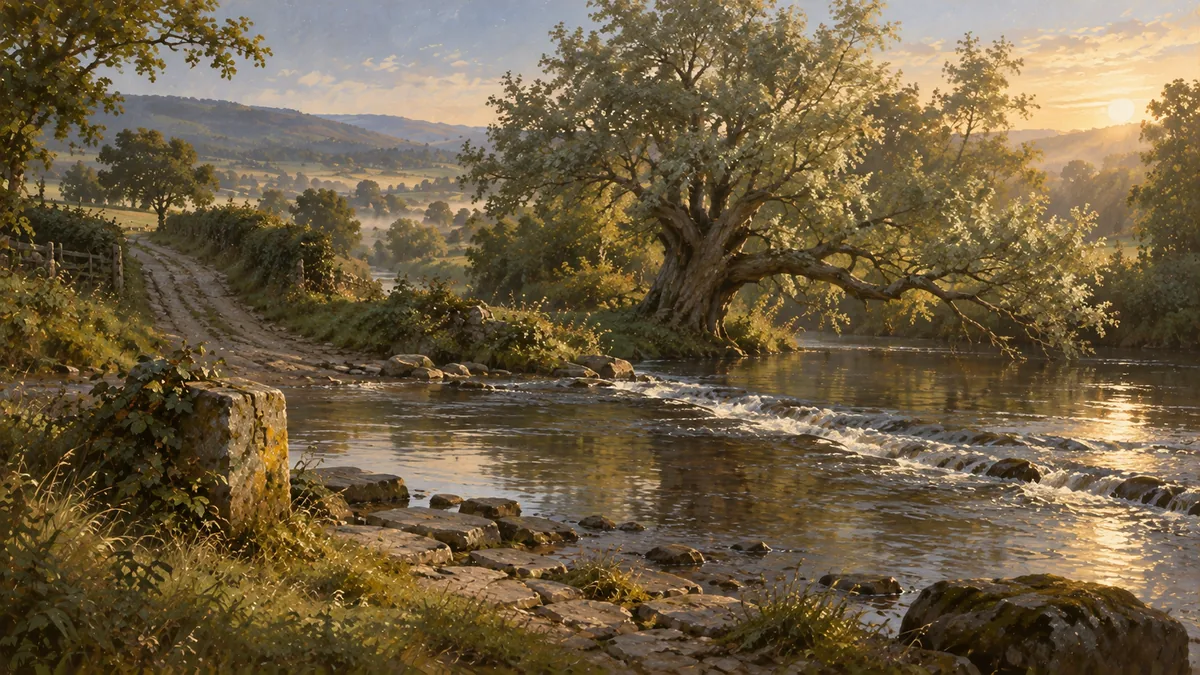
The ford lay in the first sun. The east wind had wrinkled the water above the riffle, and the old ash tree on the far bank was tossing its leaves, gray side up. The riffle ran slantwise from the near bank to the ash, a quick broken chatter over gravel. Along the near edge lay the stones Lio had crossed on since before he could walk.
The stone stood on the near bank where it had stood since August, knee-high in the long grass, with the bramble over its shoulder and the lichen gold on its top.
Stroud gave his reins to a rider and went to it. He had been told about this stone all his life, and here it was in front of him, and he had to put out a hand. He laid it on the lichen.
"So," he said softly. "There you are."
The villagers had come down the slope and stood along the road above the ford. Bet was there, and Ambrose Pennock on his stick with Rose by the hand, and Ned Cotter the smith, and the miller, and Will Snape the trapper. Joss Hobb had come down behind them with his cart, because it was Thursday. Brannoc stood at the water's edge between the riders and the villagers, with his hands empty and Garrow at his side, fetched down from Coldharbour the evening before. When the crowd pressed down the slope, one of the young crossbowmen brought his crossbow up. Brannoc looked at him.
"Put that down, lad," he said. "There's children."
The boy looked to Stroud.
"Put it down, Pym." Stroud did not raise his voice, or turn from the stone. "I didn't come all the way through the gray to shoot a man in his parish. A dead man holds no ground for anybody. Not here."
The boy put it down. Taren came last, running from the bell, with the oilcloth bundle clamped under his arm. He pulled up beside Lio with his chest heaving.
"Dry," he said, and patted it.
Stroud turned from the stone with the deed in his hands, and looked for Lio, and found him.
"I asked you first, above Sarne," he said, "and you told me no. I'll ask you once more, here, where it'll cost you least. Your grandmother's song brought us to this water. Say the bound with me, here at the stone. Name your sum after, and I'll pay it, and you'll farm here under me as long as you like, you and your father both."
"No," said Lio.
Stroud regarded him with real regret.
"Then I'm sorry for it," he said, and unrolled the deed.
He read it aloud in the old speech, slowly, turning so that his riders could hear.
"From the stone at the ford of Amberlow," he read, "north by the water to the mill-leat. West by the leat to the house tract, and the house tract whole, to the edge of the wood—"
"That's our millrace." Taren had come forward a step. "Father dug that. And the house tract, you mean our house, you're reading out my mother's kitchen in front of her—"
"Taren," said Bet.
Stroud read on. "Held by the house of Stroud of old right, before the wood, and to be held while any of the name remember it."
Behind him the riders took it up. They did not read it. They said it, all together, flat and hard and in step, as men say an oath on a parade ground. From the stone at the ford to the leat and the wood. They had it perfectly. They had learned it as boys in the Archive schoolroom, to the skipping tune Hollis made for it, and the tune was gone from it now. Only his cadence was left, and every one of them leaned on the word ford as he did.
Stroud set his hand on the stone. "Amberlow," he said.
The lichen moved. It shrank back from the letters, the gold patches drawing in on themselves like water drying on a hot stone, and under it the letters came clear. The edges of the cuts went crisp and pale. The bramble on the stone's shoulder slid back and dropped into the grass.
And the ford changed.
The riffle's voice went first, its quick broken chatter dropping deeper. The water above it darkened and slowed and gathered itself, and the white line of the shallows slid downstream. Where Bet's washing stone had lain was dark water, moving smooth. Dane had gone down to the edge to look, and the gravel went out from under his good boots. He stepped back with the river over his boot-tops and stared at his feet.
Rose had let go of her grandfather's hand. She had gone down the slope to the round stone at the water's edge to see the westerners better, and was standing on it. Then the round stone was gone, and Rose was in the river to her waist with her mouth open and no sound coming out, and the current had her skirts.
Bet went in after her before anyone else had moved. She got her by the collar and hauled, and came back up the bank with the child streaming against her.
"You'll drown her for it?" she shouted at Stroud. "For your bit of paper?"
Stroud looked at the child in Bet's arms, and his face cooled and closed. He turned his back on them both.
"Read it again," he said to his riders.
On the far bank the ash tree had changed. The bark was smooth and pale, the bark of a young tree, and the great low limb was gone, the limb Lio had fallen from at eight and broken his wrist. A clean young branch grew in its place, pointing the wrong way.
"Aldous," said Hollis. "Stop."
Stroud never looked round. He said the bound again with his hand on the stone. His riders said it with him, louder, because they were frightened and it was the only thing they had to say.
Lio went down to the water's edge and crouched and put his hand in the river.
The Lenn closed on his wrist, colder than any river had a right to be in September. Under his palm the current was wrong, pulling at him from a new direction, and the gravel had gone out from under his fingers. Up on the road the whole village stood where he had asked them to stand, and Crane was to call them now, one by one, as he had promised. But the river had Rose's wet skirts in it, and the ash was a stranger's, and the longing came up in his chest before any name could. He had felt it once before, in the gray, walking toward a mill.
He could reach with it, and he knew it. He could make the ford deep, so deep no wagon would ever cross it. He could make the stone gone, and the ash so great that the West would never look at it and call it anything but Thornby's.
He reached, and the water round his hand turned. It ran the wrong way round his wrist, upstream, curling back on itself in a slow bright coil. On the far bank the young pale ash shuddered. Its bark went dark, and ridged, and went on thickening, past the ash Lio knew, past any ash. A limb came out over the pool, low and heavy, and another came out beside it that had never been there at all.
Garrow had turned toward it. He went down off the bank into the river with his face lifted to the black tree. He went as Lio had seen him go barefoot through the gray, toward a mill that turned for no one. The water was at his knees, and then his thighs. Brannoc went in after him and took him by the collar and dragged him back, and Garrow came without a struggle, still looking.
"Lio." Taren was crouched beside him, with his free hand on Lio's shoulder, hard. "Lio. Don't."
Lio looked at the ash. It was huge and black and wrong, and it was his. Then he saw the bundle under his brother's arm. The oilcloth had come open at one end, and he could see the edge of a map, and a river on it bending the wrong way.
He took his hand out of the river.
"No," he said aloud, to Taren, to the water. "I'll not make it. I'll keep it."
He stood up and turned, not to the road, but to the man in the black coat.
"Reeve," he said.
Crane came down to the stone. He stood beside it with his hands behind his back, as he stood in the hall at Wexley when two men had quarreled over a hedge. He lifted his voice over the riders.
"This is a bound in dispute," he said, "and I'm reeve of this district, and I'll hear the parish on it. Them that know this ford, speak to it, and speak what you know. Not what you've been told." He looked up the bank. "Bet Ashby. What lies at the edge of the water?"
"The flat one's where I beat my sheets." Bet had not let go of Rose. Her voice came down the bank as it came across the yard at milking. "Twenty-five years. It's pale with the soap. It rocks. You put your weight on the left."
"Rose Pennock," said Crane.
"The round stone's for boots!" Rose was shouting, soaked and furious, from under Bet's arm. "It's for taking your boots off! Everybody knows!"
"Ambrose Pennock."
"My flood," said Ambrose. "Year I was twelve. Up to the fork of the ash, and my father cut the mark on the bark with his knife. It's there yet." He banged his stick on the road. "It's there yet, I tell you."
"Lio Ashby."
Lio crouched again and put his hand back in the water, flat, and said his own.
"The riffle runs slantwise. From the washing stone to the ash. Knee-deep, if you don't know where to put your feet. The ash has a low limb out over the pool, split near the trunk where it threw me off at eight. The drovers rest their hands on the bark by the road, so it's smooth."
"He broke his wrist." Taren had not let go of his shoulder. "I carried him home. He cried the whole way."
"You cried," said Lio.
"I cried more."
Somebody on the road laughed, and Crane let it go by.
Garrow stood dripping beside Brannoc, looking down at the river.
"A heron," he said. "Stands below the stones. Mornings."
"There is," said Brannoc roughly. "There is, lad."
"Mara Vey," said Crane. It came out of him hard, a reeve calling a westerner to speak in his parish.
She walked down into the ford. She went past him up to her knees in her borrowed dress, into the dark water where the riffle should have been, and turned round to face the road-walkers on the bank. They were her people. Lio saw them know her, all six.
She spoke to them in Western first, a few quick words. Then she changed to the old speech, so that the valley could hear it too.
"The orchard above is Pennock's," she said. "An old man prunes it, who talks to the canker and plays deaf to boys in his trees. There's a pear tree he'll not cut, because his wife planted it. That child climbs it. And there's a pig nobody wrote down. Her name's Duchess. I walked the bounds of it at his heel, and he says them better than the deed. I'm telling you what's here. Hold it so."
The road-walkers fell silent one after another, and stood on the bank in their gray cloaks. The one with the green book closed it on her finger.
Sil came down beside Lio and stood with her boots at the water's edge.
"Thornby ford," she said, clipped and steady, a surveyor calling the chain. "Bearing from the ash to the mill chimney, west of north. Riffle on a line from the washing stone to the ash. I chained it in August. Two feet at the riffle. Three in the pool."
"Sil," said Dane.
"I chained it," said Sil, and kept her eyes on the water.
Under Lio's palm the current eased. Out in the dark water a white line showed, and wavered, and held. The riffle's voice came up out of the deep water, uncertain and then sure. The washing stone rose at the edge, wet and pale, rocking as the current found it, and the round stone came up beside it. Rose shrieked and pointed.
Stroud lifted the deed high and flung up his free hand to the riders. "With me," he said. "All of you. As you were taught."
They came in on the word. Twenty voices, all together now, hard and quick and frightened, with the old man's cadence on the last word of the line. Lio felt it in the river before he heard it. The pull came back into the water from the far end, harder than before, and hauled at his wrist. The white line broke up and slid away downstream. Water lipped over the round stone, and it was a dark shape, and then no shape. The washing stone's pale edge went dark. Up on the road the voices faltered, and people looked at one another.
"Keep on," said Lio. "Mother. Keep on."
Bet said her stone again, hoarse, and it went under as she said it.
Stroud turned from the stone, breathing hard. He was not smiling now.
"Hollis," he said.
The old man sat his mule at the edge of the road, with the young Survey man at its head.
"They learned it from you," said Stroud. "You stood in your schoolroom all spring and taught it to these boys line by line. In their mouths it's a lesson. In yours it's the bound, and the bound's yours to swear to, for you made it." He held up the deed. "Say it with them, and it's settled."
"Aldous, there is a child—"
"There's a child in every house in the hills above Sarne, waiting on this ford." Stroud's voice stayed courteous, and his eyes did not. "Corren Tull is in the watch-house in Sarne on my word. Say the bound and he's home to his children."
At the water's edge Brannoc's head came round at the name of his old friend from the lost twelve. His hand went to his chest, where the compass hung on its cord under his shirt, and closed on it. He stayed at Garrow's side.
Hollis got down from his mule. He did it badly, because of his knee, and Taren went up the bank and gave him an arm and brought him down to the water's edge, beside the stone. Lio, with his hand in the river, saw him draw breath. He saw the old cadence come into the old man's face, the one he had made at his desk for children to skip to, and his lips part on the first word of it.
Taren put the bundle into his hands.
"From Lio," Taren said. "He says read the top one."
The oilcloth fell open. On top of the maps lay a small sheet folded once. Hollis unfolded it. He knew the hand before he had read a word: quick and slanting, the hand in the margins of the left-hand map.
"Mother," said Hollis.
He read it to himself, his lips moving. The riders' voices went on round him, hard and level, his cadence in twenty mouths. He read it again, and lifted his head.
He stood holding the sheet. Under it the two maps lay one over the other across his arm, the two rivers bending opposite ways.
"I wrote those words for children," he said. "I will not swear to them."
"Then Tull stays where he is," said Stroud. "And you're finished in Sarne. There's not a door on the hill will open to you after this."
"Yes," said Hollis. "I expect that's so."
Behind him the riders' bound came apart.
It did not end all at once. It went thin and ragged. One voice and another lost the line and could not find it again. Two of the young men were still moving their lips, staring at the old man's back, and nothing was coming out.
Lio felt it go under his palm. All that while the river had been hauling at his arm from the far end. Now the pull went out of it, as a rope goes slack when the men on the other end let go.
"Reeve," he said. "Again."
"Bet Ashby," said Crane.
"It rocks." Bet's voice came down the bank, hoarse and furious, the voice that ended quarrels. "The flat one. Put your weight on the left, I said. Twenty-five years I've said it."
The washing stone came up out of the dark water, pale with soap, and rocked.
"The round stone's for boots!" Rose had got loose from Bet's arm and stood on the bank with her wet skirts in her fists. "For boots!"
The round stone came up beside it, and the river ran off its back and left it dry.
Ambrose banged his stick on the road and told the river his flood was there yet. At the edge of the crowd Joss Hobb's mare looked at the sharp stone and stepped down to it to drink.
"Owen Ashby," said Crane.
Owen had come down from the fire. He walked through the crowd on the road and down the bank to the water, black to the elbows, and stood beside Lio with the river at his boots.
"Long stone under the ash," he said. "I set it."
Out by the far bank a long gray back came up through the dark water, square to the current, where it had lain since the spring Lio was born.
The riffle came back, and this time it stayed. The white line ran slantwise from the washing stone to the ash, where it belonged, and Mara stood in it to her shins. On the far side the ash came down to itself. The swollen trunk drew in, and the second limb, the one that had never been, thinned and was not there. The bark went gray and deep-ridged, the bark Lio knew. The low limb lay out over the pool where it had always lain, with the split near the trunk. On the bark at the fork was an old knife-cut, made in a flood sixty years gone.
The lichen was coming back over the stone. It crept in from the edges, gold and gray, and the crisp cuts softened under it and went blurred and old. The stone stood where it was, square and knee-high in the grass at the head of the ford, and it would stay, because the valley had remembered it now: a kept stone, and no longer a made one. But the word on its face was going under the lichen as Lio watched, until only the first letters showed, faint, and the rest was gold.
Stroud had felt something. He bent over the deed in his hands, and unrolled it to its end.
Lio was near enough to see. The first lines were black and clear. Below them the ink had gone brown and soft and run into the grain of the parchment, word into word. The bound of the house tract was a pale smear with nothing in it to read. Stroud began to read it aloud, and broke off after three words, and could not go on.
"It was copied in the Archive," he said. "From the original. I watched it done."
Dane came up from the water's edge with his boots full.
"That bank went out from under me," he said, "and then it came back." He turned to his men by the mules. "The Survey doesn't build on ground that moves. Pull nothing out of those packs. We go back in the morning."
The Survey men looked at one another, and at Stroud, and began to turn the mules.
Stroud rolled the deed slowly, as carefully as he had unrolled it, and put it back in its case and buckled the flap. His eyes went past Dane to the roofs of Thornby and the orchard going up toward the wood.
"It's a beautiful place," he said. "I knew it would be."
"Take your paper home, Aldous." Dane's eyes had gone past Stroud, across the water to Lio, and the stone, and the people on the road. He looked at them as he might look at a bank he meant to come back and cut. "There's four hundred families in the hills with deeds, and the next of them won't come forty strong. Let them come and read this one if they can."
Stroud gave his reins to the nearest rider and walked away from them all, up the road to the orchard path, and they let him go. Lio went after him.
He found him at Father's bridge. Stroud had knelt on the planks with the long case beside him, and his hand was on the left-hand rail, over the place where Taren had cut his initials at nine. He was weeping. He did it quietly, with his head down, and he made no attempt to hide it. Under him the millstream ran quick and brown toward the wheel.
Lio stood at the edge of the orchard and let him be.
After a while Stroud got up and brushed his knees. He saw Lio, and was not ashamed. He bowed to him, very slightly, and went back down through the apple trees. At the ford he took his reins and mounted, and turned the bay's head up the valley road toward the wood. His riders went after him, and none of them looked back.
When Lio came down to the water again, the road-walkers had not yet followed. The eldest of them, a lean gray woman with a staff, came down to the water's edge where Mara stood wringing out her skirts.
"Next year," the woman said, in the old speech. "If the Survey comes back, and these people say yes to it. You know the gray, Mara. You came through the Heart and out. There's none of us knows that way but you." She held out her hand. "Walk us."
Mara looked at the hand, and left it where it was.
"I know the way," she said. "That's why I'll not."
She wrung the last of the water out of her hem and went up the bank, and halted in front of Ambrose Pennock, and spoke loud enough for the road to hear.
"Ambrose Pennock. You've a roof at the top of your pasture standing empty since your wife died, and more ground than you can work." She kept her back to the road-walkers. "There's a widow with five that wants a chimney that draws. Will you hear her for a tenant?"
Ambrose took his pipe out and looked at it.
"Can she prune?"
"She'll learn." Mara looked round at Lio.
"Her name's Ruth Cardew," said Lio. He had seen her in the crowded farmyard above Sarne, with the baby pulling at her hair.
"Then she can come and ask me at my door," said Ambrose, and put the pipe back.
Mara turned to the gray woman with the staff. "You heard him," she said. "Carry it to the top farm above the Stroud tracts, and say Mara Vey sent it." Then she went on up the bank, past Rose, toward the orchard path. "There's picking tomorrow."
Crane came away from the stone at last. Gideon Marrable had been brought down from the pasture on Joss Hobb's cart, wrapped in his horse blanket, and Crane gave him an arm off the tail of it.
"And your torches, Arlen?" said Gideon.
Crane looked along the road at the people of Thornby, and up at the black strip on the hill above them.
"Rolled back to Wexley," he said. "And every year on this day the children walk the bounds from that stone." He turned to Sil. "On paper, in a hand I can read."
"I'll chain them," said Sil.
Dane turned round. "Arden. You're a surveyor of the Road Survey."
"I was." Sil had her chain over her shoulder already. "Tell my mother I'm chaining a parish. She'll understand that. She never understood the other."
Hollis would not ride up the lane. He eyed the white-nosed mule as if they had quarreled.
"I have sat on that creature since the sea," he said, "and I believe we have come to understand each other perfectly, which is to say not at all. Would someone be so good as to take it somewhere it can be unkind to grass?"
Brannoc took the bridle. His other hand had gone to his chest again, to the compass on its cord.
"I'll go back west when the ice is off the river," he said. "For Tull."
"Then I shall go back with you, knee or no knee," said Hollis.
Brannoc led the mule off toward the Wheatsheaf. Hollis gave the maps back to Taren, with the note on top, and took Lio's arm. They went up from the valley road by the orchard path, slowly, because of his knee, between the apple trees, which were heavy and red now. On Father's bridge the old man rested his hand on the rail.
"You came through the gray," said Lio. "At your age."
"Nine days, on a road sung out of a book." Hollis looked down at the millstream. "It is a thin thing, a road sung from a book. Thinner than one walked by the one who remembers it. I felt it give under that mule every mile." He was quiet a while. "Does she remember me? Truly? Or only the name?"
"She remembers you running down the Gull Stair," said Lio. "Away from her. Laughing."
"I fell at the bottom." Hollis's hand stayed on the rail. "I split my chin. She boxed my ears for it, and gave me her sugar-plum so I'd not tell Mother." He was smiling. "I'd forgotten the sugar-plum."
He felt in his coat and brought out a letter, folded small and much handled.
"Mr. Fenwick asked me to carry this to you. He began it eleven times, at my desk."
Lio unfolded it on the rail. There was one line on it, in Rupert's small running hand that leaned hard to the right.
I kept it because I could not bear to lose it, and so I gave your road away. I am sorry, Lio. Tell Brannoc I am sorry. R.F.
He folded it again and put it inside his shirt.
"Letters," said Hollis, watching him. "They are the only road I mean to have any hand in from now on."
They came up the path past the dairy and round the corner of the house into the yard.
Edda was at her gate.
She stood with one hand on the top bar, in her good shawl, small and straight and white-haired, with the morning sun full on her face. She had been there since before dawn. She stayed inside the gate. She stood and watched them come across the cobbles, the old man in the black coat with his stick and his bad knee, leaning on her grandson.
"He kept the table, Gran," Lio called across the cobbles. "The gull's still there."
Hollis halted in the middle of the yard. He let go of Lio's arm.
Edda lifted her hand off the gate. She raised it high, the whole arm, as a child raises it, and waved. She went on waving, all the way, until he reached her.
He stood at the gate with his hand on the bar beside hers. The step up to her path was a high one, and he looked down at it.
"Don't look down," said Edda.
"I never did, Lin," said Hollis.
She opened the gate.
At dusk Lio walked down to the ford. The wind had dropped at sunset. The river was low and slow, and it went over the riffle with its old quick broken voice, and above the riffle the trout were rising, noses upstream. The round stone sat at the edge with a pair of small wet boot-prints drying on it. On the far bank the ash tree leaned out over the pool with its low split limb, and its leaves hung quiet.
The stone stood at the head of the ford where the road went down to the water. The lichen had grown back over its face, thick and gold. Lio could make out the first two letters. The rest was gone under the gold.
Joss Hobb was bringing his mare down to drink beside it, as he did every evening.
"Did you come home by the Merrowby lane, Joss?" said Lio.
Joss gave him the slow, patient look. "The what, lad?" He pointed his pipe-stem down the valley road, which ran south toward Wexley between its hedges with nothing turning off it. "There's the one road. Always has been."
Lio put his hand on the stone's cold shoulder. It went down into the earth, rooty and old, and it did not shift.
Behind him, up the millstream and through the orchard, the mill wheel was turning in the dark. It knocked, and hitched on the split paddle Owen had never got round to mending, and knocked on.
The end