Taren's Map
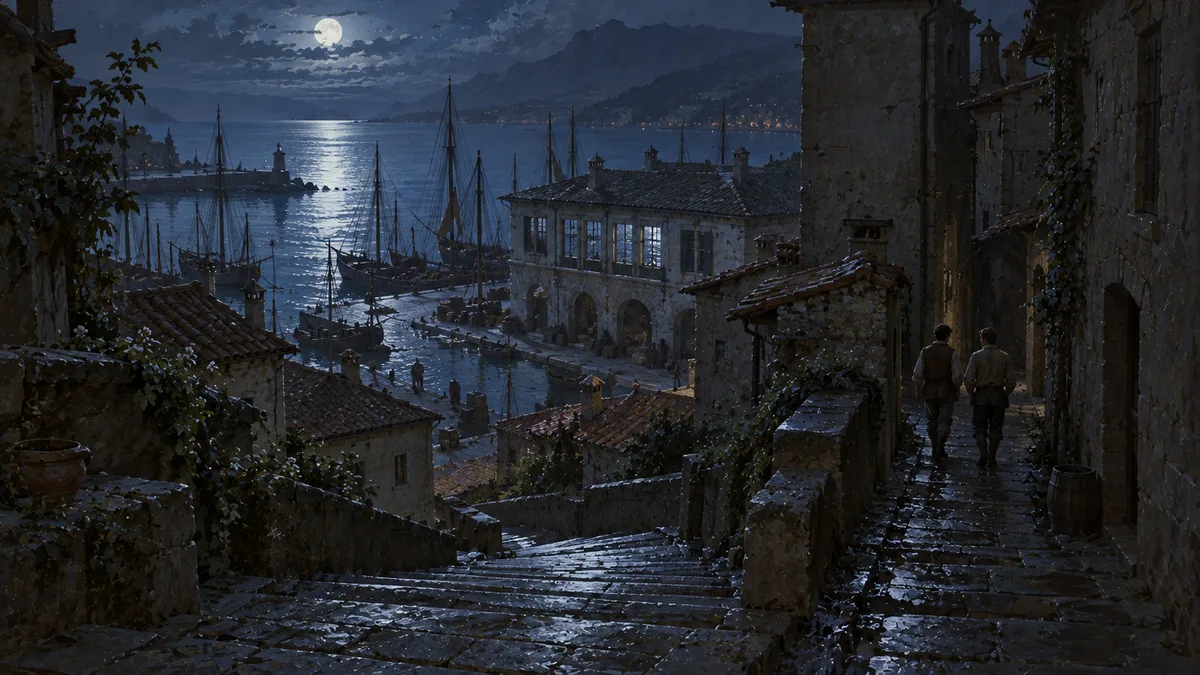
They went down through the sleeping city with no lantern, because Taren said a lantern on the harbor stairs at midnight was a thing the watch walked over to look at.
The streets were blue with moonlight, and the gutters ran beside them all the way down, west, toward the water. Taren walked fast with his hands in his pockets and kept his mouth shut. Once, on the long stair above the fish market, he stopped and leaned on the wall, breathing, and went on.
The survey office stood on the harbor front, a big square customs house of pale stone gone gray with salt. Taren took Lio round the side of it, to a narrow door in an alley that stank of fish-heads, and put the key in the lock.
"They gave me this in December," he said, "so I could work late. I've carried it ever since."
Inside it smelled of ink and damp paper. Upstairs the whole front was windows, with the moon on the harbor beyond them and drafting tables in rows under the glass. At the far end a door stood open on a smaller room.
Taren lit one candle from the tinder in his pocket and walked between the tables to the far wall. A board as big as a barn door stood against the plaster with a map pinned to it.
A valley lay on the board, drawn in brown ink, with the hills shaded in soft gray strokes and the woods washed in green. A river ran down the middle of it in blue, between fields and lanes and the tiny cubes of houses.
Across the top, in large old-fashioned letters, was a single word.
"What does that say?"
"Amberlow," said Taren. "It's what the old deeds call the valley."
Lio took the candle from him and held it close. The river came in at the top under the fells, past a cluster of houses that must be Coldharbour. Halfway down it bent in a long loop to the east, as the Lenn bent below the Long Meadow. On the west bank stood a mill with a tiny spoked wheel. At the very edge of the village, below the first trees, stood a house with a yard, and a smaller house across the yard from it.
He put out his hand and stopped short of the paper.
"That's ours," he said.
"Yes."
A footbridge crossed the millstream behind the house, drawn as two short lines. Beyond it a path ran through an orchard, drawn as a neat grid of little round trees, and out onto the valley road. A short way down, the road crossed the river, with a row of tiny dots in the water and a little tree on the far bank.
Some of the writing was in the eastern hand, squeezed into the spaces between the fields.
Beside the ford, it said: Gravel bottom. Good crossing to knee depth. Cross at the riffle, not the pool.
Beside the footbridge: Father's bridge. Heavy oak. Takes a laden barrow.
He knew the hand. He had seen it all his life on notes left on the kitchen table: gone up the track, back by dark. The tails of the letters looped back on themselves, and the crosses ran too far to the right, because Taren could never wait to get to the next letter.
Only the family called it Father's bridge. Ambrose Pennock, the old orchard-man over the millstream, called it the Ashby footbridge, and the miller called it the plank. Only the five of them said it, at the table, without thinking: go round by Father's bridge, the cow's out past Father's bridge. Taren had written it down for strangers in the same words, because they were the only words he had.
"They asked me," said Taren, very low. "Their old maps had the deeds' words and no drawing. They asked me what was there now, and I was so pleased they wanted to know. I sat at that table by the window with the clerks bringing me cake, and I was proud of it."
Other lines crossed the map. Lio had seen them at once and not let himself see them. Now he looked.
They were drawn in red, thin and ruled, and they ran across the valley over hedges and lanes and the corners of houses. They made squares and long wedges, and in each shape was a name.
"Tracts," said Taren, before he could ask. "A piece of land somebody holds a deed to, from the old days. Or a piece somebody's been promised, when the road opens."
The names were in Western, and Lio could not read them. But he could read one.
It lay beside the orchard behind the house. The red lines made a long wedge there, enclosing the orchard and the field beyond it and the low farmhouse at its edge. In the middle of the wedge, in Western letters, were two words he had heard spoken in a firelit clearing in Wending, in a strange old singing voice.
Mara Vey.
"That's Ambrose's," said Lio. "That's where his granddaughter Rose climbs the trees." He heard his voice going up and could not bring it down. "She was up the big russet apple tree the morning of the storm, shaking the last apples down, and Ambrose shouting at her to come down."
"I know, Lio."
The largest of the red shapes lay over the Ashby house. It took in the yard and the dairy and Edda's cottage and the saw-pit, and ran back to the millstream. The name inside it was written larger than the rest, with a flourish under it.
Lio needed no Western for it. He heard it in a fine voice under a vine. A house of stone under the trees of the wood's edge, with a yard before it and a lesser house across the yard.
"Stroud," he said.
"The house tract," said Taren. "It's the oldest deed they have for the valley." He took the candle back. "There's the rest. You'd best have it all at once."
The small room at the end held a plan chest of dark wood, with wide shallow drawers. Taren unlocked the top one with a second key from his string and pulled it out.
It was full of songs. Each sheet had a verse in the old speech in eastern letters, and the same verse in Western below it, and the tune set out over both in little hooked marks. The hand was small and neat, with the tails of the letters curled like fern. Lines had been struck through and written again, and struck through again. A copyist did not work like that.
"Hollis's hand," said Taren. "He brings them down himself, for the clerks to copy out for the schools."
Merrowby Fair, said the first. The Bounds of Amberlow, said the second. Halfway down it one line had been mended three times: from the stone at the ford to the leat and the wood.
Under the songs lay a sheet of heavy paper folded in four, soft with handling. Lio unfolded it. It was a heron in its ring of waves, drawn in charcoal at full size, and every line had been pricked through with a needle. He held it up to the candle, and the light came through the holes, and there was the bird in tiny stars.
His thumb knew it before he did. The curl of each wave over into the next. The separate feathers on the folded wing. He had carried that bird down the timber track in his father's coat. Taren had walked round and round the kitchen table saying it might have been cut last spring.
It had been. Here, off this sheet, by somebody with a needle and a bag of chalk.
"I didn't know," said Taren. "Not about the ship. Not till April. I swear it."
Lio put the pattern down, because he did not trust his hands with it. I came down the ship's road in the flood, Mara had said at Wending, singing it from the Sarne end. Not Gran's song. Another. A cradle-song for the house, and an old man had it yet, and Gran, and nobody else living.
"Mara sang Gran in," he said. "With the cradle-song. And Hollis taught it her."
"Yes," said Taren.
At Wending Lio had pictured a girl being sung to sleep. He saw her now in her chair by the fire at home, with her cup going cold. And the water had come down out of the west in the dark, looking for the one person in the world who still had that song in her, and did not know it.
He folded the heron along its soft creases and laid it back under the songs as he had found it. Taren locked the drawer, and they went down the dark stair without a word.
Hollis was at breakfast before them, in the window, with the cat on the chair beside him and a letter by his plate. He looked up when they came in, and his eyes went from one brother's face to the other.
"Osric Dane sent up," he said. "He wants the Coldharbour sheet by Saturday, Taren, and the Thornby one finished after it. I told him you would."
Taren stood with his hand on the back of his chair.
"No," he said.
Lio had watched them for a week. Taren fetched the old man's stick before he reached for it, and laughed at his jokes before the end, and said yes to him all day long.
"No?" said Hollis.
"No more sheets. I'm going home, Hollis. With Lio."
Hollis put down his cup. The cat got off the chair and went out. He looked at the letter by his plate a while, and turned it face down.
"Of course you are," he said gently. "Sit and eat, then. It's a long road."
Stroud came at ten in a high gig with a bay mare between the shafts, and asked for both the Ashbys.
"You promised to come and see the farms," he said to Lio from the box, and smiled at Taren. "And your brother's never once come up, in six months. Today he'll come, I think."
Taren climbed up behind. Neither of them had slept.
They went out by the north gate and up a road that climbed in long loops, until the sea lay far behind them like a sheet of tin. Along the top of the hills ran a long dark line. It was the Wood, the western edge of it, coming down to the hill farms as it came down to Thornby.
The hill country was poor. The fields were small and stony, walled with the stones that had come out of them, and every slope that could be plowed had been plowed, right up to the gorse.
Stroud stopped the gig at the last farm, a long low house of gray stone with a dozen children in the yard.
"The Cardews," he said, getting down. "And the Weirs, and old Amos Hale and his daughter. Three families. It was built for one."
A woman in a patched apron came out, thin and quick, with a baby on her hip and four more children at her skirts. She curtsied to Stroud. Then she looked at Lio, at his eastern coat and his eastern boots, and her mouth tightened.
"Ruth Cardew," said Stroud. "Her man went down with his boat off Tollmouth, two winters back. She's to have a place on the house tract. I promised him."
Ruth Cardew spoke to Lio in Western, quickly, with her free hand twisting the apron. Stroud listened and gave it to him.
"She asks if you know the lesser house. The little one across the yard. She asks if the chimney draws."
The children stared up at him, and the baby had got hold of its mother's hair.
"It draws," said Lio. His throat had gone hoarse. "It draws well. My grandmother lives in it."
Stroud did not translate that. He said something else to her, gently, and she began to turn away.
Taren spoke. He said a few words in Western, low, from where he stood by the gig. Ruth Cardew turned back and looked at Lio again, a long look, with the baby pulling at her hair. Then she took her children inside.
Stroud looked at Taren over the mare's back, and Taren looked back at him.
"I told her what he said," said Taren. "All of it."
"So you did," said Stroud, and went to see to the mare.
Behind the house the fair boy who had sung in the third row was mending a wall, with his sleeves rolled, setting the long stones across as somebody had once shown him.
"Tobin," said Stroud. "My younger. My elder has the home farm. There's nothing for a second son up here but the sea or the Survey, and Tobin's no sailor."
Tobin came to the gate, wiping his hands on his breeches. He looked at Lio with a shy hunger.
"Is it true there's beech wood?" he said, in careful eastern. "My father says there's beech trees to the edge of the yard. I'd like to learn the saw-pit."
Lio could find nothing to say to him. He looked past the boy, over the wall, up the stony field to where the farms ended and the Wood began.
The Wood was wrong there.
All along the hilltop the trees stood dark and green in the morning. But straight above the Cardews' last field a whole slope of hillside had no green in it. The trees on it were pale, with wide bare gaps between them, and the light lay on them flat and colorless, though the sky above was blue. No bird went over it. Lio had walked out of that light at the cost of more days than he cared to reckon, and here it was at the top of a sheep field, a long stone's throw from a woman's washing line.
"That's the burn," said Tobin, following his eyes. "They fired it for the grazing, when my father was a boy. It was good oak. Within two summers it had gone gray." He shrugged, as boys do at what was there before them. "The sheep won't go on it. Nor will we."
"Walk up with me, Master Ashby," said Stroud. "Tobin will show your brother the wall."
They went up the field together, between the stones and the sheep, to the last wall. Beyond it the gray began. Close to, Lio could see the grass on the near side of the wall going pale at the tips, as hay goes in a wet August.
"A yard or two a year," said Stroud. "Down toward the field. Four hundred families in the hills, Master Ashby, on deeds, waiting. I can't feed them on the city's charity, and I can't make the hills wider."
"Then why ask?" said Lio. "You've men enough. Why not come and take it?"
"Take it?" Stroud seemed honestly surprised. He nodded down the slope, at a roofless house below the wall with nettles in its door. "That was the Marrens' place, when I was a boy. They were turned off it for a debt and gave it to a harbor man with a paper. He'd never wintered a sheep. He didn't know the springs or the bad corner where the snow lies. Inside three years the gray had it to the door, and he went back to the harbor." His voice was quite kind. "Ground's held by them that know it, Master Ashby. Not by paper, and not by pikes. If I come into your valley, I'll want your father on his saw-pit and your mother at her pail. Under my name. I'm not a fool."
He laid his hand on the wall and looked east along the line of the trees. "And I've wanted to put my hand on your father's bridge since I was six. I'll not pretend otherwise. So I'll ask you straight out, for I think you'd rather be asked than handled. Give me your grandmother's song."
"It's hers."
"Then lend it me. Walk home by it, singing, as you came, with my lads a day behind you." He turned from the gray hillside, and his face was open and courteous and quite sure. "And I'll buy your father's house. I'll not take it. I'll buy it, and the yard and the saw-pit with it, at whatever figure you care to put on them. Name a sum. Your mother need never carry another pail."
Lio thought of the dairy step, and his mother on it with a full pail and her sleeves pushed up, turning to go in.
"She likes her pail," he said. "It's not for sale. Nor the song."
Stroud nodded, as if he had been told the price of beech timber at Wexley and found it about what he had thought.
"No," he said. "I didn't think it would be. I'd have thought less of you." He picked a burr off Lio's sleeve and dropped it over the wall into the gray. Lio looked for anger in him and could not find it anywhere. "Then I'll have to come at it another way, and I'm sorry for that. Remember I asked you first."
He went back down the field to the gig without looking round.
They came down in the late afternoon, with the sea gone gold below them. Lio sat beside Stroud on the box. Taren sat behind, and the gig rocked down the long loops of the road.
When the gate was in sight Stroud spoke over his shoulder, quietly, in the eastern tongue, so that Lio would hear it.
"The Thornby sheet, Taren."
"It isn't finished."
"Isn't it? Abel the doorkeeper tells me you sat at that table every evening of March with it under your hand." Stroud let the mare pick her way round a rut. "Your friend Corren Tull, in the boatyard. A good man. Married, two children. Has he ever shown you his papers?"
Taren said nothing.
"No. He came out of the forest barefoot with a name and a Wexley accent, and he's lived nine years here on the strength of them. The city's let it lie." His voice stayed exactly as it was. "I'd be sorry if somebody stirred it."
He reached back without turning and patted Taren's knee, twice, kindly. Lio looked round. His brother had gone white to the mouth.
Inside the north gate the watch had a squat stone house with a lantern over the door. A sergeant in a gray coat sat on the step with his stave across his knees.
Stroud stopped the gig.
"Forgive me," he said. "City business. I'll not keep you."
He got down and went to the step, and the sergeant stood up for him. They spoke in Western, low and easy, as men speak of the weather. Lio could not follow a word of it. But one word went by that needed no Western, because it was a name, and the name was Tull. Stroud lifted his chin toward the lanes that went down to the boatyards, where a green door stood three streets from Cooper's Steep. The sergeant touched his hat.
Stroud came back and climbed up beside Lio and shook out the reins.
"I'll set you down at the Archive steps," he said.
"We'll walk," said Lio, and got down, and Taren got down after him.
They went down through the lower town, all the way to the harbor, and out along the wall to the far end where the lantern hung. Lio stood at the parapet over the black water until he could breathe.
He saw Rose's red kerchief tied to a branch of the big russet, and then a thin woman with a baby on her hip, asking whether a chimney drew. He could not make the one go away for the other.
Taren sat on the parapet with his legs over the water. After a while he took a folded sheet from inside his coat and opened it on his knees under the lantern.
Thornby. Taren had drawn it so large that the yard alone was the size of Lio's hand. Every cobble was there, and the pump, and the stump where the limb of the old pear tree had come down on the dairy. The gap in the Pennock hedge was there, and the crooked post at the corner of the Long Meadow, and along the edges ran Taren's looping hand, a note for every yard.
"That's the one they want," said Taren. "For the stakes. With this you could put one in Mother's dairy door." He smoothed the sheet with his palm. "It's the best thing I've done, and I've been telling them it isn't finished since April. Stroud's known for weeks. He said it today where you'd hear it."
He folded the sheet and tore it across, and tore the halves, and the quarters, quickly, before he could stop, and opened his hands over the water. The pieces went down into the dark, turning, and the tide took them in under the wall.
"There," said Taren. His hands were shaking, and he put them under his arms. "That's Thornby."
Lio watched the last white scrap go under.
"I'm not sorry I came," said Taren. "But I'm sorry for every word I wrote on that map."
"Then come home and tell Father what you told them."
"They won't believe me."
"You came back from the dead. They'll believe you about anything."
Taren laughed, properly this time. "All right," he said. "All right, Stay—" He caught himself, and shook his head. "All right."
They heard Sil before they saw her. Her boots came quick along the stones in the dark, and then she was there in the lantern light, with her hood back and her short hair blown about by the wind off the sea.
"I've been up and down every stair in the city," she said, and sat down on the parapet beside them and pulled her cloak round her knees. "You've seen the map."
"Last night."
"In the woods I told Lio my books were in my cabinet," she said to Taren. "They are, behind Dane's new lock. But in November, the night before I ran, I sat up in the drafting room and copied what I could. The deed plans, and the lists of who's promised what." She laid her hand flat on her coat, over the squat field book bound in gray board that rode inside it. "From Coldharbour to the ferry."
"Why didn't you show us?" said Lio.
"In the woods? I didn't know you." She took her hand away. "And it's only my hand, copying. I don't know yet if anyone in the world will take it for proof."
"Stroud stopped at the watch-house by the north gate tonight," said Lio. "He talked to the sergeant there. I heard him say Tull."
Sil pulled her cloak tighter round her knees. Taren looked up the hill.
Up there among the roofs, in a lane where no lantern had burned the night before, two men in gray coats were walking slowly, with a light between them. They stopped at a door. One of them knocked on it with the end of his stave, and went on knocking.
Taren was on his feet.
"Sit down," said Sil, and caught his coat, and pulled him back onto the wall. "If they meant to take him tonight they'd not knock. They're letting him know." She stood up herself. "We go at first light. Packs on your backs, both of you, and Brannoc's too. The road east goes along this quay and out by the land gate, and I'm walking it."
"You said he'd let you be while you sat still," said Lio.
"I know what I said." Sil looked down the dark length of the harbor, past the boats, to the pale front of the survey office. "I've sat still since November. I'm done."