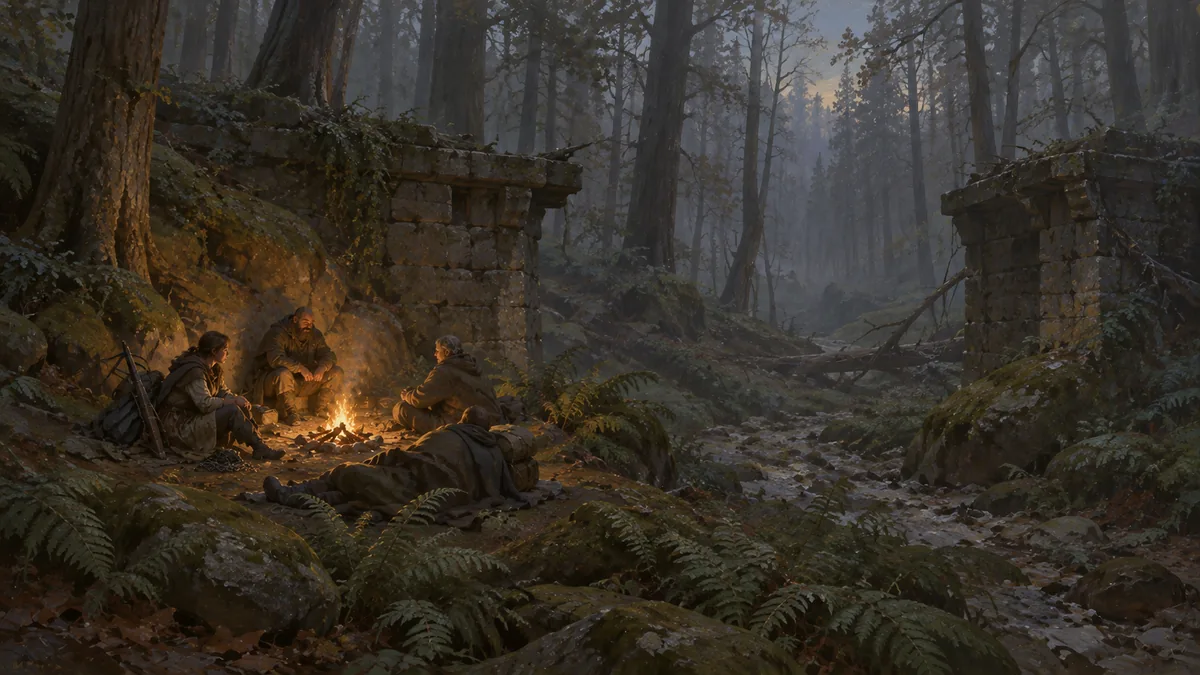
Forgotten Country
The road was gone within a hundred yards. Lio looked back once and saw only beech trunks and mist, and the leaves lying a foot deep over everything, as if no stone had ever been laid there.
Nobody said much. Sil came last, with her surveyor's chain coiled over one shoulder and her crossbow on the other. The one book they had got out of Sarne rode in her pack under oilcloth, so light she kept putting a hand back to make sure of it. She had said one short thing in Western when Lio stepped off the stones, a word Taren had once told him was not for the Archivist's hearing, and nothing since. Brannoc walked in front of her with his bow over his shoulder and his eyes on the ground.
Taren walked behind Lio with his collar turned up. Twice Lio caught him looking back west, the way they had come, toward the sea. Lio had never in his life known his brother look back at anything.
At noon Sil stopped them under a fallen beech, where the road could no longer be seen, and set her pack down.
"Listen, now," she said. "All of you. I've forced a passage once, alone, and Brannoc came out of the gray once when the rest of his twelve didn't. Neither of us means to do it the way we did it then." She looked at Lio. "You walk first. It's your home we're walking to, and you hold it best, so you hold it, and the rest of us leave it alone. Not on purpose. Taren, you keep Thornby quiet in your head and let him carry it. I keep Sarne out of mine altogether, or I'll pull us back to the harbor."
"And Garrow's road," said Brannoc, "if we find him."
Sil gave him a short nod, and counted on her fingers as if she were reading off a chain. "In bad ground, a hand on the shoulder in front, so nobody wanders off sideways without the rest of us feeling it. We stop for nothing the gray holds out. If it's beautiful, walk past it. The gray shows you exactly what you'd stop for, and if you stop, you start to belong to it. That's how Garrow went."
Taren opened his mouth, and shut it again.
"I'll cut a notch every morning," Sil went on, "so we know our own days. We'll not know theirs." She glanced back the way they had come. "Theirs will run faster. Weeks, maybe. That's the price of no road."
"And at night," said Brannoc, from where he sat on the beech trunk, "every man says one thing about his home to the man next to him, out loud, before he sleeps. Not for comfort." He rubbed his strapped arm. "Not one of us asked Garrow his mother's name for three days, the first time. By the fourth he'd not have known it. You ask, and you listen to the answer, and if it comes out wrong you say so."
Lio turned from one of them to the other. He had walked out of Thornby in March knowing nothing, and following a song.
"You'll tell me," he said, "when I'm doing it wrong."
"I'll walk last," said Brannoc. "Anyone who stops, I'll have his collar." He got up. "We've food for three weeks if we're careful, and we'll be careful."
Sil picked up her pack. There had been no vote, and none was needed.
For the first half of the day the forest behaved.
The trees were oak and beech, old and tall, with the light coming down through them green and the ground falling gently away to the east. Field walls ran under the moss. Twice they crossed a sunken lane and once a paved ford with the water gone out of it. Lio kept the sun in his face through the morning, and when it had passed over, he kept it on the back of his neck. Behind him Sil cut a mark on a tree every little while with her knife: a notch, and beside it a line pointing the way they went. She did it without breaking step. Lio had watched woodcutters blaze trees since he could walk and had never seen it done so neatly.
"For when we come back this way," she said, when she caught him looking.
"We're not coming back this way."
"That's what everyone says in here."
By noon the green had gone out of the light. It thinned and whitened, and the shadows lost their edges. The trees grew larger and stood farther apart, and the ground between them was bare and soft, with nothing on it but a gray moss that took their footprints and let them go again. Lio looked up for the sun and found a pale smear that might have been anywhere in the sky.
"There it goes," Brannoc said.
They went on east, or what had been east. Lio walked by the slope of the ground and the lean of the trees. He walked by the feel of the air on his face, which was how he would have walked in the Margin above Thornby in a fog. It served for an hour. Then they came down into a hollow where a beech tree stood alone with its roots over a fallen wall, and Sil stopped beside it.
She laid her finger in a notch in the bark, where the cut was fresh and white. Beside it a line pointed east, down into the hollow, toward the place where they now stood.
"That's mine," Sil said. "I cut that an hour ago."
"I know," said Lio.
"We walked east. I watched the light. I watched you. East, all the way."
"I saw."
Brannoc came and rubbed his thumb along the edge of the cut. "Seen this before," he said. "Twenty years back. I don't remember the tree. I remember the laughing. Somebody said one of us had a short leg." He took his hand away. "I remember when it stopped."
They made camp beside the beech tree, because there seemed no reason to make it anywhere else. Brannoc built the fire low in the angle of the fallen wall. Sil sat across from it with her arms folded and looked at Lio over the flames.
"In the morning," she said, "we go back."
"To the road."
"If we can find it."
"We'll find it," Brannoc said. "It's a road. That's what they're for."
Lio sat against the beech with his knees drawn up and felt the cold come up out of the moss. He had been wrong, and he could see how. He had tried to find east by the sun and the slope, as any sensible man finds it, and the forest had made a fool of him for it. In here east was only a word. It meant no more than Sil's notch.
Beside him Taren lay rolled in his blanket with his eyes open and the firelight in them.
"What?" Lio said, low.
"Nothing."
"You've hardly opened your mouth since breakfast."
"I've been listening to you being wrong. It makes a change." There was no tease in it. Taren turned over, away from him. "Go to sleep, Lio."
Lio lay awake. When he was frightened he thought about work, and the Margin was where his work was, so he thought about the Margin. He thought about being nine years old and lost in a fog above the charcoal clearing, with every tree gone the same. His father had found him by his noise. Owen had squatted down in the bracken and wiped Lio's nose with a big thumb and asked him the questions every child in Thornby was asked.
"What do you do when you're lost in the wood?"
"Find water."
"And then?"
"Follow it down."
"Down to what?"
"Down to the Lenn."
"And what's on the Lenn?"
"Home," Lio had said, and his father had lifted him onto his shoulders and carried him there.
Every water in the Margin ran to the Lenn. It had been so since before there was a Thornby. It had not been so of the stream beside the wreck.
He woke in the small hours with the fire gone to a red seam in the angle of the wall. Sil was a dark shape curled against her pack. Taren had not moved. On the far side of the embers Brannoc sat with his blanket round his shoulders and his eyes open.
Lio sat up. He had been dreaming of Rupert's room under the leads, the shells along the sill, and the bare place on the table where the stained book had been.
"He said we slept," Lio said, low. "Rupert. The first night in the gray, writing the song out again from the burning. He said you and I slept through it."
Brannoc fed a stick into the embers.
"I wasn't asleep," he said.
"I saw him. Back to the fire, his thumb keeping the book shut between lines so the light wouldn't show." Brannoc watched the stick catch. "I lay and watched him write till the fire was out. I could have got up. I let it be."
"Why?"
"He'd burned his whole book for us at Wending, with a face on him like a man at a graveside. Thirty years he'd carried those notebooks about the valley and been laughed at for them." His voice was rough. "I thought a man should keep one thing."
Off among the trees something stirred in the leaves and settled. Brannoc pulled his blanket closer and lay down with his back to the embers.
Lio lay looking up at the branches. He thought of Rupert's hands on the green cover, and then, because that was no use to anyone, he made himself think of the millrace behind the house in the first light, and the steam going up off it, until he slept.
In the morning he asked Brannoc to find him water.
Brannoc got up and went off among the trees with his head down, reading the ground. He was gone long enough that Sil began to pack, and it was clear from her packing that she was packing for the road. At last he whistled, low, and they went after him.
He had found a seep at the bottom of a fold in the ground. A little water came out from under a root and lay in a cup of moss, and went away from it in a thread no wider than a bootlace. It ran west. Lio watched it slide away under the dead leaves toward the place they had come from, and his stomach turned over.
"Well," said Sil. "There's your water."
"Give me a moment."
He stood over the seep and shut his eyes.
He did not try to think of east. He thought of the timber track above Thornby on a wet morning, coming down with a load of poles on his shoulder and the rain just stopped. He saw the holly banks on either side, black and shining. The ruts were full of water the color of strong tea, and his boots sucked in them. He passed the charcoal clearing with its turf mounds and the sour old smell that clung to the burners' coats at market. Then came the shoulder of the hill, where the track tipped down and the trees opened, and the roofs of home were below you. Up past them, from beyond the millstream, rose the smell of the Pennock orchard after rain.
He could smell it so hard his eyes stung behind the lids: wet bark, and windfalls going soft in the grass, and the green sourness of leaves trodden into mud. Under it all lay the cold breath of the millstream. The track came down behind the house, and there was the yard, and the dairy door, and his mother in it. Beyond the yard was Father's bridge, and beyond it the orchard ran down to the valley road. And under everything, slow as breathing, the Thornby wheel went round.
He opened his eyes.
The thread of water still ran west from the seep. A yard below the root it met a stone, and bent round it, and on the far side of the stone it was running east. Nothing had turned it. There was no fall in the ground, and no other water had come in to push it. It slipped away down the fold toward the east, bright under the dead leaves, and was gone.
Lio crouched and looked. Above the stone the leaves lay wet in a dark line going west, where the water had always run. Below it the leaves were dry. He put his finger in the water by the stone, and it tugged at him, very slightly, toward the east, like a child pulling a sleeve toward a door.
"It wasn't doing that," Sil said behind him. "I was watching it. It wasn't doing that."
"No," said Brannoc.
Sil was looking at the stone, not at him. "That wasn't there to keep," she said quietly. Then, to the others, as if setting it down in her field book: "Water in the gray runs toward what remembers it. He's what remembers Thornby. Keep behind him and keep him fed, and the water will take us home."
Lio took his finger out of the water and wiped it on his coat, and found that he did not want to look at the stone again. He walked beside the thread a long way before he trusted it, and it kept running east, gathering itself from other seeps, until it was a brook he could hear.
They followed the brook all that day.
Lio walked first. When the brook forked he did not ask himself which branch went east. He asked which one he would take coming down the timber track with the light going and his supper waiting. He took that one, and Brannoc came behind him without a question. Once, at a bend, Lio would have sworn the brook was running uphill, and he looked away from it quickly and kept walking. Behind Brannoc came Taren, and last came Sil, cutting her marks.
The gray settled on them like flour dust in a shut mill. The ground rose and fell in long soft folds where walls and buildings had been, and Lio kept his eyes on the brook and his mind on home.
Late in the afternoon the brook brought them down into a sunken lane between high banks. It curved left round a field gone to fern, and then right again, and Lio's feet knew the curve before his eyes did. It was the bend of the valley road round the Long Meadow, where the frost lay last. He walked it with his skin crawling. Behind him Taren had stopped dead in the lane with his head up.
"Come on," Lio said, without looking round.
The lane brought them through the farms.
They had no names. Lio was sure of that before he reached the first gate. The houses stood roofless in their clearings, gray stone gone green, with ash trees growing up through the floors and nettles waist-high in the yards. Field walls ran from them in every direction and gave out in the middle of nothing. In one yard a quern stone lay in the grass, the hole worn smooth by hands. In another a cart wheel leaned against a wall where somebody had set it down. The trees had grown up through its spokes.
In the last yard a well stood with its windlass whole, and the rope coiled on it was new and pale, with the bucket hanging dry at the end of it. As they passed, the windlass turned a little way on its own, and the bucket went down out of sight. Lio waited for the splash. It came a long while after, very faint, from much deeper than any well he knew. Then the windlass turned back, and the bucket came up into the light, dry.
Brannoc touched Lio's arm, and they went on.
They made camp at dusk by a broken bridge. Its arch had fallen long ago, and only the two abutments stood, facing each other across a dry bed full of fern.
Brannoc lit the fire, and lit it badly. He had laid it in the open, on the wrong side of the abutment, where the air sliding down the dry bed took the smoke and laid it flat across their blankets. Lio had watched him make a hundred fires and never seen him get the wind wrong. Brannoc sat back on his heels with the smoke going into his eyes and looked at the thing, as if another man had built it and he was too civil to say so.
He kicked it apart and built it again in the lee of the stones. Sil watched him do it from across the dry bed with the water-skins in her hands, and kept her remarks to herself, which was not like her either.
Lio turned to his brother across the embers. "Tell Sil about the millpond," he said. "The winter you went through the ice."
Taren shook his head.
"You tell it," he said. "You're better at it."
"Better at what?"
"At remembering." He pulled his blanket round his shoulders. "I always was looking at the next thing."
When Sil had rolled herself up with her crossbow beside her and Brannoc had gone out to the edge of the firelight to listen to the dark, Lio moved over and sat by his brother.
"Out with it," he said.
Taren lay on his back with his hands behind his head and watched the branches for a time. The fire ticked and settled between them.
"That lane," he said at last. "It bent where the valley road bends."
"I felt it."
"I drew that bend for them. The real one. In Sarne, in the survey office, on a long table with the windows open and the gulls going over. They had the old map, and it was all guesses, and I sat there and corrected it for them. Where the road bends round the Long Meadow. Where Ambrose's wall bends. Where the ford's shallow enough for a cart." He was quiet. "They gave me cake, Lio. I drew them our ford and they gave me cake."
Lio watched the fire. He might have said a great many things. He had said most of them already, walking by the harbor in Sarne, and none of them had made either of them feel better.
"Was it good cake?" he said.
Taren snorted. He turned on his side and pulled the blanket up over his ear, and after a while his breathing changed and he slept.
Sil heard it first.
She sat up in the dark with her crossbow in her hands, and her movement woke Lio. The fire was down to embers. Brannoc was already awake on the far side of it, propped on one elbow, his head turned east.
"What is that?" Sil whispered.
Lio listened, and under the silence of the great trees there was a sound, far off and low. It was slow and hollow, a knock and a pause and a knock, steady as breathing.
He knew it. He had gone to sleep to it every night until this March.
"That's a mill," he said.
"There's no mill in here." Sil's whisper was fierce. "There's no mill in the Heart that's had water through it since before anyone can remember. They're all dry."
Lio had stood in one, in March, with his hand on a paddle that no water had touched in a lifetime. Its millrace had been grassed over from end to end.
"Listen to it," he said.
She listened. They all listened, lying in the dark around the embers with the gray night pressing on them. The knock came up through the ground. Taren had not moved, but his eyes were open.
"I hear it," Brannoc said at last.
In the morning they followed the brook down toward the sound. It grew louder as they went, and the brook grew with it, until it was a stream as broad as the millstream behind the house, running clear over clean gravel, east. The valley it ran in narrowed. The trees leaned in. Then the banks drew back, and there was the mill.
It stood roofless and very old. Its walls were green to the eaves and a young oak grew out of one gable end. But its millrace was full, and in the race its wheel was turning. The paddles were black and furred with weed, some of them broken, and the whole wheel sagged on its axle. Still it turned, slowly, in the clean water. Every time it came round, a split paddle caught on the frame and knocked.
Taren walked down to the bank and stood looking at it. After a while he reached out and laid his hand on the wet wood as it came round, and let it pass under his palm and come round again.
Sil had her knife out to cut a mark. She put it away. "That mill," she said, "is on no map we have."
Lio knelt at the edge of the race and drank from his hands. The water was cold enough to numb his lips. It tasted of nothing. There was no stone in it and no moss, none of the iron of the Margin springs, and he wiped his mouth and emptied his hands onto the moss.
Where the race had spilled over its bank the ground was soft, and there were prints in the mud. They were a man's feet, bare. They came down out of the trees to the water's edge and went away east along it, and each was set down close behind the last, a short step and a long stop, a short step and a long stop. Brannoc crouched over them, his big hands hanging loose.
"A day," he said. "Maybe less. He's not hurrying." He frowned at the mud. "He's not going anywhere, either. Look how he stands."
Sil had her crossbow off her shoulder. "Hollowed?"
"Might be." Brannoc stood up and looked east along the stream.
"Come on," Lio said. "It goes on down."
They followed the stream east all morning, and the gray deepened around them, and the mill's knock faded behind until Lio could not tell whether he still heard it or only remembered it. At midday they came out of the trees on the edge of a wide clearing. Once it had been a field, a broad one, with the ghost of a wall around it and a tall gray stone in the middle where a boundary had been. The stream ran along its southern edge. Lio stopped.
Someone was crossing the field.
A man had come out of the gray on their left, at the far side, and was walking toward them through the ferns. He wore a long coat of brown wool, faded at the shoulders and torn at the hem, with a patch on one elbow. He walked slowly and evenly, with his head bowed and no hurry in him at all. Lio did not know the walk. Brannoc did. Lio heard the breath go out of him.
When the man reached the stream he did not look up at the company on the bank. He turned east along the water and went on at the same slow pace, as though he had joined a lane he knew.
Brannoc took one step down the bank, and no more.
Nobody else stirred. The stream ran on along the foot of the field, low and clear over its gravel. The gray stone stood in the middle of the ferns, keeping a line between two fields that nobody had owned in living memory. The man walked on beside the water, and behind him, where he had come through, the ferns lifted themselves again one by one, until there was no sign that anyone had passed.