The Gray Country
The voice behind them went on a while, and stopped, and that night they heard it no more.
Night never came. That was the first thing Lio learned about the gray. They walked on from the last wall for what he judged was two or three hours, and the light held where it was, neither growing nor fading. It lay on everything alike, on the trunks and the ferns and the backs of his hands, flat and pale and even, with no sun behind it and no moon. Nothing cast a shadow. When he held his hand out in front of him, the ground beneath it was as bright as the ground beside it.
He sang the whole way. He sang under his breath, so low that Brannoc behind him could barely have heard it, the two lines over and over. He felt the road under his feet as he sang. The leaf-mold was deep and soft and the paving lay a foot down beneath it, with no telling it by sight. But it was there, as the stair up to his bedroom at home was there under his feet in the dark, every tread of it.
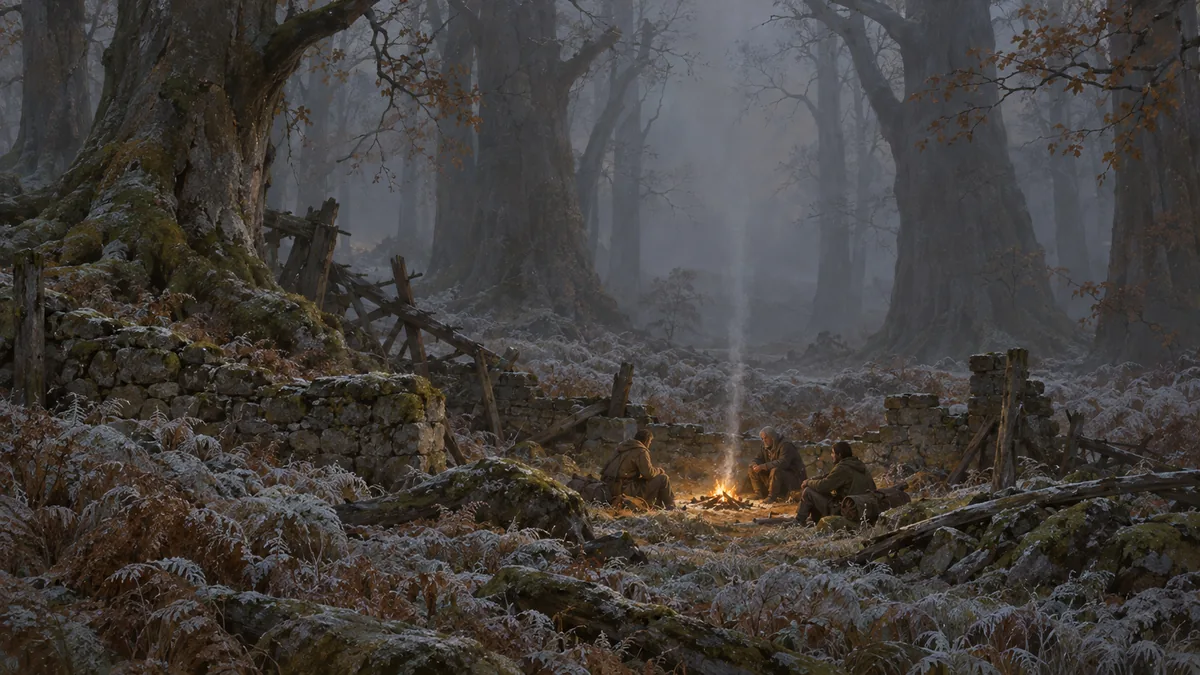
The trees went up out of the gray on every side. They were oak trees and beech trees, or kin to oak and beech, and they were so large that Lio stopped thinking of them as trees and began to think of them as hills. Their bark was furrowed in folds as deep as his arm, and moss hung off the folds in gray-green sheets. Their lowest branches were higher than the roof of the reeve's hall at Wexley. Between the trunks, ferns grew waist-high and hung motionless, because there was no wind.
Nor was there any sound. Lio listened for it out of habit, as he listened at home on any night, and heard no bird, no drip of water, no creak of a bough. He heard their breathing, and the whisper of the ferns against their legs, and his voice, low, singing.
Toward what should have been morning, Brannoc spoke.
"Lio. Go first. You've got the song. I'll keep behind."
Lio nodded. Brannoc dropped back past Rupert, so that Rupert walked in the middle, and after that Lio heard him at the back, steady and quiet, all the rest of the way through the gray.
They found the ring-stones not long before they stopped to sleep.
The road went down into a broad hollow where the ferns grew taller than a man, and they waded through them with their arms up. In the middle of the hollow the ferns gave way to a clearing, round and level, grassed with fine pale grass. The road ran along the near side of it. Around its edge stood a ring of stones. They were whiter than anything Lio had seen since the winter snow, white as a peeled willow wand. Each of them stood about as high as his chest and leaned a little inward, toward the middle.
Rupert made a sound in his throat.
"Lio," he whispered. "She was right. Your grandmother. She was seven years old, and she was right about every one."
"She was right about the oaks," said Lio. "And the bridge, and the well."
"But this." Rupert went off the road into the ring. He touched the nearest stone and snatched his fingers back. "It's warm. It's warmer than the air. Brannoc, feel it." He had his notebook out. He was writing as he walked round the inside of the ring, looking from one stone to the next. "Chalk? No. Too hard for chalk. Those faces are dressed, look, you can see the tool marks. Somebody cut these and stood them up here in a ring for a reason, and I would give anything at all to know—"
Lio went after him.
He kept singing. The line went on under his breath the whole time, and he followed Rupert round, a step and then another, to see what Rupert was pointing at. He was thinking that the stones were the color of the inside of a beech log when the bark comes off. He was halfway round the ring before he looked back the way they had come, and the gap in the ferns where the road came down into the hollow was not there.
The ferns stood all round the clearing, tall and unmoving, in an unbroken wall.
"Brannoc," he said.
Brannoc had seen it. He had come in after the two of them, and he stood just inside the stones with his hand on the bow across his shoulder, looking at the place where the road had been.
Lio walked back to where he judged it had run, and set his feet there, and sang. He made himself do it slowly, though his voice wanted to go fast and high. He sang the line through and through again, with his mind on nothing but the road, and the second time, at the edge of his eye, the ferns moved. Nothing pushed them. They drew back on either side, and there was the road coming down into the hollow with their tracks on it, deep in the leaf-mold, and he was standing on it.
Rupert stood in the middle of the ring with his pencil in the air.
"Did you do that?" he said.
"I never stopped singing," said Lio.
He looked down at his boots on the buried paving, and back across the ring at the white stones.
"I went after Rupert," he said.
Brannoc looked at him a while, and at the ferns.
"Then nobody goes after anybody," he said. "We keep to the road."
Rupert closed his notebook. He came back across the clearing onto the road, beside Lio, near enough to feel the warmth of him, and his round red face had gone pale.
"I'll go after nothing," said Rupert. "Not if it sings to me."
They slept there that night, if it was night, on the road itself, along the edge of the ring, with the buried paving under their blankets. Lio slept badly. Each time he woke he looked for the road, and each time it was there, coming down between the ferns. Once he reached out from his blanket and put his hand on one of the white stones and found that Rupert was right. It was warm, as a hearth-stone is warm in the morning with the fire long out, though no fire had touched it for longer than anyone could say.
The last time he woke, Rupert was sitting up against a stone with his new book on his knee, the cheap green one he had taken from the cart at Wending. He had it open at the back. He was writing fast and close to the page, and his lips were moving. Lio stirred, and Rupert turned to the front and wrote something there, slowly, with his thumb holding the back pages shut.
Across the ring Brannoc was awake. He lay on his side with his head on his pack, and his eyes were on Rupert's hand. They went to the thumb on the back pages, and rested there, and came up to Rupert's face. Rupert wrote on. After a while Brannoc closed his eyes and turned over, away from the both of them.
On the second day the hill went behind them.
Lio saw it first, where the trees opened: a long low rise with a single dead tree on its crest, white and bare against the gray. The road seemed to run toward it. They walked toward it for what felt like a morning, and Lio watched it as he walked, singing, because it was something to steer by in a country that offered nothing else.
Then they came over a shallow ridge and went down the other side, and when Lio looked up again the hill was behind them. It lay at their backs a mile away, with the dead tree on its crest. They had never gone over it.
"No," said Rupert. "No, that can't—"
"Leave it," said Brannoc, from the back. "It's not on the song."
Lio left it. He kept his eyes on the road at his feet after that, and on the next tree, and the next, and let his eyes go no farther than he could throw a stone. It helped. His father had taught him to plow a straight furrow that way. You looked at the clod in front of the share, never at the far end of the field, where the marker pole wavered in the heat.
Later that day, in the long sameness of the afternoon, they heard Mara.
Her voice came from somewhere to their right, north of them, though she should have been behind. She had stopped singing. Now she was calling.
"The well with the heron stone!" she called. "The well with the heron stone, and the—through the town of grass—take the left-hand—"
She broke off. When she began again her voice was higher.
"Down by the three oaks. Down by the three oaks the lane—"
Lio stopped walking, and kept singing. She had the pieces she had heard him sing in the nights before Wending, low, in his chest, and not one of them belonged to this country. She was calling them out to the trees one after another, louder each time, as if she could shout the gray into giving her a road.
A moment later he saw her, and she was nearer than her voice. She stood among the trunks a long stone's throw off, on ground that looked like their ground, with the hood fallen back from her dark hair. She had her staff in one hand and the gray book open in the other. She was turning where she stood, looking about her, as a mother turns at a fair when the child has let go of her hand. Her face had lost its composure entirely.
She saw them, and Lio watched it happen. Her head came round, and her eyes found him across the ferns, and her whole body went toward him before her feet did.
"Lio Ashby," she called. "Sing me the next. Only the next line, and I'll ask you nothing more."
He kept the line he had, low, under his breath, and felt the road under him. She stood and waited for it. When nothing came she shut the book and put it away in her cloak, slowly, and he saw her understand that it would not.
She stood out there among the trunks, alone.
"Come to us," Lio called. He stopped singing to say it and started again at once. He held out his hand. "Come to my voice. Walk straight at me and don't look anywhere else."
"Lio," said Brannoc.
"She'll die out there."
Mara came. She left whatever ground she had been standing on and came straight across toward them through the ferns, fast, with the staff held out in front of her like a blind woman's stick. The ferns broke round her knees. There was one great trunk between her and the road, no farther off than the width of the yard at home. She went behind it.
Lio waited for her to come out the other side.
She did not come out. The ferns on the far side of the trunk stood up tall and whole, and nothing moved them. He sang, louder, and called her name between the lines, and the gray took the sound of it and gave nothing back. He had taken a step off the road toward the tree before he knew it. Brannoc's hand closed on the strap of his pack and held him there.
"She's just behind it," said Lio.
"Look at the ferns," said Brannoc. "Nobody's broken them."
On the near side of the trunk the ferns lay trampled where she had come. On the far side they stood whole. Rupert stood in the road gripping his coat shut at the throat, as if the cold had got in.
"I called her," Lio said.
"Aye. And she came." Brannoc kept his fist in the strap. "She was off the road before you ever saw her, lad. Sing."
Lio sang. They went on, and he looked back at that tree until the ferns hid it, and it did not give her back.
The mill stood beside the road on the third day, and it was so like a mill that it hurt him.
The same gray stone as the road had gone into it, two stories high, with a slate roof fallen in at one end. The wheel was on the near side, an undershot wheel, bigger than the Thornby wheel, and it was whole. Its paddles were all in their places, dark and smooth and worn round at the edges by years of water. Below the wheel the millrace ran away under the trees in a deep stone-lined channel. Above it was a sluice, with its iron winding-gear rusted solid and its oak gate shut.
The race was dry from end to end, and its bottom was grassed over with the same fine pale grass as the ring of stones. Above the sluice there was no stream, and no channel for a stream. The forest floor ran up to the back of the gate, ferns and leaf-mold, as if water had never come that way at all.
Lio went down into the race without meaning to. Then he was standing in the grass under the wheel, with his hand on one of the paddles, and no memory of leaving the road. The wood was cool and dry. He ran his thumb along the worn edge. At home the paddles were green with weed and slick, and the water came off them in strings when the wheel turned. He could hear that wheel from his bed.
He opened his mouth to sing the line that belonged to this place, and could not get it out.
Above him, on the road, somebody was humming. Brannoc stood square on the line with his boots apart and hummed Edda's tune, low and tuneless and dogged, a man rowing against a current. He broke off when he saw Lio look up.
"Lio," he said gently. "Come up."
He came up. Brannoc gave him a hand over the lip of the race and held it a moment after, and let go.
"Somebody ground corn here," said Lio. "For years. You can see it in the paddles. There was a river."
"Aye."
"Where did it go?"
Brannoc looked at the dry race, and at the grass growing in it, and at the shut gate, and shook his head.
They came on the woman in the afternoon of that day.
The road ran past a ruin that had been a farmhouse once, though there was not much left of it: a gable end, a doorway with its lintel fallen, a low wall round what had been a yard. Inside the wall was a garden, the first growing thing they had seen in the gray that anybody had planted. Crooked rows of something pale and leafy grew there, like kale grown in a cellar. A woman was kneeling between the rows with her back to them, weeding.
She was small, in a dress that had been brown. Her long gray hair was tied back with a strip of cloth. She was pulling the weeds one at a time, pinching each out at the root between her finger and thumb, and laying each one down at the end of the row in a neat little pile.
Lio stopped at the wall. He had stopped singing. He knew it and could not help it, and behind him he heard Brannoc take up the tune where Lio had dropped it, low and tuneless, on the road.
"Good day," he said.
The woman looked round. She had a lined face, soft and untroubled, and her eyes were a soft brown. She looked at the three of them over the wall without any surprise.
"Good day to you," she said. Her voice was soft, and the words came out slow and rounded, with old corners to them that he half knew. "Will you have some greens? They're poor this year, but there's plenty."
"Thank you," said Lio. "We've food."
"That's good. It's a long road." She smiled at him and went back to her weeding.
"What's your name?" said Lio.
The woman stopped with a weed between her fingers and looked at it. She frowned, a small puzzled frown, the frown of someone who has come into a room for something and cannot think what.
"I had one," she said. "I'm sure I had one. I must have put it down somewhere." She smiled at him again, apologetic. "It'll turn up."
"Where do you live?"
"Here." She looked round at the gable end, and the fallen lintel, and the pale rows. "Oh, here."
"How long have you been here?"
"Oh," said the woman, comfortably. "Oh, a while."
She went back to her weeding and seemed to forget them at once. Lio stood with his hands on the cold stones of the wall and watched her careful fingers going along the row. She had been weeding that row since before he was born. She would be weeding it when he was dead. He could not breathe.
"She's hollowed," said Brannoc, very low, beside him. "Come away, Lio. There's nothing to be done."
"How do you know?"
Brannoc let that go by, and went back to his humming.
Lio turned from the wall. Rupert had not turned. He was standing at the gap where the yard gate had been, with one hand on the stone post, looking at the pale rows.
"She did offer," Rupert said. His voice was soft and pleased. "It'd be no harm to sit a minute, would it? My feet are wretched. We could sit a minute, and have some greens, and go on." He had taken a step through the gap. "It's very peaceful here. You'd not think it, but it is."
"Rupert," said Lio.
Rupert smiled at him, a soft, absent smile, a stranger's smile on that round red face, and he took another step. Between her rows the woman looked up and smiled the same smile back.
Brannoc went past Lio in two strides, and Lio caught up the song as he went. Brannoc took Rupert by the collar of his coat and hauled him back through the gap, hard, as you haul a calf out of a bog, and Rupert came without a struggle. He stood in the road blinking. His face was as puzzled as the woman's had been.
"What is it?" he said. "I was only—" He stopped. "What was I doing?"
"Sitting down," said Brannoc. He kept hold of the coat.
Lio sang louder than he had since the hollow of ferns. He stood at the wall with the woman smiling up at him and sang the lines through, and through again, with his eyes shut, until he felt the road firm under his feet.
They went on, and Lio kept his eyes on the road. Behind him he heard Rupert stumble, and Brannoc catch him by the arm, and neither of them say a word.
That night was the first night Lio was afraid for himself.
They camped in the lee of a fallen wall, among the bones of a farm that had no name. Brannoc made a fire of dead branches, and it burned small and pale, and its smoke went straight up into the gray without leaning. They ate the last of the Wending cheese. The light had dimmed a little, the only change it ever made, a thickening of the gray toward dusk. With it came a cold that seemed to rise up out of the ground.
Lio sat against the wall and watched the ferns beyond the fire. They were furred with white. It had come on while they ate, a fine white crust along every frond, glittering faintly in the firelight. He thought of the Long Meadow at home in November, and the white lying on the grass in the low corner by the river, long after the rest of the valley had gone green again. He knew that white better than anything. He had walked out on it every winter morning of his life.
He reached for the word for it, and it was not there.
He sat without moving. He knew what it was. It was white, and it came when the nights were clear and cold, and it lay in the Long Meadow longest because the meadow lay low. His mother hated it on the washing. His father cursed it on the early beans. Lio had a word for it that he had used every winter since he could talk, a short word, a word a child knew. He reached for the word and his hand closed on nothing.
He sat with his hands between his knees and felt the fear come up in him slowly, out of the ground with the cold. He tried to come at the word sideways. The windows at home in January, with the white ferns grown on them overnight. Taren breaking the ice on the water-butt with his fist, and swearing. The grass crunching under his boots. There was a place where the word should have been, and nothing in it, as a tongue finds the gap where a tooth was.
"Lost something?" said Brannoc.
Brannoc was watching him across the fire.
"A word," said Lio.
Brannoc nodded slowly, as if he had been waiting for it.
"It'll come back," he said. "Mostly they do." He put another branch on the fire. "Talk. That's the thing. Talk about home. Not the road, not this place. Home." He looked at Rupert. "You too."
Rupert had been sitting hunched in his blanket with his notebook on his knee, not writing. He seemed about to make a joke of it, but he let it go.
"Home," he said. "Well. I've not got much of a home, you know. I've got the cart." He tried to smile. "But I'll tell you about Wexley fair, if you like. The horse fair at Michaelmas. There's a man there sells hot chestnuts out of a brazier made from an old helmet. He swears it was his grandfather's, and that his grandfather took it off a dead knight at some battle nobody's heard of. Every year I ask to see it, and every year he lets me hold it, and every year I tell him it's a cooking pot with a hole in it." He drew the blanket closer. "He's been telling me about that knight for twenty years. The knight gets bigger every year."
Brannoc talked about the ferry. He talked about the stairs down to the landing, and about the spring floods, when the river ran so fast under the far willows that you had to angle the boat upstream into it. He talked about a carter's wife who came over every market day with a basket of eggs and in nine years had never once paid her fare. He kept it short. But he talked, and his voice in the gray was slow and dry and ordinary, and Lio held on to it.
Then they both looked at Lio, and he told them about the Long Meadow. He chose it because it was where the word had gone. He told them about the hay in June, and how his father would not cut it until the dog-roses on the hedge were over. He told them how the river flooded it most winters and left it shining with sheets of water that brought the gulls up the valley. In the dead of winter it was the coldest place in Thornby. It lay low, and on still nights the cold ran down into it off the hills and stayed.
"You walk out on it first thing," he said, "and it crunches, and your boots leave black prints behind you. Then the sun comes up over the hills and turns it all pink. And it lies there in the low corner by the river long after the rest has gone. The frost lies there—"
He stopped.
"What?" said Rupert.
"Nothing," said Lio. He cleared his throat. "The frost. It lies there longer than anywhere. That's all I was going to say."
Brannoc's eyes stayed on the fire. But his hand on his knee closed and opened again, slowly.
Lio sat and said the word over to himself in his head, to be sure of it. Frost. Frost. The white on the ferns beyond the firelight had thickened. He watched it until his eyes closed.
The hall came on the fourth day, and they walked through it.
The road ran straight in at one end and out at the other. The hall ran longer than Thornby street from the mill to the chapel, if a thing with no roof could be called a building. Its walls stood twice the height of a man on either side of the road, built of great blocks fitted without mortar, and they ran away ahead of him into the gray. High along them were window-holes, tall and narrow, and through every one came the same flat gray light. The roof was gone. Lio could see the sockets in the stone where the beams had gone, each as big as his body. Trees grew up out of the floor now, through the flagstones, tall and straight, with their crowns lost overhead where the roof had been.
They walked down the middle of it with the trees on either side. The chapel at Thornby would have fitted in one corner with room to spare. Whoever built this had called it something, and come into it on feast days, and been proud of it. The name had gone with them.
At the far end of the hall, where the road went out, there was a doorway taller than the rest, and over it a long stone panel set into the wall. Letters had been cut in it once, deep and large, and every one had been taken out again with a chisel, carefully, to the depth of a finger.
"Weather," said Rupert doubtfully.
"Weather doesn't use a chisel," said Brannoc.
Lio sang, and went on under the panel.
Rupert walked beside him with his head tipped back, looking up at the window-holes, and his book stayed in his coat.
They slept that night in the hall, against the north wall, under the window-holes, with a tree for a roof. Once he woke sure he had heard a woman calling for the next line, far off down the hall, and lay listening. He had told her to walk straight at him, and she had. Nothing came. When he woke again the light was the same, and the hall was the same, and he got up and sang and they went on.