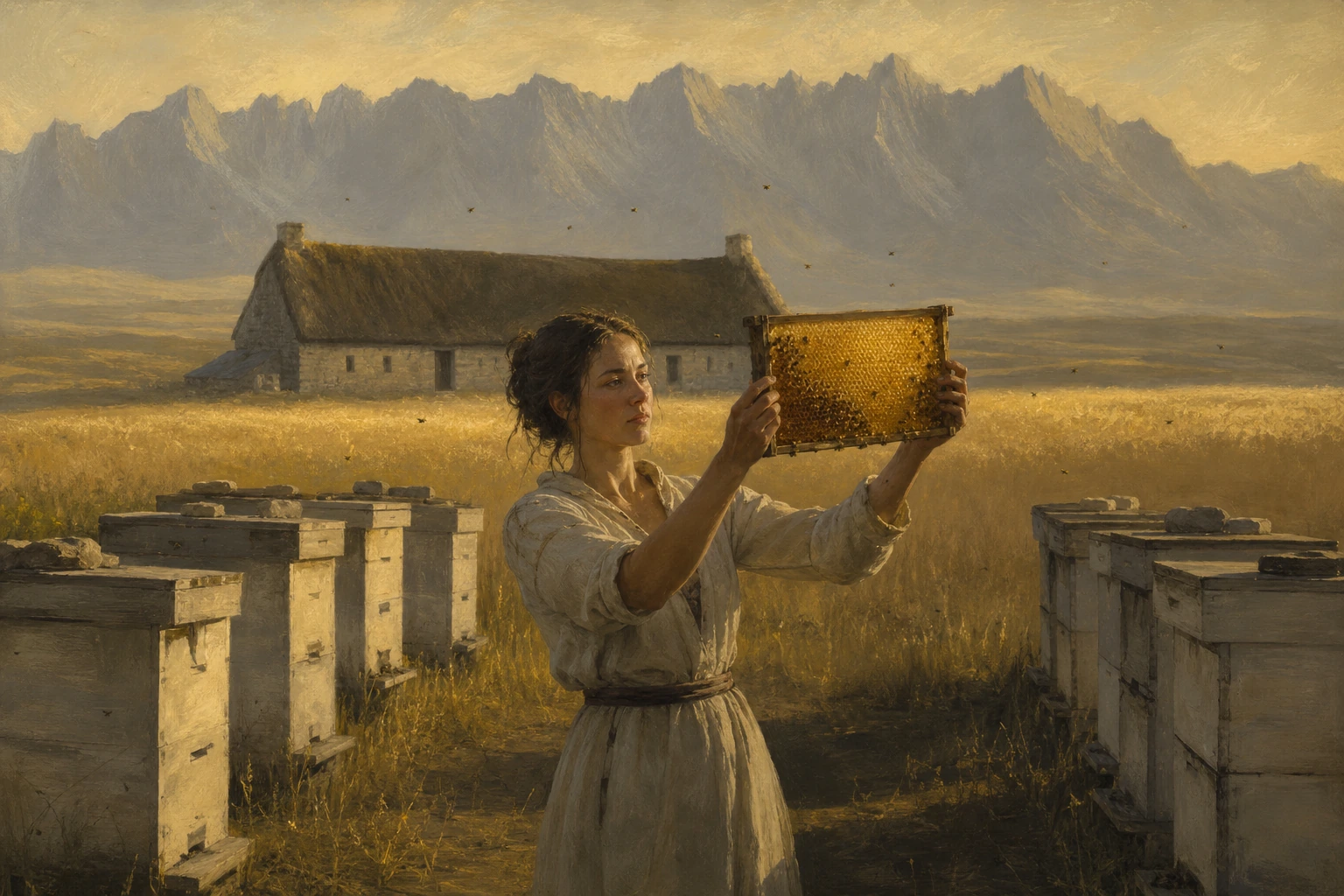
Honey Harvest
In the valley of Dall, summer ended as it always ended, in gold.
The barley had gone the color of a lion's back, and the orchards along the river hung so heavy that the plum-boughs were propped with forked sticks, like old men leaning on staves to gossip. The river itself ran low and clear over its brown stones, talking quietly, as rivers do when they have said everything important in the spring and are content to repeat themselves. Smoke stood up straight from the chimney of the Bridge Inn, for there was no wind that morning; and from one end of the valley to the other — from the high sheep-pastures under the Cloudwall to the water-meadows where the herons stood thinking — there was nothing to be heard but bees.
The bees belonged, in so far as bees belong to anyone, to Fallowmere.
Fallowmere was the last farm on the west road, a long low house of grey stone under a deep thatch, with a garden in front of it and a bee-yard behind, and it had stood there so long that the valley no longer thought of it as a building at all, but as a feature of the land, like the hill it leaned against. Eleven generations of Fallowmeres had kept bees there, and the hives stood in two neat rows down the yard — white-painted boxes on stone footings, and at the end of the row three old straw skeps that gave no honey worth the name but were kept, as Granna Tansy said, out of respect.
On this particular morning, in the yellow hour after dawn, Wren Fallowmere was robbing her bees, and the bees, on the whole, were letting her.
She worked without gloves, as her mother had, and her grandmother still did — slowly, with smoke from a smouldering roll of sacking, and a manner of moving that was less like work than like a long deliberate courtesy. The trick of it, Granna Tansy always said, was to be the sort of person a bee could rely on. Bees have no patience for surprises. Wren lifted each frame as if it had asked to be lifted, and the comb came up golden and heavy, an entire summer made solid — clover from the water-meadows, lime-blossom from the great trees by the mill, and under it all the dark taste of the heather that grew up where the sheep-walks ended and the mountains began.
The sun came up over the hill as she worked and lay warm along her right arm; the left it seemed to miss, as it did every year at that hour. She held a frame to the light and watched the crawling hundreds go about their business across it, and felt, as she felt every harvest morning, the small precise happiness of a thing done properly in its season.
"You'll have that one over," said a voice from the gate, "and then you'll be sorry, and so will several thousand others."
Wren did not startle, because startling was not a thing one did in a bee-yard, but she smiled without turning around. "Good morning, Dorrit."
"Good morning yourself. Granna sent word you were taking the honey off today, which means," said her cousin, coming up the path with the rolling stride of a woman who spends her days between garden rows, "that she sent word to half the valley, and you may expect Hobb up from the inn by noon with jars and flattery. I've come to mind the uncapping knife, before you let Dorry Millson do it again and we spend the autumn scrubbing the floor."
"That was four years ago."
"It was a memorable floor."
Dorrit Fallowmere was short where Wren was middling, broad where Wren was spare, and loud where Wren was quiet, and the two of them had divided the world between them long ago without ever discussing it: growing things fell to Dorrit, and keeping things fell to Wren, and each privately considered that she had the better half. Dorrit propped her elbows on the gatepost, out of the flight-line, and watched with a gardener's judicial eye.
"Heavy?"
"Heaviest since the year the lime bloomed twice." Wren eased the frame down into the carrying-box and reached for the smoker. "If the weather holds through the fair we'll want every jar in the house, and the crock besides."
"The weather will hold," said Dorrit comfortably. "Ask your bees."
It was an old joke and a true one. Everyone in Dall knew that the Fallowmeres could read weather out of a hive the way the miller read it out of his knee — that bees grew testy before thunder and idle before rain, and that when they flew early and far, a fine spell was as good as promised. The bees this morning had been out before the mist was off the river. Wren had noted it, in the manner of her family, without exactly thinking about it, the way one notes a clock still ticking.
They worked the rows together through the morning, and it went as harvest mornings had gone at Fallowmere for eleven generations: the smoke, and the lifting, and the low words; the carrying-boxes filling; a sting apiece taken philosophically ("There's a tax on everything," said Dorrit); and by midmorning the kitchen given over entirely to honey. The room filled with the warm wax smell that Wren privately believed was what gold would smell like, if gold were any use. Dorrit uncapped, and the knife went through the wax cappings with a sound like a sigh; the extractor — a barrel contraption with a crank, the pride of Wren's late father — rumbled and sang; and honey ran from the tap in a slow amber rope into pail after pail, while Granna Tansy sat by the window with the scales and the jars and did the arithmetic of it in her head, as she had done for sixty years.
Granna Tansy was small and dry and upright, like a well-kept boot, and her hands had the steadiness that comes to some old people as a reward. She held each jar to the window before she sealed it and read the honey against the light.
"Meadow," she said, and sealed it. "Meadow. Lime. — There's the heather starting; look at that, dark as ale. That shelf, Wren, the dark goes on the left." She said the same words every year. That was a great part of their value.
At noon they ate at the corner of the crowded table — new bread, cold butter, and comb honey still warm from the hive, with the wax to chew; and plums out of the orchard; and cold well-water, because honey-work is thirsty work and cider makes it worse. Hobb came up from the inn, as prophesied, with a cart of empty jars and a stream of compliments, and went away again with the first dozen filled and the news — which he would have carried free, but preferred to carry with honey — that the Fallowmere harvest was the best in ten years.
And once, passing through the front room with her hands full, Wren stopped — as she stopped perhaps twice a year, for no reason she could have named — in front of the book.
It lived on its own shelf beside the chimney-breast, between the clock and her great-grandfather's pipe that no one smoked and no one moved: a thick, squat volume bound in leather gone the color of a chestnut, with a brass clasp turned green at the hinge, and a smell, when you opened it — though nobody opened it much — of old ink and beeswax and something else, something cold and clean, that Wren had decided as a child was the smell of mountains. It was the oldest thing in the house. It was, though the word was never used of it, the reason for the house, in some way that had gone soft and comfortable with age, like the reason for a wall that everyone leans on and no one remembers building.
The family called it the Waybook, when they called it anything, and the family's whole duty to it, so far as Wren had ever been taught, came to three things: it was dusted; it was oiled twice a year, spring and autumn, with the same wax-and-tallow dressing they used on good boots; and it went to the eldest, with the house. There were pages of close small writing in it, and drawings of roads, and hills done in fine grey strokes, all of it concerning a country that no longer existed in any way that mattered; and in the margins, here and there, a spikier hand had written remarks that nobody now living could read entirely, because they were in the old tongue of the west, and the west was three hundred years gone.
"Autumn's coming," said Granna Tansy from the doorway, in the voice she used for remarks that were not quite about what they were about. "Oiling weather."
"I'll do it after the fair," said Wren, as she said every year.
"You will," Granna agreed, and looked at the book a moment longer than usual, and went back to her scales.
By evening the jars stood ranked on their shelves like a militia, dark honey on the left, and the kitchen was scrubbed, and the bees, robbed and forgiving, were settling in the blue dusk with a sound like a kettle far off. And because it was the eve of Dall fair, and because it was expected of her the way the river was expected to run, Wren washed the wax from her hands, put on her good waistcoat, took her fiddle down from its peg, and walked with Dorrit along the darkening road to the Bridge Inn, where every lamp was lit.
The inn stood where the west road crossed the river, and had stood there longer than the bridge it was named for, which was itself older than anyone's arithmetic. Its long room was full when they came in: farmers arguing amiably about barley, and the miller holding court about his knee, and shepherds down from the high pastures smelling of lanolin and weather, and children being ignored past their bedtimes in the tolerant way of fair-eve. Hobb presided at the taps like a bishop. The Fallowmere honey was on every table in saucers, with bread to sop it, and Wren's health was drunk twice before she had got her fiddle out of its bag, which she acknowledged the way she acknowledged the bees: quietly, and without letting it interrupt the work.
She played the old ones, because on fair-eve nobody wanted the new ones: The Miller's Waistcoat, and Down Along the Dall, and the endless pattering reel called Rain on the Thatch that the children stamped to until their mothers took them home. And late in the evening, when the room had mellowed and the lamps were burning low and amber, Hobb called — as he always called — for the Bee-Wife's Round, and the whole long room sang it, in the ragged, contented way of people who have sung a thing together all their lives:
Oh, the bee-wife keeps no ledger, and the bee-wife keeps no till, but the clover pays its tithing gold to her house below the hill. So fill the horn with heather-ale and pass it hand to hand — for the summer's in the honey-jar the sweetness of the land!
Three times through, and louder each time, and on the last time through Wren lifted the tune an octave on the fiddle so that it rang up among the rafters, and the room roared the last line and thumped the tables till the saucers jumped; and that, as everyone agreed while agreeing it was time to go home, was that, until next year.
The cousins walked back up the west road under a sky deep and thick with stars. The valley lay dark on either hand, breathing its night smells: cut barley, river-damp, the cold green smell of the water-meadows. Far ahead and high up, the Cloudwall stood against the stars — a shadow on shadow, a long saw-toothed absence of sky — the wall at the world's end, behind which the sun went every evening, about which nobody thought at all, any more than they thought about the floor of the sea.
Dorrit yawned like a cellar door. "Fair tomorrow. I'm for bed, and past it. — Wren."
"Mm?"
"You did notice the wind."
"There isn't any wind."
"That's what I mean," said Dorrit. "There was, just then, for a moment. Off the heights." She pulled her collar closed, though the night was mild. "Cold. In harvest-time. My beans felt it a week ago; I didn't say so, because it sounds like nonsense in daylight." She shrugged, already half-asleep on her feet, and turned in at her own gate. "Snow-wind in summer. There's a thing. Night, cousin."
"Good night, Dorrit."
Wren stood a moment in the road, listening. There was nothing to hear. The valley made its usual night-sounds and no others; the stars stood in their stations; the Cloudwall was only the Cloudwall, the fixed edge of everything, as ordinary as the horizon. And yet she waited, the fiddle-bag on her shoulder, the way she would have waited by a hive gone suddenly, briefly quiet.
Then the moment folded itself away, as such moments do, and she walked on up to the dark house — where one lamp burned late in the front room, behind the curtain, beside the shelf where the Waybook lay; though when she came in, Granna Tansy was in her chair by the cold hearth, only sitting, with her hands folded, like a woman who has been listening to something a long way off.
"Bed, child," was all she said. "Fair tomorrow."
And Wren went up the worn stairs to her room under the thatch, and opened the window a hand's breadth for the smell of the night, and heard, as she had heard every night of her life, the low contented murmur of the hives below in the dark — the sound of the summer banked and stored and safe under lids of wax — and was asleep before she could finish being glad of it.
Out in the yard the bees kept their own counsel. And away west, high up, beyond the last pasture and the last cairn and the long-closed pass, the first thin snow of the year fell out of a clear sky, softly, on the topmost stair of a stairway of a thousand steps, where no foot had trodden in three hundred years; and lay there, and did not melt.