Kelder Lit
Alder drew the shape of the hill in the frost-soft dirt with the end of his stick, corrected the northern shoulder once, and let the second drawing stand. He did not speak while he did it. No one asked him to. The choice to come up Kelder in the dark before the dark ended had been made two fires back, in a conversation none of them needed to hold twice, and what was left this morning was only the doing of it: packs set down to be picked up lighter, blades already out of their sheaths and back in again, the particular quiet of ten people who have each privately finished being afraid.
Bracken ran a thumb along his own edge, slow and certain, checking a thing he already knew to be true, and put the blade away without comment. He had done this before. It showed in nothing he said and in everything he did not need to check twice. Dorrit stood a little apart, staff planted, her jaw set in the line Wren had learned to read, across three years of road, as a woman deciding in advance not to be moved. Luel sat on a flat stone with her eyes closed — she never slept, in the sense the company meant the word — and her lips were already shaping something too low to carry, the first rehearsal of a voice she had not yet let out.
Pip crouched at the base of their own dead fire with Rafe Rowan's flint turning over in his hand, not striking anything, only turning it, a man worrying a coin he means to spend and cannot yet bring himself to. Wren had walked beside him half the night, her turn in the rotation Alder had set, and had felt no cold coming off him worse than the morning's own cold, and had told herself that was worth something, though she had not entirely believed it even as she thought it.
Above them, where the light had not yet reached, Kelder's crown held its three centuries of dark the same as it had held them every night before this one — unbothered, patient, waiting on nothing. Below the crown, strung along the old road's last climbing switchbacks in numbers Wren did not try, this once, to count exactly, were the shapes sent to keep it that way.
"They know we're coming," Bracken said. It was not a question.
"They've known since Ness Fell." Alder straightened from his drawing and looked at it a moment longer, then at the hill itself, something moving behind his eyes that Wren had no name for and did not ask after. "That was never a secret we kept. What we kept was the choosing of the ground. We've had four days to choose ours. They've had four days of standing on the only ground they had." He looked to Wren, and to Luel, and let it end there, in a way that told her the ordering of the day had already been settled between the three of them before the rest of the company woke. "We go up together. All four crafts, from the first step. Nothing held back for a later that will not be easier than now."
Ossen checked his own knife twice, the way he checked everything, and Wend watched him do it and checked his once more. Ferrit stood very close to Sael without touching her, which was its own language. Sael made no reply at all. She looked up the hill as if it were a debt long overdue, and hers alone to collect.
Bracken looked the four of them over once, the way he looked over any four hands he meant to put to work on a bad morning, weighing not their courage, which he had already seen and did not doubt, but the small practical things that decided whether courage lived through an hour or simply spent itself in the first minute for nothing: how a grip sat on a haft, how a foot was set, whether a shoulder dropped when a blade came up or stayed where it belonged. He said nothing to any of them about what he found. He only moved Ferrit two places back in the order they would climb in, without explaining why, and Ferrit, to his credit, did not ask.
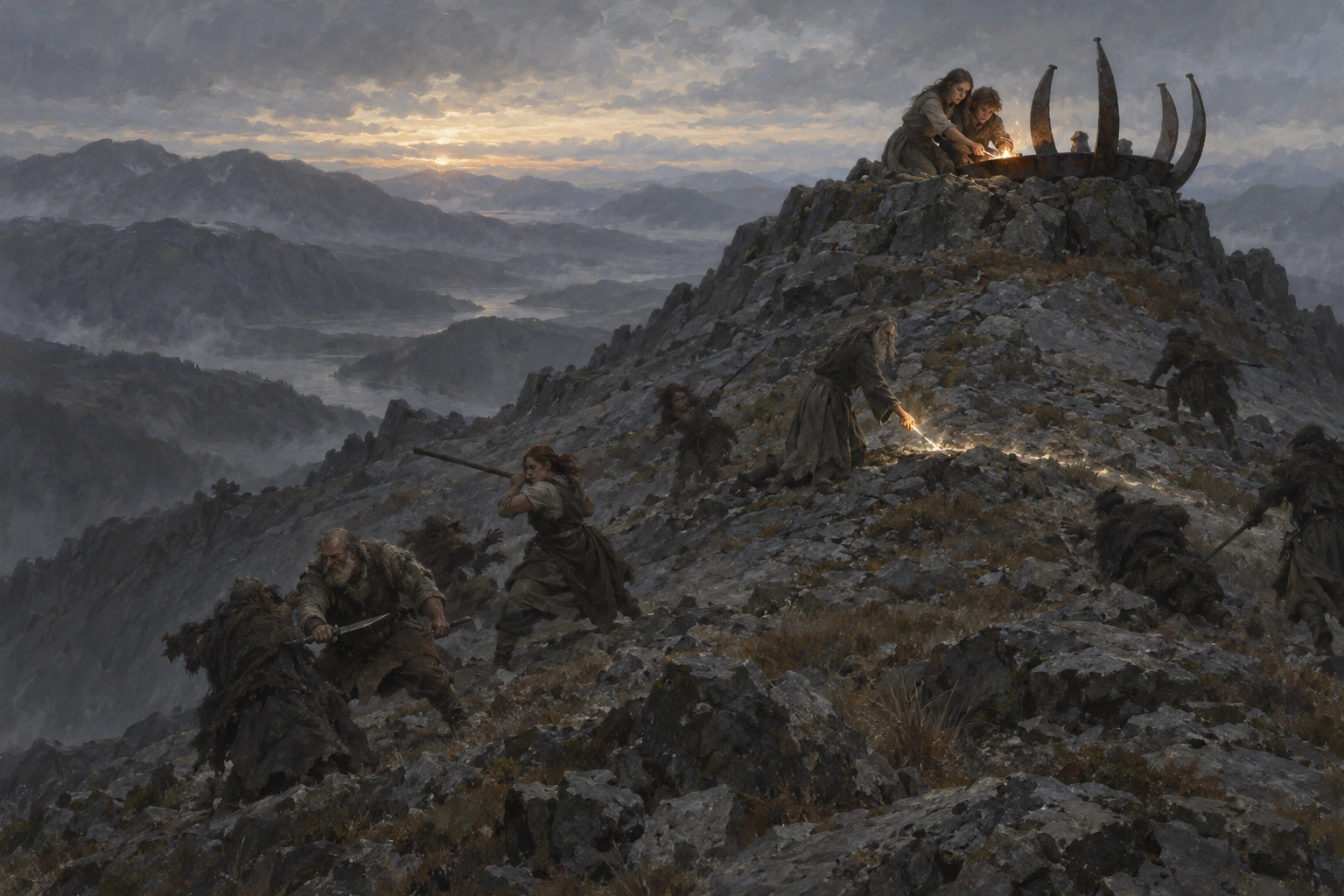
They went up in the grey before true dawn, ten abreast where the road allowed it and ten in column where it did not, and the first of the faded came for them before the light had finished deciding what hour it meant to be.
It was not a fight the way Wren had once understood the word, back when a fight meant noise and the ragged edge of fear in every voice at once. This was quieter, and worse for the quiet.
Once, in the thick of it, Bracken shifted his stance a half-step wider than the ground strictly required, and put himself where three of them would have to come at him one at a time instead of together. It was an old habit. It was thirty years old, at least, and it had kept better soldiers than Wren would ever meet alive on worse ground than this. He did not think about doing it. His feet simply found the shape a much younger man had drilled into them somewhere she had never asked him about and never would.
Bracken went into the first knot of them without a sound beyond the sound the work itself made — steel finding what steel was built to find. Three down. Wren had not finished counting to three. None of it cost him a backward step. He did not call warnings. He moved to where the danger stood thickest as though it were a chore already decided upon, and what he did to two men-shaped things that had once, unbearably, been men, he did with the flat patience of an old job done in the old way, quick and complete and entirely without heat, a thing done thirty times over until a man stops counting the doing of it and starts, instead, keeping a tally of the mornings he was still standing after. He wiped his blade once on his own sleeve when it was over and looked for the next thing that needed him. He did not look twice at what he had put down. He never did.
Dorrit held the eastern shoulder of the road and gave no ground back for the better part of an hour, though three faded in turn put their whole weight against taking it from her. Wren watched her cousin turn a blow with the iron-shod foot of her staff and follow it through into a strike that dropped a grown man's worth of cold-white flesh into the frozen verge, and thought, not for the first time this year but harder than she had ever let herself think it, that Dorrit was formidable in a way none of them had quite said aloud — startling for how plainly it had always been there, under the herb-craft and the quick tongue and the willingness to be laughed at for loving a mule. She did not retreat because retreat was not, this morning, a thing she had allowed herself to consider. The set of her shoulders said the ground behind her held people she had already decided were hers to keep, and a person does not give up ground that holds what is hers.
One came at her low, going for the knee the way the winter-bred had learned to go for a knee two years back, and Dorrit did not step away from it. She stepped into it, took the strike on the staff's shaft rather than its foot, and put the answering blow into the thing's throat with both hands and the whole turning weight of her body behind them. It went down. It stayed down. She was already looking past it for the next one before the first had finished falling. Bracken, thirty feet off and mid-stroke of his own, caught it out of the corner of one eye, and the look he gave her over the falling body was the closest thing to a compliment Wren had ever seen him pay anyone in three years of watching him work.
Alder walked the column's spine laying lines Wren felt before she saw them — not chalk, though there was ash somewhere in it; a shape set down with his hands and his voice together, old-tongue syllables she had heard him use a hundred times before, never at this pitch, never sustained this long without a breath's rest between one working and the next. Where his lines closed, the ground on the far side of them stopped being ground the faded could stand on. It made them flinch as a burned hand flinches from a second fire. They went round it, or they did not go at all.
More of them came than Wren had let herself count at the tree line. They came in twos and threes out of the grey below the switchbacks, without hurry, moving the slow patient way nothing left alive would ever choose to move, and where a man might have shouted a warning down the column, Bracken only lifted two fingers and pointed, once, and the shape of the whole company shifted to meet the number without a word passed between any of them. There was nothing to be gained by noise on that hillside, and nothing lost by its absence. A man who has done a hard thing thirty times learns that the doing of it is quieter than the fearing of it ever was, and Bracken had long since stopped fearing mornings built this particular way, whatever else in his life he still had room to fear.
And under all of it, holding it together the way a keel holds a hull together in water that wants it apart, Wren named ground.
She had done this before on a scale far smaller than this — a camp's width, a hollow's width, once, unforgettably, the width of a single spring-house wall she had failed to cross in time. This was Kelder's whole climbing shoulder, tree line to crown, and she did it the only way she knew: one name at a time, borrowed and spoken and set down like a stone laid into a wall, each one costing her the same coin it always cost, each one landing exactly where Alder's lines told her the ground would hold it, exactly where Luel's rising voice told her the working could bear the weight a moment longer. By the time the sun cleared the eastern ridge she could not have said which of the three crafts was doing which part of the work. She knew only that without Alder's shape her names would have run off the hillside like water off stone; that without Luel's voice the working would have guttered somewhere short of the crown, a fire with nothing left feeding it; that without her own names, Alder's lines would have held nothing at all — an elegant shape drawn around an empty room.
She had never held this many at once. Thirty-seven names lived in her already, taken up one at a time across two years of road, and every one of them had settled into its own small permanent place in her, fixed there for good, like a nail driven true and never worked loose again. This was different. This was not one name laid carefully beside the last. This was a whole hillside's worth of borrowed lives, poured out faster than she could properly feel each one arrive, and the only thing that kept the pouring from becoming a flood was Alder's shape catching it and Luel's voice carrying it, name after name after name, until Wren no longer knew where the counting stopped and the working began.
Twice in that first hour the working nearly came apart, and both times it was the other three crafts that caught it before it fell. Once, a faded broke through a gap in Alder's line before the shape closing it had finished closing, and Bracken was already moving to meet it before Wren had finished the name that sealed the gap behind it, so that the thing found itself fought on one side and shut out on the other in the same three seconds, unable to go forward and unable to go back to whatever ground it had come from. Once, Luel's voice caught on a line of the working itself, not the song, a low sustained note that had to be held through a full minute of fighting for Wren's names to have anywhere to land, and it was Dorrit, of all of them, who put herself bodily between Luel and the two faded pressing toward her, staff planted, taking blows meant for a throat that could not stop singing long enough to defend itself. No one had assigned her that post. She had simply seen where the singing needed a body standing in front of it, and gone to stand there. By the second hour there was no longer any honest way to say where Bracken's steel ended and Dorrit's ground began, or where Alder's lines stopped needing Wren's names to hold them and started, instead, needing Luel's voice to keep either one from failing under the strain of the other, and Wren herself had long since stopped trying to hold the four of them apart in her own head, because a working that size did not care, any longer, whose hands were doing which part of it.
"Kelder," Luel sang, and her voice widened rather than rose, filling low ground the way water fills it without ever seeming to hurry there, "held its watch three hundred years, and no one asked it to."
That line was not the lament. Wren knew the lament; she had written it whole into her own day-book years and a country ago, at another fire, in a different kind of quiet. This was Luel finding her own door before the door, and when she reached the door itself — when she gave the lament's actual first words, unaltered, to a hillside being climbed at that very hour by the company the lament had once mourned as gone for good — something under Wren's hands changed key, though not one syllable of the song itself had changed at all.
They lit the first on Kelder's height, Luel sang, and hill to hill the word was thrown—
It was a story about a night three hundred years dead, sung exactly as it had always been sung, without one word added or subtracted to make it fit the morning it was being sung into. And somewhere between one line and the next, it stopped being a story.
Pip's failure came at the worst height of the climb, in the one place in the column meant to keep him safest.
He had carried the flint the whole way up without dropping it, walking between Bracken and Wren in the rotation built around him since the twice-signed sheet had surfaced, saying almost nothing beyond a single low sound when the first faded broke from the slope ahead — not fear exactly; something nearer recognition, as if some part of him already knew the shape of what was coming before his eyes had finished placing it. Twice Wren had glanced sideways and caught his lips moving without sound, a man rehearsing a line he was afraid of losing, and each time she had told herself it was only the flint, only the weight of the one task in the whole company that was unambiguously his.
They reached the crown with the last of the faded still pressing from below, held there by Bracken's blade and Dorrit's staff and by ground that no longer wanted them the way it once had. The old fire-basket stood black and empty at the very top, its iron pitted with three centuries of weather and nothing else. Pip knelt at it, flint in one hand, striker in the other, and struck. He struck again. He struck a third time, and no spark caught anything the tinder could hold.
On the fourth strike his hands shook. The steel skated wide of the flint entirely.
"Pip." Nothing. Something in her went cold that had nothing to do with the morning.
He struck once more, and his hand simply stopped — not dropped, not flung wide, only stopped, mid-motion, flint and steel held an inch apart and going no further, his eyes fixed on a middle distance that held nothing Wren could see and everything he could. His lips moved again, faster now, no sound behind them at all. The flint began, very slowly, to slide from fingers that had forgotten what they were for.
Sael took it out of his failing hand before it reached the ground. She struck it twice against the steel, low over the tinder, and on the second strike the spark caught and held.
No one thanked her. There was no room in the seconds that followed for the thought to have occurred to anyone: Bracken was three strides off putting down the faded thing that had broken past Dorrit's shoulder in the crown's last exchange, Alder's whole voice bent toward closing the final angle of his working before the flame under Pip's — under Sael's — hands could draw anything worse up the slope to answer it, and Wren's hands were full of the last three names she had left before the morning's naming of ground was finished. The flame caught the tinder, found the seasoned wood laid in beneath it by some long-dead Meddani hand against exactly this morning, and climbed.
Luel's voice met it climbing.
They lit the first on Kelder's height, she sang again, the whole verse this time, easy in the way only a very old and very sure thing can afford to be easy while everything around it strains, and hill to hill the word was thrown— Ness Fell caught it in the night, faster than any rider's known.
Ness Fell had caught it four days ago, from this very hill, by Wren's own two hands. Now Kelder was answering — flame standing up thin and pale in the grey morning, then taking hold in earnest, throwing its first true light across a crown that had carried none since before anyone's grandparents' grandparents had names — and the second stanza rose out of Luel the way well-water rises after three hundred years of a rope going down empty.
They lit them bright for harvest home, lit them thin to say the snow, lit them so no one need roam farther than the light would go.
Then the frost came up the water and the doors we loved stood still, and the fires went out, and none came after, neighbor-dark to neighbor-hill. Every word of it was the word it had always been, made a year and a country away at another fireside for an entirely different grief. And every word of it was, on this hillside, at this hour, no longer true in the way it had been true for three hundred years. Kelder had not gone dark forever. It was burning under their hands as she sang its going-dark. The last stanza came — Kelder first, and then Ness Fell, and the small hills, one by one — but Wakelow held its watch so well it burned a long time, burning alone — three hills named in a single falling verse, two of the three now burning, the third never having gone dark at all, and the whole company standing inside a lament that had, without a line of new verse in it anywhere, stopped mourning and become instead something closer to an account paid in full.
She did not remark on it. The fire climbed the basket's black iron, throwing light far enough down the slope to show the last of the faded already breaking from the crown, going back down into the dark that still, for the moment, belonged to them.
The fighting did not end with the fire. It thinned, the way a crowd thins rather than disperses, and it took the better part of another hour to finish thinning, the faded coming on now in smaller and smaller knots as whatever passed for their own arithmetic worked itself out against the ten people who had climbed the hill to take it from them, until what had begun as a press of numbers Wren had deliberately not counted at the tree line ended as a scatter of single things going down alone, one at a time, against a company that no longer had to think about where each of the four crafts began and the others left off.
Three faded came at the crown together in the last real push of the morning, drawn, Wren thought, by the light itself, by whatever in what remained of them still recognized fire as a thing worth stopping. Bracken met the first with a stroke so plain it barely looked like violence at all — a turn of the wrist, a step that put him where the blow needed him to be a half-breath before the blow arrived — and the second he took with Sael at his shoulder, her fiddler's hands closing round a spear-haft with a competence nobody had asked whether she possessed. The third reached Dorrit, who put it down with the same iron-shod economy she had shown the whole morning and then knelt, before its stillness had fully settled, to press two fingers to Ossen's ribs where the wound had opened wider in the pushing.
Wren spent her last three names into the ground at the crown's northern lip, where the working had thinned enough under the weight of the fight that a gap had begun to open — not wide, not yet dangerous, but a gap, and gaps on that morning did not stay small on their own. She gave the names quickly, without the care she would ordinarily have spent choosing them, because there was no time left to choose, and felt each one bite into the ground like a stitch pulled tight through cloth already under strain. The gap closed. It held. She did not know, in that moment, what closing it had cost, only that something had gone out of her with a different weight than the names before it, sharper, and that she had no time to ask herself what it meant before the next thing needed her hands.
The cost came all at once, the way it always did, and it came from more than one direction.
Wren felt her own working reach past the edge of anything she had asked it to hold, somewhere in that last minute at the northern lip, when the ground wanted three names more than she had carefully spent for it and she gave them anyway rather than leave one gap standing open. She felt the names go, felt the old familiar weight settle into her, permanent, quiet, hers from now on to carry. In the same breath she felt something else slip loose that was not hers at all — a small tearing, distant, a thread pulled free of a coat two rooms away — and she did not learn what it had cost, or whom, until Dorrit's voice reached her from somewhere behind, thin and strange in a register Dorrit's voice had not once used in three years of Wren knowing it.
"What was it." Dorrit was crouched over the small grey-leafed plant at her own feet, the reflex of a woman who checked every green thing she passed whether it was needed or not. "I know this. I have known this since I was four years old. My mother taught me this plant before she taught me my letters, and I can see the leaf, and I cannot—" She stopped. Her hand hovered above it, and the name would not come.
Wren said nothing, because she did not know herself whether the name would come back by evening. She understood with a certainty that made her sicker than anything the morning's violence had managed exactly what she had spent, and exactly whom she had spent it on: a woman already carrying two graves from a steading four days behind them, a rimewort kit spent down to nothing, a quarrel with her own cousin gone quiet rather than gone. Wren did not say she was sorry. There was no shape sorry could take on that hillside that would have given the plant's name back to her, and she had learned, across two years of learning it, that the saying of the thing was never truly for the person who had lost something. It was only ever for the one doing the losing, to feel less alone in having caused it.
She herself was worse than she had been in a long while — thin through the face by evening, grey around the mouth, her hands shaking too hard by the descent's first halt to manage her own water skin without Bracken's steadying grip under her elbow. She had not spent this much of herself since before she learned, properly, how to spend it at all, and even Alder's teaching, which had made every lesser working since almost gentle by comparison, had nothing in it built for a hillside this size.
Alder's cost showed later, and smaller to look at, and worse to understand.
He came to stand by the newly caught fire once the crown had gone quiet, looked at it a long moment, and said a single word of the old tongue under his breath — a small closing shape he had used a hundred times to seal the last edge of a working once its purpose was served. It did not come. Nothing came. He tried again, lower. It still did not come — not wrong, not garbled, simply absent, a shape his mouth no longer knew how to make, as if some door that word had always opened had been shut from the far side and the key lost somewhere on the climb. His hand rose half a span, the same old gesture Wren had watched fail to finish itself outside a different fire five days before, and then he let it fall, and closed the working the long way instead, with three words where one had always served him. He did not mention it.
Bracken was not marked the way the other two were marked, and Wren was glad of that in a way she did not examine too closely. He had taken a shallow cut along one forearm sometime in the crown's last exchange, the sort of wound Dorrit could close by evening and forget within the week, and he wore it as he wore everything: wrapped by his own hand before anyone could fuss over it, and set aside so he could go back to counting heads.
Two of the four Amarin came down off the crown hurt badly enough to need help walking part of the way — Wend with a wound along the ribs that had Dorrit's full attention for the better part of an hour, Ossen with a hand that would not close properly around anything for days to come. Both were, when the counting was finished, still arguing with Dorrit about how much help they actually required, which Wren had learned, by now, to take as a fair sign of a person who was going to live.
Sael walked down under her own power, unhelped, saying nothing to either of the two who leaned on Bracken's shoulders in turn, and nothing to Ferrit, who kept close to her the whole descent without once trying to take her arm. Wren watched them go past her on the switchback and thought of Luel's own six, of a company of six reduced to four at a ford none of them had reached yet, and did not say any of it aloud, because there was nothing in it that would have helped Sael carry the flint she had used and set down again without anyone noticing the moment she let go of it.
Pip was carried.
He had not woken since the flint left his hand. Bracken built the litter himself out of two spear-hafts and a length of tent canvas, without asking anyone's opinion of the design, and lifted the boy onto it with the same wordless care he had shown moving a bedroll five nights before. He did not remark on how much lighter Pip felt in his arms than a boy of sixteen should have felt. It was worse to look at than a wound would have been. A wound has an edge to it, a place where the harm stops and the person begins again. This had no edge Wren could find. She walked beside the litter a while on the way down, watching his chest rise and fall, evenly, steadily, telling her nothing at all about how much longer that particular rhythm still belonged to him.
No one said the hill had been worth it. No one said it had not. They went down Kelder's western shoulder in the full light of a morning that four hours before had belonged to something else entirely, carrying two litters and two limping Amarin and a grief for a plant's stolen name and a fire that would not go dark again on their account, and none of them tried to weigh the one thing against the other. There was no scale built that could have held both without breaking under them.
They made camp that night in a fold of ground a mile below the crown, close enough to see the fire still burning behind and above them whenever the wind pulled the smoke aside, and far enough that Pip's litter and Wend's ribs and Ossen's ruined hand could all be settled where the ground was flat rather than where the ground was defensible, for once in this whole long road. Dorrit worked past dark by firelight, hands moving over three patients in turn with the same unhesitating competence she had shown on the hillside, though every so often, mid-stitch or mid-binding, Wren caught her glance sideways at the small grey-leafed plant she had gathered without thinking and set down beside her kit, as if looking at it again might jar the name loose. It did not. Alder sat a little apart from the fire with his hands loosely folded, not working, not sleeping, simply present, and once, when Bracken passed him a cup of something hot without a word, Alder took it with the hand that still answered him and let the other rest in his lap, and Bracken, who missed very little that happened within arm's reach of a fire, took the cup back empty some while later and refilled it without remarking on which hand had emptied it.
The fire-code ran the whole length of the line five nights later, and it took less than an evening to do what no rider in three hundred years had ever managed in a season.
They watched it from Kelder's own crown, where the company had made a rough camp to give Pip and the two hurt Amarin time enough to mend before the next stretch of road, and where the fire Sael had struck five days before had burned low and steady every night since, banked carefully and kept from going out. On this night Alder built it high again, and higher, and then, with Luel beside him reading the old count aloud under her breath, began working the flame itself — smothered and freed, smothered and freed, in the particular rhythm three hundred years of Cartographer-lighters had built the code to carry. Ness Fell answered within the hour, a small hard star opening on the eastern horizon exactly where Luel said it would open. Wakelow, which had never gone dark at all, only burned a fraction brighter, as though acknowledging company it had waited three centuries to have again. Beyond both of them, hill after hill down the line the company had walked the length of, small lights woke one after another faster than any horse could have carried the news between them — exactly as three hundred years of Cartographer-lighters had always meant it to work, and had never, in all that time, had the chance to prove.
Wren watched the line burn itself alive across half a night's horizon, Luel standing with both hands pressed briefly to her own mouth, and thought it the gladdest thing she had seen in the whole of that year. She did not try to make it last longer in memory than it lasted in the sky. She had learned, by now, that some things are only glad for exactly as long as they are happening.
The snow came four days after, on the Doors of Cloud, and did not stop for three more. By the time it stopped, the Gray Stair had shut behind it, the way it shut every year at this season — only this year with the whole company standing on the wrong side of it, and no way left to be otherwise. Whatever remained east of that pass would stay east until spring found a way to open it again. Whatever remained west of it, Cael Meddan and everything still moving in the dark around it, would have to be met, if it was to be met at all, by ten tired people with no one coming up behind them.
Far off, low on the western horizon where the falling snow thinned enough to let the eye through, Wren saw it for the first time in this whole long road. Cael Meddan: white, and vast, and utterly silent. The winter that had just shut the door behind her was already there ahead of her, arriving at its gates.