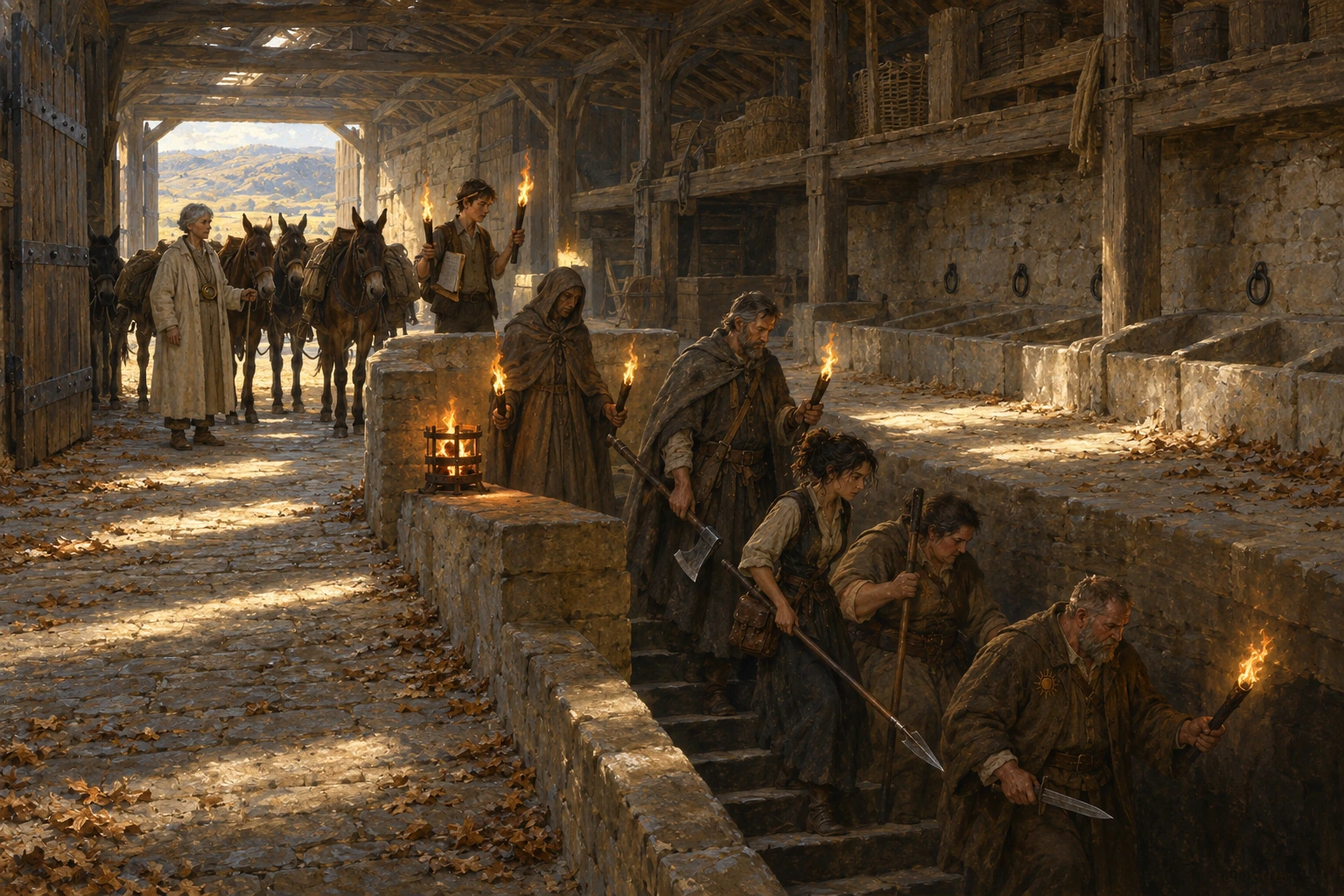
The Way-Fortress
"I have looked at this house from every angle a stone's throw allows," Dorrit said, over the last of the porridge, "and I am done admiring it from a distance. Somebody go in and tell me whether it has a kitchen."
"I mean to," Bracken said, already on his feet and working the last of the bowl clean with a heel of bread, "and I mean to go in alone, before the string comes through it. Thirty years I've kept mules, and I have never in that whole thirty years put a loaded string into a building I hadn't walked myself first. Won't start on this one."
Iyene said she and Pip would take the fabric of the place once Bracken had walked it clear — the spans, the stonework, the plan of it, drawn true before boots had disturbed the dust of it. Alder said he, Wren, and Luel would see to the far end and whatever yard lay behind it. That left Dorrit to go in on Bracken's heel and take the stores and the standings with him, which suited her, since stores and standings were the whole of her business in any house she meant to live in.
Bracken walked the gateway alone first, taking his time, a lit brand held low and swinging gently as he went, and came back out a few minutes later with nothing more remarkable to report than that the road ran straight through and the roof held the whole way. Then the mule-string came, Iyene leading Suet by the halter and the rest following nose to tail behind him, and the company went in behind them, on foot, into the first roofed ground any of them had stood under in five days. The change was in the sound of it before it was in the light. Bootfalls that had been going out flat into open country all week came back off the stone overhead, doubled and gone soft at the edges — the answer a barn gives back — and the mules' own feet made a rounder noise than they had made ten paces back.
The road ran through the gateway and did not stop there. It ran the whole length of the house, under one continuous roof, wide enough for two loaded carts to pass abreast without either scraping a post, and out again through a second gateway a good stone's throw beyond the first — the same road, unbroken, the house merely a long covered stretch of it, built to carry traffic through exactly as any bridge is built. The great leaves of the near gate lay flat inside against the wall where they had come off their pins, or been taken down by some hand long since gone — two long tables of oak stood on edge and leaned there, waiting on a carpenter who never came — the timber of them still sound enough, Bracken said, running a thumb along one hinge-scar, to be re-hung by anybody with the will and the ironwork for it. It answered a question none of them had thought to ask aloud: the road had run through this house exactly as it always had, all this time, because there had been nothing left standing across it to hinder anything.
Light came down the length of the roof in long soft bars where age had loosened a slate here and there, falling across a drift of dead leaves just inside the threshold, deep enough in one corner to have made a nest for something that no longer used it. Down one side of the road stood bays for beasts, stone mangers built into the wall of each and iron rings still set true in the stone above them, waiting on head-ropes that had not been tied to them in longer than any of the company had been alive — a good inn's whole stabling, swept out and standing ready, with the horses generations late. Down the other side, opposite, stood open bays for goods, each one deep enough to back a laden cart into, a loft-floor running the whole length above them on stout beams that Bracken thumped once with his fist and pronounced, with real satisfaction, "sound as the day they were cut."
Over the goods-bays ran a gallery of small plain chambers, reached by two stone stairs at either end, each chamber holding nothing at all but a shuttered window that looked down onto the road below and had never, by the look of the dust on every sill, looked at anything else. Jackdaws had built and abandoned generations of nests in the high spans — whole grey twig-towns of them, wedged into every joint the roof offered and built again on top of themselves more times than anybody could have counted from the ground; a single old swallow's nest, empty and papery, clung under the farthest eave. One bay near the road's far end had lost its slates entire, and the floor beneath it carried three hundred winters of rain in a long pale stain across the stone — the one ruined thing in the whole building, and even that no more than a stain, nothing fallen in, nothing given way.
"It's not a ruin," Iyene said, halfway down the road's length, turning slowly on her heel with her glass raised to take the spans in one sweep. "I keep waiting for it to be a ruin, because that's what three hundred years generally leaves a person, and it simply isn't one. A person could move a household into this tomorrow."
"A person's about to," said Dorrit, who had already found the stairs down the road's far end and was walking them with the particular suspicion she brought to any building she meant to feed people out of.
At the road's far end, off the through-way, the house opened into rooms built for staying rather than passing: a kitchen with two hearths and a bread-oven sunk into the thickness of the wall itself, its mouth a low black arch wide enough to take a day's baking for fifty; a common room with one long hearth broad enough to have warmed a road's worth of travelers at a single sitting; a clerk's room with a long table and shelving run empty round three of its walls; and, past all of that, a walled yard open to the sky with a well sunk true in the middle of it, its coping stone worn to a shallow curve on the side that faced the kitchen door, hollowed soft as a doorstep by generations of the same errand. Bracken dropped a stone down it and counted, satisfied, before the small distant answering plash came back to them. "Sound," he said. "Wants drawing off is all, same as any well left standing unused this long."
Nobody lit anything. Twice over the morning somebody moved toward the kitchen hearth with flint and steel already half out of a pocket, and twice Dorrit stopped them with nothing more than a look and the flat statement that she would not have a fire lit in a house that was not yet theirs. "When we've walked it end to end and found nothing owed a second look, I'll light every hearth in the place myself," she said, the second time, to Pip, who had only meant to warm his hands. The working fire Bracken built later at the stair-head — kindling and pitch-pine laid ready against a need not yet arrived — was a wholly different thing from a hearth, and was allowed.
Luel walked the through-road once from end to end without speaking, and stood a while under the roof's central span with her head tipped back. "This is the comb-mark," she said at last, to Wren, "drawn in stone instead of ink. A way-house, built to hold a road rather than to hold anything off it. I have not stood under a roof this shape in longer than I generally care to say." She did not stay to watch the survey finish; she took herself instead toward the far end, where Alder and Wren were already tracing the last of the rooms.
It was there, off the road's spine and short of the yard, going down a narrow side-passage neither Alder nor Wren had yet walked, that they came on the stair — a broad stone flight running down under the goods-bays, a stout door standing open at its head. Wren looked down it, saw nothing but dark and the first three worn steps the daylight reached, and noted it in passing, exactly as she had noted the well and the loft-beams and the stairs to the gallery: one way down, one door, a cellar for keeping stores cold, of a kind any house this size would want and any house this old would have. She thought no more of it, and went on to help Alder measure the yard's own walls, because there was still a whole house's worth of ordinary daylight left to walk.
It was Dorrit who found the wrongness in it, an hour or so later, coming up from below with an armload of empty grain-sacks she had gone down to fetch, and stopping three steps from the top with her face gone thoughtful.
"That's not cellar-cool," she said, and then, when Bracken came to see what had stopped her, said it again, more exactly. "I know cellar-cool. I've stood in forty cellars if I've stood in one, and every last one of them has the same flat, stale, held-breath sort of cool to it, the kind that never changes whatever the weather's doing outside. This has weather in it. This is a cold with something moving behind it, on a fine dry morning, in a house that's dry as a biscuit everywhere else I've stood in it."
Bracken went down two steps himself, knelt, and ran a thumb along the underside of the third step from the bottom of that flight, where the stone overhung the one below it. He came up with frost on his thumb — thin, fresh, gathering in a house that had stood warm and dry under a whole clear autumn morning's sun.
They sent for Wren, because Wren's office was names and the Waybook and, more than either, the particular attentiveness the company had learned to trust in her when a thing did not sit right; she came down the passage at a walk that was not quite a hurry, and was three steps above Dorrit and Bracken when she heard it — not loud, not close, and gone again almost before she had finished hearing it: the sound cold makes when it finds a crack in something that had been, until that moment, whole. Or nearly. The one at the picket had kept to the edge of the firelight and had never come nearer; this one was climbing.
Bracken said, "Up," in the same flat voice he used for turning a mule off bad footing, and they came up together, steady and in good order, and he pulled the door shut behind them and dropped the bar across it that had waited all that time for somebody to need it again.
The council was held in the yard, in full daylight, over the everyday business of the morning — Dorrit's grain-sacks set down where she'd been carrying them, Pip's board still under his arm from the survey he'd been running when he was called over. No voice in it went above the pitch of the porridge that morning. The stair-head door stood shut a good thirty paces off, and every person in the yard kept a shoulder turned to it.
"It's been lain up in a long while," Bracken said, when Alder asked what he read in it. "Not a night's visit, not one bad season's worth. Frost building on the underside of a step wants years of the same thing happening over and over in the same spot before it leaves that kind of mark, and that's a mark, not an accident. Whatever's down there came to that cellar a long time before we came to this house, and it's been keeping it because it's home, and has been home a long while — not because it followed anybody's road to get there."
Alder gave no more of a speech than four short sentences needed. "We go down today," he said, "in good light, with every one of us awake, rested, and fit for it. Tomorrow we'd be going down having slept a whole night over the top of it, which I don't recommend to anybody. Better to meet a thing at ten in the morning with the whole day behind us than at three, with half of us dreaming. That's the whole of my argument, and I don't think it wants a longer one."
Luel said only that her own songs did not know what was down there, and that she found she wanted to see it for herself rather than go on not knowing, and that was the whole of her case, offered and accepted in the same breath. Positions were settled in the space of a few sentences and never revisited: Bracken, Dorrit, Alder, Wren, and Luel would go down; Iyene would keep the mules and the mouth of the stair; and Pip — Iyene named him for it before anyone else could, in the same tone she used for any working assignment — would hold the light at the stair-head and keep the count of who went down and who came back up, a tally being exactly his craft. He took a fresh leaf, ruled two columns on it without being told how, and said only, "I'll want everybody's name said to me going down, so I've got it in my own hand and not just my head," and that was how it was done.
Bracken built the fire at the stair-head himself, pitch-pine mostly, laid to catch fast and travel well in a carried hand, and while it caught he saw the company armed, without fuss, exactly as he would have armed any party going into beast-country. He took down his own sword — the short heavy single-edged soldier's blade he had carried unremarked the whole year and kept an edge on since the beacon road — and beside it two broad-headed spears out of the panniers, each fitted with a cross-bar set below the head. "That bar's so the thing can't drive itself up the shaft onto your own hands once the head's gone in," he said, once, and gave it no more weight than he gave any other piece of kit worth naming, and put one of them into Wren's hands, checking her grip on the brace and the bar exactly as he had already shown her twice on the road. The second went back into the panniers; between Dorrit's staff and Alder's axe and his own sword there was no spare hand left in the party to carry it. Dorrit took up her own staff, iron-shod at both ends and long since proven on a wolf's shoulder. Alder took a felling axe from the store Bracken had broken open, and hefted it once to find the balance of it. Every one of them wore a belt knife besides, and every one of them carried a brand in whichever hand was left over. There was no more ceremony in the going-down than there had been in the coming-in that morning. Bracken went first, sword in one hand and his brand in the other; Dorrit a step behind him with her staff; then Alder with his axe; then Wren, her spear held low exactly as she had been shown; and Luel last, carrying nothing but the small knife at her belt and a brand in either hand, held high — and the cold met them on about the fourth step and did not let up after that.
It deepened with every step down, not sharply but steadily, until the brands they carried burned low and grudging, their light shrunk to a small reluctant circle that gave back only a few feet of vaulted stone at a time. The flames stood up thin and blue along their edges and leaned nowhere, which is what a candle does in a draught, and there was no draught in that stair at all. The vaults themselves opened low and wide once the stair let out into them, one squat arch after another running the length of the undercroft, the air still and close and cold enough now to show every breath as a small pale cloud that hung a moment before it thinned.
They found the den at the far end of the second vault: a drift of old fallen dunnage and broken cask-staves heaped loosely against the wall, the stone behind it frost-furred white and worn to an unnatural smoothness in a long low patch where something had lain, and lain again, for longer than any one season could account for.
It came at the light before any of them had finished taking that in — low, fast, and heavier than its size promised, a shape that filled the reach of Bracken's brand for one instant and then was already inside Dorrit's swing. Her staff took it across the shoulder and turned it half around; Bracken's sword went in behind the turn, and Alder's axe came down over both, and it went still on the stone within four strokes of the first, with no cry given at any point in the taking, only the small cracked-ice sound she had heard on the stair, sharper now and gone the instant the steel cleared it. There was nothing in it, laid out on the vault floor, worth a second look.
Wren had already begun, low and steady, before the first blow fell: her own name, and then the others', said over in order and started again the moment the round finished — Wren, Dorrit, Alderin, Iyene, Bracken, Pip, Luel — not raised, not hurried, said the way the Cold Coomb had taught the whole company to say a name that mattered. She felt the cold give back a little wherever the round reached, not driven off but held at a kind of arm's length, the ground under the company's own feet staying the company's own for as long as she kept saying. It was a smaller task than the one the fold had asked of her — that had wanted a whole day's carrying, a town's worth of names spent one at a time across a distance none of their own seven could have crossed alone. This wanted only minutes. Seven names, said steadily and never let drop, turned out to be plenty for it.
The second did not come at the light and did not run from it. It held the open floor of the vault, low and long and by far the largest of the three, and for a moment nobody moved on it at all.
Then Bracken did, and the company found out what the short heavy blade had been carried for.
He did not swing. He walked it — two steps to his left, unhurried, so that the thing had to turn its long body in a space that would not let it turn; and when it committed to the turn he was already inside the arc of it. It raked his forearm as he came in, and he took the graze rather than give up the opening. The sword went in under the shoulder and stayed in while he set his boot against the ribs and dragged the edge the whole length of the wound and out. It took about four seconds. He stepped off it before it had finished going down and checked the room in one flat sweep — Wren, Dorrit, Luel, Alder, the stair — and only then said, to the room, "Two."
Dorrit looked at him. Bracken was already wiping the blade down on his own sleeve.
The third had been at the far wall in the dark the whole while, and it had learned something from the other two. It broke as they were still standing over the second: not at the light and not at any of them, but low along the wall and up the stair in four bounds, past Bracken's reach before he had finished turning, out through the stair-head door into the daylight and the covered road beyond.
It got perhaps nine feet down the through-way.
Nettle had not shifted from where Iyene had given up trying to move her a full minute before, which was square in the middle of the road with the whole covered length of it at her back. She put a hind foot through it with the flat unthinking violence of a mule swatting a fly, and it was finished before anybody had come up the stair behind it. "Of course it was her," Iyene said afterward, in a voice carrying no more feeling than a note filed away in a working sheet, and went back to steadying Suet.
"That's the three of them," Bracken said, once, flatly.
They came up the stair in the order Pip had asked for, each name given to him aloud and set down in his second column against the first, until the tally stood whole and answered — five down, five up, nobody left below. Bracken came last, his sleeve already dark along the forearm, and it was Dorrit who caught his wrist and turned it to the daylight before he'd finished saying it was nothing.
The wound's edges had gone frost-white, and did not bleed. For most of a minute — the worst minute of the whole day, by every face turned toward it — it sat there pale and dry across his forearm, wrong in a way none of them had a ready word for, until the warmth of the yard and Dorrit's own hands working at it brought the color back into it by slow degrees, and then, all at once, it began to bleed ordinary red, the same as any cut anywhere, and every shoulder in the yard came down half an inch at the sight of it. Dorrit's hands went faster on the binding than they had gone on the examining. She bound it clean at the kitchen hearth she had still not lit, and Bracken sat and let her, and that was the whole of it. Nobody else had so much as a scratch. Pip had stood the entire time at the stair-head with his tally board in both hands and had come no closer to the fight than that.
They carried the three of them out beyond the far gate before the afternoon was old, and laid them out in ordinary afternoon light to be looked at once, before the burning. In that light they were smaller than the vault had made them seem, low four-limbed shapes no heavier built than a big lean hound apiece, and there was nothing to be read off any of them once looked at — no mark, no meaning, nothing a person could carry away and call learning. Bracken burned them on open ground past the gate before evening came down, because a house a person meant to live in was no place to leave carrion lying, and there was no more solemnity in it than in any other end-of-day chore he had ever seen through.
"They were bred, not made — nothing chose them, and nothing will miss them," Luel said, when Wren asked her, later, what they had been. "The long dark grew them the way cold ground grows ice, and that is the whole of it."
The rest of the daylight went into walking the house whole, room by room, bay by loft by vault, with lights carried into every corner a lamp could reach — because a house was cleared once, in full, and then a person stopped worrying at it. They found nothing else. The emptiness, room after room of it, came as a plain relief rather than any kind of letdown, and after the last chamber had been walked and found only dust and jackdaw-straw, every dark doorway in the place went uninteresting for the rest of that day.
Iyene went down into the undercroft herself before the light left it, and came up an hour later with the whole vaulted length of it drawn true to scale on her working sheet, the den, the stair, the one door, set down clean among the goods-bays above it. "A house we mean to live in ought to be known," she said, "not merely survived," and put the sheet away. Bracken drew the well off before supper, working the rope hand over hand until the water came up clear and cold enough to ache in the teeth and tasting of nothing whatever, which is the whole of what good water tastes of, and pronounced it, with visible satisfaction, fit for anything.
Somewhere in the middle of it, hauling a last sack of meal in from the yard, Bracken said, in half a sentence, that seven people and four mules were not going to winter on what four mules could carry, and went on hauling. There was nothing yet to answer him with.
It was Pip, carrying a lamp down the through-road in the day's last hour to check a sill he thought he'd mismeasured, who found the letters cut into the lintel over the inner gate — the same gate they had all walked under twice already that morning, in flat unhelpful light, the cuts so thick with years of dust that they had read, to every eye that passed them, as nothing at all. Raking lamplight found what the day's own sun had missed: the shadow dropped into each cut and stood the letters up, and the dust that had hidden them all morning did the work of ink now that something came at it sideways.
"There's writing up here," Pip said, and held the lamp steady while the others came to look.
Wren could sound it, the forty old letters given to every keeper whole, handed down like a tune and never taught like a lesson — Ollathen — though the shape of it carried no more sense to her than any string of notes carried words, and sounding it gained her nothing of the tongue it belonged to.
"It means the open door," Luel said, when Wren looked her way, and turned back toward the kitchen.
Pip held the lamp a while longer at the angle that kept the letters standing, and copied the shape of each cut down onto his own leaf, and then took the lamp away again, and the lintel went back to reading as nothing at all. They went in to their supper calling the house what they had always called it. Wintergarth it was, and Wintergarth it stayed.
Dorrit lit the kitchen hearth first, because it was the one that made food, and she made no speech of it — struck the flint, coaxed the tinder, and had a fire drawing well in the nearer of the two hearths within a few minutes, exactly as she had said she would once the house had been walked whole and found owing nothing further. The room came back up out of the dark around the light of it by degrees, walls and shelving and the long table taking their old places one at a time, each of them turning out to have been standing there the whole while. The long hearth in the common room came next, big enough to throw its warmth the width of the room, and then a small fire at the stair-head itself, banked low for whoever sat the first watch over it.
"Three tonight," Bracken said, counting them off on his fingers without being asked, "and every other hearth in this house stays cold till we've the wood and the need to spare for it. A house with forty cold hearths isn't a poverty, so long as three of them are burning proper. It's a start, same as anything else worth having generally is."
Pip walked out through the far gate as the light was going, to see what the house looked like from outside with smoke standing up off it, and Iyene went with him, her glass in hand more from habit than any real need of it in that light. They stood together on the road a little way off and watched three thin columns rise straight in the still evening air off Wintergarth's roof — the first smoke off those chimneys in three hundred years, drawn true against a sky already going the color of pewter to the west. From where they stood it looked exactly like a place where somebody lived.
The mules went into the standings for the first time since spring, into stalls built for exactly this, their head-ropes made fast to iron rings old beyond any of their reckoning and none the worse for the waiting. Gable was asleep on his feet inside a minute of being tied, first as he generally was. Suet put her nose down into the stone manger, found generations of nothing whatever in it, and went on standing over it regardless, with the settled contentment of an animal that has been told at last where it lives.
Supper was eaten at Dorrit's own long table in the kitchen, by firelight, with the wind beginning to find its way round the yard's outer wall in low testing gusts that had not been there an hour before — a hand going along the outside of the house, trying every latch it could reach and finding, one after another, that all of them were shut — the first real change the whole fine day had shown, cloud thickening from the west since noon, the birds gone early to whatever shelter they kept, the light through the shutters going from gold to grey inside the space of that one meal. Dorrit passed the bread round and observed that the weather had held for them exactly as long as it needed to and not one hour longer, which she took as no more than fair.
Dorrit came round to Alder's end of the table after the plates were cleared, and stayed standing.
"That cut went white," she said. "I had warm water, my own two hands and a strip off Bracken's own shirt, and I do not know which of the three brought it back. I do not know that any of them did." She put her palms flat on the boards. "It was a graze. Had it been a bite I would have stood over him telling him it was going to be all right, and been wrong."
Alder set his cup down. "Yes," he said.
"That's not the answer I came for."
"It's the true one, and you'd have known the difference if I'd handed you another." He turned the cup a half-turn on the wood. "There's a plant. It isn't rare and it isn't hidden. It grows on ground the old roads ran through, which is most of the ground we've walked since the pass. Nobody gathers it, because what it's for has gone out of living memory."
"And what is it for."
"It makes a cold wound bleed."
Dorrit waited for the rest of it, and after a moment understood that there was none coming. "That's the whole of the virtue."
"That's the whole of it, and it's enough. A wound the cold has had doesn't bleed, doesn't close, and doesn't stay where you left it. Warmth will answer a graze, sometimes, if you're quick and the ground is with you. It will not answer anything deeper." He looked up at her for the first time since she had come round the table. "The root, not the leaf; the leaf is worth nothing whatever. Steeped, not crushed. Into the wound before the white has finished travelling — and then you want somebody sitting on the arm, because it hurts a very great deal more than the wound did."
"And if I'm not in time?"
"Then you were not in time," Alder said.
Dorrit stood with that a while. Down the table Bracken was working one-handed at a bootlace and pretending to hear none of it.
"It has a name?"
"Rimewort, this side of the mountains. A poor name — it has nothing to do with rime except that it answers it." He said another word after that, older and longer, with more weight in it than length, and did not offer to spell it. Dorrit did not try to take it up. She had spent her whole life being exact about the names of things and knew a name she had no business handling.
"Show me," she said. "Tomorrow, in daylight, growing — not dried, and not drawn on a leaf of Pip's."
"Tomorrow," Alder said.
"Thank you, Master Alder."
She had called him Alder for two years and better. Nobody at that table looked up, and Wren, at the far end of it with her hands round a cup gone cold, understood that she had just watched something get handed from one person to another, and that neither of them would mention it again.
Wren wrote the day-book by the stair-head fire, once the rest of the company had drifted off toward whatever corner of the house each of them had claimed for sleeping, and did not hurry it.
We went in this morning expecting a building and found a house instead — sound, dry, and usable, built long ago to hold a road and holding it still, the gates down and lying flat inside against the wall where somebody left them long before we came, which is the whole reason the road has run through here unhindered the entire time nobody was left to mind it. The undercrofts were not empty. Three of the long dark's own creatures had denned there a good long while, and we went down after them today, in good light, and fought them, and killed them, and I find I want to set that down as plainly as I have set down everything else this week, because that is simply what happened, and dressing it up any further than that would only be a way of being frightened of it after the fact.
Bracken took a cut across the forearm in the doing of it, and for most of a minute it came up white and would not bleed at all — the edges of it gone the color of a scar twenty years old, on a cut ten minutes old — which was a good deal worse to watch than the cut itself; then it warmed, and bled the color a cut ought to bleed, and I have never in my life been so glad to see red. He will carry it stiff a fortnight, Dorrit says, and after that only a scar, and he has already begun making the kind of jokes about it that mean he has stopped thinking about it as anything worse than an inconvenience.
Nettle killed the last of the three in the through-way, where it ran to when the cellar stopped being worth holding, by putting a hind foot through it square in the road she had refused, on principle, to be moved out of. Iyene has recorded this as an act of the house rather than of the mule, and I have let her.
We drew the well off, and it is sound. We walked every room of the house with lamps before we would let ourselves stop worrying at it, and found nothing further anywhere in it. Over the inner gate, where the through-road narrows before it lets out the far side, there is a name cut into the stone that none of us could read this morning for the dust sitting in the letters: Ollathen. I can say it, one of the old sounds given whole to a keeper and never taught, though I cannot read a word of what it belongs to, and Luel gave me its meaning in three words and no more. I am not going to write the meaning here, except to say that it explained, better than anything we worked out ourselves all morning, exactly how a road came to run straight through a house nobody had shut against it in three hundred years.
Tonight we lit three fires: the kitchen, because it feeds us; the long hearth, because a house this size wants one room in it that can hold the whole company at once; and a small one at the head of the stair, for whoever sits over it tonight. Every other hearth in Wintergarth stays cold, on purpose, until we have wood and need enough to spare for another. Bracken says a house with forty cold hearths in it isn't a poverty so long as three of them are doing real work, and I think that is very likely true of a good many things besides houses.
A house is not taken by walking into it, and I did not know that this morning. You take a house by being willing to go down into the cold part of it with a light, and only afterward are you allowed to light a fire — and the fire, when you finally light it, is an altogether different thing for the going down first.
That was the end of the entry. She blotted it, set the day-book on the ledge above the stair-head fire where the morning would find it, and took her lamp up.
The chamber she had chosen for herself stood over the goods-bays, small and shuttered like every other one in the gallery, with nothing in it but a narrow cot Bracken had carried up and a roof sound enough to have kept generations of weather off whoever had slept there before. There was no fire in it, and she wanted none; the fires were downstairs where they belonged. She lay in the dark with the day's whole length of it still settling in her, warm enough under her own blankets, and near enough to the stair-head's small glow that she could hear, faintly, the low murmur of talk from whoever had taken the first watch of it.
Somewhere past midnight the wind that had been feeling its way round the yard wall all evening found its full strength at last, and brought the rain in behind it — not a shower but the first real weight of autumn, arriving all at once, as if the whole day had been leaning quietly toward it since noon. It came down first in a scatter and then in a steady drumming across the whole broad roof overhead, slate holding it off exactly as it had held off three hundred winters' worth of the same, and Wren lay listening to it a long while in the dark, dry and warm and unafraid, before she let it carry her under.