The Deep Quiet
The grey stone stood exactly where Jessa had said it would, two days south of the last worked row of flax, and it turned out to be no more and no less than a stone: waist-high, canted a little from some forgotten winter's frost, bearing nothing cut or scratched into it that any of them could find. Bracken laid a hand flat on its crown as he passed, the unthinking courtesy a man pays a gatepost.
The season had gone, in the days since Ashcroft, from midsummer's ripeness into the leaner light of late summer's first turn — mornings a shade slower to warm, the hedgerows past their first green froth and settled into a heavier, dustier color. The swifts that had screamed over the flax-fields were thinning out of the evening sky now, a bird or two at a time, as though they too were being called somewhere south on business of their own. Only Dorrit noted it aloud, once, that the light came later to her boots in the morning than it had a fortnight back. The road they walked was Jessa's own last honest knowledge and nothing past it: two days of graded going, easy enough underfoot, the flax country falling away behind them into unremarkable sheep-cropped upland, and then, on the second evening, the stone.
They reached the stream itself the following noon, a half-day's walk on, exactly where the bound had promised — a slow brown water threading a shallow cut, willows leaning both banks, good clean footing at the ford. Past it, by every account Ashcroft could give, lay nothing at all: not danger named, not safety promised, only the bare fact that no one living had walked there, and nothing dead had left a word behind that anybody could read. Bracken called the halt himself, short of the water rather than past it, and named it to the company, flat and clear, before a single pack was set down. "This is where we stop being told anything," he said. "From here it's our own reckoning, or nobody's."
They made camp on the near side rather than the far, by unspoken agreement, so that the last known ground stayed at their backs one night longer than it needed to.
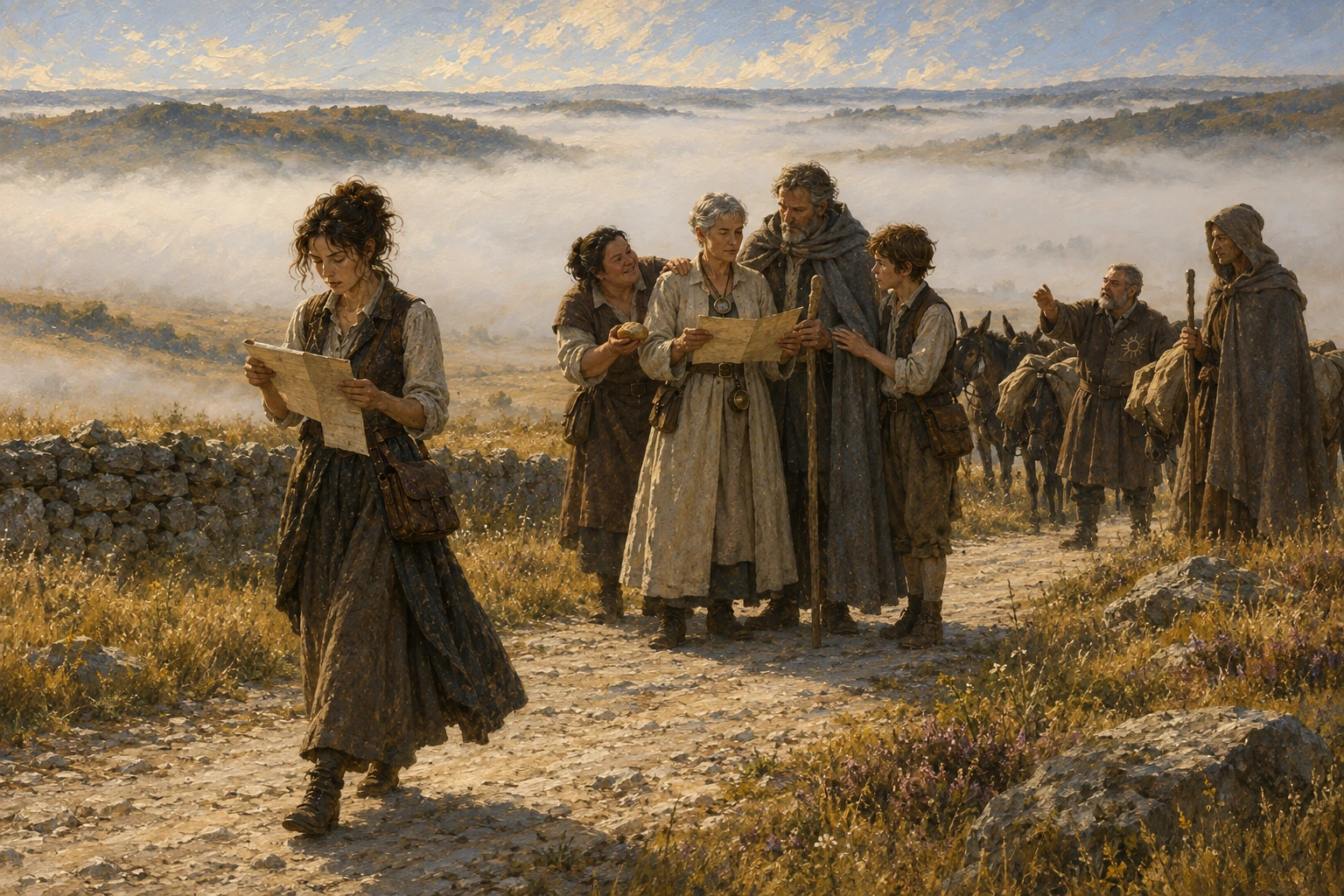
Iyene had the map spread before the fire was fairly caught, weighted at its corners with a stone, a boot, the strap-buckle of her own satchel, and Pip's cupped hand, which he held steady over the fourth corner with the patient stillness of a boy who has been given one clear job and means to do it perfectly. "The fold runs the whole width of the low ground," she said, tracing it with one finger that did not quite touch the vellum, "a day's crossing at a fair pace, dawn to dusk, and nothing anywhere in it that Ashcroft could bound for us past the stream. We go through in one daylight or we do not go through at all — there's no clean way to make two days of it, not with nowhere inside it a person could call a camp."
"Then we go through in one daylight," Alder said, and it was not a question, only the shape the evening's talk had already been taking since the stone.
The reasoning, once it was landed, took less time to say than Wren would have guessed, given how long it must have been growing quietly behind Iyene's eyes since Ashcroft. A single round of names — their own seven, said over and over, the coomb's old craft — would carry a company handsomely through an afternoon's touch of deep ground. It had never been asked to carry anyone through a whole day of it, and everybody at the fire knew what a small round of names does over enough hours: it thins. The coomb had taught them that a name kept turning stays warm, but seven names turned for ten or twelve hours running was a fire fed the same seven logs from dawn to dusk — and even a well-kept fire wants new wood before the day is out.
"A load carried too long on one back fails before the mile does," Bracken said, into the pause, in the flat teaching voice he used for provisioning and for nothing else. "Doesn't matter how sound the back is. You don't ask one mule to carry the whole train's water from the first well to the last — you spread it, and you spell it, and the water gets where it's going without one mule left foundering under the whole of it. Names, near as I can tell, carry the same as water does. It's not that seven names are too light a load. It's that seven names carried the same distance, over and over, by the same seven backs, is asking one mule to do a whole train's work."
It was Iyene who set the answer on the table — plainly, proud of it, and careful not to make a performance of the pride. Ashcroft's roll was the fair copy written out at the hall's own long table in her hand and Pip's together: four hundred and thirty-one adult names, with Jessa Linden's signed true beneath the last of them, given freely, with the town's own leave, to be carried east on whatever post might someday reach that far. Before it ever reached any post, it could do the company one service no round of seven names could match. It did not need to be theirs. It only needed to be true, and new. "A name said seven times in an hour is a name growing thinner with every saying," she said. "A name said once, and then handed to a fresh one, never repeats itself and never wears down to a habit. We are not going to carry our own seven names across that ground alone. We are going to carry a town."
She had done the arithmetic already, sitting at Ashcroft's own long table the evening the roll was copied, though she had said nothing of it until now: four hundred and thirty-one names, a day's crossing paced at a name for roughly every hundred strides, would carry the company the whole of the distance with names still unspent to spare, and would never, from first name to last, ask anybody to say the same word twice. Bracken's own pace-count, checked against Iyene's cord-measured mile from a long way back east, agreed with her well enough that the last few strides of it went unargued.
"It wants a reader," Alder said, "and it wants a company that can hold what the reader gives them, and pass it on, and not let a single name drop between one mouth and the next. That is the whole of the craft, and it is not a new one — only a larger one than we have ever asked of it."
Wren had known, before anyone looked her way, that the reading would come to her, and found she did not mind it — had, in fact, been half expecting it since the roll was signed in Jessa's own hand across the hall table at Ashcroft, and again since the sea-ledgers, and Woldsend's log before that: the keeper's own office, given a book to hold and voices to lend it, turned now on a scale she had not yet had cause to test. Bracken set the rest of the craft out, station by station, the same drilling grammar he had used on the open flights of the Stair in the spring — not a lecture, a rehearsal, everyone saying their own part back to him before the fire burned low enough to sleep by. Wren would read, walking near the front, one name given every hundred paces by her own count, checked against Iyene's. Each name, once given, would be caught and held and given back — not by Wren alone, but passed hand to hand down the company as the coomb's own names had once been passed, and held in pairs, per Woldsend's own drill. Alder would walk beside Wren, holding each name the instant it left her before it could be lost between the reading and the road; Iyene and Pip would come a pace behind, Pip's task to check the reading's own pace against hers, name for furlong; Dorrit and Bracken would mind the mule-string, each name reaching them last and steadiest, the way water reaches the lowest field last and stays there longest. Luel would keep no partner and no station at all, and nobody thought to ask her to take one.
"I will walk near the whole while," she said, when Alder looked to her at last, "and I will keep a line low under all of it, the way I kept it once for seven frightened people in a coomb a whole year and a world behind us — only longer, and lower, and nearer the edge of what I have left to give a thing that size. I will not sing it, and you will not hear it as singing. You will only find, I think, that the names come a little easier wherever I am standing, and I would rather you trusted that outright than asked me to explain the mechanism of it, because I am not entirely certain I could."
The roll itself went unaddressed beyond that, and unblessed, and was never lifted for admiration at the fire; it sat where Iyene had set it, wrapped in oiled cloth in the same satchel that carried her working sheets, an instrument and nothing grander, exactly as it had been offered.
The wolves came at the picket an hour past dusk, while the fire was still finding its full height. Every blade already in a hand stayed in it, and every hand without one stayed empty and still. Bracken had doubled the watch at the first fresh sign that afternoon — a scat pile, a scraped bank, nothing more — and briefed full stations before supper was cleared away, so that when Suet's ears went back and Barrow shifted his feet, the whole camp was already moving before Bracken said a word. Dorrit's staff took the lead animal across the shoulder in one clean turning stroke that sent it off yelping into the dark and not returning; the rest broke at the fire's sudden flare, fed hard and high by Alder's own hand, and were gone into the willows before Bracken's blade had cleared its sheath, nobody hurt in any of it, and Nettle holding her temper for the whole company before spending every bit of it on one wolf, on the excellent grounds that a wolf is owed no principles whatever.
Bracken sheathed the blade he had not needed. "That's a considerably shorter evening than the last one of these we had." It was the whole of his commentary, and it was, in its way, the loudest praise any of them had given the year gone by.
The second visitor came deeper in the night, and gave itself away first by what the wolves did, not by anything of its own. Somewhere past the second watch-change, far off in the dark beyond the willows, a long low chorus of retreat rose and thinned and was gone — not a fight-sound, not a kill-sound, but the particular unhappy hurry of things that know their own country and have just been told, by something they trust more than they trust each other, that a stretch of it is not tonight's to hold.
Bracken had the fire built to its full height before the sound had finished dying, without needing to be told why. Iron came into every hand that had any to close on — shown, held ready, never raised to strike at anything, because there was, from the first breath of it to the last, nothing within reach of any blade to strike. It stood, if it stood at all, at the very outer rim of what the firelight could rightly claim: not a shape so much as a wrongness in the shape the dark ought to have had there, a stillness with none of the give a watched night usually carries in it — no shifting weight, no drawn breath, no small settling sound a living thing makes even when it means to be quiet. Once, and only once, there came a sound none of them had a true word for, and the nearest any of them ever got to naming it, then or after, was Wren's own private one: the sound cold makes when it finds a crack in something that had been, until that moment, whole.
Nobody spoke to it, though everything in that stillness was clearly meant to be spoken to. The company said its own names instead, low and steady and in turn, the same craft the coomb had taught them a year gone by, said now not because any name was slipping but because it was the only answer any of them had ever been given for a thing that could not be reasoned with, only outlasted. Luel stood nearest the fire's edge, her own line brought up under the company's, and said nothing to the dark beyond one sentence, given quietly to Alder and not raised for the thing itself to hear, if it heard anything at all: "My own songs are older than almost anything I have ever met, and they do not know this. Whatever the long dark bred down here, it is younger than my lore, and that is not a comfort I expected to be giving anyone tonight."
It withdrew sometime before the sky greyed, without a sound to mark the leaving any more than there had been one to mark the coming. By full light the ground beyond the picket showed nothing at all until Bracken, casting a wide slow circle on foot with Dorrit at his shoulder, found where something had stood and turned and gone — tracks, if they were tracks, that ran a good way north and then stopped short, well shy of the low ground where the fold began, as though whatever had made them knew that particular country no better than the wolves did, and wanted no more of it than the wolves had. Bracken read the sign for what it plainly was and said so, once, flatly: even that had gone round the deep Quiet rather than into it. The visitor went unmentioned past breakfast, and it did not return.
The fold showed itself first as weather, exactly as the Drowned City's had, low pale banks lying along the road's whole line into the middle distance, ordinary to the eye and entirely still. They entered it a little past mid-morning, the last clear rise falling away behind them, and the crossing of it, when it came, arrived from a direction none of them had thought to brace for: not as a wall met and passed, but as a curtain drawn shut behind their own backs.
Wren felt it first in her ears rather than her eyes — the hush of the road's small daily noise, insects, wind in the verge-grass, some distant water she had stopped consciously hearing an hour before, all of it gone entire, all at once, as though a door somewhere behind the company had swung to on a well-oiled hinge. What was left, in the whole wide silence where a morning's worth of small sound had been, was only the company's own: boots on packed earth, the creak of a girth-strap, a mule's steady breath, and — beginning exactly then, because it could not have begun a moment sooner and be believed — Wren's own voice, giving the roll's first name.
Marta Coyle. The name went out into a silence so complete it seemed, absurdly, to make room for it. Alder caught it before her own next breath and gave it back, once, low; it passed to Iyene, to Pip, down the short chain to Dorrit and Bracken at the mules' heads, and was there and gone and answered before her hundred paces had run their count. She gave the next.
The hours told themselves after that not in any measure a clock would have honored but in names and furlongs together, the two counting each other out at a steady, companionable pace: Osric Vane. Thomasin Reed. Sim Padgett. Half a furlong on, Cara Doss, and her daughter beside her on the roll, Nell Doss, thirteen strides later, because Ashcroft's clerk had kept mothers and daughters close on the page without being asked. The fold's ground gave nothing away underfoot — no fog to push through, no cold beyond an evenness of temperature that never quite matched the day above the banks, no shape anywhere that any of them could rightly claim to have seen, because there was nothing anywhere in it to see. It did not press. It did not lean toward them or draw back from them. It simply lay, the way the Drowned City's had lain, entire and unmoved and unmoving, the whole long day, in every direction the eye could carry.
The mules walked it as they had walked the Cold Coomb and the Drowned City's margin both, entirely unbothered. Nettle bit at a low willow switch with her usual disdain for the dignity of the occasion. Gable's gait was no shorter and no more careful than it was on any road at all. Suet and Barrow leaned into their harness with the same patient indifference they gave any long straight stretch of nothing much. Bracken's old verdict on the business held true a third time running: whatever the fold was doing to the company's names, it had nothing whatever to hold on to in a mule's mind, and every mule's footing stayed excellent the whole day through.
By what Iyene's own count made early afternoon, the roll stood past its two-hundredth name, the company's rhythm long since settled into something closer to breathing than to effort. The reading, the catching, the passing on, over and over — each small act was small enough by itself that none of them, walking it, could have said exactly when the day's real weight had begun to sit on their shoulders rather than merely pass through their mouths.
It was on the longest of the fold's banks, the one Iyene's paced cord would later put at a little under two miles unbroken, that Iyene herself stopped walking.
She did not stumble, and she did not sit, and there was nothing about the stopping itself, at first glance, that read as anything but a woman halting to check her own instrument against her own eye — upright at her full height, her working sheet held level and steady in two sure hands, her boots planted square on the road's own line. It was Pip, her paired partner, who caught first that something in it was wrong, because she had not spoken since the halt began, and Iyene Sath did not, as a rule, go a full minute without some dry observation about the ground beneath her feet.
"Iyene." He said it once, gently — the pairing drill's own habit, worn smooth by now. She looked at him — looked at all of them, in turn, with her whole clear intelligence present behind her eyes, nothing dimmed or wandering in her at all — and said, in a voice that had not lost one degree of its usual precision, "I know your face. I know every one of your faces. I cannot presently tell you my own name, and I find that I have just tried three times."
She turned her own flyleaf toward herself and read it, aloud, in the same flat clerical voice she gave any working note: Iyene Sath, Cartographer-Royal, chartered to the Survey by the Crown's own hand. The words came out of her exactly as written, and answered nothing at all — a true word in a hand she knew for her own, sitting on the page as foreign to her, in that one unbearable moment, as any stranger's signature in any book she had ever authenticated for somebody else.
Wren did not stop reading. It was, afterward, the single fact of the whole crossing she set down with the most care, because stopping had never been offered as a choice worth weighing. The roll unbroken was the only thing standing between the whole company and the same slow thinning that had just closed over the sharpest mind among them; a reading broken off to grieve its own trouble was only a silence — and a silence was the whole of what it took, on ground like this, for a name to go. She gave the next name, standing where the halt had caught her, her eyes on the page and her back to the whole of it. And the one after that.
Alder reached Iyene in three strides and took her free hand in both of his, and what he did then he did without light, without wind, without any spectacle at all beyond the bare fact of a tired man reaching for something that cost him a great deal to reach for. He spoke the same unspelled word he had spoken at the bottom of the Cold Coomb — slower now, and longer, drawn out the way a man draws out the last of a rope he does not know will hold. For a breath, two breaths, nothing changed at all, and in that gap, for the first time since any of them had learned to trust it, the word alone was not enough.
It was Pip who moved first, because he was her partner and the drill had never let him forget it: he took her other hand and gave her name back to her, whole, in his own steady apprentice's voice — Iyene Sath, Cartographer-Royal. Wren, without breaking her own count, folded the same words into the roll's own rhythm a breath later, so that for a handful of names the reading carried two things at once, a stranger's name and their own leader's, given back in the same even cadence. Dorrit came from the mules and took Iyene by the shoulder from behind, said her name a third time, and then her office a fourth, and then — because Dorrit's whole instinct in any hard hour ran toward feeding a thing rather than merely naming it — pressed a heel of travel-bread into her free hand, as though a name and a meal were, in the end, much the same kind of gift; and Bracken called it from the mule-line without leaving his post, loud and certain, the way he had once called a fight's stations. Luel's low line, kept under the whole day's reading without any of them quite marking when it had begun, came up now nearer and lower than it had been at any hour since the fold's mouth — not louder, only closer, the way a hand set flat against a cold wall is not louder than the wall but nearer to it.
It came back to her all at once, the way every return on this whole road had come back to anyone who had lost a piece of themselves to this ground: not in pieces, not by degrees, but whole — like feeling flooding back into a foot gone numb, pins and needles and then hers again, entire. Her hand tightened on Pip's. Her eyes found her own working sheet and read it a second time, and this time the words answered.
"I make it," she said, when she had breath again to spare for speaking, in a voice gone dry rather than shaken, "the better part of an hour, start to finish, though I will want your own count checked against mine, Pip, because I do not entirely trust my own reckoning of an hour I spent without my own name to hang the minutes on. I did not enjoy a single minute of it. I would like that noted plainly, and not softened, and not rounded up or down to make a tidier number of it."
She was, by every measure any of them could take of her in the hours that followed, entirely whole — no thinning left in her, no hesitation over any name asked of her, nothing in her bearing that a stranger meeting her fresh that afternoon could have read as anything but a tired woman on a long day's road. Alder's own cost showed rather more openly, and did not pretend otherwise. His voice, when he spoke again, had gone to something not much above a whisper, and stayed there for an hour afterward. The stick that had ridden upright at his side the whole year long, carried rather than leaned on, became for the first time on the whole road a thing he actually walked with, his free hand white-knuckled on its grip. And when Bracken came alongside without being asked and set a shoulder under his arm, Alder did not refuse it — which told Wren, watching, more than any word he might have troubled to say.
He said only one thing about it, once his voice had recovered enough to be heard past a pace's distance, and it was not addressed to what had just happened but past it, the same grammar he had used at Ashcroft's own hall table: "That was not mine alone to do, and I would not have it remembered as though it were. Iyene came back because seven people and a whole town's worth of names wanted her back, and said so, together, and did not stop saying so until she heard them." He got no more questions than that, and the company walked on.
They came out onto the fold's far lip a little before full dusk, the ground rising underfoot by degrees until the last pale bank lay behind them and the road ran, bare and entirely their own again, up onto clean high ground with the day's failing light gold across it.
Bracken was the first to say anything, and he said it looking back over the ground behind them rather than forward at what lay ahead. "That's a crossing made, that is." He let it stand there a moment, the same short unadorned shape he had once given a watch stood down in a hollow town a year behind them, and did not dress it up any further than that.
Nobody spoke of the fold as a thing beaten, or hunted, or fought. It had done nothing, the whole day through, but lie exactly where it had always lain, unmoved and unmoving from first light to last; what had crossed it was not a victory taken from the ground itself but a road, walked whole, on names that had not once been asked to carry more than a hundred paces apiece. Iyene, already unwrapping her working sheet before the last mule had cleared the lip, said as much herself, dry as ever: "We did not fight that ground. We simply outlasted it with better arithmetic than it had ever once been shown." Ahead, past the last of the day's light, low dark shapes stood along a further rise that none of them had a name for yet — walls, roofs, a shoulder of built stone against the sky where no built stone had any business standing in country this far past the last living road. Dorrit gave it the only word anybody spent that evening, one glad breath: "Will you look at that." The naming of it could wait for morning.
The camp that night sat a clean half-mile past the lip, on ground so unremarkable it might have been any camp on any evening of the whole long year — grass cropped low by nothing more sinister than a steady wind, a stream close enough to hear, and not one thing about the ground itself that asked for a second look. Iyene checked Pip's name, and her own, and then everyone else's in turn, twice, with the same dry thoroughness she gave any instrument after a hard day's use, and pronounced the whole company, herself included, entirely and unremarkably themselves. Alder's voice had come mostly back by the time the fire was well caught, worn still but no longer a whisper; his color, which none of them had liked to mention on the road, was ordinary again by the time Dorrit's supper was half served. The mules had crossed the whole fold, start to finish, without so much as a flattened ear between them, and Gable, true to the honor he had first won a year back in a very different fright, was asleep on his feet before the fire had fully settled.
Dorrit cooked to her full authority that night, more than the evening strictly wanted and exactly as much as the evening had earned, and the fire's whole circle went to sleep fed.
Before she ate, Iyene took out her own working sheet a second time and entered, in her own hand, the interval itself — the better part of an hour, unrounded, dated against the fold's longest bank — and set it down beside the day's other findings with no more ceremony than she gave any of them. She wrote it herself, unaided, and made plain by her face alone that help would not have been welcome. Not setting it down, Wren thought, watching her write, would have been the only real defeat of the whole afternoon, and Iyene had no intention whatever of handing the Quiet that victory.
Wren wrote late, by the fire's last low light, and did not hurry it.
We crossed the Deep Quiet today, the whole width of it in one daylight, on a plan built two evenings back at a stream that marks the last edge of anybody's living knowledge south of Ashcroft. The roll carried us — four hundred and thirty-one names, given us freely, with the town's own leave, to carry east on a post that has not yet reached that far, and put instead, for one long day, to a use I do not think Jessa or anyone signing that book ever pictured for it. She would not, I think, mind in the least if she could see it now. A name for every hundred paces, never repeated, never let wear thin in the same mouth too long — Bracken's own doctrine, that a load carried too long on one back fails before the mile does, turned from water and wax to something no less real for being carried in the voice instead of the pannier.
We had two visitors the night before we crossed, and I mean to set them down honestly, which means setting them down differently, because they were not the same kind of thing at all. The first was wolves, and we knew exactly what they were and exactly what to do about them, and it was over almost before it had well begun. The second we do not have a name for, and I do not think anyone living has one either. It stood at the edge of what our fire could reach, and did nothing our fire could rightly call an attack, and left before morning without a mark on any of us beyond the memory of a sound I have no better word for than cold finding a crack. Even it, we found by daylight, went round the ground we crossed the very next day. Whatever that means, I have not yet worked out, and I do not think tonight is the night to try.
The fold itself held nothing, the whole day through — no shape, no light, no sound of its own, nothing that watched us or wanted us or noticed us pass. It was only, and entirely, still, and the stillest thing about it was how completely it swallowed the ordinary morning noise the moment we stepped inside — birdsong, wind, water, gone all at once, so that our own voices and the mules' own feet were the only sound left in the whole wide world. I understand now why the reading held: there was nothing left in that silence to compete with a name once it was given.
Iyene lost her own name at the fold's longest bank, mid-afternoon, standing upright at her own instrument with her hands steady and her whole mind present but for the one word that mattered most. The interval ran the better part of an hour, by her own reckoning, checked against Pip's, and she set it down herself tonight, in her own hand, unrounded in either direction — nobody else's writing would have done for it, and I think she was right not to let it. She came back whole, exactly as everyone who has ever lost a piece of themselves to this ground has come back whole before her, and I do not believe, watching her enter the hour into her own working sheet by this fire tonight, that she has kept one shadow of it on her.
Alder's own cost I will set down as plainly as he would want it set down, which is to say without any dressing at all. His voice went to a whisper for an hour together, and he leaned on his stick as a stick for the first time since I have known him, and let Bracken carry a share of his weight the last half-mile of the crossing — which he has never let any of us do before. He is entirely recovered tonight, by his own color and his own easy good humor at supper. He told the same kind of truth about it later that he told Jessa at Ashcroft — that it was not his to have done alone, and that seven people and a whole town's worth of names brought Iyene home together, and he would not have any one part of that forgotten in favor of any other.
We came into this country carrying seven names between us. Today we carried a town's, with the town's own leave freely given, and the town carried us across in return. It is the first ground in three hundred years that could not be waited out, or gone round, or left for some braver season, and it has a road through it again tonight. The road, turned over every way I know to turn a thing, is made of nothing grander than names, said once each, and passed on.
Past that she wrote nothing more, because the day's account was finished. Iyene had already bent her own patient care over the fold's small mark on the working sheet, drawing through its old sign for deep ground — unchanged, no new symbol struck for it — the same road-line she had drawn ten thousand times on other pages. Two marks she already had, set together for the first time, saying between them what neither had ever said alone. Deep ground, and a road across it, walked. "It is the same ground it always was," Iyene said, half to herself, setting her pen down, "and I do not know it the same way I did yesterday — walked through now, rather than told about, which I have found, this whole year, makes a difference to a mark that no ink by itself ever could."
The fire had burned to its own quiet coals, and the company had gone as still around it as the evening itself, when Dorrit — no more ceremony in it than there ever was in anything Dorrit did — began, low, almost to herself, the old tune the whole company had carried east to west and now south again since a snowbound midwinter hall most of a year behind them. Wren's fiddle stayed silent at her knee, and nobody reached for it. Pip's voice came in on the second line, and Bracken's under his, and Luel's last of all, quiet among the rest and leading nothing.
So here is your name, and here is mine, and here is the name of everyone dear; I'll hold them warm till the morning line, and give them all back, safe and clear.