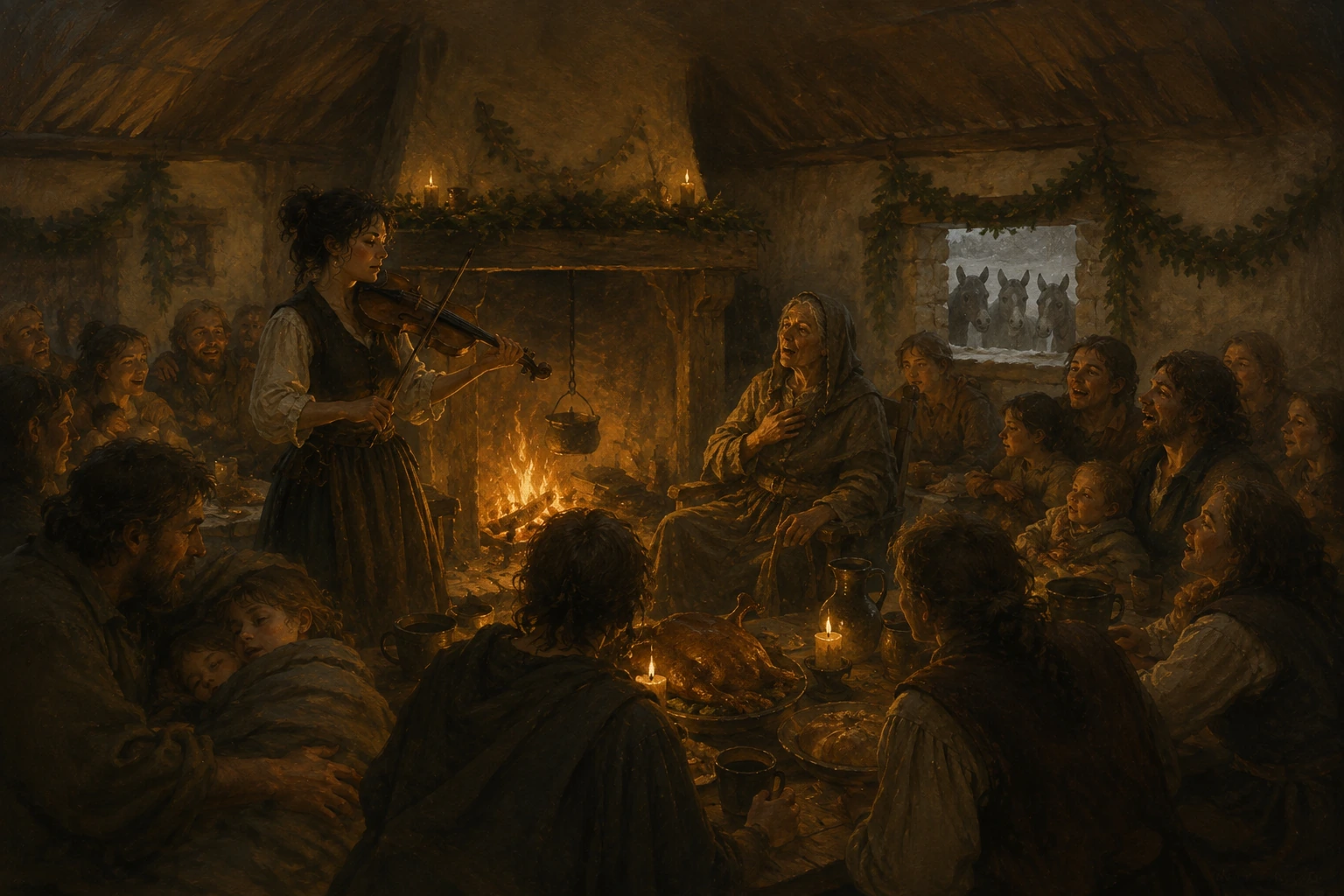
Songs Against the Snow
Enna had been promising the geese through the map-room wall since the first week of the snow, and on the shortest day of the year she delivered: two on the long tables glazed dark, and a third besides for the watch's youngest, who could be trusted to eat nothing that was not crisp at the corners. There was bread enough to paper a road with, a barley soup thick with the last of the root cellar, and a dish of honeyed parsnips Dorrit had helped put by and was sworn to secrecy about; and the last jar of the Fallowmere honey went round in a saucer at the high end of the table, dark now as good ale, and Wren watched it go by the spoonful with the plain pleasure of a woman watching a thing she loved be loved by other people.
Nobody at the watch called the evening anything but midwinter, and nobody troubled it with more ceremony than the turning of the year had ever been troubled with in Wren's own house — which was none at all, beyond the human wish to eat well on the darkest night. The hall had been swept until the flagstones shone faintly gold, and fir boughs cut from the wind-break stood in buckets of water at both ends of the long room: not for any meaning, Enna said at once when Pip asked, but because green was the one colour a white country hadn't seen in two months, and green put a hungry man in mind of supper faster than bare rafters did. More lamps hung lit along the beams than Wren had ever seen burning at once, so that the hall glowed instead of merely lighting itself.
The tables filled by whoever had arrived hungry and found a space beside a friend. Harrol sat near enough the door to see trouble coming and not one inch nearer; Orran sat beside her, his hands scrubbed pink where the forge-black never quite left them. Willem, back three days from his last run and greeted at every table like a man returned from somewhere considerably farther, sat with his boots still steaming; Tolly and Dill, the watch's two youngest, had crowded in at the Survey's end of the table, having spent the whole winter at Pip's fire-craft elbow and considering him by now very nearly one of their own. The children were everywhere at once, underfoot and overloud, three of the smallest already wearing greenery pulled loose from the nearest bough without anybody's permission.
It was Bracken who insisted — flatly, as though the matter were beneath discussion — that the mule-yard's small window onto the hearth-hall's back wall be propped open a hand's width for the evening, so that Suet and Barrow and Nettle and Gable, stalled warm not thirty feet off, might be said to have attended.
"They'll hear the noise regardless," he said, when Iyene asked what a mule was meant to do with an open window on the coldest night of the year. "Might as well let them hear it properly, and have their share of the supper besides." He went out into the cold himself before anyone sat down, with four scraps in a cloth: a heel of bread for Suet, a strip of goose-skin for Barrow, a carrot for Nettle out of what Wren suspected was pure diplomacy, and for Gable nothing more strenuous than a scratch behind one drowsy ear. He came back reporting that all four had received the courtesy exactly as it was owed them.
The children had a counting-rhyme they used for choosing who was out, and they had rattled it through a dozen times that evening without anybody at the high table hearing a word of it, because nobody hears a counting-rhyme any more than they hear a door. Then Tolly, warm with cider and pleased with himself, sang it out slow and loud for the Survey's benefit, on the grounds that they were the only people in the room who had not known it since they were three.
It ran the ordinary course of such things — nonsense, and half-nonsense, and one or two words that had clearly been other words once. In the fourth line there was a word that was none of those.
It was short. It was hard. It did not belong to the tongue the rest of the rhyme was in, and the whole hall said it together in the easy manner of people saying a sound rather than a word.
Luel set down her cup.
She did it without haste and without any sound at all, and the hall did not notice; but Wren, three feet from her, watched a woman who had sat out a whole winter of the watch's noise without once altering her posture become, between one breath and the next, entirely still.
"What's that one mean, then?" Tolly asked, cheerfully, of nobody in particular. "My gran would never say. Said it was nothing. Said it was only the sound that goes there."
"Every rhyme's got one," said Harrol.
"It is not nothing," Luel said.
She said it quietly, and it went down that loud hall like a hand laid flat on a table.
Iyene had her pocket-book half out of her coat before she had properly decided to reach for it. "Would you give me the sense of it?"
"No."
Iyene waited. So did everyone within hearing. Luel looked at the fire and not at any of them.
"I have not said that word since the passes shut," she said, "and I am not going to say it in a warm room full of children on the longest night of the year to settle a point of scholarship." She turned her cup a quarter-turn on the board. "Ask me again on the other side of the mountain, if you still want it then. I will very likely say no there as well."
Then she looked up, and whatever had been in her face folded itself away, and she asked Enna, in an entirely ordinary voice, what she had put in the goose.
The hall let it go, as a hall generally does. Harrol changed the subject with the flat competence of a woman who had been changing subjects at that table for twenty years. Tolly, mortified without quite understanding what he had done, did not sing the rhyme again that night.
The singing began not long after, and began where such things always begin — with the old reliable pieces, sung half in earnest and half for the pleasure of a room full of people who mostly knew the words; and it was somewhere in the loosening warmth after the second round of the Bee-Wife's Round, Hobb three hundred miles off and entirely unaware how faithfully his song was travelling without him, that Luel turned her chair a little more toward the fire and let a sound come.
She did not stand, and gave no signal Wren could see. It was low at first, and then rising, in the old speech that had never been set down in any tongue but its own. The effect moved through the hall like weather through a valley, felt everywhere at once and traceable to no single cause: the fire steadied past anything the wood alone accounted for, burning straighter and warmer without growing any larger; the lamplight thickened, gold going a shade richer, as honey looks richer held to a low sun than a high one. And under it, unbidden and entirely welcome, old good things rose up in Wren without asking her leave: the bee-yard at the first cutting of a summer morning, mist still on the grass and the hives just waking into their long low hum; her grandmother's hands turning a jar to the light and saying meadow in the flat contented voice she kept for nothing but honey and good news.
She was not the only one so visited. Down the table Dorrit's face had gone soft and inward; Bracken, of all unlikely men, sat with his eyes half closed and one hand resting still on the table's edge, as though he were somewhere with better weather and an old friend's voice in his ear. It lasted the length of the song and not a breath longer, and when it ended the hall let out, all together, the sigh a room gives when it discovers it has been holding something without knowing it.
Then the watch, which would not be outdone on its own hearth, gave back its dead-of-winter grumble through a dozen throats at once — unlovely, beloved, and worn smooth by generations of grousing use — and the tables were thumped for it, and Harrol permitted herself a laugh with nothing dry left in it at all.
It was into the last of that noise that Luel rose from her chair, the first time all evening she had stood of her own accord, and said into a quiet that gathered around her without being asked that she had one more thing to give, if the hall would have it.
"This one is given," she said, plainly, as she had said it once before at another fire to a smaller company. "Not sung to be admired, and not held back afterward. Given, to keep."
She did not sing it in the old tongue. She gave it entire in the common speech, low, more breath than voice at first, in the register a person uses for a room already half asleep:
Snow on the road and snow on the sill, snow on the lamp where it burns down low; sleep now, the house is warm and still, and everything kept is kept in the snow.
The fire's gone down to a coal, to a spark, small as a word a mother might say — but a coal holds warm the whole night dark, and a name holds warm the same soft way.
So here is your name, and here is mine, and here is the name of everyone dear; I'll hold them warm till the morning line, and give them all back, safe and clear.
She was midway through the second verse when she looked once toward Wren — no more than a glance, entirely without ceremony — and gave the smallest nod toward the fiddle resting under Wren's hand; and Wren understood it for the invitation it was, and brought the bow up under the melody so softly that the two musics seemed to arrive at the same note from two different distances, the fiddle finding the shape of the given tune and settling in under it, carrying without leading. It was the first time in all the company's long road that the two had been played as one. The hall went down with the song rather than merely listening to it, and by the last line half the children in the room were asleep exactly where they sat, heads pillowed on whatever shoulder had been nearest when it began, and nobody woke them.
The hall thinned slowly after that, until what was left was the late company any gathering keeps back for itself. Harrol and Orran sat with their mugs gone cold and neither minding; Iyene had her working sheet forgotten, for once, unopened on her knee; a scatter of sleeping children lay heaped against whatever grown lap or bench-end had claimed them, breathing slow and even.
It was Pip who asked the question, in the voice of a boy who had been carrying it a long while and had finally judged the hour warm enough to risk it.
"Master Alder — how do you know the things you know? The old tongue. The —" he hesitated, choosing his words with more care than was usual for him, "— the coomb. All of it. Nobody's ever told us where a Warden learns it."
Alder turned his cup slowly by the rim, and when he answered it was not in the voice he used for lessons but a lower, easier one.
"For once I can simply answer you, because it isn't a secret. It only sounds like one, because nobody's troubled to ask before now, and a thing unasked gathers mystery around it that it never earned."
He looked into the fire a while before he went on.
"Three hundred years ago, when the passes shut, the people who came down out of them came into a kingdom that took them in. Fed them, housed them, gave them work where work could be found and charity where it couldn't. But a refugee brings very little beyond his own two hands, and what these particular refugees had carried down off a mountain was not gold, because they hadn't any. It was the other kind of freight. Roads walked and remembered. Maps, some no more than the memory of a memory. Letters that wanted delivering to people who might, for all anyone yet knew, still be alive to receive them. Names — a great many names, because a person who has just lost everything else learns very quickly how easily a name gets misplaced. Songs. And one or two warmer crafts besides, carried over the mountains in a handful of hands rather than in any pack." He said the last without slowing for it, and went on before Pip's visibly opening mouth could shape a question. "I won't make more of that than it deserves. It was never the largest part of what they kept. It only sounds the largest, told cold, by a fire, to people who don't yet know how ordinary the rest of it was."
"So a handful of them sat down together, in a corner of Merrow that doesn't exist any more, and swore to keep what they'd carried — the whole raggle of it, roads and letters and names alike — on the one line of oath most of them could still afford to make good on, which was each other. They called themselves nothing grand. I don't believe they called themselves anything at all the first winter; there wasn't leisure for naming things when the naming wasn't going to put bread on a table. What they swore, as near as it's come down to me, was this: that they would hold what they'd carried, against the thaw, until the roads opened wide enough to carry it home again."
"They did not choose that word carelessly," Alder said. "A thaw is weather changing its mind. It had done that once already, to everyone they loved, and they knew it clearly enough to found an institution on the knowing — that a road opening again was not the same as a road being safe. So they did not build a homecoming society. They built something meant to still be standing on the day the mountain changed it back."
Wren sat with her hands folded and her eyes on the fire, and did not trust herself, for the length of several slow breaths, to look at anyone at all; she was thinking of nine keepers who had never said four words outside a farmhouse door, and of how the very same charge had been sworn in a different room, by different mouths, by people who had no door left of their own to say it behind. Keep it against the thaw.
"That fellowship kept its word," Alder went on, "as most true keepings are kept, which is slowly, and mostly without anyone noticing, for a very long time. And keeping a thing well enough and long enough turns out to be its own kind of institution, whether the keepers meant to build one or not. In time the crown gave them a hall to work from, because a crown likes its roads charted same as anyone; and the hall grew a charter, and the charter grew wardens, and the wardens grew apprentices, and somewhere in the slow turning of all that, without any single day a person could point to and call the founding, the thing had become the College of Roads." He looked up briefly around the fire. "You've all six of you sworn to it, so you'll know it as a place that maps roads and trains cartographers, and that's entirely true. But underneath the charts it has always kept the older freight as well, as a house keeps its foundation without troubling to mention it to every guest who admires the roof. That's why a waymark, once the College sets it, is never let lapse, however forgotten the road. That's why your charter provides — Iyene wrote the clause herself, and I don't think she ever quite knew, until tonight, what she was writing room for — for such guides as the road provides. That's why a Warden walks west with a Survey at all, rather than drawing maps sent home by men who stayed comfortably in Merrow. The wardens keep the inner freight. The rest of the College is the roof we built to keep the rain off it."
"And Wystan?" Wren asked. It was the first thing she had said in a long while, and it came out quieter than she meant it to.
"His name is on the earliest roll we kept," Alder said, something gentler in his voice now, turned toward her particularly. "I've seen it myself — long before I ever set foot in a valley called Dall and found the very same name written out a second time, in a different hand, on a different shelf, and had to sit down rather suddenly in your grandmother's kitchen. Whether he was one of that first fellowship in Merrow, or they simply knew his name and kept faith with it from a distance, I can't tell you for certain; the earliest roll is a roll of names, not of stories. But he was of them, or they of him, close enough that it makes no real difference which. The Waybook and the College are two keepings out of one walking, Wren. Split apart by a single hard winter and a road that stayed shut long after, and neither one was ever meant to stay east of the mountains forever. They were only waiting on somebody to carry them back toward each other."
The fire settled once, with a small collapsing sigh of its own, and Harrol said into the quiet — dry again, but gently so — "The Crown's always known, near enough. Osmund's grandfather's grandfather knew, and every one since. A crown that's watched wardens come and go since before anyone now living, and never pressed the matter, has made its peace with not knowing."
"That's all of it," Alder said, and closed the subject like a ledger for the night. "No order-name, because we never troubled to make one, and no great secret dressed up grander than a promise kept a long time by ordinary tired people. It's a story about luggage, in the end, and about people who refused to put it down."
Wren wrote it down that night — not the meaning, which she did not have, only the four hard sounds of the word in her own spelling, small, at the very foot of the day's page, beneath the line she had already drawn to close the entry.
It sat there by itself, with nothing above it and nothing after it, in a book otherwise entirely full of things she could account for.