The Assessor's Ledger
Five days beyond Millgate the province had gone on gentling under them: green pasture rolling wide on either hand, hedgerows thick with hawthorn blossom and loud with birds that had long since forgotten there was ever a reason to be otherwise. The mules went along at the easy, opinionated walk of animals who have concluded the whole world is a corridor between one patch of good grazing and the next.
They had passed within a morning's sight of Aldwick two days back, near enough that old Fennick himself had come out to the fence to raise a hand to Garron across a field, calling something the wind took most of before it reached the road, of which only good name, that had carried whole. Garron had raised a hand back, grinning, and the company had walked on without stopping, because Fennick had sheep to see to and they had road to make. A wave across a field, Bracken observed, was its own kind of full conversation between two people with real work in their hands.
That same morning, well before noon, Garron called a halt at a fork the road hadn't shown them before — a lesser track striking off south past a stand of old elder grown up thick and untended around what had once, by the look of the worn stone at its foot, been a proper crossroads marker.
"Elder's Cross," he said, not stopping, not slowing, only naming it the way a man names a dog he has no intention of calling to him. "We'll keep the left fork."
Garron kept walking, and the company went round it exactly as his people had gone round it for longer than anyone now living could account for. Iyene glanced back once at the worn stone with the professional regret of a woman filing away a mark she was not yet permitted to draw. Wren felt, for a dozen paces, the small unremarkable chill of a shadow that might have been the elder's own and might not, and chose, in the manner the company had learned from Garron, not to make more of it than that. By the time the crossroads was out of sight the talk had already turned to whether Nettle's sulking was owed to the flies or to simple boredom, and the talk moved on without a second look back.
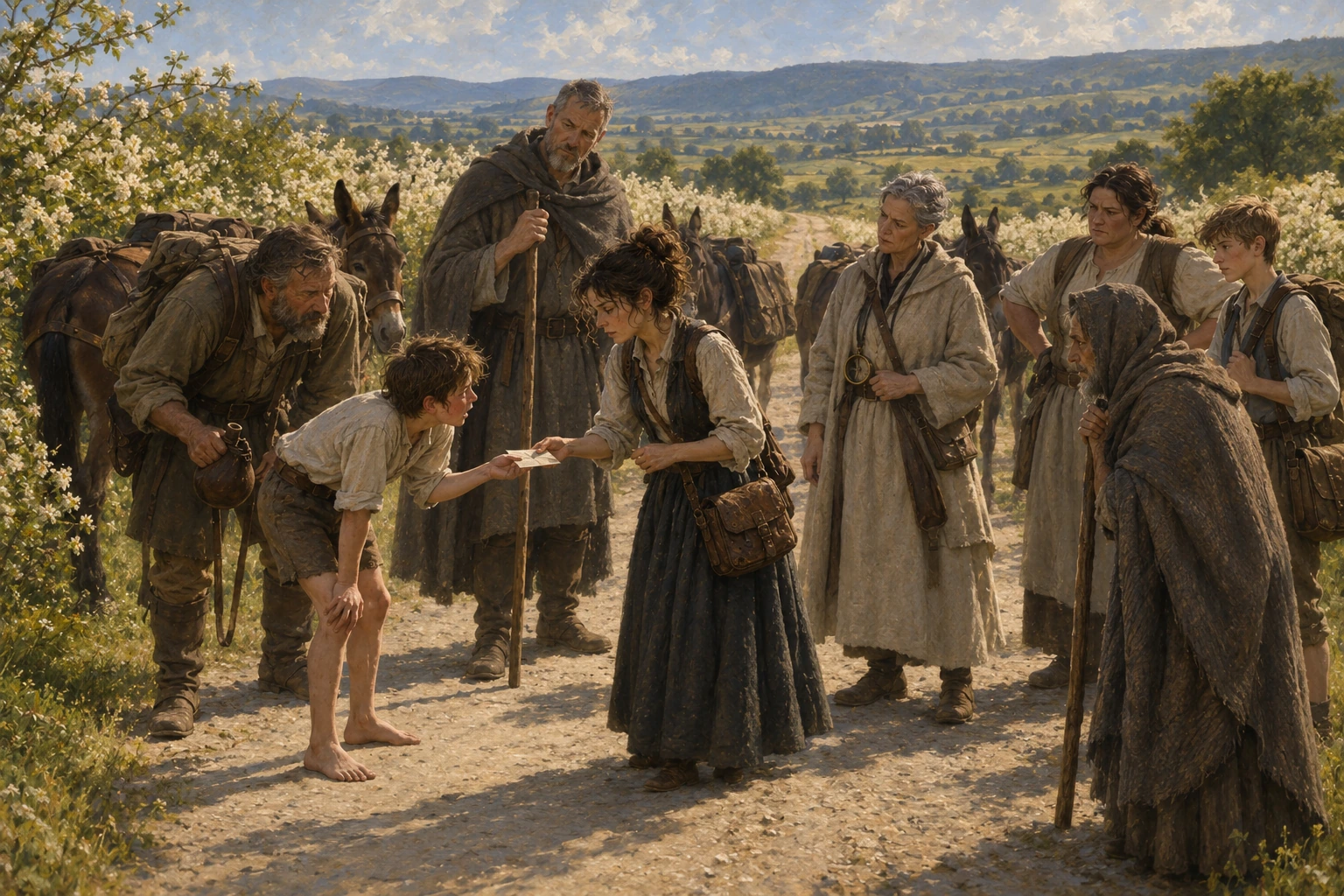
The boy came up the road behind them at a dead run, some three hours past their midday halt, and Bracken saw him first — a smudge of movement a long way back where the road ran straight across open pasture, resolving by degrees into a boy of perhaps twelve, bare-legged, red in the face, and running in the particular headlong, arms-pumping fashion of someone who has been told a thing is urgent and has decided to take the word entirely at its face.
"That's Fennick's youngest," Garron said, shading his eyes, and then, a beat later, in quite a different voice, "That's Tuck."
Tuck arrived among them with no more ceremony than a boy generally has to spare after three miles of running, doubled over with his hands on his knees for a good ten breaths before he could get out more than "Company—" and "Grandad said—" and "Ran the whole way past the Cross, near enough, only I went round the long way same as always, and it slowed me some, but I didn't stop, not once, not even at the stile."
"Take your time," Bracken told him, not unkindly, passing him a water-skin. "Nobody here begrudges a boy his breath."
It took the water-skin and one more long breath before Tuck straightened, reached inside his shirt, and produced — a little warm from the running, a little creased where his arm had pressed it against his ribs the whole three miles — a folded square of paper, no wax on it anywhere, its corners tucked one under the next in a plain farmhouse fold that needed no seal because there was nothing left in that country to seal it against.
"For the Survey," he said, with the enormous, careful formality of a boy who has been given exactly one sentence to say and means to say it correctly. "Wherever the road's carried them. It come up from Sereth, hand to hand — Sella's man brought it to Grandad two days back, and Grandad give it me soon as he heard which way you'd gone, and told me not to stop for anything, and I didn't." He looked round at the eight of them and four mules with the frank, cataloguing stare of a boy filing away a story he intended to tell for the rest of his life. "Grandad says to say it's the first letter's ever come up that road the wrong way round, in his whole life or his grandmother's neither, and he wanted it said proper."
Bracken took the letter from him and turned it over once, the way a man turns over a new piece of tack before trusting his weight to it — testing the fold, the plain hand on the outside (For the Survey, on the road west), the entire and slightly wondrous absence of any seal at all.
"No wax," he said, half to himself. "No ribbon. No office stamp." Something in his weathered face had gone, for a moment, quite young. "Thirty years of soldiering, and I don't believe I've ever once held a letter that got here on nothing but people deciding it ought to."
"It got here," Iyene said, in the stillness of a woman doing arithmetic she had not expected to need this year, "because somebody in Sereth handed it to somebody in Millgate, who handed it to somebody in Aldwick, who handed it to this boy, on no authority whatever except that a letter for the Survey follows the Survey's own road, and every hand along it already knew which road that was. Do you understand what that is? That is a post. That is an institution, built in five days, out of nothing but people who already knew each other's names."
"It's a fair thing to want," Bracken said, "and no harm in wanting it named properly, once it's happened."
Garron had said nothing through any of this, standing very still, and it was Wren who saw his face — not fear, not the flat frailty of the morning after Woldsend, but something plainer than either: a grown man looking at a folded square of paper with his mother's hand on the outside of it, addressed not to him, not to Sereth, but out onto the open road itself, as if she had trusted the road to know where her son was better than she did.
"That's her hand," he said, low, to no one in particular. "That's my mother's hand, on a letter, going out."
"Then I think," Alder said gently, "that it wants reading where we can all sit down to it properly, and not standing in the middle of a road with a boy who has run three miles and deserves better than to be kept waiting on his own errand's ending."
They made camp early, on a broad shelf of pasture above a stream, with more daylight left in the sky than the halt strictly wanted; the whole company let the extra daylight go unused, and Dorrit had the fire going and a kettle on before the mules were properly unloaded, on the theory that a letter this long in the making deserved to be read to people who had eaten first.
Tuck, pressed to stay the night rather than run the return leg in failing light, accepted with the unconvincing reluctance of a boy who had been hoping to be asked, and settled himself at the fire's edge between Pip and the mules, plainly intending to miss not one word of whatever came next.
It was full dark before Wren broke the fold — carefully, the way she had once been taught to lift a comb, as though the paper had earned a courtesy — and found the hand inside as plain as the hand outside: small, upright letters, a little stiff at first and looser as they went on, the writing of someone who had spent a great deal of her life reading and very little of it holding a pen.
"Shall I read it out?" she asked, and looked round the fire and found nobody, not even Garron, inclined to say no.
To the Survey, wherever this finds you on the road, and I trust the road, having done this much for us already, to see it into the right hands—
This is the first letter I have set down in my whole life, which Liss tells me is worth remarking on, and I told her a woman who has kept one door sixty years has never before had cause to write past the reach of her own voice, so it is no boast to have gone this long without the skill, only a plain fact of the life I've led.
Wren paused there, and Dorrit made a small sound that was half a laugh and half something gentler, and the fire waited with her, in no hurry at all.
I will give you the news plain, in the order it came, because that's the only order I trust myself to give it in.
Some days after you left us — Liss says the better part of a fortnight; I did not count them closely, having had my own household's spring on my hands — a train of heavy carts came up the south river road, the same fork Garron will have told you of, and went by us at a distance without stopping, driven careful, the way a man drives when he has no fear of being stopped. We did not go down to it, and it did not come up to us, and I set it down here only because I believe this is the train whose crossing puzzled you, and I would rather close a wondering for you than leave you carrying it.
Wren looked up, and found Iyene very still across the fire, and understood, in the same moment Iyene did, exactly what had just closed. "The tracks," Wren said. "The fork Garron marked for us, that turned south. It went to Sereth's own valley, and past it, and we never knew which way it had gone after."
"It went south," Iyene said, quietly, "same as we reckoned it might, and never confirmed. There's a page in my own book I can close a mark in now, without wondering." She said no more, but Wren saw her pocket-book come out all the same, and a small, satisfied line drawn under something already written.
Two days behind the train came a man I am told is called Assessor Marle, with a clerk beside him — Mercer, a quiet young man, ink to the elbow and words to spare of nowhere else about him — the two of them riding mules, lawful as any traveler I've ever fed, with papers, when he showed them, in better order than my own hearth-beam.
He came to the door at midmorning, dressed for the road and not for anything worse, and did what every soul who has ever crossed that threshold has done: he stood where a guest stands, and waited to be asked his business, rather than walking in on the strength of whatever paper he carried. I will say that much for him plainly, because it is true, and because I think you would want to know it before you hear the rest.
I asked him, same as I ask anyone. Who crosses?
He gave his name, and his clerk's, and the charter he rode under — Factor Quill's standing purchase, and his own assessor's seal from Merrow, read out to me whole and correct, because that is his own honest habit, he told me after, to read a thing aloud rather than only hand it over, so that nobody can say later they took his word for something they never heard. And then, very properly, he asked leave to assess the holding and its contents.
I told him — and you will forgive an old woman for enjoying the telling of this part more than any other — that he'd want supper first. It's been kept.
There was a small, general stir round the fire at that, and Garron let out a breath that was very nearly a laugh, and Alder's silence had the quality of a man watching a door close somewhere with great satisfaction.
"She said it to him," Wren said, half to herself, "the very words she said to us."
"Of course she did," Dorrit said. "It's not a phrase Edda Hazel keeps for special company. It's the phrase. It's what the house says, to whoever's standing in the door, and I don't imagine it occurred to her for one moment to say anything different to an assessor than she'd say to a king."
He ate at my table, same as you did, and same as the last supper before your own would have been, that long gone, though I did not tell him that, it not being any of his business what suppers this table has served before his own.
After, I answered the paper, since he had been civil enough to give me the whole of it. I told him plainly that this is no salvage site, and never has been one single day it's stood — that it is a kept holding, eleven generations in unbroken keeping, under a charge older than his charter and, I told him, a good deal more binding, since nobody has ever once needed a seal from Merrow to hold me to mine.
He asked, then, might he see some account of it, and I had Liss fetch down the guest-book — Garron being off doing your own work rather than mine, which I do not begrudge him, though I told the Assessor so, plain — and Liss read him the names in it. Yours first, keeper. I watched him hear it, and I do not think he knew, until that moment, that this house had already entertained a party chartered by his own King, and set their names down in the same ink his own hand was about to sign in.
Garron's head had come up at that, and Wren saw an expression cross his face she had no exact name for — something between pride and apology, as though he wished he had been there to see his mother do it, and was glad, in the same breath, that he had been off doing the Survey's own work instead.
Then I showed him the beam.
You will remember it, keeper, from your own supper under it. Feed the fire, keep the door, and believe the road, cut into the wood eleven generations back, and I laid it out to him plain, the way I'd lay out any true account: three hundred years of a fire kept fed against a road that might never in all that time have opened again — no wage for it, no charter, no promise it would ever once be worth the wood burned — set beside his own trade's honest arithmetic, which he had given me himself, over supper, without my even asking: forty-one pieces of somebody's whole life, chalked into a crate at a crossroads hamlet two days south of here, and tallied, lot three, same as flour or nails.
I asked him to weigh the two of them, since weighing is his trade and not mine, and tell me honestly which was worth more: a fire that cost everything and promised nothing, kept anyway, or forty-one pieces of a stranger's grandmother's furniture with a fair market price already chalked beside them.
Alder had gone very still, in the way of a man listening not to what was said but to what it cost the person saying it, his eyes on the fire rather than on Wren, as though he were already turning the shape of the thing over for later.
He did not answer me straight off, and I will say for him that I do not think he tried to. He asked instead for a moment with his ledger, and I gave it him, and what he did with that moment is the whole of what I have to tell you that I think you will want most.
He copied the charge down. The beam's own words, whole, into his own book, in his own hand, and nobody asked him to, and I do not believe it was any part of his trade to do it — a ledger has no column, so far as I know, for a thing that isn't for sale. And then he footed his own sums — his train's tally against Sarnholt, and whatever else he carries in that book of his — twice over, at my own table, by my own lamp, and got the same figure both times, and looked, for one whole breath, like a man who has just discovered his ledger has a page gone missing from it somewhere he cannot find, though every column he can see still adds up correct.
He thanked me, then, with entire correctness — I have no complaint of his manners at any point in the whole visit, and will not pretend otherwise for the sake of a better story — and he assessed nothing. Not the beam, not the house, not one board or bowl in it. And when he closed his ledger, he told me plainly what he had written of Sereth in it, because he said a body is owed the knowing of what's set down about them in a book that may well outlast the body — three words only, and I set them down here exact, because I think you of all people will want them exact: nothing here is masterless.
The fire cracked once, settling, into a silence that held a moment before anyone spoke.
"Nothing here is masterless," Iyene said at last, very quietly, something not quite wonder and not quite triumph in her voice. "Do you understand what that is? That is not a compliment. That is a finding — written into a chartered assessor's own ledger, in his own hand, it is the one sentence that closes every claim his charter could ever make on that holding, in any court in Merrow that would ever hear it argued." Something like delight crept, cautiously, into her precise face. "I have spent two winters copying Quill's provenance-blind language into my own pocket-book as evidence of everything wrong with it. I did not expect the man's own hand to write me its answer, unasked, at somebody else's supper table."
"He didn't write it for you," Bracken said, mildly. "He wrote it because it was true, and he's the sort of man who writes down what's true, whatever it costs his own trade to write."
"That's the whole of what makes it worth having," Iyene said. "A finding bought is worth nothing. A finding a man hands you against his own interest, because his own ledger left him no honest way round it — that's the only kind that ever holds."
Garron had not spoken through any of this, sitting with his forearms on his knees in something very like the posture Wren had found him in the morning after Woldsend. "She fed him first," he said at last, half to the fire. "Whatever else she did to him after, she fed him first, same as she'd have fed anyone standing in that door. I don't know why that's the part that's caught in my chest hardest, but it is."
"Because it's the truest part of her," Wren said. "It's the part that isn't a strategy at all. She'd have fed him supper if he'd come with no charter whatever, and never thought to reckon whether he deserved it first. The reckoning came after. The supper came because he was standing in a door."
Alder had watched the fire through the whole of it with the particular quiet that meant he was weighing something and had not finished weighing it. When he did speak, it was slow, and entirely without triumph.
"A ledger-man met a sum today that would not close," he said. "Footed twice, closed the same both times, and still it would not close — not because the arithmetic was wrong, but because the arithmetic was never the right tool for what he was trying to weigh. I will not tell you what that means for him, because I do not know, and it is not ours to know tonight. A man who has trusted his columns his whole working life does not stop trusting them over one uneasy supper. But I have never met an honest man who forgot the one sum that wouldn't close. He may go on assessing salvage the whole rest of his life. But he will remember Sereth's supper the way a man remembers a debt he was never asked to pay, and could not, afterward, quite forget that he owed."
Wren let that stand where he had set it, and went back to the letter.
There is little enough news besides, and it is all of it good. The beacon is kept nightly, same as it has been since your own hand lit it — Garron's father would be glad to know his son's craft holds, though I don't say that to Garron; he'll only get modest about it, and modesty in that much has never suited him.
The girl bids me tell Pip Sandover that she is keeping her own list of everything owed the true account he promised her, so he had better not think of shortening it on the strength of distance. The boy's message is shorter, and I will give it to you exact, because I do not think it wants any of my own dressing added to it: tell him he is not home yet.
Garron made a sound at that which he covered, immediately and without much success, by clearing his throat and reaching for a stick to feed the fire, and Dorrit, watching him do it, handed him a second stick he had not asked for.
Liss's hand, added below mine, because four hands are steadier than two and hers is neater: the garden's in and thriving past all reasonable expectation; tell Dorrit her beans would be put to shame by this year's row, and I mean that kindly, and also entirely truthfully. Bring home whatever seed you find worth the carrying — there is ground here glad of new things now, in a way it has not been glad of anything in longer than any of us can properly account.
One more thing, and then I am done, because Liss tells me a letter that goes on past its own good sense stops being a letter and starts being a habit, and I have had quite enough new habits this fortnight without adding that one.
The guest-book has had its second party sign it in a fortnight, after longer than anyone could rightly say with none at all. The Assessor and his clerk both put their names to it before they rode on — he asked, very properly, whether a man in his trade was welcome to sign a book kept by a house he'd come to assess, and I told him a book doesn't ask a signer's trade, only whether the house was glad of him, and I had been. He signed it below your own seven names, in a hand a good deal finer than mine, and did not seem to find that beneath him, which surprised me more than anything else in his whole visit.
The Assessor came to weigh a dead country and was fed supper by a living one. His ledger got the only answer it will ever need, and I do not think he has finished hearing it.
Write when you can, and know the door is kept, same as it always was, and always will be, whether or not the road ever brings you back through it.
— Edda Hazel, keeper at Sereth
— and Liss besides, with love to all eight of you, and the mules, who I am told deserve their own letter someday and shall have to be content, this year, with a share of ours.
Wren let the last page settle into her lap, and for a while the fire alone spoke, settling a log through its own middle, while somewhere past the picket-line one of the mules — Gable, by the sound — blew a long breath through his lips as if he too had an opinion on assessors and had decided, on the whole, not to trouble himself with it.
It was Iyene, in the end, who said the thing that wanted saying. "We ought to write back."
"We ought," Alder agreed. "Nobody has ever founded a post by deciding to found one. They have only ever founded it by writing back."
They wrote it by the fire, between them, with rather more argument over word-count than over content — Dorrit insisted on a full account of Millgate's cheese and was overruled on grounds of paper economy — and what went into Tuck's care the next morning, folded corners-under-corners in the same plain farmhouse manner Edda's own letter had come in, was shorter than hers by a good half, and no less full for the shortness.
Edda —
Your letter found us five days beyond Millgate, carried the whole way on nothing sturdier than people who already knew each other's names, which is, we think, very near the finest thing that has happened on this road since we crossed it. We have read it three times through already and expect to read it a good many more.
The town you have heard Garron call the hollow town has a true name now, spoken aloud for the first time in three hundred years: Woldsend. Its watch is relieved — the count closed, the gate kept, the keeper stood down at last — and we have begun, since, the reckoning of what else stands unrelieved in this province, four places named and honestly graded, none of them yet resolved, all of them written down as questions rather than left as silences. Your son gave us the whole of it, and gave it well, and we think you would be proud past any modesty he'd permit himself to hear of it, so we are telling you instead.
Garron is well. He is better than well — steadier in himself than the day he left you, and minds the mules with the same hands his father taught him to mind a byre with. Tell the boy, from all of us, that his father is not home yet, but is coming, one relieved watch and one written mark at a time, exactly as he promised.
We do not know what to make of an assessor's ledger any better than you did, and are glad, on the whole, that it was your table he sat at rather than ours, since we suspect you managed it better than any of us would have. Keep the door. We mean to see it again.
— Wren Fallowmere, for the whole Survey
Tuck took it the following morning with a solemnity that suggested he understood he was carrying the second half of something that had never before existed on this road in either direction, and set off east at a pace considerably more measured than the one he had arrived with, on the sound theory, offered unprompted to Bracken, that a letter that old in the waiting could stand a boy walking it home at a walk rather than a run.
That evening, camped a further day on, with the fire down to companionable coals and Tuck's dust long since settled behind them, Wren took out her day-book and wrote the whole of it down.
A letter came to us today by a road that has not carried one in three hundred years, hand to hand, from Sereth to Millgate to Aldwick to a boy named Tuck who ran three miles without stopping because he had been asked to. It is, I think, the most remarkable object I have held since the Waybook itself — proof, plain and foldable and small enough to carry in one hand, that the west has begun, on its own, without any charter of ours to prompt it, to speak to itself again across distance. Only people can do that, one letter at a time.
Edda Hazel's letter closed a wondering I had carried privately since the tracks on the relic road: the train we crossed was indeed the one Marle awaited, and it went south, past Sarnholt, to whatever ledger it answers to. Two days behind it came the Assessor himself, to Sereth's own table — fed first, and answered after, exactly as the house's own law requires of any traveler, king or clerk alike. He assessed nothing. He wrote, in his own hand, that nothing at Sereth is masterless — three words I believe will outlast every column he ever foots beside them.
Alder will not call it a change of heart, and neither will I. A man who has spent a life trusting his arithmetic does not stop trusting it over one uneasy supper. But he footed his own sum twice, at her table, and got an answer his trade has no honest column for, and I do not think an honest man forgets that kind of sum. We have written back — the first return post this road has carried in longer than any of us could count — and no one of us thought to call it an institution while we were writing it. We only wrote back, because there was a letter, and it asked one.
Garron said very little through the whole reading, and what little he said was worth more than anything the rest of us managed: she fed him first. That is the whole of his mother, in four words, and I do not believe I have ever heard a truer thing said of anyone.
Somewhere behind her, on a road running the other way, a boy was walking a folded square of paper home to a house that had never, in all that time, stopped keeping its door open for exactly this. Wren thought about that a good while, and above the pair of them the stars went on standing in their old stations, indifferent to ledgers and letters both.