Wystan's Message
The last road on the page stopped in the middle of a stroke, as though the pen had simply lifted and never come down again, and Wren's thumb found the place without having to search for it, the way a hand finds a worn step in the dark of a stair it has climbed a hundred times before. She turned two more leaves past it, past ink thinned down to nothing and then to a faint grey ghost of itself, and then a third leaf into vellum no hand still living had read since the man who filled it had set it aside for good, sealed the case, and never opened it again in whatever years were left to him.
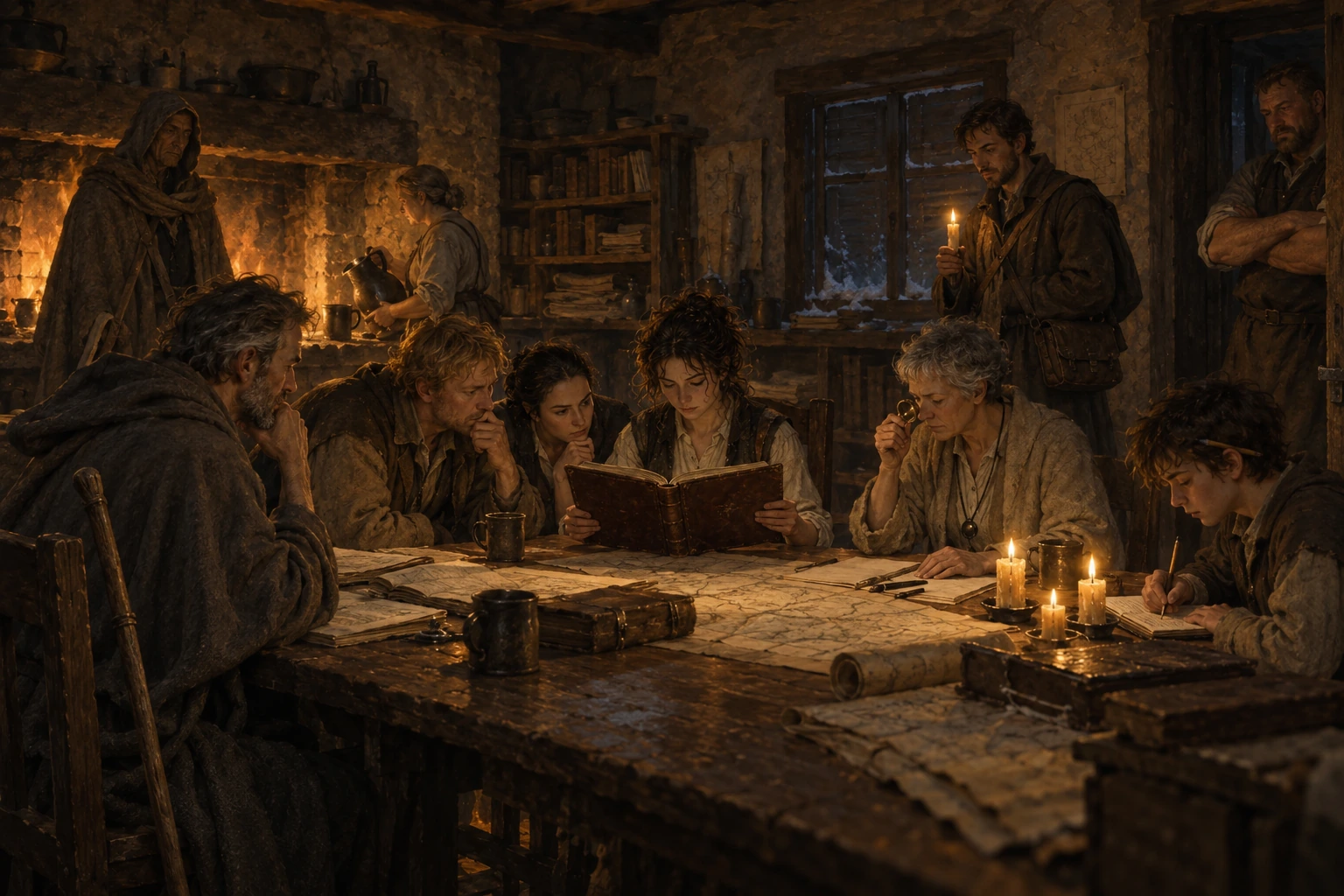
Twelve people stood or sat around the long table in the map-room to watch her do it, crowded close in the light of four candles and a built-up fire because the room had never been meant to hold so many at once, and not one of them had touched the book since Alder had set it dark and clear in her hands that morning, and not one of them was going to. Snow lay thick against the shutters and had done for nine days running, packed hard enough now that no rider could have gotten a horse through it in either direction even with the passes themselves still theoretically open, and the house had stopped pretending, sometime in the last week, that a letter might yet come before spring. It was the shape the winter had settled into, and nothing about it wanted saying aloud.
She had told Dorrit that morning, and no one else, why the book was finally open past the last road. "Granna told me not to be in a hurry to be first," she said, over the bread she was not eating. "I'm done waiting on her reasons to catch up with mine." Dorrit only nodded, once, and went back to the kneading, and did not tell her she was owed the anger or that she ought to set it down; she let the sentence stand in the kitchen, the same as any true thing is let stand once it has been said.
The reason the rest of the house had gathered for it that evening was Bracken's, given once at the midday meal in his own flat voice: a Warden of the College under one roof with an Amarin who had known Meddani when they were still a living people, four Ashcroft folk whose own charter came down out of that same hand, a Cartographer-Royal who could read a surveyor's shorthand in her sleep, and a man who had spent a working life reading dead men's ledgers for a living — and nothing at all between now and the thaw but time to spend it in, since the roads had shut and the fold had shut behind them and there was no other work in the whole house that wanted twelve pairs of hands at once, said once and left to stand. It would not come round again this winter.
They found their own places in the map-room after supper without being told where to stand, a household falling into a chore it had discussed for days and never rehearsed. Iyene took the table's near corner with her lens on its cord and a stack of blank sheets squared already at her elbow, three pens laid out side by side though she would use, in the end, only one of them. Osric and Thomasin took their stand at Wren's left, close enough to see a letter-shape without crowding the book itself, Thomasin a half-step nearer the lamp because her eyes, she said without apology, wanted the light more than his did. Alder took the single chair anyone sat in for the first several hours of the evening, his own working papers squared in front of him and his stick, for once, propped against the table rather than left by a door; Luel stood back by the fire with her hands loose at her sides and her weight settled evenly on both feet, and came no nearer the table than that for the whole of the night that followed. Marta set a jug and cups within reach of the hearth and then found a stool near Sim's shoulder, and Sim himself leaned in the doorway with his arms folded until the room's business made it clear there was nowhere better for him to be. Dorrit reached once to help Iyene square her sheets before the reading began, and Iyene said, "I have it," without looking up from them, and Dorrit let the offer go without a word and turned instead to see about the fire.
Marle asked to look at the leaves before anyone read a word of them, and Wren let him, holding the book open on her own two hands while he bent close over it with a taper held well clear of the vellum and touched nothing at all — not the page, not the binding, not even the case's worn corner, though his fingers hovered near it more than once out of what looked like old habit rather than any present intention. He took close to a quarter hour over the inspection, turning nothing himself, asking her twice to tilt the page a degree toward the light and once to hold it perfectly still while he looked along the grain of a fold near the spine. Then he straightened, rubbed one knuckle absently against his jaw, and said the single thing he had come prepared to say and no more than that.
"This was not written at one sitting. There are three inks on these leaves, and the third is a long way from the first — years, not months. And the ruling stops after the second leaf, because a man who ruled his lines for twenty years stopped bothering to."
He was talking about ink, in his own dry professional register, and the whole room let him do it without so much as a glance passed between two of them. Iyene turned back to her own sheets and squared their edges a second time, for no reason the edges themselves required. Sim came in with an armload of split wood and stacked it by the hearth without a word, and went out again for more. Bracken fed the fire. The reading began.
She was not reading, not yet, and would not be reading for hours still to come. She had the forty sounds, given her whole the way a tune is given to a child too young to ask what the words underneath it meant, and nothing more than that; she could voice any letter Wystan had ever set to vellum in his own hand and understand not one syllable of what she was voicing, the sound arriving in her mouth and leaving it again with nothing of its own attached. She was a mouth, and she had known that about herself since she was nine years old in the orchard at Fallowmere, and everyone else standing round that table was doing the part of the evening's work that actually mattered.
The first two leaves went slowly, the way any wall comes down when it has to be taken apart stone by stone instead of pushed over whole. Wren sounded a word, low and careful, sometimes twice if the first pass came out wrong to her own ear; Alder turned it over against the shape of the sentence forming around it and offered a meaning, usually right and sometimes not; Luel, when the sound reached far enough back into an older register of the tongue than Alder carried easily, supplied what he could not, without once turning her head toward the table to see what word she was answering or who had asked it. Iyene copied every reading onto her own sheet in a hand grown almost as small as Wystan's own, dated each line against the ink-change Marle had already marked out for her at each leaf's start, and said nothing whatever about the sense any word carried, only its shape and its place on the page. Behind them all, Pip's pencil moved without pausing, catching each sound as Wren gave it, spelled as it sounded rather than as it was ever likely meant to be spelled.
Twice in the first hour Thomasin thought she knew a word by its shape alone, before anyone had sounded it — her own town's charter, copied and recopied for three centuries running out of a hand descended from this very one, had taught her young to read a signature the way another woman reads a face across a crowded room and knows it before she has consciously looked. The second of her two guesses she took back herself, unprompted, before anyone else could correct her, turning the stroke she had called a place-name over again under Iyene's lens and finding, on the second look, that it was a number after all, badly formed by a tired hand at the ragged end of a long day's writing. "That one's mine," she said, of the mistake and not of the word itself, and went back to watching the page for the next shape she recognized. Osric said, once, without any complaint in it, that she had always had the better eye for a letter than he did and that he meant to leave the close work to her from here on, and Thomasin took it without lifting her eyes off the page.
For most of an hour the table took one of Wystan's own lines as weather — a cold coming down out of the mountains toward the coast, or else the reverse, and the table could not agree which it was meant to be — until Iyene set his dates against her own careful tables of distance and found that the arithmetic would not hold, either way it was read. The roads that had fallen silent first were not the highest of them, or the coldest, or the nearest the sea. They were, when the figures were laid out clearly enough for the whole room to see at once, the ones with the fewest names signed in the way-house books he had walked out to check for himself. Wystan had watched it happen three separate times, close enough to time each occurrence by his own reckoning, and had set it down in his report not as a guess dressed up to look like knowledge, but as a fact a careful man had earned the right to state.
"They do not go quiet together, and they do not go in order of height, or of cold, or of distance from the sea, whatever a man might guess sitting comfortable at a desk two hundred miles off from any of them. They go quiet in the order they stop being walked — traffic first, then silence, then the cold moving in after, once there is nobody left to hold the door open against it. I do not know what does it. I have never seen it happen with my own eyes, and I do not put much trust in any man who tells me that he has. I can give you the order. I cannot give you the cause."
He said a good deal less about why he had gone on obeying the Hall's own standing order to write down every name a living mouth would give him along the road, and to keep on writing them down for as long as he remained able to walk and hold a pen. He had asked what the names were wanted for, twice, in two separate letters sent home over two separate years, and had been answered neither time by anybody at the Hall. He wrote the names down anyway, because a working surveyor does what the Hall instructs him to do without expecting his own curiosity to be indulged, and because it seemed to him, increasingly, the further west he walked and the fewer people he found left to name, that somebody a good deal further up the chain than he would ever stand knew a great deal more than the Hall had ever troubled to set down on paper for a field surveyor to read.
Somewhere in the middle of an ordinary line about provisions and the state of his boots he set down, almost in passing, that he expected to be back east across the passes himself within the year, or failing that, that the Hall would send someone after him before a second winter had turned. The room read past it and on to the next word.
Once, reading ahead of where Wren's own sounding had reached, Alder took a cluster of syllables for the name of a hill or a ford, the ordinary kind of word a working survey line is full of from its first page to its last, and was wrong about it. Wren sounded the same cluster again at Luel's asking, slower this time, and Luel said, from her place by the fire and without moving from it, that it was not a place-name at all — that it was what a woman says to call a dog home across an open field at dusk, nothing grander than that, and that Wystan had most likely picked it up from whoever had fed him that particular week on the road and set it down afterward because it pleased him to. "Then I had that wrong," Alder said, and let the correction stand exactly for what it was, without a joke to soften the shape of it or an excuse to explain how he had come to make it.
It was in that same long stretch of the evening, reaching for an ordinary connecting word — the one that ties a clause of cause to a clause of consequence, a small plain word Wren had heard him use easily a hundred times over on the road without either of them once remarking on it — that Alder stopped mid-sentence, and did not find it where he reached. The room felt him stop before a single person in it understood why he had.
"I had that word," he said, after a moment, to no one in particular and to the whole room at once. "I don't have it now."
He offered no apology for it, and no accounting of how or when it had gone from him, and read the line again a different way, with two shorter, simpler words standing in the gap where the one word should have been, and went on reading. Luel did not react to any of it. Wren, three feet from his elbow with the book still open under her own two hands, turned the next leaf when it was time to turn it.
The third and fourth leaves were the densest writing in the whole book, denser by far than anything that had come before them, and the room did not get them, not that night and not at all. Alder could read the individual words well enough, most of them, called out singly the way a man reads a stranger's name off a gate before he has any notion who lives behind it, but not the sentences those words made once they stood together on the page; whatever office within the Hall Wystan had written these two leaves for kept its own private grammar, its own contractions, its own shorthand for things that had only ever needed saying once, behind walls long shut to everyone now living. Osric turned the leaf twice under the lamp, holding it at two different angles to the light, and offered the one thing anyone in the room managed to establish about it the entire evening: that the hand was the same hand as the one on the first two leaves, unmistakably, and that the writing itself was not the same kind of writing at all. The finding stood unimproved for the rest of the night, though several of them tried.
Iyene could see the shape of an argument sitting inside the notation, even without being able to read a word of its content — a list here, set out in a column; a correction struck through cleanly and rewritten just beside it; a figure carried down one margin like a running total kept in a ledger — and she said so, once, plainly, and would go no further than the shape of it. "I don't guess at content from a form I've never been taught to read," she said, when Bracken asked her outright whether she had any real feeling for what the leaves were saying underneath their own strangeness. "I have never in my working life drawn a single line onto a map from someone's telling rather than their showing, and I am not about to start with a page I cannot even fairly call a telling."
Bracken tried Alder instead, not unreasonably, and asked him for nothing more than his best guess, even a wrong one, on the grounds that a wrong guess was still better than the nothing they currently had between them. Alder looked at the leaf a long while before he answered him, turning it once under the light exactly as Osric had, and set it back down flat on the table before he spoke.
"No. Some lines want leaving exactly as dark as they are, and I would rather be a man who admits plainly that he cannot read something than one who tells you he can and turns out to be wrong about a thing this size."
Bracken did not press him a second time, though something in his face had not accepted the answer as an answer, and the room went a little colder for a moment or two than the built-up fire could account for. Iyene stood a half-step nearer Alder's chair than she had been standing before Bracken asked his question, which was, in that house, its own kind of statement. Bracken fed the fire one-handed while the silence settled — his left hand still would not close the whole way around a split log, and had not since the night at the gate, and he made nothing of it.
By then Wren's voice had gone thin at its edges, worn down by hours of pure sound without a single grain of sense attached to any of it, and a cup of something hot appeared at her elbow without her having asked for it, carried up quietly by Marta, who set it down and stepped back to her stool without waiting to be thanked. Somewhere in that same stretch of the evening Dorrit brought a plain kitchen chair up from below and set it in behind Wren's knees without a word of explanation offered to anyone, and Wren sat in it because standing had stopped, by then, being a thing her legs would reliably go on doing, rather than because anyone in the room had told her she ought to sit.
They set the third and fourth leaves aside a little before midnight, unread and likely to stay that way past anyone now living in the room. Alder said only that he did not believe another hour spent on them would buy the household anything a full night's sleep would not go on to buy it a good deal more cheaply. Wren turned to the fifth leaf, and the whole room leaned in around her.
The hand on the fifth leaf was not the hand that had written the four leaves before it. The strokes ran bigger and slower here, spaced wider across the page, as though whoever had held the pen at the very end of it needed a good deal more room for each single letter than the young man on the first two leaves had ever required for a whole sentence. Marle, watching from near the door, said only that the hand had changed again — an old man's hand now, by his own reckoning, slower and heavier than the first — and stepped back to let her read. Wren sounded the opening word from habit, just as she had sounded every other word of the night before it, and then found, without quite noticing the moment it happened, that she had read it instead of sounded it, and went on reading in exactly that way.
"To whoever comes back carrying this," it began. "I do not know your name, and will not pretend to guess at what kind of person you might turn out to be, since I could be wrong about that in more ways than there are ways left to be wrong."
He had reckoned three generations, he had written — four, if the winters ran long and the roads stayed shut as often in the years to come as they had lately been staying shut on him — before anyone at all would open this leaf.
Pip did the sum before anyone in the room had thought to ask him for it. "Eleven," he said, not much above a mutter, and looked, the instant the word was out of him, as though he wished badly that he could take it back. He was not wrong, and nobody told him he was clever for it. He bent back down over his own copying and did not say the number again that night.
Wren read on. The book was to go to the Surveyors' Hall, at Cael Meddan, and nowhere else at all — not to a College, not to a Crown, not to whatever might by then have taken it upon itself to call itself an authority in either place. Four days east of the last road he had drawn her, then two days north by the shoulder of the hill rather than down through the low valley, which was not to be trusted after any year's second thaw had come and gone. He did not know whether the Hall still stood. He did not know whether the road there was still walkable, or whether any part of what he had written would matter in the least to whoever ended up holding the book by the time they read it. He was sorry, he had written, for the poor state of that last stretch of his own drawing — his hand had gone by then, he admitted plainly — and sorrier still that he had used the good vellum at the back of the book for a letter rather than for a proper record, which was never what that vellum had been cut and bound for in the first place.
Luel spoke once, from her place by the fire, before Wren could read any further. "The glass city," she said. "I have said that name once before, about window glass, and no more than that." Wren read on without pausing.
The last lines on the leaf came smaller still, crowded closer together, as though the writing itself had cost the old man whatever strength he had left in him to spend on it by the time he reached them.
"Keep it against the thaw; and when the road opens, the book goes home. The hinge on the case wants oiling before it travels again. I never got round to it."
Wren turned the leaf once more after that, to be certain there was truly nothing written past it, and there was not — only the same bare vellum that had run on blank behind every leaf that came before this final one. She turned back then, past the fifth leaf to the fourth and the third and the two before them, and looked again, more slowly this time, at lines she had already sounded once that same night. Nothing on any of them said her own name, or her mother's, or anything at all about a mark, or about whatever else she carried besides the book itself into every room she had ever stood in. She turned forward again and closed nothing, because there was nothing left in the whole book for her to close it against.
Iyene wanted the route given back to her once more for her own working sheet — the four days, the two days north, the shoulder rather than the valley — nothing more than bare working information, stated once and set down. Wren opened her mouth to give it back to her, and found the words would not come when she reached for them. She tried a second time, and her voice broke somewhere in the middle of the words "four days," and did not finish the sentence.
Nobody moved to take the book out of her hands, because there was nobody else in the room who could have taken it. No arm went round her shoulders, and nobody told her that it was all right, or that she had done well by all of them, or that the rest of it could easily wait until morning came. The room simply waited with her, the fire ticking low in its bed of coals, three of the four candles burned down now to their last inch of tallow, until Dorrit spoke into the silence.
"You're a Fallowmere," Dorrit said, "and so, as it happens, am I — same as you, same as him, whatever that's worth to either of us tonight."
It started out near enough a joke that Wren almost heard it landing as one, and did not finish as one in the end. Dorrit looked once more at the five closed leaves under Wren's still hands, and let the sentence be the whole of what she offered.
Then Bracken said, in his own even voice, that the hour had gone later than any of them had proper business being awake for, and that the fire wanted banking before anyone thought about their own bed, and the household went up the stairs in twos and threes after that, as it went up most nights in that house.
The next two mornings went almost wholly to copying what the household had managed to get off the five leaves the night before. Pip's phonetic pages went into a fair working copy in Iyene's own steady hand, checked twice against Wren's own memory of the sounds as she had voiced them and once more against Alder's sense of the grammar underneath them, the three of them bent together over the long table through most of both mornings while the rest of the household went back around them to its ordinary winter work — wood split, stock fed, the passageways swept clear of the night's fresh drift. On the second morning Thomasin, turning the previous night's notes over again with fresher eyes than she had brought to them at midnight, found that she had misread one figure the first time through. It was a route distance she had taken for a four, and it proved, on the second careful look, to be nearer a seven. She said so at once, and without a shred of embarrassment in the saying of it. The correction went into the fair copy beside the original reading, in Iyene's smallest working hand, rather than written over the top of it and lost.
Osric and Thomasin spent a good part of that same second morning going back over the third and fourth leaves with Alder one more time, patiently, without any real hope between the three of them that a fresh morning's light would open a door the previous night's had not, and it did not; the leaves went back into the book unread, exactly as they had come out of it, to wait for spring. Nothing had been decided about a road to Cael Meddan, and nobody tried to decide it in those two short days that followed the reading. There was still copying to finish, and a long winter still to get through regardless of what any single leaf of the book had to say about it, and the decision, whenever it finally came, would want a good deal more of the household awake and gathered for it than had been gathered the single night the book was opened. Iyene said, at the close of the second morning's work, that the whole household ought properly to sit down together over it, soon, and Bracken agreed at once that the following evening would serve as well as any evening was likely to. Nothing more than that was settled between them.
For the first time since the map itself had been finished, she did not leave the book lying on the map-room table that night. She carried it up the gallery stair on her own two hands, and in the morning the long table stood bare where it had lain for so many nights running. She had already taken the grey stone back down to the yard, and left it where it had always sat.