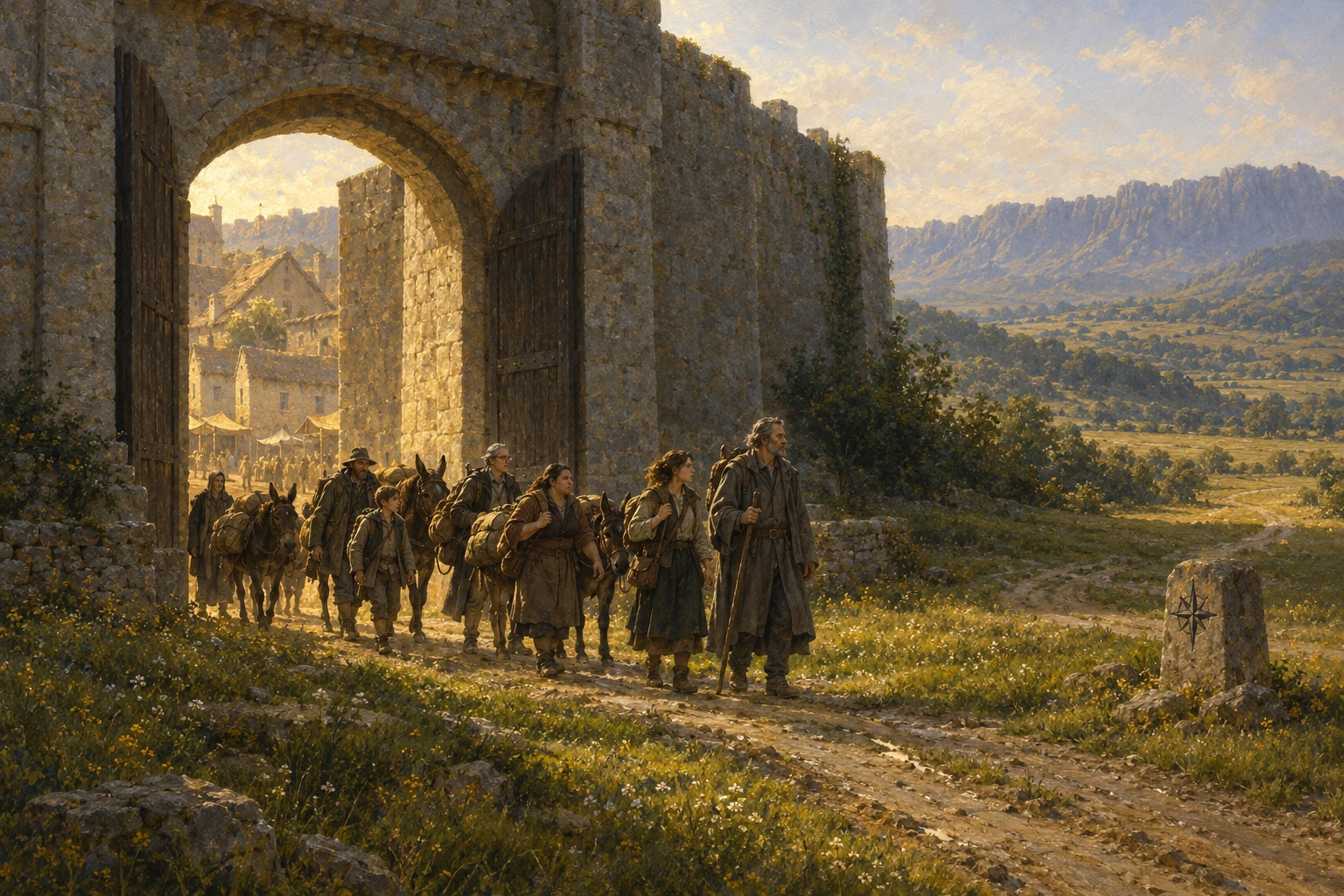
The West Gate
The mules woke first, as Bracken had promised they would. By the time Wren came down into the stable yard in the grey before sunrise, Suet and Barrow were already leaning into their headstalls with the particular hopeful insistence of animals who knew, in whatever way a mule knows anything, that today was not a day for standing about.
"Told you," Bracken said, without turning from Nettle's girth, which he was checking for the second time though he had checked it once already by lamplight the night before. "They always know before we do. I've broken camp on a hundred ordinary mornings and had a hundred ordinary mules stand there half asleep about it, and I've broken camp on the first morning of a long road maybe a dozen times in my life, and every single time, the animals have been up and leaning at the rail before the cook fire's lit. I don't know what tells them. I've stopped asking."
The yard filled by inches rather than all at once. Pip arrived at a half-run with his hair still standing up on one side, an inkwell tucked safely inside his coat as though he had learned, overnight, to trust a pocket the way he had once trusted a whole roll of spares. Dorrit came down eating a heel of bread and talking with her mouth half full to no one in particular, which was, Wren had come to understand, simply how Dorrit greeted a morning she was glad to see. Iyene Sath appeared last and most quietly, already dressed for the road in a coat Wren had not seen before — shorter than the oatmeal draftsman's coat, weathered to the color of a walked-over field, the brass lens already hung round her neck where it would live, Wren suspected, for the better part of the next three years.
Alder came out to the rail with his ash stick in hand and his satchel of papers slung crosswise, and stood a moment simply looking at the six of them and the four mules and the neat grey light coming up over the College roofs. It was an expression Wren had seen on him only once or twice before — at the charter supper, over Bracken's plain toast; on the road out of Dall, looking back once at the last hill. He put his hand briefly on Suet's neck, as Bracken did, and said, "Well," which from Alder, Wren had learned, generally meant that something large had been felt and was not, for the moment, going to be spoken of further.
Bracken finished the girths, walked the whole string once more with his slate though he did not consult it, and pronounced the load fit to travel — every pannier exactly where the last night's yard had left it.
"Fit to travel," he said aloud, which was evidently a phrase with some weight to it, because Pip's face did its fierce, hopeful thing at hearing it, and even Nettle's ears came forward as though she too had been waiting for the words.
They went out through streets that were themselves only just waking, and Wren found she liked Merrow best this way — in this half-hour that belonged to bakers and milk-carts and the watch changing at the corners with a tired courtesy that had nothing of ceremony in it. It was a city getting on with its own small business, entirely unconcerned that six people and four mules were passing through the middle of it toward the mountains. A baker's boy, setting out trays in a doorway, watched the string go by with frank interest and no idea at all what he was watching. That, Wren thought, was as it should be. The valley of Dall had made a small festival of their leaving; Merrow, rightly, made none, having watched companies go out its gates for three hundred years and learned not to make a fuss over ordinary work simply because it mattered enormously to the ones doing it.
The College sent them off at its own door rather than the city's, in the manner of people who had already said the large things at the charter supper and saw no reason to say them twice. Master Hollis was there, wrapped against the early cold in more shawl than the weather strictly wanted, his shaking hands folding something small and flat into a square of oiled paper before he pressed it into Wren's hands without preamble.
"A fair copy," he said, "of the road as the College currently has it — as far as the border watch, and no further, because no further is as far as the College knows. It is not your book, and does not pretend to be. Only ink from a living hand, checked within these ten years, and it may save you an argument with your own book, somewhere a fortnight from now, over a bridge that has moved or a ford that has silted since Wystan's day. Roads change, child, even when the men who love them do not." He looked at her a moment longer, eyes doing the work his hands no longer quite could. "The last little way is the only part anyone ever remembers to be grateful for. See that you remember the rest of it too, on your own account, for as long as you're able."
Stane pressed nothing on her but a last quick correction of her grip on the folding rule, made and unmade in a single practiced motion, and a look that was very nearly proud, though he would certainly have denied it if asked. The clerk from the mail-hold walked with them as far as the corner, in his own coat over his own nightshirt, to say once more that any letter arriving for W. Fallowmere, the Survey, would follow them faithfully, market to market, for as long as the Survey sent word of where it next expected to be. There was no crowd, and no speeches, and no one cried, which Wren was privately grateful for, having already done that particular business once, on a hilltop above Dall, and having no wish to do it again before breakfast.
The West Gate, when they reached it, was larger than anything in the wall around it had any present business being.
It rose in dressed grey stone twice the height of the wall on either side, with a wagon-road running through it wide enough, Bracken observed, for ten carts abreast, and a lesser arch beside it for foot traffic. That arch saw, this morning, exactly the traffic it was built for: themselves, and a farmer walking two thin cows toward some market Wren did not know the name of. The old guardrooms cut into the stone stood shuttered; a single watchman leaned in the wagon-arch's shadow, bored past caring, and nodded them through without troubling to ask their business, because six people and four laden mules going out at dawn was, evidently, not a thing worth a Merrow gate-watchman's curiosity anymore.
"They built it," Alder said, stopping a moment under the arch's shadow to look up at the stonework the way a man looks at an old friend gone stout and quiet in his later years, "for the western trade. Wool coming down out of the passes, and glass, and I'm told a particular blue dye nobody this side of the mountains has been able to match since — a whole road's worth of wagons a day, once, coming and going through this one gate. It hasn't carried a tenth of that traffic since the wool trade failed, and it will not carry a tenth of it again in our lifetimes, and the College has never once suggested building it smaller, because a gate this size standing nearly empty says something true that a smaller gate standing full would not." He set his stick down once, lightly, on the flagstones, the closest thing he had to a full stop.
Iyene made a small dry sound, drier than a laugh. "You might tell her the other thing, since we'll be walking under the joke itself for a fortnight." She glanced at Wren. "This is the King's Road West. A road is named for where it means to arrive, not the bearing it happens to be walking when somebody first writes its name down. This road bends north not a mile past this gate and stays bent north the better part of three weeks, and does not turn honestly west again until it has crossed most of a kingdom into country no College surveyor has seen since the passes shut. We call it the West Road the whole way, north and all, because west is where it was always going, however far round it has to walk to get there." She let the glass drop back to its cord. "A very honest kind of dishonesty. Rather like most promises worth keeping."
Wren looked back once, through the gate's shadow, at the city waking gold and ordinary behind them, and then ahead, where the road ran out pale and wide under a sky just beginning to color. She felt the particular clean pleasure of a thing finally doing the work it had been built and provisioned and promised to do — a whole autumn's readiness made suddenly, simply, useful.
The company found its shape within the first mile, the way water finds the shape of whatever ground it is given, without any of them, so far as Wren could tell, deciding it on purpose.
Bracken and the mules went first, setting a pace that was neither fast nor slow but simply correct, the pace of a man who had walked more loaded miles than anyone present and had long since stopped needing to think about how many made a good day. Iyene ranged wide of the column almost at once, her glass up and down and up again, pausing to write something quick in a pocket-book kept for exactly that purpose. Pip went everywhere — ahead to walk backward and ask Bracken a question, up alongside the mules to check a strap that did not need checking — with the restless energy of a young dog let off a lead in a field larger than any he had run in before. Alder fell in last of all and stayed there. When Wren glanced back to ask if he meant to walk the whole day at the rear, he only said, mildly, "I like to see everyone ahead of me on a good road. It is one of the few pleasures of getting older that nobody warns you about."
That left Wren and Dorrit walking together in the middle of the string, between Bracken's mules and Alder's watchful rear-guard, and it was Dorrit — of course it was Dorrit — who said the thing Wren had noticed and not yet let herself think through.
"D'you see where they've put us," Dorrit said, not quite a question, swinging along with her hands in her pockets and her face turned up to the widening morning. "Bracken in front with the weight, because he's the one who reads a load and a hill both at once. Iyene out wide because seeing further than the rest of us is her whole trade. Alder at the back because he likes to watch the road close up behind a company the way a shepherd watches a gate shut on a full fold. And you and me tucked here in the very middle of it, snug as a raisin in a pudding, where nothing on this earth is going to reach either of us without going through the whole rest of the company first."
"I'd noticed," Wren said. "I've decided to be flattered by it rather than insulted, which took me most of yesterday to settle on, so don't spoil it by agreeing too readily."
"I thought you might have." Dorrit let it lie there and went back to watching the morning, which was, from Dorrit, its own kind of tact.
The road itself, for the first hour past the gate, was as fine a piece of paving as Wren had ever walked — broad and cambered, laid in great fitted stones gone smooth and pale with generations of feet, a College waymark standing square and confident at every mile, its carved distance sharp-edged as the day it was cut. But it began, almost without her noticing the moment of it, to change.
The good stone gave way first to stone laid rougher, patched here and there with gravel where some long-ago repair had simply run out of the will or the money to match what had been there before. The camber flattened. Grass crept in along the crown of the road where the traffic had once been too constant to let it, and then along the wheel-ruts themselves — a thin green seam running the whole visible length of the road ahead like a hair-line crack down the middle of a good plate. They crossed an old stone bridge an hour on, three arches over a modest brown river, and Barrow — true to every word Bracken had ever said of him — laid his ears back at the first hollow drum of his own hooves on the planking. He would not be hurried across it for anything short of Bracken's low, patient, endlessly repeated word in his ear. He crossed in the end, and shook himself out on the far side like a man setting down a weight he'd privately decided not to be dramatic about.
Past the bridge the farm country began in earnest, and the road's decline went with it: fewer carts met them, and then almost none. The fields came up closer to the verges, as though the land itself had begun, mile by patient mile, to reclaim what it had once only lent. And still, faithfully, at every mile, a College waymark stood — squared, mason-cut, the same carving as the ones outside the city gate, the same two-hundred-year-old promise that one stone could be trusted because all of them could. Only now the stones stood, more often than not, in a road gone narrow and grassed and half a farm lane.
"It's a strange thing to build for," Wren said, at one such stone, more to herself than to anyone, "keeping faith with a road that's forgetting itself."
"It's the only thing worth building for, I've always thought," Alder said, coming up quietly behind her, having heard her, as he generally did, without seeming to have been listening. "Any fool can mark a busy road. It takes a particular kind of patience to keep marking an empty one at exactly the same care, on the chance that someone, someday, will need the mile to be true." He looked down the long grassed ribbon of it, waymark after waymark dwindling into the distance like a row of good intentions nobody had yet had the heart to abandon. "I think that's rather what we're for, in the end. Not so very different from a stone."
They stopped at midday in the lee of a hedge, bread and hard cheese and the last good apples from the Merrow market going round the circle, and it was here that Wren watched Iyene Sath be, for the first time since she had known her, entirely out of doors — the College economy still in her, but something in it softened at the joints, the way a good tool softens with the first real use after a long spell hung on its peg. She took a bearing off a hill to the north, not because it was needed but, Wren suspected, because taking it was a pleasure long deferred, sighting along a small ugly instrument that had, she said, survived two scree slopes the fine one in the map-room would not have survived once.
She glanced at the satchel Wren had set down within reach, as satchels belonging to keepers apparently always were. "You keep a day-book too, I understand." Wren produced it, a little shy of the offering, and Iyene read a page in a silence Wren found she did not mind at all.
"Good," Iyene said, handing it back. "Plain, and dated, and honest about what you don't yet know how to measure — I'd rather have three lines of honest uncertainty than thirty of confident guessing. You've noted the bridge crossing by its arches and left the span unmeasured, which is Alder's kind of noting and not mine — both have their uses, but a College hand ought to give a rough span by eye within a season, sight alone. I'll show you the trick of it this evening, if the light holds." She closed the matter with a short, satisfied nod, the same nod Bracken gave a well-packed pannier, and went back to her bread. Wren carried the exchange the whole rest of the day like a small warm stone in her pocket.
They made camp with the last good light, in a fold of ground off the road where a stream ran clean over stones and a stand of old ash trees offered a windbreak Bracken pronounced, after one slow circuit of the ground, "as good as we'll find this side of the border, and better than we've any right to expect on a first night out."
The mechanics of it went quickly under Bracken's low, steady direction — picket line, mules unloaded as carefully as they'd been loaded, the tent canvas up in two low shapes, one for the men and one for the women, a College habit nobody troubled to argue.
Pip tried to do all of it at once.
He was at the firewood and then at the water and then back at the tent-lines before the firewood was properly stacked, moving with the scattered, well-meaning haste of a boy determined to be indispensable everywhere before anyone could notice him useless anywhere. The inevitable happened within the half hour: an armful of kindling dropped half in the stream, a tent-peg driven crooked and pulled again, a bucket set down and forgotten and very nearly kicked over by Nettle, who registered her opinion of the matter with a look that needed no translating.
Bracken watched the whole of it without a word until the bucket, and then crossed the camp, crouched by the scraped fire-ring, and said, in the same level voice he'd used over the load-doctrine a week before, "Come here a moment, lad, and forget the water and the pegs — Dorrit's got the water in hand, and I'll see to the lines myself, same as I have every night these thirty years and will for a good many more. I want this fire built, and kept, and fed at the right times with the right wood, and I want it to be your fire, the way Suet's my mule and Nettle's her own particular problem to be managed by anyone with the sense to speak to her first. One job, done properly, is worth six jobs half done and forgotten. Can you give me that?"
Pip, red to the ears and visibly braced for something worse, looked at the small pile of kindling and then at Bracken and said, "Yes," in a voice that came out smaller than he'd meant it to.
"Good," Bracken said, and stood, and walked away without looking back to check on him. Within the hour the fire Pip built was burning even and bright and exactly the right size, tended with a fierce, quiet concentration that had nothing scattered left in it at all. Bracken, passing behind him once with an armful of pot and pan, said only, "That's a proper fire, that is," and went on, and Pip's whole back seemed to unknot at the words.
Supper was Bracken's stew, pronounced by its maker "fair for a first night, and it'll improve," eaten round the fire with the good humor of people who had found the doing every bit as satisfying as the planning had promised. Dorrit produced a jar of honey from her chest, unlabeled, and owned, when pressed, that she'd smuggled a small crock of Fallowmere's own out of the last household stores — "for exactly an evening like this one, when a person wants reminding what home tastes like without having to say so out loud." It went round the fire on spoons, in silence, in a way that said more than anyone troubled to put into words.
It was Bracken, scraping his own bowl clean, who nodded at the fiddle-case propped against Gable's saddle-frame and said, with the elaborate carelessness of a man disguising a planned request as an idle one, "That mule's had a long first day of it. Might be worth trying, if you've a tune that doesn't mind an audience of four."
"For the mules," Wren said, straight-faced.
"For the mules," Bracken agreed, and did not glance toward his own bowl going cold at his knee while he waited.
She played Down Along the Dall, low and easy, the fire between her and the dark. Gable's ears swiveled toward the sound and settled, and Nettle's did the same a verse later, with rather more suspicion. By the time she'd finished, Bracken had somehow acquired a second helping of stew without appearing to have moved for it, and pronounced the whole performance "very near what an evening ought to be" — which Dorrit informed her, in a whisper Bracken clearly heard and did not deny, was the highest compliment the man possessed.
The watch was set before the fire burned down, in the plain, practical way Bracken set most things — not against any particular danger on so ordinary and well-marked a road, he was careful to say. A fire wants tending in the small hours, and a picket line wants an ear kept toward it, and a habit begun easy on a quiet night held better, in his experience, than one begun in a hurry on a bad one.
"I'll take first," he said, "since I'm awake anyway, checking what I've already checked twice. Alder, you're a man who reads half the night regardless of what anyone asks of him, so you may as well read it usefully and take the middle." Alder inclined his head, unsurprised, as though the arrangement had been made for him some years before he arrived to hear it. Bracken looked last at Wren, and asked it almost gently, a question rather than an assignment. "And you'll take the last of it, I think, if it suits — the grey hour, before proper light. I'm told a bee-keeper's up with the dark half the year regardless of who asks her to be, and I'd rather put the last watch in the hands of somebody it costs nothing at all."
"It suits," Wren said, and it did: the notion of being the one awake to see the dark thin into grey over a strange field, alone but for four dozing mules and a low-burning fire, held nothing in it that felt like a burden, only the old familiar shape of a morning she had kept, one way or another, her whole life.
Dorrit and Pip and Iyene, spared the first night by unspoken agreement — Pip too new to it, Iyene too valuable rested, Dorrit simply too tired to argue the point — turned in early. The camp settled by inches, much as the yard in Merrow had the week before: canvas creaking as bodies found their shapes inside it, the stream going quietly over its stones, the mules shifting their weight one by one into the stillness of animals who had decided, for tonight, that nothing further was required of them.
Bracken's watch passed without anything to report beyond a sky gone thick with the season's first hard stars, and he woke Alder for the middle turn and went to his blanket without another word.
Alder's two hours held the same easy quiet until near the end of them, when Wren woke to find him sitting with his stick laid loose across his knees rather than leaned where it usually stood, his eyes going now and again to the dark past the ash trees in a way that had no book behind it.
"Anything?" she asked, taking the fire from him.
"Nothing I could name," Alder said, which from him was not the same as nothing at all. "The wind's wrong for smelling much, and I've been an old man imagining things on quieter nights than this one before now. Wake Bracken if the mules give you real reason, and not before — he'll want the sleep more than his pride wants proving right." He went to his own blanket, and left her with a caution she could not trace to anything he had actually told her.
She sat a long while in the grey hour before real light, telling herself, as she told herself on every last watch, that a mind left alone before dawn goes looking for company in shapes that mean nothing. Then the dark past the trees went quiet in a way the rest of the night had not — no owl, no small thing working the verge grass, only a stillness that felt held rather than empty. All four mules came up onto their feet inside the same handful of seconds, ears flat, Barrow straining back against his picket with a sound she had never heard a mule make. She had the nearest fire-brand in her hand before she had decided to move, and it was that — not sight, not thought, only her own body understanding the danger a half-breath ahead of her mind — that put her between the picket line and whatever came out of the dark at Gable's flank, low and fast and silent.
It was grey, and lean, and moving with a purpose that had nothing curious left in it. She swung the brand across its path rather than at it — some old bee-yard instinct telling her fire wanted showing more than striking — and it checked, snarling, close enough that she felt its breath against her own knuckles. Bracken was already moving, a second brand in one hand, his voice gone flat and carrying in a way she had never heard from him: "Fire up, all of it — Pip, the kindling, don't think, just feed it — Dorrit, my pack, second flap, the knife—" There was more than one of them, grey shapes working the very edge of the firelight where sight gave out to guesswork. Three. Perhaps four. A hungry season, or a road grown too empty, too long, to teach its beasts what a person was for.
Gable screamed, going down hard against his own rope with something briefly at his flank before Bracken's brand drove it off into the dark, yelping. Alder's stick found something in a short, economical arc, and swung again. Iyene stood over Pip with a knife of her own and nothing of the map-room left in her face. Wren felt her forearm catch — a fast raking heat, there and gone before she knew it for teeth and not a branch's stray edge — and did not let go of the fire, because letting go of the fire was, some clear cold part of her understood, the one thing she was not permitted to do.
It broke as suddenly as it had come, the grey shapes peeling back from the light all at once. Gable's ragged breathing filled the whole clearing. Nettle was still screaming her flat outrage at the treeline. Bracken crossed the firelight fast, checking each of them in the terse, wordless way of a man counting a load he could not afford to be wrong about, and found Wren's arm before she had properly looked at it herself.
"Sit down," he said, nothing gentle in it. "Dorrit. Now."
Dorrit had the sleeve cut back and the wound in the light before Wren had finished obeying — four parallel lines, not deep, welling slow in the firelight. "Clean bite," she said, working fast, her voice pitched for calm rather than truth. "You'll keep the arm and the use of it. It wants binding tight and watching hard three days, because a wolf's mouth carries fever the way a market carries gossip, and I'll not pretend otherwise to make either of us feel better." She reached for her chest and came up with two jars rather than one — the pale and the dark, exactly as she'd packed them, exactly as she'd fought to keep them both — and set the pale one within reach of her own hand. "This is why I carry the weight, Bracken Hale. You'll not say another word to me about it."
Bracken didn't.
Gable had a long shallow gash along one flank, ugly and honest, Dorrit judged, nothing that wanted more than cleaning and a light load and a watchful week. He stood through the cleaning of it with his old patience only a little frayed, and put his head, once, hard against Bracken's chest, in a way no mule on that picket line had done before.
Nobody went back to sleep. They sat the rest of the grey hour around a fire built up past any pretense of economy, Bracken making a slow circuit of the picket whether the mules asked for it or not. It was Iyene who said the direct thing first, in the dry voice she kept for facts too large to dress up.
"I have walked this road eleven times and never past the first week out of Merrow with worse than a blister to show for it. I don't know if this is a hard season, or a hungry one, or simply the first time in longer than anyone's kept count that something out here has forgotten to be afraid of us. I mean to find out which, because a Survey that doesn't know the answer is guessing at its own safety, and I've never drawn a map on a guess I could have measured instead."
"It's the emptiness," Bracken said, low, still watching the treeline, none of his usual dryness left in it. "Saw it twice on the border watch, both times after a bad winter thinned the sheep and thinned the shepherds with them. A country that stops seeing people often enough starts treating them like anything else that walks through it — meat, or a threat — and it takes a beast a season or two to work out which we are." He looked at Wren's bound arm. "I set that watch tonight the way I've set a hundred watches on a hundred quiet roads, because quiet roads are quiet roads. I'll not make that mistake again on this one. First night or fiftieth."
Wren, holding her bound arm against her ribs, believed him.