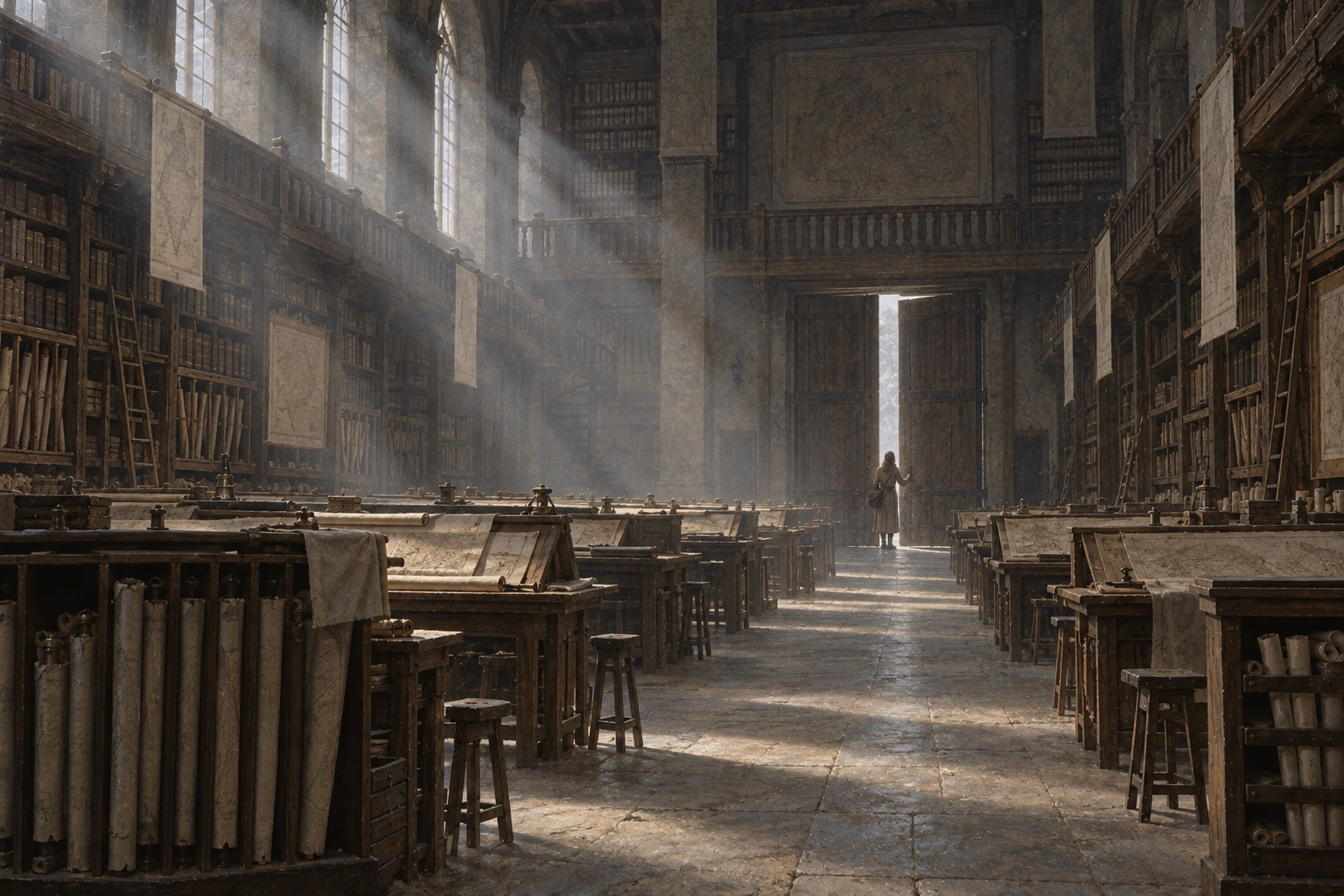
The Surveyors' Hall
"Two days," Dorrit said, not looking up from the bandage, "and I am down to willow bark and good wishes for that hand, and good wishes have never yet set a bone in the whole history of anybody's medicine chest." Ossen flexed the fingers she'd just finished wrapping, got them to within a thumb's width of a fist, and allowed that a thumb's width was better than yesterday's two. Wend, watching from across the fire with his own ribs held carefully under one arm, said that between the two of them they made a single passable person, and Ossen told him that was the first time anyone had called Wend passable at anything, and Dorrit said if the two of them had breath enough left to trade insults they had breath enough to help break camp, which ended the morning's entertainment.
Pip sat a little apart from all of it, working the buckle of his own pack over and over with fingers that did not seem entirely sure of the task, and said nothing to any of them. Bracken passed close by him twice while the mules were loaded, both times without any evident reason, and both times let a hand rest briefly on the boy's shoulder before moving on, which was as near as Bracken had ever come to saying a thing out loud that he plainly meant.
They came at the Hall a second time an hour later, in a cold clear light with the snow stopped entirely overnight, and stood again at the foot of the broad steps while Alder tried the door the way he had tried it the evening before — a hand flat to the wood over the place where the bar should have run, nothing spoken aloud, a working Wren had seen him use on stuck gates and swollen chests her whole time on the road. Nothing answered him. Bracken set his own shoulder to it next, on the plain chance that three hundred years of damp had done what craft would not, and got for his trouble a door that did not so much as complain, solid as the stone around it.
"That isn't an ordinary lock," Alder said finally, stepping back and looking up at the compass rose over the lintel rather than at the door itself. "I've felt that kind of shut before, and this isn't it. This is shut the way the Waybook is shut in the wrong hands. Which would be a very strange thing for a building to be, except that a surveyor built it, for surveyors, and I don't imagine he saw much difference between a book worth keeping and a room worth keeping."
Wren felt the whole company's attention arrive on her before she had finished understanding why.
She did not want to be the one. She had not wanted it on the steps the evening before, and a night's warding and a morning's willow bark had done nothing to change her mind, but there was no arguing with what Alder had just said, because she had heard the ink test done over her own grandmother's table before she had heard almost anything else about what she was. She went up the steps alone, the others staying back at Alder's raised hand, and set her palm flat to the door where his had rested, over the worn place at its center where a bar's cross-plate had once sat.
Nothing happened for the length of three breaths, long enough that she began composing, privately, the sentence she would use to say it hadn't worked. Then the wood under her palm went warm, not with any heat she could have named, more the warmth of a hand that has been shut in another hand for a while, and somewhere deep in the door's thickness something old and swollen let go with the ordinary, unglamorous groan of timber settling, the exact sound a shed door makes on the first dry morning after a wet month. The door did not swing. It only ceased, very slightly, to be shut, a hair's width of black showing down its whole seam, and that was the whole of the miracle, if it was a miracle at all and not simply a lock built for a hand it had been waiting three centuries to feel.
Bracken got his fingers into the gap and the door came the rest of the way on its own weight, slow and grinding, and the cold that came out to meet them was not the cold of the street. It was older than that, and drier, and it smelled of dust and tallow and, very faintly, of ink.
The hall beyond the door was one great room, three stories of gallery running round it on every side, lit from above by a bank of skylights whose glass had held as well as the square's had held. The morning came down grey and even over row on row of standing desks, each with its own high stool, each stool pushed in square to its own desk, as if the room's last working day had ended in perfect order rather than in whatever had actually ended it. Wren stopped in the doorway a long moment simply looking, because there was more paper visible from where she stood than she had seen in her whole life put together — rolled charts stacked in racks along one wall floor to gallery, ledgers shelved spine-out in their hundreds, a drafting table near the center still bearing a chart pinned flat at its four corners, ink long dried in its well beside it.
Nobody spoke for a while. Pip, at her shoulder, made a small sound that was not quite a word, and when she looked at him his eyes had gone round and wet in a way she had not seen since before Kelder, the fading momentarily nowhere in his face at all, only the plain, enormous fact of more maps than he had known existed.
A board hung just inside the door, wide as a man's outstretched arms, ruled into columns and crowded top to bottom with names in a clerk's careful hand — a roll, it took her a moment's looking to place, of everyone who had ever held a post in this building, each name followed by a short notation in a second, later ink. She read the first few without meaning to: gone east, third winter. Died at the north relay, frost. Departed for the coast, with family, second spring. There were perhaps two hundred names on it, and she did not read further, because Alder was already moving past her toward the drafting table, and there was a whole building's worth of colder, more pressing business to be done before anyone had leisure to stand reading a roll of the dead.
The galleries above ran three deep, reachable by narrow stairs at each corner, and every one of them held the same silent trade in some new form — drafting tools laid out in fitted cases, a rack of surveyor's chains hung by size from smallest to largest, a whole wall given over to nothing but ink-pots, corked and shelved and dated in a hand too small to read from the floor. Sael, leaning over the gallery rail above, said it looked less like a hall of any king's than like the College of Roads grown three sizes too large for the country that had built it, and nobody thought to disagree with her.
By evening they had shifted the whole of the camp indoors, mules and all, into the drafting hall's wide floor. Alder walked its walls once with the chalk stub before anyone slept, laying a line at the room's own foundations the same way he had laid one round the merchants' yard two nights before — shorter work this time, the walls themselves doing most of what a length of open ground would have asked of him. Wren's own part of it was done and finished before the mules had properly settled into their new stalling. It held. It would go on holding, night after night, for as long as they stayed inside it, and none of them said aloud how much of a comfort that plain fact was, because saying it might have tempted something to test it.
"We work in this room," Alder said, laying his satchel down beside the pinned chart, "and we work by daylight, and nobody goes wandering this building alone. It's sound. It doesn't mean it's safe, and those two words have never meant the same thing in three years of this road." None of them argued the point. Bracken and Dorrit went to see about the nearer galleries for anything that might serve as fuel or shelter for the mules; Sael and Ferrit took the ground floor's far end, calling out room by room in flat, unfrightened voices that carried oddly in the emptiness; and Wren set the Waybook down on the drafting table, beside Wystan's own pinned chart, and opened it to the back vellum's third leaf for the first time since Wystan's own hand had closed it.
It gave up nothing, at first, except its own difficulty.
The hand was Wystan's, unmistakably — the same forward slant, the same habit of crossing a t with a stroke that ran on a fraction too far — but the words themselves ran in a contracted, close-packed notation none of them had been trained to, half of every common word reduced to its first and last letter with a small mark standing for whatever fell between. Alder read a dozen lines aloud, haltingly, and got perhaps one word in five whole; the rest he could only call by shape, a longer word here, a column of shorter ones there, laid out like a list rather than run on like a sentence.
"It's a working register," he said, after the better part of an hour spent on four lines. "Surveyors writing to surveyors, for their own use, never meant for anyone outside the trade to read — which was every bit as true when your ancestor wrote it as it is of us trying to read it now."
Bracken, going through the shelved ledgers a gallery up, found the same hand and the same notation in perhaps a dozen books before midday, and brought the nearest three down to the drafting table still wearing three centuries of dust on their covers. "If it's a trade hand," he said, "then it's these men's trade too, and there's more of it here than in your one book. Might be we learn to read your ancestor's hand off a hundred strangers' instead of off the man himself."
It was, in the end, the slower and more honest way in, and it cost them the whole of that first day and the better part of the next. Bracken's own reading came first and came wrong: a column of short marks recurring at the head of nearly every page he opened, which he took, from long habit, for a tally of stores — grain, nails, rope, the ordinary bones of any working camp's accounts — until Wren, following his finger down the column, said that one of the marks was a sound she knew, one of her own forty, and it did not belong to any word for grain or rope she had ever heard sounded. Alder took the ledger back from both of them and sat with it a long while, and came up, finally, with the correct reading, quieter than his wrong one had been: not stores, but people. A tally, kept at the head of every working day, of how many mouths had spoken a name aloud to a surveyor's ear and had it written down.
Sael and Ferrit came back from the ground floor's far end partway through the telling, having found nothing worse than an empty stable block and a store-room of surveying poles stacked upright in their racks like a forest cut and never carried away, and stood listening from the drafting table's edge without adding anything of their own. Ferrit asked once, quietly, whether the count had ever gone back up, at any point in all those years, and Alder said that as far as he had read, it had not, not once, not for a single season, and Ferrit did not ask again.
"Every road crew," he said, "kept this count. Every day. Not once, not as a special order for one bad season — for years. Long enough that whole shelves of ledgers are nothing else."
Nobody in the room said the obvious thing aloud, which was that the number, page after page, only ever went one direction.
Evening found them no further than that single fact, and cold enough, all of them, that Dorrit called a halt before anyone's hands stopped being useful for holding a pen or a page. They built a fire in the drafting hall's own hearth, laid with wood Bracken had found stacked and ready in a store-room two galleries up, as if the last clerk out had banked it against a winter he expected to see the end of, and ate a thin supper without much talk.
Pip tried, that evening, to do the thing he had always done without being asked — a fair copy of the day's four decoded lines, neat, for the record — and got as far as the second word before his hand stopped answering him the way it had stopped at the fireside two nights before, the chalk hovering a finger's width above the page and going nowhere. He sat with it a long moment, willing it, his jaw working, and Dorrit, without a word to him or to anyone else, reached over and took the chalk out of his fingers and finished the four lines herself, in her own rounder, less practiced hand, and set it down beside his where he could see both. Pip looked at the two copies a while. He did not say thank you, and Dorrit did not wait for him to, and that was the whole of it — no speech, no comfort offered or refused, only a boy's worth put quietly back on the page by somebody else's hand, which for a boy whose whole worth had always been his own hand on a page was very nearly the cruelest kindness anyone could have done him.
Wren watched it happen from across the fire and said nothing, and understood, in a way she had no words ready for, that she was watching the exact thing Alder had warned them of on the steps: sound, and not safe, and never the same word twice.
Sael took the first watch that night with Ferrit, at the drafting hall's own great door, and the hours passed without incident, the line holding the way it had held every night since Wintergarth. Wend and Ossen slept close by the banked fire, Ossen's bad hand curled loosely against his chest even in sleep, as if it meant to guard itself. Dorrit sat up a while longer than the rest, mending nothing in particular, her eyes going now and then to Pip's blanketed shape by the hearth, and if she slept at all before her own watch came round, Wren did not see it happen.
The second day gave them more, and gave it faster, because a trade's own habits, once found, do not vary greatly from one clerk to the next.
By midmorning Alder had confirmed what the tally columns implied and Bracken's own road-sense had half-suspected the evening before. The count of names written down had, over some run of years neither of them could yet fix a date to, begun to fall — not all at once, not by any single bad season, but steadily, road by road. Bracken laid three ledgers side by side and read their headers against each other, and the order they gave matched the very order the roads themselves had gone quiet in, the same order Wystan's own first two leaves had already told them once, a lifetime ago now, over that long evening at Wintergarth. Traffic first. Then silence. Then the cold moving in after, on ground no one was left to walk across and keep warm with the plain fact of somebody walking it.
"It isn't three things," Wren said, slowly, working it out loud rather than announcing it, because she had only just heard herself arrive at it. "The roads. The beacons. The names we've been carrying home this whole way. Wystan didn't write about three different duties in these books. He wrote about one."
Alder looked at her for a long moment before he answered, the way he looked at a lock he had just heard give.
"A road kept open," he said, "a fire kept lit, a name kept spoken — none of them holds anything on its own. It's the three together, worked at the scale of a whole country, by people who mostly never knew that was what they were doing. Walking their own roads. Minding their own beacons. Saying their own dead's names over supper because that's what a person does with their dead." He set the ledger down very carefully, as if it had grown heavier in his hands while he spoke. "It was never a country's roads and a country's fires and a country's memory. It was one boundary, and we have been rebuilding a piece of it every single day since we left Dall, and not one of us knew it until this hour."
Bracken said, into the silence that followed, that he had graded forty miles of the King's Road West himself, boot by boot, and lit or relit every beacon on it he'd been shown how to reach, and it had never occurred to him that he was doing anything grander than a quartermaster's honest day's work. No one answered him. There was nothing to add to it that would not have made it smaller.
It was Pip, oddly, sitting nearer the hearth than the table and taking no active part in the reading, who noticed the second thing, because he alone was looking at Wystan's leaf four rather than at the ledgers, turning its pages slowly with the one working corner of his attention the fading had not yet taken. He said, without looking up, that there was a drawing on it, and that he thought it was the room they were sitting in.
It was. A rough plan, in Wystan's own hand, of a circular chamber, its floor marked in eight radiating lines from a center point, each line ending in a small annotated symbol. Bracken, looking at it over Alder's shoulder, guessed first and guessed wrong — a surveyor's compass rose, he said, something a drafting hall might set into its own floor for pride rather than for purpose, a guild's mark and nothing more. Dorrit thought it might be a dance-floor's pattern, some old formal figure danced out along the lines on a feast night, and defended the guess longer than the evidence really supported it. It was Luel, saying nothing for most of the argument, who finally offered that eight lines from one center was exactly the shape the old joint-tending had always kept, back when Amarin and Meddani together minded a beacon-line neither people could have held alone — which sent Alder back to the symbols with a different question in mind, and that question was the one that opened them.
He read them, one by one, over the better part of an hour: road. fire. name. And a fourth, standing alone at the head of the circle, that he could not read at all, not as a whole word, not even as a shape he recognized from anywhere in the old tongue he had spent his whole life inside.
"Not a working done in one place, then," Alder said, half to himself, tracing the three read lines with one finger without touching the brass. "A boundary walked — that's the road. A boundary lit, hill to hill, the whole length of it burning at once rather than one beacon at a time — that's the fire. And somewhere in it, holding the two together, every name that boundary was ever built to keep, spoken all at once rather than one grave at a time." He looked up. "It is not a spell a person says over a table. It is the whole of what we have been doing since Dall, done once, everywhere, in the same hour."
Bracken asked, flatly, how a person walked a boundary that ran the width of a country in the same hour it needed lighting. Alder said he did not yet know, and that not knowing was very nearly the whole of what frightened him about the fourth mark, because whatever answered that question was very likely also the piece he could no longer sound. Dorrit said nothing to that at all, which from Dorrit answered the question as plainly as any words would have.
They found the room itself an hour before dusk — a plain, round chamber exactly where the drawing placed it, its floor inlaid in worn brass along the same eight lines, the metal gone dull but the pattern unmistakable once they knew to look for it. The finding itself took no more than a few minutes, and once it was made the others drifted back to the evening's ordinary business — Bracken to the mules, Dorrit to supper, Sael and Ferrit to the watch roster — leaving Alder alone at the chamber's center with Wren, who had lingered without quite deciding to.
He walked the room's circumference once, slowly, the way he had walked the ward-lines every night since Wintergarth, and stopped at the fourth mark, the unread one, and stood over it a long while without speaking.
Then he crouched, and set two fingers to the brass, and said something under his breath in the old tongue — low, careful, a shape rather than a word Wren could follow — and stopped. Tried it again, the same shape, a half-tone lower, as a man tries a key a second time when the first turn didn't take. It did not come the second time either. Nothing dramatic happened. His hand did not shake, his voice did not fail audibly, there was no grey coming into his face in the low light of the chamber; he simply reached for a sound and found the place where it should have been standing empty, the way a tongue finds the gap where a tooth used to sit and reports, flatly, that the tooth is gone.
He straightened, and looked at Wren, and said it once, plainly, the way he'd have reported a bridge out or a ford too high to cross.
"I lost that shape at Kelder. I knew I'd lost something there — I told none of you, because there was nothing to be done about it that night and a great deal else that needed doing. I did not know, until this moment, that it was this. Whatever this fourth mark asks for, at the closing, it will not be asked of my voice. It will have to be yours."
He did not apologize for it. He did not wait to be told it was all right, and no one moved to tell him so, because there was nothing in his manner that was asking for it. Wren said only that she understood, which was not entirely true yet, and Alder nodded once, as if a schedule had been confirmed rather than a grief admitted, and went to see about supper, because the fire in the drafting hall would want banking before full dark and a working man's evening chores did not stop for what a working man's voice could no longer do.
Wren stayed a moment longer in the round chamber after he had gone, looking down at the fourth mark in the cooling brass light, and found that what she felt was not quite fear, though it stood close beside fear and shared a good deal of its posture. She had carried names before. She had never carried a piece of a working meant to close a whole country's wound, and she did not yet know what shape that carrying would take in her, only that Alder had handed it to her as plainly as he'd have handed her a rope to hold, trusting her to hold it, and that trust was, on its own, heavier than the mark itself.
The fourth mark's name came two evenings later, out of the last of the ledgers Bracken had carried down, a slim volume kept apart from the rest in a locked chest that had taken Bracken the better part of an afternoon to force. It was not written in the trade notation at all, but in plain Meddani, in a hand shakier and later than any of the others they had read, and it used, four times in six pages, a single word none of the company had ever heard spoken, rendered as best the writer's own ear had been able to catch it from a mouth that was not his.
Alder tried it first and stumbled on it, the shape sitting wrong in a mouth that knew the grammar around it but not the word itself, and it was Wren, glancing at the same cramped letters, who found the sounds among her own forty and gave the word its first clean voicing in three centuries. She had not finished it before Luel's eyes were on her.
She had gone very still, in the particular way Wren had learned to read as the stillness costing her something rather than the stillness of simple attention, and for a moment nobody in the round chamber said anything at all, the brass lines cold underfoot and the last of the daylight going grey in the skylight overhead.
"Vosk," Luel said. Just the word, said once, flat and low, the way a person sets down something they have carried a long way and are glad, finally, to put on a table where somebody else can see it too. She did not explain it. She did not soften it or dress it in any lore about the Amarin or their reasons, and no one asked her to. She looked at the brass mark a moment longer, and then she turned and walked out of the round chamber into the drafting hall's wider cold, and no one followed her, and when she came back to the fire a little while later she sat exactly where she always sat and asked, in her ordinary voice, whether there was any of the evening's tea left, and there was, and that was the whole of what the word cost her that anyone in the company was permitted to see.
They found Gilbert Rudge on the last morning.
It was Dorrit who went back to the roll by the door, on the strength of nothing more than a Fallowmere's plain curiosity about a list of names. Most of the others were already outside, finishing the mules for the road that would, in a handful of days, put them on the ford below the city and the long climb toward whatever came after. Dorrit read the roll from the top this time, properly, start to finish the way she had learned to read a hard page that long night at Wintergarth — every name, every notation, working down the board a column at a time with her finger tracking the ink.
Two hundred and eleven names, by her own careful count, counted twice to be certain of it, and two hundred and ten of them ended in something: gone east, died at the relay, departed for the coast, retired to a nephew's farm in the shire country, drowned crossing the lower ford, old age, plainly stated, in a hand that seemed almost pleased to write it. She found the odd blank near the board's foot, between a woman who had gone east with her whole family in the second spring and a man who had died, the notation said, "well, and old, and at his own hearth" — a single line, no second ink beside it at all, where every other line on the board carried one.
Gilbert Rudge, chainman.
Nothing else. No date, no direction, no word for what had become of him, in a roll that had troubled itself to record even the ones who had simply grown old and stopped, as if whoever kept this board had run out of pen, or patience, or time, on the one name in two hundred and eleven where it mattered most that they hadn't. She checked the line above and the line below twice each, in case her own eye had skipped a stroke of ink gone too faint to see easily in the gallery's early light, and found nothing either time — no faded mark, no scraped correction, nothing at all where something plainly ought to have stood.
Wren came to stand beside her while she was still looking at it, drawn by nothing more than the stillness of Dorrit's stance, and read the blank line for herself. It was an ordinary name. That was the whole of what unsettled her about it, standing there in the cold with the mules stamping outside and the light already climbing the eastern gallery windows — not a grand name, not a name marked out in any way from the two hundred and ten around it, only a man who had done an ordinary trade for however long he'd done it, and then had simply stopped being written down. She could not have said, if asked, what exactly she thought had become of him. She only knew, looking at the blank space where every other name had something, that she did not want to know it standing in this room.
Dorrit stood looking at it a moment longer than the blank line itself seemed to warrant, though she could not have said why, and then Bracken called from the square that the mules were loaded and the light wouldn't wait on anybody's reading, and she copied the name into the day-book without comment, the way she copied anything that struck her as worth keeping and nothing more, and went out to the cold morning and the road, leaving the roll hanging where it had hung for three hundred years, one line short of whole.