The Refugee Road
The old road ran east out of the watch along the mountain's own skirts, above the fields the watch-folk kept and below the last true climb toward the pass. For the first mile or two it might have been any road anywhere in the borderlands: cold bright morning, frost still lying blue in the shadowed folds of the ground, the grass gone the color of an old coin, and the company's talk running easy and unremarkable, the ordinary talk of seven people and four mules glad to be moving after two days of settling in.
Harrol had seen them off from the yard gate with nothing more than good directions and a plain word or two — her own people had their own autumn's work waiting, and this stretch, she said, was one the watch had never had cause to walk beyond its near mile, since nothing out there needed keeping the same as the Stones did. "You'll find your own road easier than we'd find it for you," she'd told Bracken, handing up nothing but a clear account of the first day's landmarks, "and I'd sooner keep my people home mending fences than send them out minding a College party that's crossed harder country than this without us." It was said without unkindness, and taken the same way; and so it was the seven of them alone, with Suet's basket riding quiet under its wrapping and the mules stepping out well in the cold, who took the old road east that morning, the watch's smoke dwindling small and blue behind them.
Wren noticed the first wheel-rim before she understood what she was noticing.
It lay half in the turf at the road's edge, a curved dark line she took, for the length of three strides, for a vein of iron ore breaking the surface, as such veins sometimes did on the high ground — she had seen the like on the sheep-hills above Dall, rust-red seams that the shepherds called the earth's own stitching. But this curve had a rim to it, and a rim had spokes, three of them still traceable under the moss where they met the ground, splayed like the ribs of something that had lain down and let the grass close over it by inches, year on year, for longer than anyone now living had drawn breath.
"Wheel," said Bracken, who had stopped beside her without her hearing him stop, and crouched, and touched it once with two fingers, the way a man touches a thing to be sure of it before he says its name aloud. "Cart-wheel. Iron-shod, by the rim. Been down a long while."
They walked on, and for a while the road gave them nothing more, only the ordinary high ground climbing gently under a sky scoured clean and blue by the night's frost, a pair of ravens working the thermals off the slope above them with their usual noisy business, a hare startled once from cover and gone before anyone's eye could properly follow it. It was easy, for that while, to believe the wheel-rim an isolated thing, a single old wreck left by some single old misfortune, the kind of story any road might tell once in its length and think no more of.
Then the road, which had seemed only a road, began — slowly, singly, and then not singly at all — to show them what it truly was.
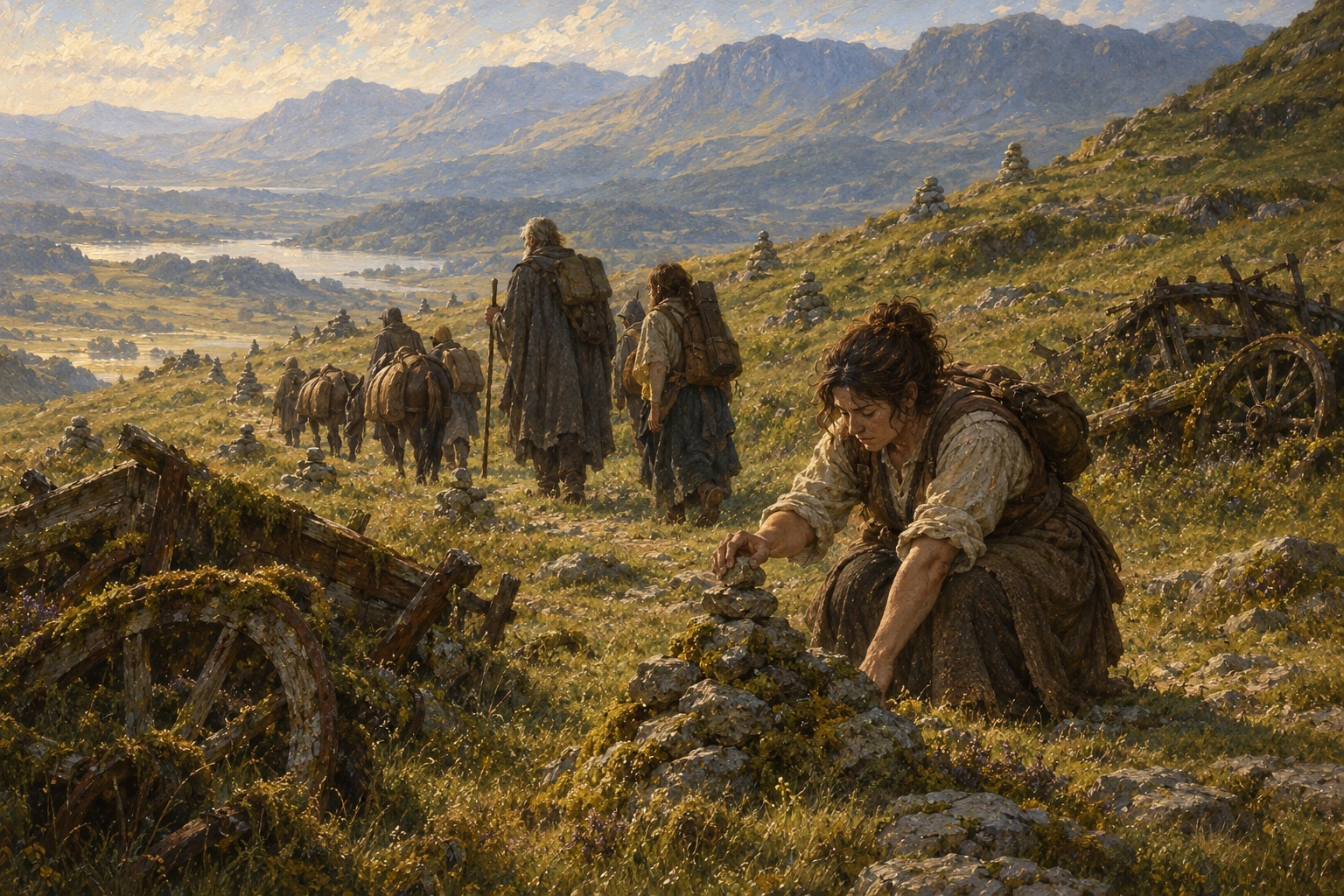
By midmorning the leavings had stopped being occasional and become simply what the road held, the way a riverbed holds stones: not a scattering to be remarked on one at a time, but a condition of the ground itself, present in every stretch the eye troubled to rest on. A cart lay canted in the roadside ditch not fifty yards past the wheel-rim, sunk to its axles deep in turf, its bed long since rotted to a soft dark outline that the grass had learned to grow along rather than through. From a little distance it read almost as a drawing of a cart, done in moss and shadow, more than the thing itself. Further on, a second stood square in what had once clearly been the road's own verge, its iron fittings gone to a fine rust-lace so delicate that Dorrit, crouching to look without touching, said under her breath that she had seen spiderwork sturdier.
"They didn't drag these off the road," Bracken said, low, walking the line of them with the particular attention Wren had watched him give to a badly loaded pannier — a man reading a thing for what it told him, not what it merely was. "Left them where they stopped pulling. That one's still got its brake-block set." He straightened, looking back down the road the way they'd come, and then on ahead, at the long visible scatter of it stretching into the middle distance. "That's not panic. Panicked folk leave a cart wherever it happens to fail them, sideways, blocking the road, no thought given. These are set square. Braked. Left tidy, every one I've seen so far." He was quiet a moment. "They loaded right, whoever they were. All the way down this road, near as I can tell, they loaded right — food and children and tools first, and every ounce of anything else let go by the mile, in good order, like they knew exactly what they were doing and did it with their whole hearts anyway."
The bundles were harder to read and Dorrit read them best: shapeless mounds along the verge that had once been cloth-wrapped goods, gone now to a soft green moss-shape that kept, in ghost-outline, something of what they had been. There was the long straight bulk of a rolled rug, the round hump of what might have been a cheese-basket, and a huddle of smaller shapes that Dorrit named, after a long careful study, as most likely spare clothing, packed for a growing family and packed too heavy to carry the whole way. She read the turf on the cart-beds too, crouching by each in turn with a gardener's practiced eye: a particular kind of grass had long since taken hold on ground that had once held cloth and wool, she said, a finer, paler grass than grew on bare rock or bare soil, as if the goods themselves, gone to nothing, had left the ground something to remember them by.
"A hand-mill," Iyene said once, kneeling by a squat stone shape half-buried at the road's edge, running a thumb along a worn groove in its upper stone with the same careful reverence she gave any working tool whose use she could still read. "Somebody's kitchen. Carried this far, and then—"
A little further on lay a dropped ladle, its wooden handle long gone but its bowl of hammered tin still holding its shape under a skin of soft green patina, half sunk in the turf as neatly as if someone had set it down between one stir of a pot and the next and simply never come back for it. Past that lay a low huddle of harness-buckles, rusted into a single fused clump the size of a fist, all that a full set of tack had come to once the leather that had held it together gave up its work to the years. Wren found she could not look at any one of them long without her mind supplying, unbidden and unwanted, the hand that had once closed around the ladle's handle. She found, just as quickly, that the supplying did no harm, because the hand it imagined was always simply lifting the ladle, or setting it down, ordinary and unremarkable, never anything worse than that. The road did not ask her to imagine worse. It only asked to be looked at honestly, and looked at honestly, it gave back nothing but a very old, very thorough tidiness — the tidiness, she thought, of people determined to leave their trouble in good order behind them, whatever else the day was costing them to carry.
Pip walked very close beside her most of that morning, quiet in a way that was itself a kind of working, and once, at a cart heaped thicker than most with its soft green burden, Wren saw him lean toward Iyene and ask her something too low to carry, and saw Iyene's whole face soften at whatever it was before she nodded. At the midday halt Wren learned what the question had been — should he draw the carts, or was that a kind of taking he oughtn't do without leave. The question mattered rather more than any answer to it could: a boy who had once drawn anything that stood still long enough now asked first.
Iyene had her own working question, turned over aloud once at the midday halt while the mules cropped what thin grass the roadside offered: what did a surveyor do, exactly, with ground like this — a road whose condition she was chartered to record, and whose contents were clearly not the road's condition at all, but something else entirely, something a working sheet had no ruled line for.
"The College keeps two kinds of record," she said finally, working it out for herself as much as for the table of listening faces around her. "One is for the traveler who comes after — is the ford safe, does the bridge hold, how many days to the next water. That's the sheet I'm chartered to keep, and I'll keep it faithfully, because a traveler's life may hang on it." She looked back down the long scattered line of the road behind them. "But this wants the other kind. Not for anyone's traveling. For memory, and nothing else — a record that owes nobody a use, only an honesty." She took out a second book, smaller and plainer than her working sheets, that Wren had not seen her carry before, and opened it to its first blank page. "I bought this in Merrow on a hunch I couldn't have named at the time. I believe I understand the hunch now."
Alder, listening, said only one thing, quietly, and let it rest without building further on it: "A thing recorded honestly is a kind of keeping, same as a thing carried home. It costs less, and it's owed nonetheless." He had said his piece in the same key he had said it at the relic-cart's fire, and he let it stand there, small, beside the larger silence of the road.
Luel walked the whole morning a little apart from the others, not withdrawn so much as keeping a pace of her own that fell naturally behind or ahead of the company's without either of them minding it, and she named almost nothing at length. Once, passing a cart whose contents had long since become indistinguishable from the ground around it, she said only, "This family kept goats. You can tell it by the bells," and pointed, without further comment, at a small tarnished shape half-sunk in moss that none of the rest of them would have known for a bell at all had she not named it one.
Cairns had begun appearing not long after the carts did, bare heaps of fieldstone down the long slope below the road, none of them marked with so much as a scratched letter. Luel walked past the first two without pausing; at the third she stopped, bent, took up an ordinary stone from the open ground, and set it on the cairn's low summit, and walked on without a word.
Dorrit did the same at the next cairn, glancing up half-embarrassed; Pip did it at the fourth, gravely. By the time the sun stood at its highest, adding a stone at every cairn had simply become what the company did, the way the watch swept a doorstep — Bracken squaring a fallen capstone left-handed, twice, until it sat true — his right arm staying where it had stayed since the Long Shelf, close in against his coat, out of the work.
It was Pip who found the shoe, a little past midafternoon, at a cart more thoroughly spilled than most — its load scattered wide across the verge in a long fan of moss-grown shapes, as though something, wind or frost or simple age, had finally given the whole soft mass a shove and let it settle where it would. He had been crouched at the cart's edge a moment, working out, with Iyene's quiet nod beside him, whether the shape of the load was worth a page of his own; and then Wren saw him go very still, one hand half-reached toward something small among the moss, not touching it, only pointing, in a voice that had lost all its working steadiness.
"There's a shoe," he said.
It lay half clear of the moss that had claimed everything around it, small, gone the deep worn brown-black of old leather kept long past any leather's natural span, its shape holding true and whole — a child's shoe, unmistakably, its little curled toe and its worn heel visible even at this distance, set down on its side as though simply stepped out of and left.
The company gathered without discussing it — the same wordless gathering they had made at the cart with the goat-bells, at the fallen capstone. For one long breath the quiet that held them was not the easy quiet of the road's ordinary walking but something with weight in it, a held stillness Wren felt in her own chest before she felt it anywhere else. She saw Pip's face gone pale and fixed in a way that frightened her rather more than the shoe itself did.
It was Luel who broke it, and she broke it simply, without ceremony, in the same level voice she had used all morning for goat-bells and turf and nothing else.
"This is not a grief," she said. "Or — it was, once, and is not any longer, which is the whole of what three hundred years are for." She crouched, not touching the shoe, only looking at it with the same unreadable care she had given the cairn. "A shoe left whole beside a cart, set down and not dropped, is a shoe a child walked out of, not one a child was lost from. They carried spare shoes on that road, for feet that grew faster than the walking allowed — every family that could manage it did, mine no less than yours. A small shoe left behind, whole, upright, no hurry in how it was set down, means only that somewhere ahead of this cart a larger one went on her feet, and she kept walking." She looked up, once, at Pip, and something in her face gentled further still. "Somewhere down this road, a long time gone, a child outgrew a shoe. That is the whole of what this tells us. It is, if anything, a kindness to find."
It was a different quiet now, and Wren watched it move through the company like a released breath — Pip's shoulders coming down from where they'd climbed toward his ears, Dorrit's hand coming to rest, briefly, on his arm, Bracken looking down at the small brown shape with an expression gone soft rather than grim. Pip crouched at last himself, close but not touching, and looked at it a long moment, and then nodded, once, to himself more than to anyone, and stood.
"We leave it," Alder said, quiet, not quite a question, and it was Iyene who answered him, closing her small notebook over the line she had just finished writing in it.
"We leave it," she agreed. "The road's things belong to the road. We've a record of it now, which is the only kind of carrying that costs it nothing." The company gathered itself and walked on, and the road, a little further along, breathed easier for all of them.
The road bent sharply upward not long after, climbing a shoulder of open ground that Wren had watched approaching for the better part of an hour without quite understanding what it would show them once they reached its top. It was here, at the bend itself, with the whole company strung out along the last steep pull of the path, that she took the satchel from her hip, as she had at every midday and every notable turning since Merrow, and drew out the Waybook to check the day's road against Wystan's old one.
The bend was there, drawn clean in his hand, the road's turn marked with the same careful economy he gave every ordinary mile of it. Beside the drawn bend, small, in the white margin's edge, in a script Wren knew now as well as her own, ran a line she had to read twice before her mind would properly hold it. It was not in the old tongue, and not a figure either, but plain common speech, rare as anything in three hundred pages of his spiky careful hand:
I turned back here to look. I should not have.
She stood with the book open on her forearm and did not, for a long moment, look up from it at all.
It was Alder who came to stand beside her first, not at the page but at her face, as he had watched it at the Drowned Bridge and at the Singing Ford and in the map-room at Merrow, and only stood near. It was Iyene, reading the line over Wren's shoulder a moment later, who went very still herself, in the particular way of a woman whose whole understanding of a thing has just been asked to hold considerably more weight than it had held a breath before.
"He wasn't only mapping this road," Iyene said, low, half to herself. "He was on it. He walked it — with them." She looked down the long visible scatter of carts and cairns falling away below the bend, and something in her face reorganized itself entirely. It was the professional wonder of a woman realizing that every mile of margin-notes behind them in that book was not a scholar's survey of a vanished country but an eyewitness's clear account, set down by a man walking his own grief with a pen still in his pack. "That changes what the whole book is."
Bracken had turned, at the words, to look back down the line of cairns they had climbed past all that day, small and grey and patient on the long slope below. He stood a while simply looking at them, his jaw set, his hands loose at his sides.
What all of them had half-known since the lament at the fireside a fortnight gone stood plain now, and stood unsaid: that the first keeper had not merely written of a lost country, but walked out of it, one of its own, the book already old and already his even then.
Wren closed the book with her usual care, and did not, for a moment, move.
Then, because it was the thing the margin itself seemed to ask of her — because Wystan had stood at this bend, long before, and turned to look back, and told her, across all that time, that he wished he had not — Wren turned, deliberately, in his stead, and looked back down the road exactly as he must have looked.
There was nothing behind her now but morning.
The road fell away below the bend exactly as it had fallen away all that long day, carts and cairns and all, but the light lay across it clean and ordinary and entirely without shadow of anything but its own cold brightness. The mountains stood white and settled and utterly unremarkable against a sky gone a hard high blue. And far down, small as a coal in a wide grey hearth, the watch's own smoke rose straight and thin into the still air, exactly where she had left it that morning, waiting, faithful, and entirely unafraid. The slope was healed, and had been healed, she thought, standing there with the book warm against her arm, for a very long time before she had ever been born to come and look at it — ordinary weather, ordinary grass, ordinary birds working the thin cold air above the cairns, doing, patiently and without anyone's asking, exactly what a very long time is for.
She stood a moment longer, and then turned back to the road ahead, and walked on.
They camped that evening on clean open ground a mile or more past the thick of the leavings, where the road ran level again through ordinary high pasture and the last cairn was well behind them, dwindled to a grey speck on the darkening slope. Nobody had proposed it aloud, but nobody had suggested making camp any closer either, and it was Dorrit, unpacking the cook-pot, who said the only word given to it: "Better ground down here for the beasts, and for us. No sense crowding folk who've earned their quiet, even in fun." It was said lightly, in Dorrit's usual register, and taken exactly as it was meant — not fear, only manners, the same manners that had put a stone on every cairn all day without a single word said over any of them.
The fire took well in the still evening air, and supper went round in the ordinary way — a simple stew, bread from the watch's own ovens, the small comforts of a well-run camp reasserting themselves without anyone having to call for them. The ordinary textures of the road came back to them gently, one at a time, the way feeling comes back into a foot gone numb from sitting. Bracken checked the picket-line by feel in the near-dark, murmuring to each mule in turn by name as he went down the row. Pip built up the fire with the settled competence that had once been only hope in him, adding wood exactly as it was needed and not a stick before. Dorrit and Iyene compared, with real scholarly interest, the differences between three-century moss and ordinary moss, until Alder pointed out, mildly, that she had now founded an entire new discipline in a single afternoon and ought to write to the College about it, which won a real laugh from the whole fire, the first proper one since the shoe. Even Barrow, tethered nearest the flames, had settled to his hay with his old placid thoroughness, as though the day's long climb had been no more than any other to him, which, Wren supposed, watching him, it likely hadn't.
Luel sat a little back from the flames, in her own fashion, and said, once, into a lull, that she thought the company kept a cairn well — no more than that, offered without ornament and taken the same way.
Iyene had one more thing to enter before she closed her second book, and she entered it without comment, because she had not decided yet what it was.
She had found it on the last cairn of the day, the big one at the bend, on the flat stone somebody had set last across the top: four marks scratched into the face of it with a nail or a knife-point. Not Meddani. Not the College's. Not any of the four alphabets she had learned in nineteen years of surveying — and cut deep, cut by somebody who had the time to be sure of it and nothing else left to spend the time on.
She copied them exactly, and wrote purpose unknown beneath, and ruled a line under that.
"Somebody's name, most like," said Bracken, looking over her shoulder. "Or somebody's town."
"Most like," said Iyene.
Luel came past behind them while the copying was going on. Wren, across the fire, watched her look at the open page, and watched her walk on to her own place at the edge of the light without breaking her stride by half a step.
Later, when the camp had settled and the first watch was set, Wren wrote one line for her own bend of the road, and it was the only line she wrote that night.
I turned to look. There was only morning.