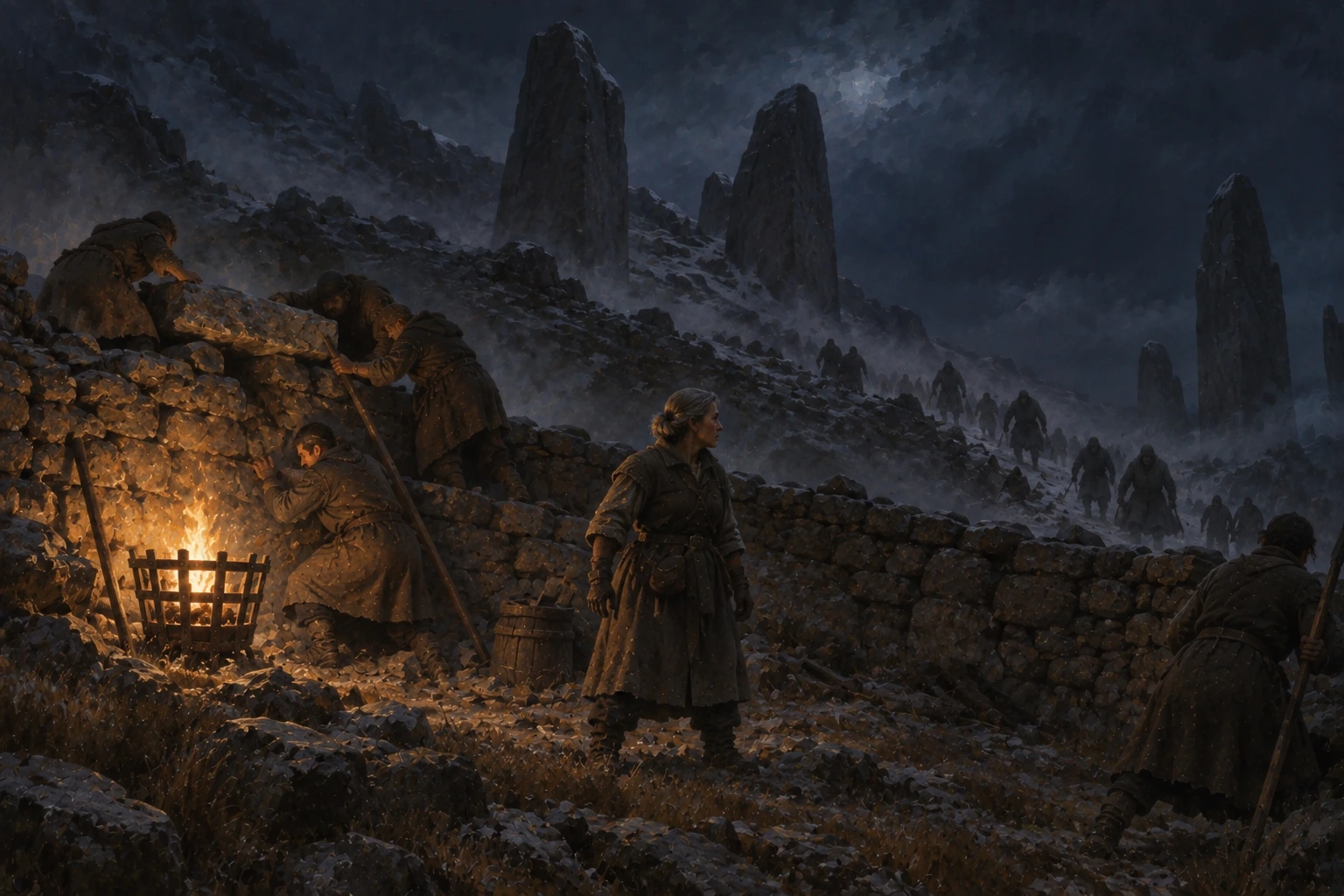
The Night at the Stones
The last flock of the season came down off the high ground a little before noon, and Harrol stood at the sheep-yard gate with the tally-stick in her hand and watched every animal go through the count. Three hundred and eleven up the fold in spring, three hundred and eleven down it now, the summer's losses already chalked and closed against the number, and it came right to the animal. She marked the total on the gate-post beside the year's other marks and went to see about the rest of the day, because a flock counted true by noon left the whole afternoon free for everything else the season wanted done.
The watch was no more than it had ever been: a scatter of long, low, turf-roofed houses sunk into the fold of the hill for shelter, a walled sheep-yard and a smaller picket-yard for the mules and horses, a smithy set apart for the sparks' sake, byres and ricks along the near slope, and the beacon shelf above it all, strung with iron-cradled lamps that had burned some version of that same line longer than any ledger in the hearth-hall could account for. Close on forty souls lived and worked there that autumn, and Harrol knew every one of them by more than name.
Frost had come early enough this year that she had moved the watch's whole cold-weather list forward a week off nothing but two mornings' look at the sky, and the watch fell into the new schedule within the hour, because in eighteen months of running this place her reads of the sky had earned that much trust. Frost climbed the north-facing stone overnight now, higher each morning than the last, and she had the wood-ricks turfed against the wet by the second morning of the change, the harness off its summer pegs and onto the winter ones, oiled and hung where the cold couldn't stiffen the leather by dawn. The high road above the pass mouth, past the last of the great standing stones the watch was named for, she left unposted — nothing up there worth a watchman's frostbite once the snow started sitting — and the lamps on the beacon shelf above the houses were trimmed and filled and set two at a time in their iron cradles, so that by the week's end every one of them would carry a full night on a single filling if it had to.
The wall she was proud of was the east course of the sheep-yard: bellied out badly for two years past, and this the first season she had had both the hands and the weather to have it taken down course by course and rebuilt true. It had taken six weeks and every hand that could be spared from the flock, hauling and dressing stone up from the scree below the pass mouth, and she had grudged not one day of it. She had walked it herself with her palm on the new coping the day the masons called it finished, feeling for anywhere the fit was less than good, the way a joiner tests a seam for the give that isn't supposed to be there, and found nowhere. The north belly of the same wall, bellied worse and longer, sat on next year's list, because a captain works a list in the order the list wants working, and this year's hands and weather had stretched to the one course and no further.
In the year and a half since the road had opened both ways, she had built the watch a job its own history had only ever pretended to have — a relay running east past the Steading Lamp, mail crossing the pass twice while the season allowed it, riders rotated on a schedule chalked and rechalked on the map-room's own slate, and hands trained onto a rota with real work sewn into it instead of a habit kept for its own sake. Three generations of watch-captains before her had drilled their people to a standing that had never been asked to answer for itself, and she had spent eighteen months quietly making sure that if it ever was asked, it would answer. It was the best work of her life, and went on down the yard to see who else needed seeing to.
Grigg had the newer recruit in tow near the mule-stand, running him through the loading rule exactly as it had come down to him — not in his own words, but the watch's own worn version of somebody else's, three seasons handed on. "You don't load for the flat road," he was saying. "You load for the ugliest stretch of the day, and you check it there, not at the yard gate." The boy said it back wrong once and right the second time, and Grigg told him that would do for one morning and sent him off after water. He had learned it the same way himself, three winters back, and had been just as pleased with getting it right the second time as the boy was now with getting it right at all.
Bawden was up on the new east course with two others, bedding the last of the coping-stones true before the frost got fully into the mortar, sleeves rolled past a forearm that still carried the pale double crescent of Nettle's bite, a mark she showed off at the smallest excuse and had shown off again only that week. "Wall'll want checking come the spring thaw whatever we do to it now," she said to nobody in particular, straightening with a stone half-set in both hands, and went back to setting it.
Pinnick had drawn the lamp-shelf that week, working down the row with a fresh can of oil and a rag for the glass, young enough to still be pleased at a job with her own name on the roster instead of somebody else's chore to help with. "Oil'll want fetching up from the smithy store before month's end at this rate," she called down as Harrol passed beneath the shelf, and Harrol told her to see to it herself rather than wait to be told twice.
Enna had a haunch half broken down on the kitchen table and was rendering the fat off it into a crock for the winter stores, arms floured to the elbow, and told Harrol without looking up that she'd put by a pot of the thick soup Fossick liked so well, against his coming back hungry off that pass the way he always was. "Man eats like the mountain's trying to starve him out personal," she said, and went back to the haunch.
Dill was down at the picket-line arguing with the gelding he'd drawn for relay work, a big ill-tempered brown that hated having its feet handled and had made that plain to every hand at the watch by now, and he'd got exactly one hoof up when Harrol passed, swearing at the animal in a low even voice with no real heat in it. "You and me both know you're going to let me do this," he told the horse, "so we might as well get on with it," and the horse, after a while, let him. He turned up at the wall itself later that same afternoon with a coil of rope over one shoulder, announced that he'd rather be trusted with rope than left to fight that horse a second time, and left it at that.
The mail party — two of the watch and the courier Fossick — had gone up eleven days back on what should have been a nine-day round to the first crossing point and back, and were two days over now. Fossick was a lean, down-country man who had made a living gambling roads for a dozen years and had never yet lost badly enough to stop; the two watch-riders with him were young and capable, chosen for exactly this kind of ordinary crossing, and knew the first stretch of that road as well as anyone living. Harrol was not yet worried about the two days themselves; she was worried about ordinary things — that the first hard snow had come in higher than the log predicted and slowed them coming down.
Willem thought otherwise, and said so that evening in the map-room, gear laid out across the table for the morning's work. He couldn't put a name to what unsettled him — no track, no sign, nothing a captain could act on — only that Fossick ran a tight schedule on principle and two days was a day more than the man had ever lost in three seasons on that same crossing. He had ridden that stretch of road himself a dozen times since the crossing opened and knew its moods the way any good rider knows a horse's, and could not have said what was different about the not-knowing this time beyond a low, unnamed feeling he could not have defended to anyone. Harrol heard him out, weighed it against the log's own record of two other years the snow had come in early and cost a party exactly this much time, and overruled him on the evidence. "Weather's weather," she told him. "You'll have your two days back the minute they come down that road complaining about it." Willem tried once and let it go when she gave her reasons, and the evening's work went on. Checking a stirrup-strap on the relay leathers a little later, he told her the horse-ford would want fresh stone laid before the ice properly took the crossing, and she told him to see to it before the frost stopped the work rather than after.
The first sign came a little after full dark on the second night: the lamps on the beacon shelf drawing down in order along the line, west to east, each one dimming just before the next did, the way an untended hearth-fire dies down in an empty room. Orran, standing near the smithy with his eye on the shelf out of old habit, said "Going Meddan-wise" once, flatly, and went to see to the shutters.
The children were gathered and walked to the far end of the long house within those same few minutes, Enna sweeping the two littlest by the hand as she went, telling them this was a game of quiet mice and they had better be the best mice in the whole valley, and had them nearly laughing by the time she handed them through the door to two of the older hands and turned back toward the yard. The door was barred from without and stayed that way until first light.
They met it at the north belly with whatever tool was already in a hand, because there was no time to go and choose a better one — short blades, a hay-fork, a smith's hammer somebody had snatched off the rack — and none of it did the smallest good. Steel went in and came out and changed nothing. Nothing minded being struck. Enna died there in the very first minutes, before anyone in that yard had worked out that steel wasn't going to be the answer to anything that night. Harrol saw it happen from thirty paces off, across the yard, giving an order to somebody else with her back half turned, and turned in time to see it and not in time to close the ground between them. She did not stop giving the order. There was a flock still loose near the gate and a wall still standing open at the belly and a yard full of other people who needed telling what to do next, and Harrol told them.
For a stretch of minutes that felt a good deal longer than it later measured out to be, the yard held every hand not already at the wall, trying six or seven different answers to the same problem at once, and none of the answers were any good. Somebody rang the smithy's iron bar against its hook, the old alarm that had not sounded at that watch in living memory, and the sound of it did nothing to settle anyone — if anything it told the whole place, all at the same moment, exactly how bad the trouble already was.
Two more went down in that same first stretch — a man at the flock gate, and the watchwoman working beside him — and for a stretch of minutes it looked possible, likely even, that the watch would lose the whole of the north wall before anyone worked out what to do about it.
The whole winter's meat was standing in the walled sheep-yard, and the sheep-yard's north belly was exactly the stretch of wall that would not hold. Harrol gave the order to open the yard and drive the flock out into the open dark rather than lose the ground fighting to keep both. Orran argued it hard, and he had every reason to: a winter's meat scattered past any hope of gathering again was a cost the watch would still be paying come the hungry end of the season. Harrol heard him out to the end of the sentence and gave the order again, unchanged. The gate came off its pin, the flock went out into the dark in one loose roar of moving wool, breaking for the open ground the way water breaks for the first gap it finds in a bank, and most of it was not recovered before winter closed the account on it for good.
It was Harrol who worked out what would do the job. She looked at what was actually in front of her instead of what she wished were there: steel wasn't stopping them, and steel wasn't going to start. But whatever they were, they were built like men and moved like men, and a man — any man, however little steel troubled him — could be stopped from getting anywhere at all if enough weight came down on him at once and stayed there. You could not cut a thing down that did not care about being cut. You could put a wall on it.
"Get the coping off the top course," she told the nearest three hands, and was already moving to the next order before she saw whether they understood why. "Lever it, don't lift it. Drop it on anything that's still coming."
It took four hands to lever a single course-stone free and two more standing ready to guide its fall, and every one of them was already cold to the bone and would be colder before the night let them stop. Frost had turned the coping's underside slick within the first hour, and more than one lever skidded before it bit, and more than one hand came away skinned across the knuckles doing work no coping-stone at that watch had ever been asked to do before. They levered the coping-stones off the rebuilt east course first, because that stretch was already true and square and the stones came away clean, and dropped them from the wall-top onto whatever was working the belly below — one stone rarely enough on its own, but three or four brought a man down and kept him there, pinned at the shoulder or the leg under the whole dead weight of worked granite while somebody found the next thing to do about it. Hurdles came off the picket-yard fence and went flat over anything still moving under a stone, weighted at each corner by two or three hands standing their full weight on the rails. Rope came from the smithy and the byres both, looped and drawn tight by people who had spent their working lives hauling stone up a hill and knew exactly how much a rope could be trusted to hold.
There was a stretch, well into the second hour, when Harrol called for the next basket of coal before Orran had finished loading the last, reading the whole weak run of the wall at a glance she had never before had cause to need. Something in her answered to it — the reading, the ordering, the whole shape of the trouble laid out and solvable at once — and she gave the next order before the thought had finished arriving, and the one after that before the first was done.
Weight held them. It did not finish them. Harrol saw that inside the first quarter-hour, when one of them worked an arm free from beneath a coping-stone a stroke at a time, without a sound. What finished them was fire, and Orran had the forge already broken open — a job that in any ordinary season would have taken him a careful hour and cost him a week of banked heat he'd need again by spring — its coals shovelled into the iron baskets used for carrying charcoal up to the lamp-shelf, before anyone told him to. The baskets went out to the wall at a run and were upended onto whatever the stone and the hurdles were holding down. When that wasn't fire enough, the wood-ricks came open — turfed that same week against the wet, and torn apart again inside the hour — and the dry wood went onto the same ground, doused with what lamp-oil could be spared and lit from a coal carried out on a shovel. The first time it burned all the way through, three centuries came due in the space of one breath, and what was left was ash and old cloth, nothing worth a second look. After that, nobody at the wall needed telling twice what the fire was for.
Somewhere in the middle of that work, three came up the pass road in clothes cut this generation, not the older stuff the ground usually gave up. Two wore the watch's own undyed weave, unremarkable at any distance in the dark. The third wore a courier's coat, cut narrow through the shoulder and belted different from anything the watch's own tailoring ever produced, and it was Fossick's, and Harrol read it at forty paces in bad firelight before she read anything else about the man wearing it. She did the work on that one herself, without calling anyone off what they were already doing, and it took no longer than the others had, and she went straight back to the wall.
After that the work did not change in kind, only in what it was understood to mean. The wall crew had watched the coats go by, and knew now that the ground below the pass mouth was sending back its own dead along with whatever else it sent, and the only sane answer to a fact like that was to keep working.
The rest of the night went on in the same rhythm, hour on hour: coping-stone, hurdle, rope, fire, the count called out across the yard and answered back, right most times and wrong once, when somebody miscounted the two who'd gone out after the flock and had to be called in by name before the tally settled. Hands changed off at the wall in twos and threes as people wore through and others took their place, and the fires along the belly burned low and were fed again, never let all the way out and never let get ahead of themselves either. Once, well past what Harrol judged the middle of the night by the state of the fires rather than any clock, a stretch of hurdle gave under its own weight before enough hands had reached it, and for several held breaths two of them were up and moving inside the yard's own ground before the nearest fire-basket closed on them and drove them back against the broken hurdle long enough for a fresh stone to come down. Willem's voice carried across the yard once, flat: "West hurdle's slipping — three more hands." He had them inside the minute. Orran's voice came up from the smithy once too, just as flat: "Coal's half gone already." He went back to shovelling before anyone could ask him how much time that left.
By the hour past midnight, fingers had gone clumsy with cold and work both, and breath stood white and ragged in the firelight, and more than one person was working past the point where the labor itself had stopped hurting and simply gone on happening to them. Harrol walked the wall's whole length twice an hour when she could manage it, once when she could not, checking each stretch of hurdle and each fire in turn before moving to the next. Somewhere in the second half of the night, working a coping-stone into place over one that was still shifting under the weight already on it, she misjudged the lever and took the stone's edge across the last two fingers of her left hand. She swore once, set the stone anyway, and did not stop to look at the hand until there was light enough to see what she had done to it. It would be splinted and strapped by whoever at the watch had the steadiest fingers for bone-setting, and it would stay stiff for good.
They held until dawn. It cost them nine.
Sleep was not a thing anybody at that watch had managed, and none of them would manage it well again until well after the fires had burned down to nothing, but the work of an ordinary morning did not wait on any of that: by the time the sun was fully up, the mule-pickets had been checked, the byres mucked, and a pot of something hot was going round the yard in whatever vessel came to hand.
At first light Harrol had the whole watch counted before anything else was done — the living hands first, then the children at the far end of the long house — and both counts came right. Willem brought her that second count himself before she had finished with the fires. "All of them, the two babies included," he said, and went back to the wall without waiting to be thanked.
She gathered the watch in the yard before the day's real work started and said the nine names once, plainly: "Enna. Grigg. Bawden. Pinnick. Nabb. Vint. Lomas. Fitch. Yarwood." Nine, said once, and she moved directly into the next order — count what remained of the flock. What straggled back on its own by midmorning numbered rather less than half of what had gone out the gate, and what the smithy still held after a night of feeding its coals to the wall was three days of iron-work at most, and both figures went straight into Harrol's reckoning for the day.
The yard by full light was mud and ash and scattered stone, coping-stones lying where they had fallen the night before, some of them still marking, more or less, where they had done their work. There was too much else the day wanted from her to spend any of it sweeping.
"Orran," Harrol said. "Build a fire. Two of them, either side of the flat stone with Tolly's name on it. Ours goes on the near one." He did not ask what it was for. He got the wood and set both fires exactly where she had told him to set them, the grave between them the same as any other stretch of ground in that yard. One of the younger hands started to say something about a person deserving to be seen properly into the ground rather than —, and Harrol cut across the sentence before it finished, sending her instead to the smithy to see what coal could still be salvaged. The fire went up without further argument.
The nine of the watch's own burned on the near side of the yard, kept apart from what had come over the wall in the night, which burned on open ground past the picket fence before the morning was out. Harrol set the division herself and moved straight on to the count of what the smithy still had left in stores.
She wrote the report for Merrow at the map-table before the smoke off either fire had fully cleared, in her own flat professional hand:
Watch on the Stones, this date. Men came down the pass road in the night, in numbers unlike anything on record, and attacked the watch directly. Nine dead, named separately in the watch's own log. We remain at our post. Send word of what is known above us on that crossing, and send it without delay.
She called Dill to her at the map-table before the ink was dry and gave him the sheet, folded and sealed, with instructions given plainly and once: ride to the Steading Lamp first and say it there in his own words as well as the paper's, then on to Merrow without stopping longer than the horse needed. He repeated it back to her correctly and went to see to the horse, fresh and grain-fed for exactly this kind of morning, checking the girth twice out of habit rather than doubt.
Willem asked for the ride himself before Dill was even mounted — he was the better horseman, he said, and everyone in that yard knew it, and he said it without heat, only as a plain fact laid on the table beside the others. Harrol refused him. She needed her best rider on that wall for whatever the next night brought, and Merrow needed a message carried, not a man kept idle on the road who could be doing the watch more good standing on it. Willem heard the reasoning and let it go without pressing it twice, and his anger at being refused was his own to carry — cold and controlled, an ask and a refusal and both of them back to work inside the same minute. Harrol was already turned away, giving an order about the flock count to somebody else, when Dill rode out through the gate a few minutes later.
That evening she wrote the day into the current volume on the hearth-hall shelf, setting down what the log had always asked for: what came, what was done, what it cost. The nine went down by name, then the tally of what had come over the wall and been put down and burned — three separate accounts of the night, agreeing well enough with each other to trust. Against that she set the number actually accounted for by daylight on the ground past the picket fence, and the two numbers did not match. She would not set a guess down in a log that had not carried one in generations of hands before her own, so the entry's last line was the shortfall itself, plain and unexplained, a number that did not come right. She ruled the line for the next day, and closed the book with her strapped hand.