The Twice-Written Name
Wren was three hundred paces into the morning's bearing-check, murmuring the count under her breath the way Iyene had taught her — a habit that had gone untended since Iyene stayed behind — when Bracken's voice cut across the camp in the register he kept for things that would not wait on anybody finishing what they were doing. She lost the count at three hundred and eleven and did not try to recover it.
He was standing at the line-shelter's open door with one hand still on the bar-strap, and the strap was not broken. That was the thing she noticed first and could not, for a moment, make sense of: the leather hung whole from its peg, coiled loose the way it fell when nobody had pulled hard against it, and the door stood a foot open on its own weight, swinging a little in the morning's small wind. Somebody had lifted the bar clear and set it down and had not put it back.
Inside, the oat sack lay on its side with its neck chewed through and the parched grain scattered in a fan across the packed dirt floor, and the corner of the dried-mutton chest had been worked at until the lid's leather hinge tore free of the wood. Something with teeth and patience had gotten a full night alone with both. Bracken crouched over the sack a while without touching it, the way he looked at any ground before he trusted himself to say what it meant. Then he stood and did the arithmetic out loud, because that was how he did all of it, and because Wren had learned, over the whole of this road, that a number said aloud could not later be argued down to something kinder.
"Call it two-thirds of the oats," he said. "What's left has been in a mouth and I won't feed it to a mule I need in three weeks. The mutton chest is worse — foxes, from the sign of it, or something that hunts like one, and they took what they could carry and fouled twice that again getting it out." He gave the number the way he had given the pannier lost in the storm, flatly, without rounding it kinder than it was, and he did not look at Pip while he said it, though Pip was standing four feet off with an armful of blanket rolls and had gone very still. "We're down to eleven days of grain at the ration we're already keeping thin, and that was before this morning cost us most of a fifth of it."
Bracken had set the watch roster himself the night before, as he had every night since the Long Eaves, and he did not ask aloud who had barred the shelter door last, because he did not need to. Pip had had the shelter two nights running — nobody else managed the strap's particular knack, a half-turn under the peg he alone did without looking down to check it — and everybody standing in that clearing knew as much without being told it in words. Nobody said so. Sael, who had not yet learned to read the company's silences for what they meant, asked plainly whether foxes could work a bar-strap loose on their own, and Bracken told her, just as plainly, that they could not, and left it there, and she did not ask again. Bracken gave the figure to Alder, and then to Wren for the day-book, and went to see what could still be salvaged out of the sack before the mules got into the rest of it themselves.
Wren wrote the number down in her own hand rather than asking Pip to enter it, which was not how the day-book usually got its figures, and told herself it was only because his arms were still full of blankets and there was nowhere convenient for him to set them down. It was true as far as it went.
They ate a thinner breakfast for it, bread and the last of yesterday's cheese passed hand to hand rather than the porridge the oats would have made. Dorrit sat across the low fire from Pip with a physician's plain excuse ready — she wanted to look at the scrape he'd taken off a stone two days back, she said — and held his wrist a moment longer than the looking required, her thumb laid flat along the place where a person's pulse runs close under the skin. Two days on the road in autumn ought to leave a boy's hands rough and reddened and, this early, still cold from the night; his were cold in a different way than that, evenly cold, the whole width of the wrist and not just the fingers the wind had gotten at, the way a stone stays cold long after the air around it has warmed. She kept the finding out of her voice entirely. She told him the scrape had closed clean, let go of his hand, and went back to her own bread. Nothing in her face gave away what her thumb had just told her.
Pip ate the way he had been eating for two days: he turned his heel of bread over once, set it on his knee, and picked at the cheese instead, until Wend, without any thought behind it beyond a boy's ordinary hunger, reached over and finished the bread for him. Pip let it go. He did not seem to notice it going, or if he noticed, he did not think it worth remarking on. Ferrit, sitting nearest, laughed at Wend for it and called him a scavenger, and the small joke did the ordinary work of small jokes at a fire with bigger things on it, and was gone again inside a minute.
Dorrit noticed both things, the wrist and the bread, and set them beside each other the way she set any two facts about a body that did not, on their own, add up to an alarm and did, taken together, add up to one. She had spent years learning what a body does when something inside it has started going wrong before the body has found words for it yet — a fever that hides for two days behind a person's own good humor, a wound that stops hurting for exactly as long as it takes to become dangerous. A boy who had gone cold in his wrists and forgotten to be hungry on the same morning the company lost two-thirds of its grain was, to her eye, the more alarming of the two losses by a wide margin. She did not say any of it aloud. She had learned that too, the hard way, more than once: a suspicion spoken before it is certain does nothing but frighten the person it is about, and she was not going to spend Pip's morning on a feeling she could not yet prove.
They kept to the high ground above the King's Road West rather than on it, as Alder had ordered at the river crossing two days back, close enough to see the pale graded line of the road below them through gaps in the gray scrub, boots kept off the metaled stretch the whole day long. The country had gone harder since the crossing — bare rock showing through thinning turf, the wind carrying less warmth in it with every mile they climbed. The column kept the loose order it had kept since the Long Eaves: Bracken and Ossen up front with the lead mules, Sael and Ferrit minding the loaded pair, Alder and Luel a little back from the front where Alder liked to walk when he wanted the whole line in view at once. Wren walked near the tail with Wend, who wanted to talk about the runners his mother's household might have raised by now and how far up the line word of a muster might already have traveled, and she let him talk, because there was nothing kind in telling a boy three days from home that hoping about it changed nothing. Ahead of them the road ran on below the ridge exactly as it had run the day before and would run the day after, pale and straight and indifferent to who used it. Wren found herself doing the arithmetic Bracken had already done for the grain — eleven days, one lost fifth, the distance still standing between them and Kelder — and coming out, each time, at a number that did not leave much room for anything else going wrong.
Pip walked near the middle, leading Suet, and it was there, at the midday halt, that Dorrit found her second thing.
She did it plainly: she called his name across ten feet of open ground, the way anyone calls a name to ask an ordinary favor, wanting to know whether he'd seen where Wend had left the second coil of guide-rope. Nothing in the question mattered. Nothing in the moment asked for care. She had chosen it for exactly that reason, because a name spoken about nothing important is a name a person answers without having to decide to answer it.
"Pip." Nothing. She let two full breaths go by — long enough that Wren, walking near enough to hear it and not yet understanding why she was counting, felt the gap open under the word the way a stair gives when the tread a foot expects simply isn't there. Then Pip's head came up and he said he hadn't seen the rope, and told her to try Ferrit, and that was the whole of it, and to anyone who had not been listening for the gap there was nothing in it worth hearing at all.
Dorrit did not call his name a second time that day. She had what she had come for, and getting it had cost her nothing except the particular ugliness of having gone looking for a thing she had hoped, walking into the question, that she would not find. She spent the rest of the midday halt sitting a little apart from the fire with a strip of dried apple she did not eat, turning over in her own mind the wrist and the bread and the gap under his name, weighing them the way she weighed any three symptoms that had never, in her whole practice, meant the same small thing twice.
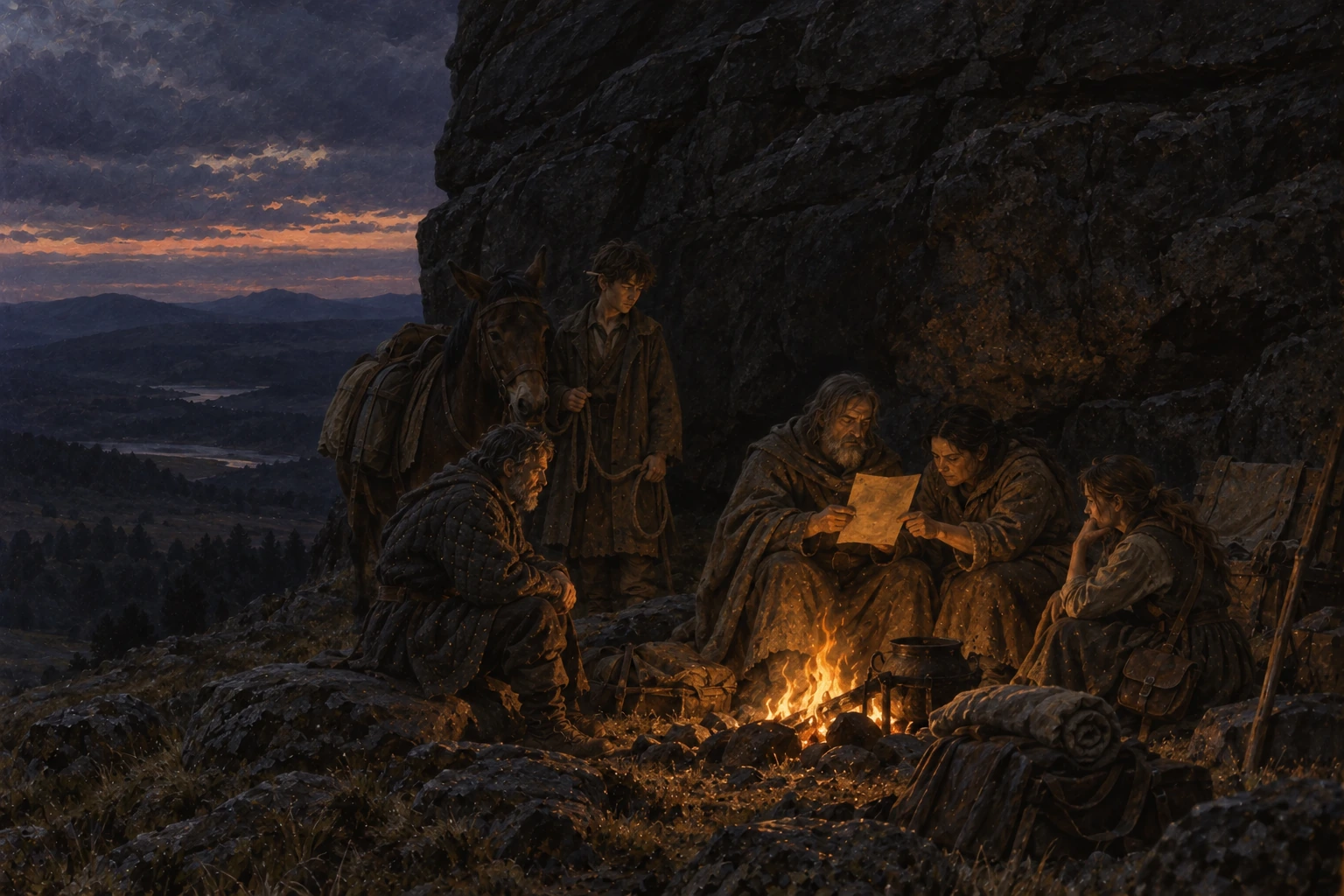
They made the evening halt in the lee of a long outcrop that broke the worst of the wind, close enough to the road that they could hear it, faintly, running down its own open length below them. Bracken called the halt early because the light was already going and because a company down two-thirds of its grain gained nothing by walking an extra half hour into the dark to learn that again in the morning. Loads came off the mules in the order they always came off — Barrow first, because Barrow objected loudest to standing loaded a moment longer than he had to, then Gable, then Suet — and Ossen went to find water while Sael and Ferrit got a fire started against the outcrop's own stone, which held the heat back into the camp better than open ground ever did.
Alder wanted the day's loss set into the day-book properly before anyone forgot the exact figures in the telling and the telling grew kinder than the truth — a Survey habit three centuries old and older than any of them, and none of them had ever thought to ask what it was for. Pip did it, because Pip had done every fair copy the company had produced since before Wren could remember not asking him to. He laid the count out under the date in his neat, close hand, the grain figure and the mutton figure and Bracken's own words about the door, and signed it in the corner the way he signed every fresh sheet since the coomb, and then a second time at the foot of the page, in the place where a maker's name goes, in full: Pip Sandover.
Dorrit asked to see it before it went into the satchel. She said she wanted to check the arithmetic, which was true as far as it went — she did check the sum, and it was right — but what she was actually looking at was the two names, the small quick one in the corner and the full one under the day's tally, close enough together on the one page that a person could hold both under a thumb at once and set them letter against letter, the way she had learned, years back, to set one leaf against its neighbor on the same branch when something had gone wrong between the two of them too small to name outright.
They were not the same name.
Not wildly different. Nothing a person glancing at the page would ever have caught — no crossed-out letter, no tremor anywhere in the hand, nothing a tired boy's fatigue would explain, because both were even and steady and plainly written by someone who had meant every stroke of them. But the corner's second p carried a small hooked tail the foot's p did not, and the surname's third letter, written twice inside the same quarter hour, leaned two different ways — so slight a difference that Dorrit read it four times before she let herself believe she hadn't invented it out of what she already suspected. She held the page up against the last of the light to be certain, tilting it, tracing the two shapes with a fingernail that did not quite touch the ink, and the light did not change what she found there.
She did not say anything to Pip. She folded the sheet along its crease, carried it to where Alder stood checking Gable's off hind foot, and put it into his hand without a word, her finger under the two signatures. He looked at it for the length of time it took him to understand what he was being shown, and then he called the company in — all of it, Amarin included, Pip included, because the only alternative was a conversation held behind a boy who had earned better than being talked about instead of to.
They gathered around the fire in the half-light the way they gathered for anything that needed the whole company hearing the same words at the same time, Sael and Wend and Ferrit standing a little uncertain at the edge of it, not yet knowing this company well enough to know what a gathering like this one usually meant.
"He's been going since Ness Fell," Dorrit said, to all of them at once, flatly, the words already stripped of anything that might have softened them on the way out. "I've watched him three days running. He doesn't eat unless somebody puts the food directly in his hand. His hands have gone cold in a way that has nothing to do with the weather. He was a full breath and a half late answering to his own name at midday, over nothing, which is the only conversation a person answers slowly in, when whatever holds the name in place has come loose underneath it. And he signed this sheet twice inside one quarter hour, in the same hand, and the two signatures aren't the same word." She held the sheet up, not near enough for anyone to read at that distance but so the fact of the paper itself would sit in the air between them while she said the rest of it. "I am not glad to be right about this. I would give a great deal, right now, to have spent three days being wrong."
Nobody spoke. Sael's hand found Ferrit's sleeve and stayed there. Pip, standing at the edge of the gathered company with Suet's lead still looped around his wrist, stayed quiet as well, and his face did not do anything Wren had a ready word for — not shock, because a person is not shocked by news they already carry somewhere in themselves, but something nearer the stillness of a man hearing a verdict read aloud that he had already reached on his own.
It was Ossen who spoke next, and he had never in all the miles since the Long Eaves offered more than four words together at any one time, which was part of why the whole company went quiet again the moment he opened his mouth.
"He had the second watch two nights back," Ossen said. "I came to relieve him at the turn, same as always. He was standing where he was meant to stand, and he was facing the wrong way." He did not say which way was wrong. Nobody needed to ask — whatever Pip's eyes had fixed on for the length of that watch was plainly not a thing Ossen meant to put into words in front of the boy it belonged to. "I didn't wake anyone. I took the rest of it myself, facing it the way it should've been faced, and I said nothing because a watch standing right can cover for one bad night. There's more than one bad night behind us now."
Alder did not ask him why he had waited. He asked Pip nothing at all. He stood with the sheet still in his hand and looked, for a moment, not at the company and not at the boy but at some middle distance past both of them — the look Wren had learned, over years of this road, to read as a man doing an arithmetic he had done before and hated doing again — and there was no arrangement available to him that did not cost the boy something in front of everyone he had crossed half a country with, and she could see, in the half second before Alder spoke, that he had already priced every one of them and chosen the one he could live with rather than the one that looked kindest from the outside. His hand had begun, once, to rise toward Pip — the start of some old shape his fingers still half remembered from a country where they had once meant more than they meant now — and he let it fall back to his side before it found itself, and closed it instead around the folded sheet. When he spoke it was in the flat, carrying pitch that meant the thing coming next was not going to be discussed.
"He doesn't stand a watch again until this is finished, however it finishes," Alder said. "Somebody sleeps within arm's reach of him every night from tonight on, and it isn't Wren." He said that last plainly, without troubling to explain it. "He isn't left alone in daylight either — not to fall behind on the trail, not to fall back on an errand, not for as long as it takes a person to step off into the bushes without somebody near enough to hear him if he stops answering his own name partway through it. Bracken has him at night. I'll walk him near me by day when I'm not needed at the front, and Wren the rest of the time it's neither of us."
"The flint too?" Bracken said. It was the only question anyone put to him, and it was Bracken's to ask, because it was Bracken's country, the fires and the gear and who carried what.
Alder looked at Pip a moment before he answered it. "Not tonight," he said, and left the flint exactly where it was, in the pocket it had ridden in since Rafe Rowan's hand had last held it.
He looked at Pip directly for the first time since the sheet had reached his hand. "I'm not going to tell you it will come right, because I don't know that it will, and you've earned better from me than a comfortable thing I can't stand behind. What I can tell you is that you won't spend one more hour of this alone, whatever it costs the rest of us, and there is nothing in that arrangement that is open for you to argue against."
Pip's mouth opened, and closed again, and nothing came out of it.
Alder held the moment a breath longer, and then said, low, to the company generally rather than to any one face in it: "I've done this before." He did not say when, or for whom. He turned and went back to Gable's foot, which had not needed him any more urgently five minutes before, and the company let him go and did not follow. Luel alone watched him walk away from it, her own face giving away nothing about what she saw in the set of his shoulders, and if it cost her anything to keep it there, that did not show either.
Bracken came for Pip's bedroll himself once the fire had burned down toward coals, without asking anyone's leave and without making anything of the doing. He laid his own roll a hand's width from Pip's, close enough that a shoulder turning in the night would find another shoulder there, the same distance he kept from a green mule its first winter on the road — near enough to catch trouble before it went anywhere, not so near as to make a frightened thing feel cornered by the nearness. He had spent thirty years learning that distance on animals before he ever spent it on a person, and it showed in how little there was to watch: no words wasted on the arrangement, no explanation offered for why the packs on that side of the fire had been shifted to make room. He simply moved them, checked the knife at Pip's belt with the same plain thoroughness he gave any piece of gear before a hard night, decided against saying anything about it either, and lay down, and told Pip which side of the fire he'd be sleeping on, in the same voice he used for telling any of them where to set a load.
Pip did not argue it. From the moment Alder had said Wren's name and left it there, and then Bracken's and left that there too, the rest of his nights on this road had already found their shape, and there was nothing in his face that argued with it — only the stillness of someone who has already done the arguing in private and lost.
He spoke once more before the fire went all the way down, and it was not to Bracken, who lay with his back already turned the way he turned it toward anything he trusted to hold through the night without him watching it, and not to Alder, who had gone to face the dark past the outcrop the way he faced it on every bad night this company had ever kept. He spoke to Wren, low enough that only she and Bracken were near enough to catch it.
"Check my knots tonight," Pip said. "All of them — Suet's picket, the near guide-line, what's left of the strap on the mutton chest. I tied the picket an hour before dark, and I know I tied it, because I remember choosing the peg. I don't remember my hands doing it." He looked at the coals rather than at her while he said the rest. "I'd rather you found it wrong tonight than have Gable walk off in the dark because I was careful about the wrong part of being careful."
Nobody at that fire said anything comforting back, because there was nothing to say that would not have been exactly the lie Alder had just refused to tell, and Pip did not look as though he wanted one. Wren went and checked the picket herself before she lay down, working the knot loose and retying it by feel in the dark the way Bracken had taught her their first winter, and found it, when her fingers reached the end of it, tied correctly — every turn where it belonged, the peg set true — which told her nothing at all about whether it would still be true by morning, or whether the hands that had tied it that evening belonged, in every particular that mattered, to the boy who had tied every knot this company had trusted him with since before any of them thought to keep count. She checked the guide-line after, and the mutton chest's ruined strap last of all, and found both exactly as they should have been, and went back to her own blankets no more certain than she had been before she started.
Wren lay awake longer than she meant to, listening to the wind work at the outcrop's lee, to Bracken's breathing gone slow and even a few feet off, and beneath it, closer to the coals, Pip's — even too, and steady, and telling her nothing at all about whose breath it was. Luel took the first watch facing out into the dark below the ridge, upright and unhurried in a way that made the standing of it look easy, though the ease had stopped fooling anyone awake at that fire long ago. Sael and Ferrit had gone quiet at last on their side of the coals, Ferrit's hand still loose in his cousin's sleeve where she had left it hours before. Somewhere past the ridge's black shoulder the King's Road West ran on toward Kelder, pale and graded and three centuries proud of itself, carrying whatever else meant to use it before the snow shut the passes for good.
Wren thought, before sleep finally took her, of her own ledger — thirty-seven names she carried now that had not been hers to carry a year ago, each one a small permanent weight she had learned to walk under without setting down — and understood that whatever was working loose in Pip was not the same debt as hers, however much the shape of the two things wanted to be compared in the dark. Hers she had chosen to take on, name by name, with her eyes open. His had been taken from him without asking, on a hillside he could not even remember standing on wrong. She did not know which was the crueler arithmetic, and she was too tired, finally, to keep working at the sum.
In the morning they would load the mules on a fifth less grain than they had carried the day before, and walk on beside that road instead of on it, with a boy near the middle of the column whose name had come loose somewhere behind them and had not, yet, come all the way off.