The Sleeping Town
The road found the town before the town found the road any use to be found by, which was very much the shape of the whole day: they came upon it walking, exactly as they had come upon every mile of the west so far, and only slowly understood that the walking had changed its errand somewhere along the way, from crossing country to entering a room somebody else had left tidy.
It began with small changes that refuse, singly, to add up to very much. The verge-trees that had walked the road down from the way-house began, a little past the third day's midmorning, to give way to walls: low field-walls first, dry-stone and moss-capped, marking ground that had once, plainly, belonged to someone in particular rather than to the valley in general. Then a byre, roofless and settled into its own collapse, its stones gone soft and round with three centuries of weather. Then a second, less collapsed than the first. Then, cresting a low shoulder the road climbed without any great ceremony about it, the whole of it stood below them at once, and the company stopped walking, all together, without any one of them giving the order.
"Oh," said Dorrit, very quietly, into the stillness that followed.
It was not a large town, as towns went — Wren had seen Marlford on a fair-day and Merrow entire — but it was whole, in a way that struck her harder than either of those larger, living places had ever struck her, because it had no business being whole at all. Two streets of stone-and-timber houses ran down toward a market square, their slate roofs holding true and grey and unbroken, chimney after chimney standing straight against a sky gone the pale, washed blue of a morning after rain. A mill stood at the town's near edge astride its own stream, its wheel dark and still. And rising a little above the ordinary roofline at the square's center stood a way-house, its doorway open the same wide, doorless way every way-house they had passed all year had stood open, because a shut door, Luel had told them once, by a different fire, was thought an insult to whoever might be coming.
No smoke stood over any chimney. No voice carried up the slope to meet them, no dog barked, no gate creaked on a hinge worked by any living hand. And yet the town did not look, lying there in the clean morning light, like a thing that had died; it looked like a thing that had gone very deeply, very peacefully, to sleep — the way Wren had seen a whole bee-yard go still under a hard frost at Fallowmere, every hive silent, every comb sealed, and not one bee inside it anything but perfectly, patiently alive, waiting only for a season it trusted absolutely to come back around.
"Aldern," Luel said.
She had come up quietly beside Wren while the rest of the company stood looking, and she said the name plainly, without weight laid on it beyond what the word itself carried, and yet Wren felt the whole company's attention turn to her at once — as it always did now when she chose, of her own accord, to offer something before anyone had troubled to ask.
"There were fairs here," Luel said, after a moment, looking down at the roofs with an expression Wren could not entirely read, though there was nothing grieving in it that she could find. "Wood-fairs, mostly — chair-frames and cart-wheels and good honest furniture, the whole valley's worth of it, once a year, in the square." She was quiet another moment, and then, as though it were the whole of what needed saying and she meant to say no more of it than that: "Walk it kindly."
It was Bracken, in the end, who broke the stillness, with the plain, practical attentiveness he brought to any ground he was about to lead four mules and six other people across.
"No smoke," he said, scanning the roofline once, methodically, as he'd scan a picket-line before dark. "No stock in any pen I can see from here. No wash on any line." He was not saying it as a worry; Wren had heard him say very nearly the same words, in very nearly the same tone, cataloguing a camp he judged entirely safe. "Whatever this is, it isn't waiting on us in any way that wants watching for. It's only sitting where it was left." He looked at Alder, a brief professional glance rather than a request for leave, and Alder gave him back the smallest of nods, and they went on down.
The streets, when they walked into them, kept the same discipline the roofs had promised from above.
Every door they passed stood closed — not barred, not broken, not hanging drunkenly from a single surviving hinge, but set gently to, on its latch, the way a person closes a door behind them when they mean to be back before very long. Wren found she could not walk past the third such door, nor the sixth, without her mind offering her the road east of the Watch on the Stones and the three-century leavings that had lined it — the carts braked and squared, Bracken's own eulogy for people who had loaded right, with their whole hearts, even while they were losing everything the loading was for. This was the same hand at the same work, she thought, only turned the other way about: not what a family chose to carry away with them, but what they had chosen to leave standing behind them, closed up neat, on the chance that someone, someday, might want to find it kept.
"They didn't run," Dorrit said, low, echoing something of Bracken's own old judgment without seeming to know she was echoing it. She had stopped at a garden gate gone soft with rust at its hinge-pin but still, remarkably, swinging true when she tried it with two careful fingers. "Nobody runs and remembers to shut a gate behind the goats they don't have anymore." She looked back down the street, at door after closed door, window after shuttered window. "This was a leaving. A proper one. The kind you plan for, even when you don't want to."
They went slowly, by unspoken agreement, and the town gave itself to them the way the refugee road had given itself, to be read rather than merely walked: gardens gone to three-century tangle on every side of every house, and Dorrit crouching over one after another with the same delighted attention she had given the terrace-orchard. Roses had run wild into hedges twice her height, still blooming in thin sprays of white and dusty pink. A walnut tree stood alone in what had once been somebody's dooryard, its trunk thick enough now that three of them together could not have circled it with joined hands.
"Planted the year somebody's daughter was born, I'd wager," Dorrit said, laying one palm flat against the bark as she might lay it against a friend's shoulder. "You don't plant a walnut for yourself. You plant it for whoever's still walking under it after you're not."
Nobody cut so much as a sprig of the roses, though Wren saw Dorrit's fingers pause, once, near a particularly fine spray, before she drew her hand back and only looked at it instead. "There's a difference between pressing a blossom and taking a whole garden's worth of somebody's kept work," Dorrit said, half to herself, when she caught Wren watching, "and this is the second kind, whatever it looks like from here. It isn't ours to thin. It's only ours to be glad it's still growing." She put her hands behind her back for the rest of that garden, and for every garden after it.
At the mill Bracken spent the better part of a quarter hour walking the sluice and the race and the great dark wheel with the same absorbed care he gave a mule's girth, and came away from it more moved than Wren had expected him to let himself be.
"Somebody shut this mill down the way you bank a fire," he said, running one hand along the wheel's topmost paddle, dry and grey with age but sound. "They've hauled the wheel clear of the race on its own winch, so the water wouldn't sit and rot the wood, and pegged the sluice-gate shut so nothing could work loose and go wandering off on its own. That's not a thing you do running for your lives. That's a thing you do because somebody, right up to the last hour they had here, was still thinking about what this mill would need to still be a mill, whenever anybody next came looking to grind flour in it." He stepped back and looked at the whole quiet building a moment, in the stillness of a craftsman honoring another craftsman's work across a gap of centuries. "They meant to come back. Every stitch of this says so."
The wells, when they found them — three, spaced through the town at sensible intervals, each capped with its own low stone coping — Bracken tested each in turn: a stone dropped and counted down, a hand cupped and drawn up dripping, tasted, and pronounced sound and sweet and cold, the water moving somewhere far below exactly as it had moved every day since anyone had come to draw it.
"Good water doesn't care how long it's been waiting to be useful," he said, wiping his hand dry on his trousers. "It just goes on being good water."
Iyene, through all of it, worked steadily and with a quiet, absorbed happiness Wren had rarely seen so plainly on her face — ruling out, on a fresh sheet begun that morning specifically for the purpose, the town's two streets and its square and the mill-race and the line of its walls, filling in detail as the company itself supplied it to her, mile by patient mile.
"A town on a living map is a town somebody can come back to," Iyene said once, sitting on the low rim of the dry fountain-basin to steady her hand for a finer line. "That's the whole of what I can do for it, this morning. It isn't much, set against what it must have been to the people who built it. But it is not nothing, and I don't mean to treat it as though it were." She glanced up at the ring of quiet houses around the square, the market-stones still standing where generations of chair-frames and cart-wheels had once been set out for sale. "A town that exists only in memory can be forgotten. A town on a chart has to be forgotten twice, on purpose, by somebody who has to look at the chart first and choose to."
Pip, kneeling at the fountain's dry basin to sketch the worn carving at its rim, looked up and asked Iyene, in the same careful voice he had used once on the refugee road about carts he wasn't sure he had leave to draw, whether it was a kind of taking, to put a dead fountain into a live book.
"No," Iyene said, without having to think about it. "It's the opposite kind. Draw it exactly as it stands, dry basin and all. Someday somebody may want to know it was dry, and know it was worth drawing anyway."
He drew it exactly as it stood.
The way-house at the square's center drew them, in the end, not by any pull stronger than the ordinary, but by the plain, settled expectation, built into a whole company's habits by now, that a way-house was a place a traveler went to rest, and record, and be, for a little while, indoors.
Its door-opening stood exactly as wide and doorless as every other they had passed, and the company went in as they had learned, this whole year, to go into any house not their own: feet wiped, voices dropped to something nearer a hush than a whisper, hands kept to themselves, and nothing touched except by the plain, unspoken leave that Bracken's working eye or Dorrit's gardener's care or Iyene's steady pencil gave itself, one careful thing at a time.
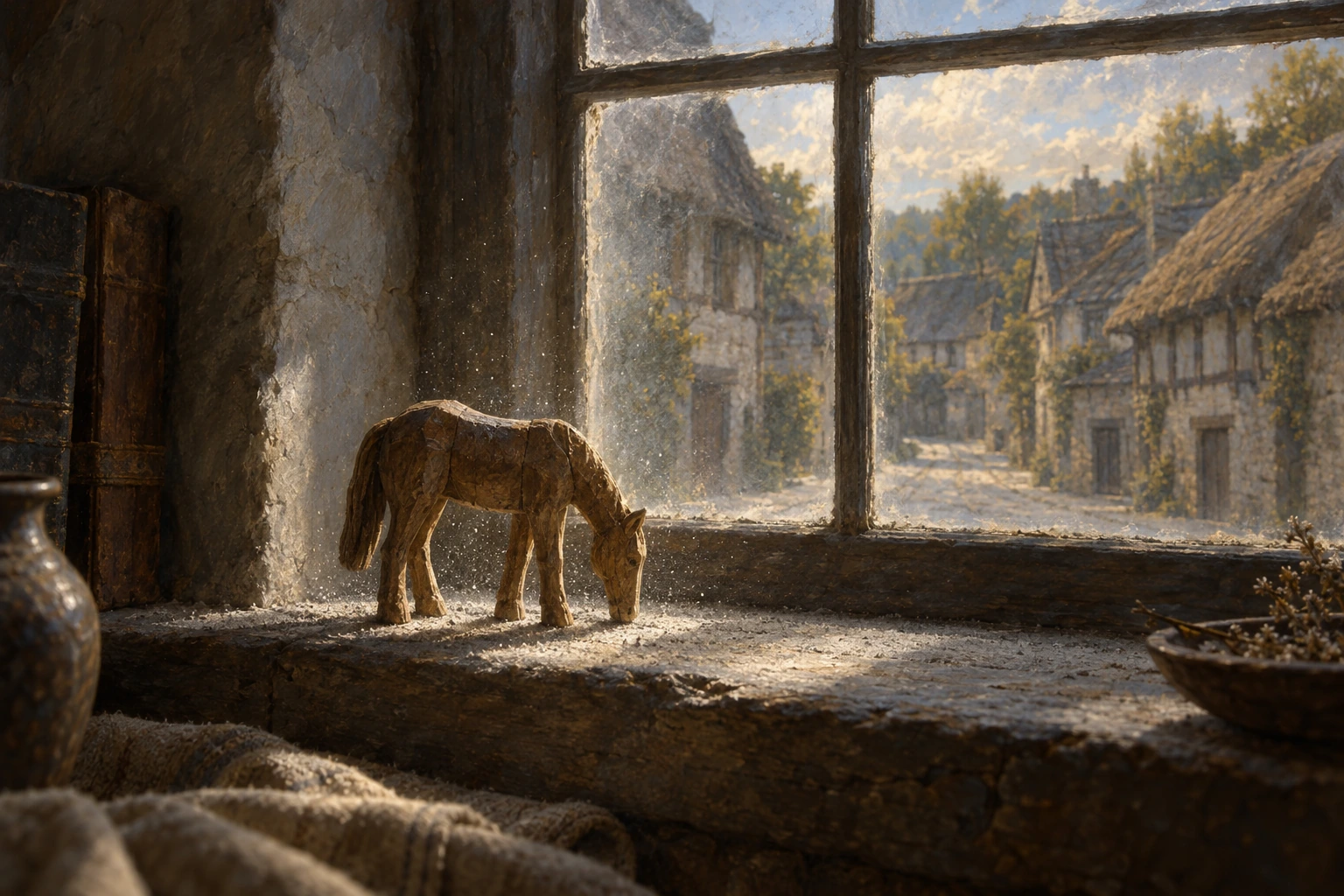
Dust lay over everything inside — not the grey, gritty dust of a place merely neglected, but something finer, settled in long unbroken drifts along every sill, pale as ash and soft as new snow, so even that Wren found herself half expecting it to be cold to the touch.
"Three hundred winters, one grain at a time," Dorrit said, very softly, looking at the drift along the window-ledge. "It never has anywhere else to go, once a room's shut up tight enough. It just settles, and waits for somebody to want the floor back."
The main room held a long trestle table, its benches drawn in neat, as a house-keeper draws in her chairs at the end of a serving. A row of pegs by the door stood empty of coats. A shelf above the cold hearth held a stack of plain wooden bowls, dust-furred but whole, set one inside the next exactly as a careful hand had left them.
It was Pip who found the horse.
It stood on the deep sill of the room's single small back window, where the light fell soft and grey through glass gone slightly clouded with age — a child's toy, whittled from some pale close-grained wood, small enough to sit easily in one cupped hand: a horse at rest, head lowered as if to graze, one leg drawn back, hipshot and easy; the carving was not fine work — a little rough at the mane, the tail no more than a few confident strokes of the knife — but it was work done with plain, patient love, by someone who had known exactly what shape they were after.
Wren felt the whole room go still around her, just as it had gone still on the refugee road at the sight of a small brown shoe half-lost in moss, and for one held breath she felt the old grief reaching for her, unbidden — a child, somewhere, some small hand that had set this down and never come back for it —
And then, in the same breath, she heard Luel's voice again, from a different road, a different fire, saying that a shoe left whole and upright beside a cart was not a shoe a child had been lost from, but one a child had simply outgrown; and before Dorrit had finished crossing the room the same law held here, plain and immediate and entirely without a grief spike to earn.
"Left," Dorrit said, gently, looking at it without touching it, "not dropped. Set square on the sill, facing the window, meant to be found by whoever came after." She looked around the swept, ordinary room. "Somebody's child grew past wanting to carry a toy horse everywhere they went, in about a season and a half — and somebody, packing up the last of a house they loved, couldn't bear to throw it in with the rest of the cart, and couldn't quite bear to carry it either, because it wasn't theirs to carry any longer. So they left it here. For the house. As you'd leave a good knife with a house you were selling, because the house had more right to it, by then, than you did."
Luel had come to stand beside them, and looked at the little carved horse a long moment with an expression gentler than Wren had often seen on her.
"That's the whole of it," she said. "A mercy, left on a sill. Nothing more needs finding in it than that." And then, quietly, she reached out — the only time any of them touched anything in that house beyond what the working plainly required — and set two fingers briefly against the horse's small carved back, as Wren touched things that mattered to her, and drew her hand away again.
Nobody moved the horse from the sill.
The hearth, when Bracken went to it, proved as sound as every hearth they had found on Meddani ground all year — lintel true, firestones swept, the draw pulling clean and strong up into the dark of the chimney above.
He crouched there a while, and did not light it.
"It'd take," he said, at last, more to the hearth itself than to any of them. "First strike, like as not, same as every one of them has." He straightened, and looked around the room once more, and something in his plain, weathered face settled into a decision he did not trouble to argue for. "But this one's not ours to light tonight. We've a fire enough of our own, out past the town's edge, and this house isn't asking us for company. It's only asking to be found sound, and it is." He laid his palm flat a moment against the cold firestone, the same brief gesture he gave a good strap. "We'll light it on the way back. When there's somebody here to light it for."
Nobody argued that either; it seemed to Wren that the not-lighting was a gift — the restraint itself a courtesy, the same courtesy that had kept every hand in the company off the roses and the thyme and the small carved horse, offered to a house that had been minding its own good order since before anyone living was born and had not, this afternoon, actually asked anyone for help doing it.
It was there, in the way-house's hush, that Wren took the Waybook from her satchel and opened it, and found Aldern drawn plain on Wystan's own page — the two streets, the square, the comb-mark of a way-house set neat at its center, exactly where the real one stood around her. And beside the comb-mark, small, in the margin's white edge, in the same spare hand that had counted suppers down the length of a stair three hundred years and a whole company's journey ago, stood a single figure:
1
One supper. He had stopped here a single night, on the road out of everything he had ever known, eaten one meal at this table or one very like it, and walked on the next morning into a world he was leaving for good.
Wren looked at the figure a long moment, and then let her two fingers rest, lightly, beside the drawn comb-mark on the page — not on the ink, only beside it, the old gesture, kept faithfully all year — and closed the book. It was only, like the horse on the sill, a small true thing, found and honored and left exactly where it stood.
They found the gate on the town's western edge, where the second street gave out into paddock-ground and the road took up again beyond it, bound for whatever lay farther west than any of them had yet walked.
It was an ordinary field-gate, waist-high, hung between two stone posts at the mouth of what had once, plainly, been sheep- or goat-ground — and it was new, not the slow, three-century new of the town's own stone, but new in the way a gate is new when somebody has, within the last year or two, cut fresh withies to hang it on and worked them supple enough to take the hinge-strain, and set the whole thing swinging true and square with the plain care of a person who expected to be opening it again, sometime.
Bracken was at it before anyone else had quite registered what they were looking at, running his hands along the withies as he'd run them along a mule's girth.
"That's not old work wearing well," he said. "That's new work. A year, maybe two, since somebody cut these and bent them round the post — the bark's gone pale at the twist, and hasn't had time to weather to match the rest yet." He swung the gate once, easy on its hinge, without a catch. "One pair of hands did this. Maybe two, over more than one visit — the near post's binding's a shade different from the far one, like somebody came back a season later and finished what they'd started, or mended what a hard winter had loosened." He let the gate swing shut again. "Whoever it was, they weren't in any hurry, and they weren't doing it for show. That's the kind of mending a person does for their own satisfaction, on ground they mean to keep walking."
It was Wren who noticed the well.
It stood a little way inside the paddock, nearer the gate than the town's other three, and its coping — unlike the mossed, undisturbed stone of the wells they'd tested that morning — showed a clean-swept ring around its rim. A length of new rope, its splice still pale and unweathered, hung coiled neat on a peg driven into the post beside it.
"Someone's been drawing water here," she said, her voice low, careful — though she knew there was nothing here to wake, only something to be glad of. "Recently. Look — the coping's swept, and that rope can't have hung there through more than a winter or two."
The company gathered around the well and the gate together, and the quiet that came over them then was a different quiet altogether from the shoe on the refugee road or the small mercy of the horse on the sill — the one Wren remembered from the saddle's northern lip, watching a single thin thread of smoke stand steady over unwalked country. The same held gladness.
"Someone keeps a gate," Luel said, and it was all she said, but she said it the way she had said someone keeps a fire at the saddle, and it carried, in six words, everything the company had learned all year not to say more plainly than that.
Iyene had her small plain book out before anyone else had properly finished looking — not her working sheet, but the other one, bought on a hunch in Merrow and kept ever since for memory rather than use — and read the lines back, half aloud, in her flattest and most careful voice.
"A mended gate. New withies, perhaps a year old, perhaps two, one visit or several. A well-coping kept swept. A rope replaced within the same span. Consistent with one or two people, in no hurry, tending as they pass, not living here." She closed the book and looked up, and something in her steady face had gone as warm as Wren had ever seen it. "I want to be careful what I let myself believe past what the gate itself tells me. But I will say this much: somebody walks these roads. Somebody has walked this one recently enough to matter, and cared enough about a gate nobody was forcing them to mend to mend it properly."
Bracken looked back east, once, in the general direction of the thin smoke they had logged the evening before, still weeks off by the honest reckoning of a road none of them had walked yet.
"Might be the same hands," he said, and then, before the thought could run any further than the saying of it, "and might not. A gate and a fire a day and a half apart aren't the same thing as a name and a face, and I've been wrong about smaller guesses than that." He said it plainly, without disappointment in it. "But it's a fair thing to want, and no harm in wanting it, so long as we don't mistake the wanting for the knowing."
"It's weeks off still, by the road we've got," he added, after a moment, in very nearly the same words he had used the evening before, on the ridge, with the smoke standing thin and steady over unwalked country. "And the road's going that way regardless. We'll log it — the gate and the well both — and walk it, and let the one answer the other in its own good time."
The company passed out through the mended gate, one at a time, Bracken swinging it shut behind the last of them and setting the latch true, as a guest closes a gate behind himself, the same plain courtesy that had kept every latched door latched all morning — and took up the road west once more, Aldern falling quiet behind them, kept, and swept, and no longer, so far as any of them could honestly say, entirely alone in the keeping.
Behind the mill, where the ground rose again into the hill's own shoulder, they found a second field-building that the road above had never shown them: low, turfed nearly into the slope itself, one door and no window, built for keeping food cold through a summer, not for keeping people.
Bracken reached it first, in the same plain working step he had given the mill and the wells, and stopped short of the door in a way he had not stopped short of anything else in the whole quiet town.
"That's not shut like the rest of it," he said.
It wasn't. Every door they had passed since morning stood closed on its own latch, easy to a hand's push, set to by somebody who meant to come back before long. This one carried a baulk of oak dropped crosswise into two iron brackets driven deep into the stone jamb, and past the bar, where the wood met the frame, three iron pins had been hammered through at a slant and bent flat against the grain, so that no lever short of an axe would ever lift that door off its hinges again; the iron had gone soft and orange with age, though the oak underneath it had not moved a hair's width in three hundred winters.
Dorrit set two fingers against the bar the way she would set them against a plant she wasn't certain of, and drew her hand back almost before it had landed.
"Somebody didn't want this coming open," she said. "Not by weather, and not by accident, and not by anybody who came after and didn't know what they were looking at." She studied the pins a while longer, in silence, and did not touch them a second time. "You don't nail a door shut like that against the cold."
Wren felt the sentence land in the whole company at once, and watched each of them decide, without a word passed between them, not to finish it.
At the building's rear, where age had opened the turf along the roofline, a gap showed between two collapsed timbers, no wider across than a grown man's shoulders, black even at midday.
Dorrit went to look at it while the rest of them were still turning the barred door over in their hands, the same plain curiosity that had carried her to every garden and every well since morning, and had her head and one arm through the gap before anyone thought to call her back.
"There's cold coming up out of this that isn't right," she said, her voice already flattened by the timbers around it. "It isn't cellar-cold. It's —"
She did not finish that sentence. The turf gave under her braced hand without warning, and she went through to the shoulders in one scrabbling breath, and then, before Wren had covered half the ground between them, all the way down and out of sight.
"Dorrit!"
Three heartbeats came back empty, which was three heartbeats longer than Dorrit had ever, in a whole year of roads, left anyone waiting on an answer of hers.
Then, from below, in a voice that had all the right words in it and nothing else that was right about it: "I'm here. I only — " A pause considerably longer than the sentence it was breaking. "I don't remember what I came down here for."
Wren was flat on the broken turf with her face over the gap before she had decided to move, and could see nothing below but a darkness that seemed, absurdly, to be rising toward her rather than merely sitting there — the way cold rises off a cellar floor in deep winter, except that it was not deep winter, and this cold had a floor of its own that had nothing to do with any season.
Alder was down beside her almost as quickly, one hand flat against the broken turf, and when he spoke into the dark, his voice carried none of the mildness Wren had grown used to hearing him spend on breakfast tables and bad roads alike.
"Dorrit. Say your own name."
A silence came back that went on a good deal longer than it should have.
He tried the old tongue next, three low words Wren had heard him use exactly once before, at a very different doorway, on a very different night — and stopped on the third, his mouth already shaping the start of a fourth word that did not arrive; he did not chase it, and went back to the common speech instead, as though nothing at all had happened, saying her name again, and then Wren's own name, and the mill, and the horse on the sill, plain nouns laid down one after another like stepping-stones across water neither of them could see the bottom of.
It brought her voice back up, thinner. It did not bring her the rest of the way.
Bracken went down through the gap feet-first before Alder's sentence had finished landing, without asking leave of Alder or Iyene or the charter that would ordinarily have wanted asking. He did not call down first to see if the drop would take his weight. He went down anyway.
The cold on the far side of that gap was not like any cold above ground; it did not sit on the skin like an ordinary morning's cold, but reached past the skin, the way frost reaches past a pane of glass and finds the room behind regardless of the window, and Bracken felt it close over his boots, then his knees, standing on packed dirt that gave off no smell at all — no mould, no grain, no damp stone, nothing, as though the air itself had been swept as bare as the floor.
Dorrit was on her knees in the middle of that floor, both hands flat on the dirt, looking at them as though she had only just been told she owned two hands and might be answerable for what they did.
"Up," Bracken said. Nothing more than that.
She looked at him a moment as if the word wanted translating. Then she took the arm he put under hers, and stood, and let him turn her toward the grey coin of daylight in the roof above them, and that was the whole of the argument either of them made about it.
He put her through the gap first, boosting her from below with both hands cupped under one boot until Alder's grip closed over her wrist and Wren's over her forearm, and between the two of them they had her out into ordinary daylight before she had finished saying that she still did not know what she had gone in there for; then Bracken came up after her under his own strength, one hand on a broken timber and one scrabbling at the turf's cut edge, and stood a moment in the sun with his eyes shut, breathing, before he did anything else at all.
He did not get the feeling back into the last two fingers of his left hand, not that evening, not ever.
By the time they had walked Dorrit into the sun and sat her down against warm stone, she had her own name back, and Wren's, and enough of the morning to ask why everyone kept looking at her like that.
"You went in after something," Wren said, and did not say what, and did not say who had gone in after her.
"Did I." Dorrit turned her own hands over once, as if checking they still answered to her. "Well. I don't suppose I'll try that twice."
Bracken dragged a fallen roof-beam over the gap before he touched anything else, and gave no reason for it.
Luel had come no nearer the gap than the building's corner, the whole time, and looked at it now a long moment from there.
"That one keeps itself," she said, when Wren caught her eye. "We'll leave it that."
They walked on without any of them proposing to go back and look at it again.
They camped that evening a mile or more beyond the town's last wall, on a low rise above the road where the grass stood dry and the ground sloped away clean toward a stream too far off to trouble anyone's sleep with its voice, and it was Dorrit, unpacking the cook-pot in the last of the light, who said the only word given to the choosing of it.
"Better ground for us out here," she said, "and no sense crowding a town that's earned its quiet. We'll leave it its evening the same as we found it — whole, and shut up tidy, and none the worse for a company of strangers walking through it kindly for one morning." It was said lightly, and taken exactly as it was meant, and the mile stood.
Supper went round in the ordinary way, and the fire burned low and companionable, and the mules cropped what grass the rise gave them with their usual indifference to how remarkable a day it had been. Bracken ate one-handed, and switched his knife to the other hand without a word when Iyene's glance caught on it, and went on eating. Pip added a page to his book by firelight, working from memory now rather than the ground itself — the fountain's dry basin, the horse on its sill, the mended gate's fresh withies — and Iyene, watching him a while, said only that a town drawn twice, once from the stone and once from memory, was a town remembered rather better than most towns managed, living or otherwise.
Looking back the way they'd come, before full dark folded the last of the valley away, Wren could just make out the town's roofline against the paling sky, dark and whole and unbroken, holding its own particular silence — patient, and entirely unafraid, and no longer, this one evening at least, quite so alone in the holding.
When the fire had burned to its own quiet coals and the first watch was long since settled, Wren took out her day-book, and sat a while with the pen unmoving before the words came, once she let them.
We found a whole town asleep today, and it was not a grief. I want to set that down plainly, first, because I think it is the truest thing I learned on Aldern's streets. A town on a living map is a town somebody can come back to, Iyene says, and that is not nothing, even set against what it must once have been to the people who built it.
There was a horse on a windowsill in the way-house at the town's heart, whittled plain and loved, left square and facing the light. I thought of the shoe on the refugee road, and of Luel's law, and let the horse teach me the same lesson a second time, more gently than the first. We found the hearth in that same house sound and true and did not light it. I think that not-lighting was the kindest thing any of us did all day.
And at the town's western edge we found a gate lately mended — new withies, a swept well, a rope not a year old. Somebody walks these roads. We did not go looking to find out who, tonight; the road is going that way regardless.
There was a second door, nearer the mill, shut from the outside and nailed past shutting, and a cold behind it older than any winter I have stood in. Dorrit went into it without meaning to and came out again having forgotten her own name for a handful of breaths. Bracken went in after her without being asked, and cannot feel two fingers of his left hand now.
Behind her, unseen now in the dark but no less present for the not-seeing, a whole sleeping town lay kept and swept and patient under the same wide sky, waiting for a spring it had never stopped quietly trusting would come.