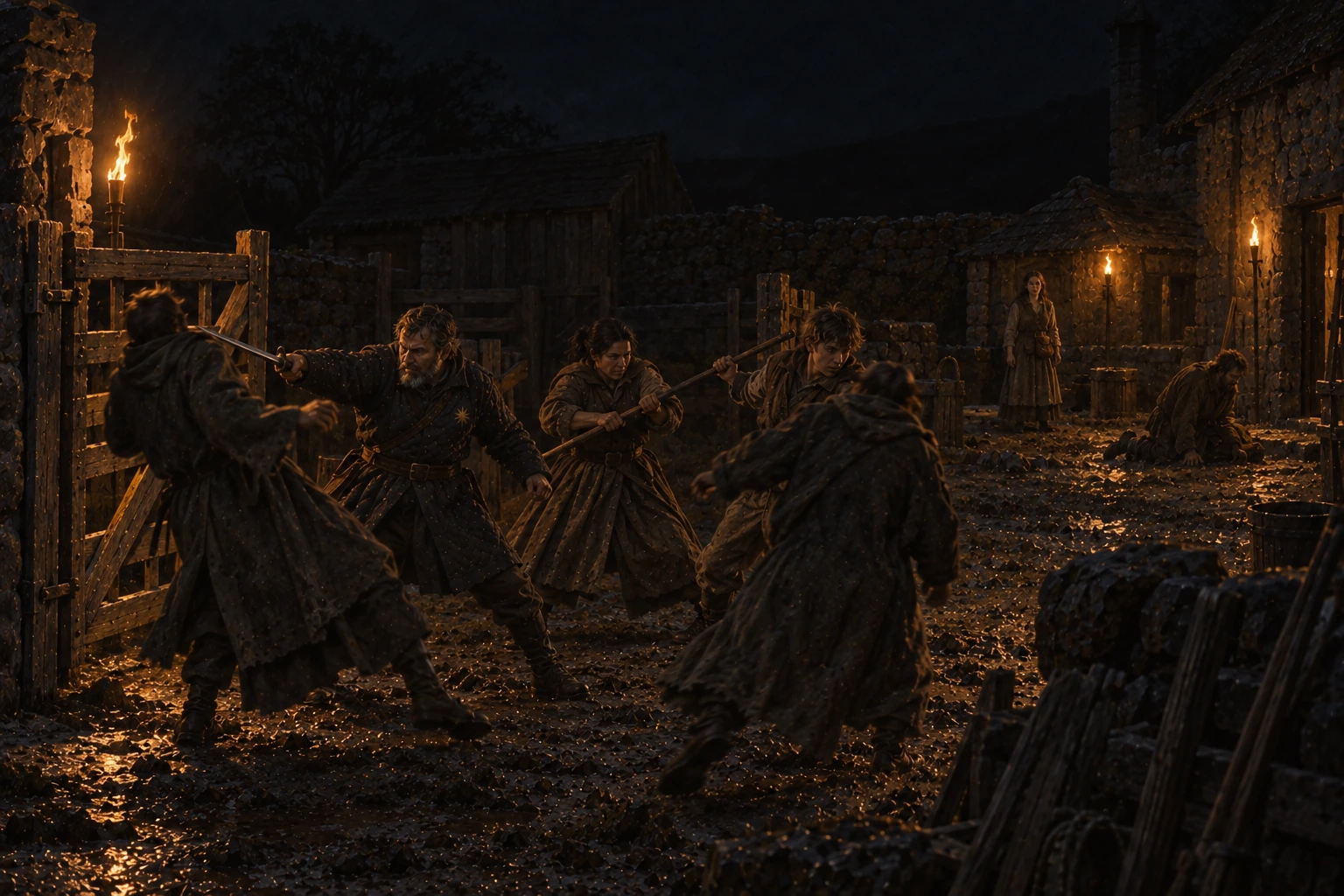
The Steading She Did Not Spend
"You're giving up the fold," Sarl said.
She was a short, iron-haired woman with a shepherd's permanent stoop and a voice built for calling across weather, and she said it flat, not as a question. Bracken had the whole steading's shape drawn in the yard's mud by then — a dozen strokes with the point of a stick, walls here, gate there, the sheepfold's low wall marked once and then struck through with a second stroke.
"I'm giving up the fold." Bracken did not look up from the mud. "Ten of us, forty of you, and I count five ways a body could come at this yard tonight without trying hard. I can hold three. I can't hold three and a fold besides. I'd rather bury sheep in the spring than argue with your people over which of them gets left standing at the wrong wall."
Sarl looked at the three strokes still standing in the mud and the two struck through. She did not argue with the arithmetic, because there was nothing in it to argue with, and because something in the set of Bracken's shoulders told her this was not the first yard he had ever drawn this way, nor the first time he had watched somebody decide, in the space of a breath, whether a stranger's certainty was worth trusting a household to.
They had come up the last mile of that road meaning only to ask after water and a night's shelter under a roof that was not their own canvas — the ordinary business of any company still three long days off the next high ground. It was Wren who stopped at the gate first, one hand going to the cold stone of the wall before she had worked out why she had reached for it. It was Bracken, coming up behind her, who read the rest of it in about the time it took to cross the yard: no dog anywhere in a steading that plainly kept at least two, judging by the size of the bowls set out near the door; ravens working a stand of trees below the near field in a low, patient wheel over something already dead; frost furring the north face of the byre wall in a season when the ground for two days' walk in every direction had stood soft and brown underfoot. None of it, taken alone, would have stopped a company that wanted only supper and a dry floor for the night. Taken together, it stopped Bracken cold at the gatepost, and he said one word to Alder, low, before Sarl had so much as come out to greet them.
"Tonight."
Alder did not ask to see the signs for himself. He walked the yard once, his hand resting a moment against the gatepost and a moment more against the byre's near corner, and came back to where the others stood waiting with his face giving away exactly nothing.
"We stay," he said. That was the whole of it. No one asked him to say more, and he offered none, because there was nothing in the saying of it that wanted lengthening.
"That's a day gone," Dorrit said, not gently, from where she stood with Suet's lead wound twice round her fist. "Maybe two, if it runs the way Bracken's face is telling me it might. You know what a day costs, where we're going."
"I know what a day costs." Alder did not turn to look at her. "I also know what a night costs forty people who haven't got Bracken's eyes to read a yard with. We stay, and we spend the day, and we go on knowing exactly what it bought."
It was not put to a vote. It was not the kind of decision that improves for being voted on. Within the hour the company had stopped being seven travelers and four newcomers asking after bread, and had become, without any one of them announcing it to the rest, the only defense forty people on the last inhabited road had left standing between them and whatever the dark was bringing down on that particular fold of ground tonight.
Sarl gathered her own household into the long kitchen before dusk — forty of them by her own count, with no Iyene there to check the figure against a second reckoning — and Bracken gave them the whole of his plan in about as many sentences as Alder had given his order. The house and the byre would be held, joined by the covered way between them. The sheepfold was given up outright: gate barred and left unmanned, whatever came for it welcome to what it found there. Both wells were drawn and covered. Everyone under fourteen or over seventy went into the house's inner room, behind its second door, and nobody in that room was to come out of it again for any reason short of the roof itself coming down.
Sarl put names to her people plainly and without ceremony, a woman long past expecting a stranger to keep them past supper and not troubled either way by the certainty of it. Her husband was Rill, broad through the shoulder and slow to speak, already gone to check every hinge on the byre door twice, because he trusted his own hands over anyone's report of them. A shepherd named Crake, younger, steady, had lived on that particular stretch of ground his whole life and stood very still when he had nothing useful to say, a stillness Wren found herself trusting before he had spoken a dozen words to her. A girl called Ede, sharp-eyed and restless with the waiting, put three questions to Dorrit about the jars in her kit before Dorrit had finished laying them out, and got honest answers to all three, because Dorrit did not believe in soft ones. A boy of perhaps ten, sent up to the loft the moment the company's purpose became clear, looked back down the stair once before a woman old enough to be his grandmother drew him the rest of the way up by the collar and did not let him look again.
"You keep bees," Crake said to Wren, while the two of them carried water up from the covered well between them, nodding at the old callus along the side of her first finger that no amount of road had worn smooth. "My mother kept three skeps behind the byre when I was small. Lost the last of them the winter my father died, and never had the heart to start again."
"I've got two rows and three skeps of my own, a long way east of here." Wren shifted her grip on the bucket's handle. "Or my grandmother has, and calls them mine, which comes to the same thing most years."
"Long way," Crake said, and did not ask how long, and set his bucket down at the well's rim with the particular care of a man glad of an ordinary task in the middle of a day that had stopped being ordinary an hour before.
"You'll want somewhere central to work," Wren said to Dorrit, once the kitchen had emptied out toward its evening's business. "Somewhere you're not choosing between two doors."
"I know how to choose a working spot." There was an edge on it that had nothing to do with the steading and everything to do with a fire two nights back. Wren let it lie where it fell, because there was no arguing that particular edge down before dark, and the dark was coming whether or not either of them had forgiven the other first.
Bracken set the lighter posts to the Amarin — Ossen at the covered way's near end, quiet and thorough, checking the same bar three times without being asked; Ferrit in the loft window above the byre door, fidgeting with a knife he did not yet trust himself to use and pretending he was not — and kept Sael and Wend close by himself at the yard gate, where the weight of the night would fall first if it fell anywhere at all.
"You've never done this," he said to Wend, not unkindly, checking the boy's grip on a hafted hedging-hook that had plainly been a farm tool a good deal longer than it had been a weapon.
"No," Wend said.
"Do exactly what I tell you and nothing you think of on your own." Bracken's voice did not change register to say it. "Tonight's not the night to find out what you think of on your own." Wend nodded, and did not look reassured by it, and Bracken did not try to make him look reassured, because a boy who believed this was going to be easy would be more dangerous standing at that gate than one who was honestly afraid of it.
Sael said almost nothing at all, which from a fiddler's hands Wren found stranger than any amount of talking would have been. She stood at the gatepost counting something under her breath that was not quite a number and not quite a tune, over and over, until Bracken told her once to stop, and she stopped without any sign of having minded being told.
Pip laid three fires before full dark — one at each door the company meant to hold, kindling and pitch-pine set ready against a need not yet arrived, the way he had been laying fires the whole length of the Survey. Alder checked his work without being asked to and found nothing in it wanting correction, and said so in four words, and Pip's face did something it had not done since Stanhope.
Full dark came down without fanfare, the way it does in a country with no lamps left to hold it off. The ten of them settled into the posts Bracken had given them and waited, and the waiting was the worst part of it, the way waiting always is.
It came first from the tree line below the near field, where the ravens had spent the afternoon, and it came as more than one kind of trouble at once.
The winter-bred broke from the dark low and fast, three of them, heavier than their size promised in exactly the way the things denned in Wintergarth's cellar had been. They went straight for the sheepfold's unmanned gate, because a fold full of penned animals that cannot run is the easiest meal on any steading, and nothing hunting on hunger's plain logic passes an easy meal by for a harder one. Two more shapes peeled off toward the yard wall's near breach instead, walking rather than running, patient in a way that told Wren, before she had properly looked at them, exactly what they were and exactly how much worse the night was about to get.
"Four," she said, low, to Bracken. "Faded. Behind the winter-bred, not with them."
"Heard." Bracken did not look away from the gate. His grip on the short blade had not tightened. It had, if anything, loosened, the particular ease of a man's hand settling into work it already knew the shape of. "This one's ours."
The winter-bred went through the fold's barred gate as though the bar had been a suggestion and not a bar at all, and the noise that came up out of the fold once they were in among the penned sheep was a noise Wren had heard before, on a different road, and had never gotten used to hearing. She made herself stop listening to it as closely as her ears wanted to. There was nothing in that sound she could do a thing about, and a working spent on a sheep's behalf was a working she would not have for whatever the yard still owed her.
What the yard owed her came through the gate itself, and Bracken met it there with Sael and Wend at his shoulders and Alder a few strides back, his axe already loose in his hand.
The first faded through had been a big man once, broad enough across the shoulder that it caught on the gatepost coming through. It came on without haste and without hesitation, the pace of a thing that had stopped needing either. Bracken did not wait for it to clear the gate. He had never waited, in three years of road, for anything that wanted killing to finish arriving first; waiting was a mistake made once, by younger men, and rarely twice. He went into the gap low and fast, inside whatever reach it might once have carried a weapon for, and there was nothing careful in the going — nothing that looked, from where Wren stood, like a man defending a gate rather than a man closing on something he had already decided was his. His short blade went in under the arm exactly as it had gone into the thing in Wintergarth's undercroft two years and a long road back, and it went down in about the time it took to say so, with the same small cracked-ice sound Wren remembered from that cellar and had hoped, without much real confidence, never to hear again. Bracken did not step back from it to see it fall. He was already turning for the next thing before this one had finished going down, and there was nothing in his face that a person watching from the byre door would have called relief.
Sael found her use in the half-minute after that, and it was not one the company would have guessed at from a fiddler's hands.
The second faded came wide of the gate, along the wall, aiming past Bracken for Wend where he stood half a step behind. Sael — who had spent every evening of the whole road counting time under a bow that made a room follow her without a word said — put two fingers to her lips and gave one short, sharp, exactly-placed whistle. It was not a warning. It was a beat, the kind she might have counted a fiddle tune in for dancers who could not yet hear the music, and it told Wend precisely when to step and precisely when to swing. His hook came round clumsy but timed, caught the thing across the knee, and put it down half a second before it would otherwise have reached him. Bracken finished it where it lay, one short economical stroke, without breaking his own stride toward whatever the gate sent next.
"Again," Sael said, to no one and everyone, already counting the next beat under her breath. Wend — white-faced, shaking, his knuckles gone bloodless on the haft — held his post anyway, because there was a rhythm now telling him when, and a rhythm was a thing a frightened boy could follow when his own judgment had stopped being anything he trusted.
Luel came up the covered way at a pace Wren had not seen her move at before, singing low in the old tongue the company had heard from her only in scraps across two years, and there was nothing gentle in the sound of it tonight — nothing that would have passed, in any hall, for a lullaby. The third faded, already through the breach in the wall and making for the house's back door, stopped as though it had walked into something solid. It turned toward her voice instead and went entirely still, as something goes still once it has been told, plainly, exactly what it is facing. That stillness was long enough. Alder closed the ground in it and took the thing from the side with the axe, and the strike carried something past its own steel — a cold that came off the axe-head at the moment of the blow and left the frost on the broken stone beneath it thicker than the night alone could have laid there. He did not remark on it. He never did.
The fourth broke for the byre door itself, the one point Ferrit had left unwatched to go help Bracken at the gate, and it would have reached bare timber and nothing else standing in its way if Ossen had not seen it coming and put himself square in the doorway to meet it, a spear he had never used on anything larger than a fence-post held low and steady in both hands. He did not swing wide or step back from what came at him. He drove the head in under its ribs with his whole weight behind the shaft, and held on to it, braced against the doorframe, while it thrashed the spear half out of true and very nearly out of his hands besides. That was enough to slow it, though not enough to finish it, and Dorrit's staff found it in the covered way a breath later, catching it hard across the knees as it dragged itself the last few feet with Ossen's spear still standing out of its side. She did not wait to see whether the blow had done enough. She drove the shod end down a second time before it had finished falling, with the flat unsentimental violence of a woman who had turned a wolf once with that same staff and had never needed telling that a thing on the ground can still get back up if you give it the chance. Alder, coming up behind, finished it anyway, because two strokes were cheaper than a third chance.
By the time the fold had gone quiet — too quiet, all at once, the particular silence of a thing having eaten its fill and moved on — the yard held four faded down and unmoving, and not one soul of the company hurt worse than a bruise and a split knuckle on Bracken's off hand. Sarl, come as far as the kitchen doorway with a boning knife in one fist and no clear plan for using it, looked at the four still shapes and then at the six strangers standing over them breathing no harder than they might have after a brisk walk, and said nothing at all. Nobody had raised a voice in that yard from the first stroke to the last.
Wren, counting from the covered way's shadow the way she always counted on ground like this, thought that this yard was what the whole long road should have looked like from somewhere very near its beginning: a company that met a threat and ended it, rather than one that only survived a threat and counted its wounds afterward.
She did not let herself think it twice. There was still a third winter-bred loose somewhere past the fold, and Rill had not come back from the byre's far hinge.
Ede had taken a graze in the crush of it and had not said one word about it, being occupied at the time with dragging two of the household's younger hands through the covered way and in past the house door before the third faded reached them, and it was only once the yard had gone quiet around the four bodies that Dorrit caught her wrist, meaning to wipe a smear of someone else's blood off it, and found the girl's own blood underneath.
The cut ran shallow across the back of her forearm, no worse to look at than a scratch from a hedge — except that it had already gone the pale flat white of a thing the cold had begun to claim, no blood standing anywhere along its edge, wearing the same stillness Alder had once described to Dorrit across a kitchen table in a house three hundred years old, in four plain words: not being in time. This time, Dorrit was.
She had the root out and steeping before Ede had finished asking what was wrong with her own arm, working fast and saying nothing about why, because there was no way to say it that would not have frightened the girl worse than the wound itself was going to. "This is going to hurt a great deal more than it does now," Dorrit said instead, which was the only warning Alder had ever thought worth giving, and put her whole weight across Ede's forearm the moment the root went in.
Ede screamed. It was not a small sound, and Dorrit did not flinch from it, and did not ease off the pressure, because easing off was exactly the mercy that would have let the wound close wrong. She held the girl's arm flat against her own braced knee with both hands driving, riding out a thrashing that nearly cracked her own nose before Sael came and knelt on Ede's other side to pin her shoulders down, and somewhere under all three of them fighting the one small wound, the white began, at last, to run.
It came up dark first, then ordinary, then simply red, the color a cut ought to be and had not been a minute before, and Dorrit sat back on her heels with her hands shaking harder than Ede's had, and said, half to herself, "There. There, that's done, that's the whole of it," in a voice that did not sound entirely certain of its own words until the bleeding had gone on long enough to prove her right.
She was still kneeling over Ede, binding the arm properly now that the danger in it had passed, when Pip's voice came from the byre door, thin and carrying further than a boy's voice should have had to carry that night.
"Rill's down. Rill's down, he's not moving, come now—"
Pip had gone to bank the fire he had laid there rather than let it burn to nothing wasted, and had found, instead, Rill on the ground at the hinge he had gone to check alone, with the fifth faded already turning from him toward the sound of Pip's own breath. Bracken reached the doorway before the thing had finished turning and ended it in one stroke, the same flat appetite he had brought to everything else that had come through that yard, the kind of ending a man gives a thing when there is somebody down behind it who needs every remaining second more than the killing does — but Bracken's blade could do nothing for the wound already opened, and Dorrit's hands were the only hands on that whole steading that could, and Dorrit's hands were still on Ede's arm, holding a working that had not yet finished its course.
She did not leave. Leaving now would have let go of a wound half a minute from closing wrong, and there was no version of tonight in which she gambled a girl she had already saved on a man she had not yet reached. She finished binding Ede's arm with hands that would not entirely stop shaking, said one flat word to Sael to keep pressure on the wrapping, and ran.
It cost her perhaps ninety seconds, start to finish — the binding, the flat word to Sael, the run itself — and ninety seconds is not a long time by any ordinary measure of one.
Dorrit went down on both knees in the frozen mud beside Rill and had the wound bared before her own breath had settled from the run. It sat high on his shoulder, not deep, not wide — the kind of wound that would have wanted nothing more than a clean binding on any other night of the whole long road. It had gone the same pale flat white Ede's had worn, except that it had had ninety seconds longer, and Ede's own household, and Dorrit's own hands, to itself.
"How long has it been," Dorrit said, already reaching for the root at her belt.
"I don't know." Pip's voice had gone very small. "I found him like this. I don't know how long before that."
Dorrit steeped the root faster than she had for Ede, faster than Alder had ever shown her, and pressed it into the wound anyway, because trying and failing would cost nothing that not trying would have saved her. She knelt over Rill with both hands driving and her whole weight braced across his chest against whatever remained in him waking enough to fight the treatment. Nothing woke. The white did not run. The wound stayed exactly as it had been through a second steeping, and through a third, and somewhere in the middle of the third Dorrit understood, with the flat certainty of a woman who had spent a great many years being exact about the things she knew, that the white had finished its traveling before Pip had ever found him, ninety seconds or a very great deal longer, and that no root steeped fast enough now was going to call it back.
She did not stop working for a long minute after she already knew it. There is a kind of not-stopping that has nothing left to do with hope, and everything to do with a pair of hands that have been taught one true thing and cannot, the moment it fails them, think of anything else worth doing with themselves.
Thirty feet away, on the far side of the yard, past the covered way and the wall's near breach, Crake had gone down against the old spring-house wall — not struck, not marked anywhere the eye could find, but down all the same, on his knees in ground that had stood colder than the rest of the yard the whole evening without anyone troubling to ask why, ground he had given up step by step across the fighting without ever noticing how much of it he had given.
Wren heard it before she saw any of it, the way she always heard that particular kind of going: not a name being spoken, but a name coming loose from wherever names are ordinarily kept, the way frost comes loose from a roof in the season's first true thaw — quietly, and all at once, and past any stopping by the time it can be heard at all.
She was thirty feet off. She was whole, and armed, and entirely capable of covering that ground in under five seconds. She had a name in her she had judged, since Thistleton, truly spendable, held the whole width of this road against exactly the need Cael Meddan was going to make of her, and every single thing Alder had spent two years teaching her said that this — a shepherd on his knees behind a spring-house, the fight not yet fully finished around him — was precisely the moment the craft existed to answer.
She looked toward him.
Something in her went very still, the same stillness the wound in Rill's shoulder wore under Dorrit's hands, though nothing about her showed it to anyone standing near enough to see it happen.
She did not move.
It was perhaps three seconds, by any clock that could have measured it. It felt like no time whatsoever. It also felt like the longest three seconds she had stood inside in the whole of her life, and both of those were true at once, the way the worst things generally are.
Crake's breath went out of him as a held thing finally gives up what it was holding, and did not come back in. By the time Bracken reached the spring-house wall, drawn there by nothing more than the ordinary soldier's habit of counting every body still standing in a fight, there was nothing left to do beyond closing his eyes, which Bracken did, without a word to anyone. He stood, and looked once across the yard to where Wren still stood exactly where she had been standing when it happened, and said nothing either.
Sarl came out into it once word had reached her, and stood over her husband's body without kneeling and without a sound, her hands loose at her sides in a way that told Wren more than weeping would have told her. Ede sat back on her heels beside Dorrit, streaked to the elbow with blood that was not her own, and said nothing at all. Wend stood at the gate still gripping a hedging-hook he had not had to swing again after the second faded, and looked, for the first time all night, like a boy rather than a defender. Sael put a hand on his shoulder and did not tell him it would be all right, because it would not, and telling him otherwise would only have been one more small lie added to a night that had already cost the steading two truths it was not getting back.
Dorrit rose from Rill's body last of anyone, wiping hands that would not properly come clean on a cloth that had been white that morning. She did not look toward Wren — not out of the anger three nights old that had not gone anywhere and was not going anywhere soon, but because there was nothing presently in her own face she trusted herself to keep off it, and she had already, this week, said one true and cutting thing to her cousin across a different fire, and had no wish to learn what a second one, said over a dead man, might cost either of them before morning.
Alder came and stood beside Wren a while, close enough that she could feel the cold still clinging to his coat, and did not touch her, and did not speak. After a time he went on to see to the split skin across Bracken's knuckles instead. That was the whole of what he offered her, and it was exactly as much as he trusted himself to give without its becoming either a lie or an absolution she had done nothing yet to earn.
Luel, passing, looked at her once — long enough to be noticed, not long enough to be mistaken for anything so soft as sympathy — and went on to see to the fold, where two ewes had lived through the night and a third had not.
They buried Rill in the morning, in ground the steading kept apart for it a little way past the near field, and Sarl said the words over him herself, dry-eyed and short and without ornament, and asked no one's help in the saying. They buried Crake beside him, and it was an old woman from the loft, who had taught him the trade as a boy and had not expected to outlive him by decades to do it, who said his own words instead, because Sarl could not say them twice in the one morning and nobody thought to ask her to try.
Wren wrote it into the day-book before they walked, sitting apart from the rest with the book open across her knees and her hand gone smaller on the page than it usually ran, the way it always went small when a page held more than the page rightly wanted to carry. Two names, Rill and Crake, set down one under the other. Beneath them, because the day-book had never let her leave a true thing out of it for being an unkind one to write, she set down the plain fact in her own hand: that she had stood thirty feet from the second name with the means to keep it in the world, had judged the distance, and had not crossed it.
Dorrit did not speak to Wren once across the whole of that morning's walking, and made no particular effort to hide that she was not speaking to her, which was its own kind of statement in a company that had spent three years learning to read every silence any one of them produced. The anger from three nights past had not burned itself out in one bad night at a fire; if anything it had found a second thing to feed on, larger than the first, and Wren did not ask her cousin which fire she was currently angriest about, because there was no version of that question either of them wanted answered aloud on a cold road the morning after two funerals. Whatever the night had cost them toward Cael Meddan, nobody sat down and added it up exactly, not even Wren, who added up most things without deciding to. A day, Dorrit had said, at the start of it, or two if it ran badly. It had run exactly as badly as a night could run and still be called, by the woman whose husband lay in it, a night the steading survived.
The page went unread over her shoulder, and unasked-for too. The company shouldered its packs and went on west with the steading's smoke still climbing behind them into a sky gone the color of an old bruise. Forty people were alive that morning who would not have been if the company had walked past that gate the evening before. Two names had gone into a reckoning that would not balance whichever side of it anyone chose to add up from, and the road ahead of them, when it came, had nothing further to say about any of it.