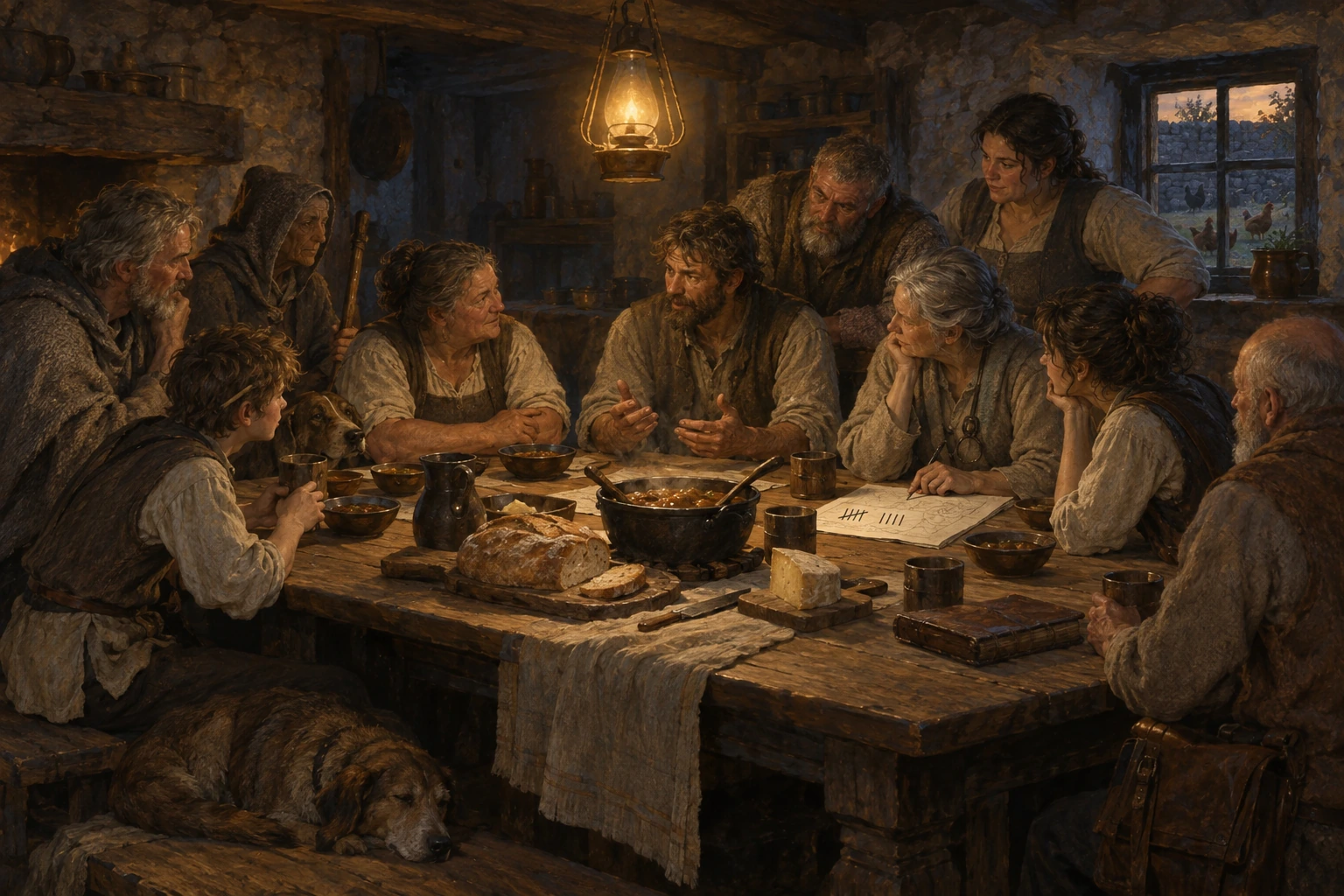
The Watch Relieved
The whole camp slept worse than usual, and let the morning pass without remarking on it.
Wren woke before the true light, in the grey hour when the birds have started but not yet committed to it, and lay a while listening — an ordinary morning's worth of larks and finches, going about their ordinary business, so that she could have laughed with relief at the sound of them, had laughing aloud before dawn been a thing anybody did in a shared camp. It was late spring now in good earnest, three days out from Sarnholt and one clean mile back from a gate that had a name again, and the road ahead would only be more of that same ordinary westward country: green, quiet, and entirely willing to let them walk it.
She found Iyene already awake and sitting up with her working sheet spread flat across her knees, not writing, only holding it open to its flyleaf, where her own name stood in her own hand in the plain, unlovely lettering of someone who had learned to write for use rather than show. She was looking at it the way a person looks at a bridge they have just walked back across, to be sure, for no reason that survives daylight, that it is still standing.
"Cartographer-Royal Iyene Sath," Wren said, gently, from her own blankets, "keeper of two books."
Iyene looked up, caught, and had the grace to laugh at herself, low and short. "I have checked my own name against my own flyleaf twice this morning already, which is a thing I have never once done in twenty years of keeping this book, and which I find I am rather annoyed with myself about." She closed the cover with a small, decisive snap, as if shutting a door on the annoyance along with the page. "It answered both times, for what that is worth."
"It's worth a good deal," Wren said, "I should think," and left it there, and Iyene's small dry nod told her it had landed exactly as intended.
Garron she found a little apart from the fire, sitting on an overturned pannier with his forearms on his knees, looking at his own two hands as a man looks at a tool he has used every day of his life and has, for the first time, had cause to wonder whether it will answer the next time he reaches for it. He did not seem unhappy, only thorough, turning them over once, palms up and then down, as if reading them the way Wren's own family read a hive before opening it.
"They're the same hands," Wren offered, coming to sit near him, not too near.
"They are." He flexed them once, slowly. "I lost the whole of it in that street — my own name, that my mother put into me before I could walk, gone clean out from under me like a floor I'd never thought to test — and I find this morning I keep wanting to check that the floor's still there. Foolish, maybe."
"Not foolish." Wren thought of Iyene's flyleaf, and kept it to herself; one person's small morning frailty was not hers to trade for another's comfort. "I lost mine too, a little, in the same street. It came back whole. Nobody's the poorer for the losing, so far as I can tell — only a little more careful of a thing they'd never before had cause to be careful of."
Garron considered that, and something in his shoulders let down half an inch. "Well," he said — the sound, Wren had learned, of a Hazel quietly making up his mind — "I'll not spend the morning staring at my own palms like a fortune-reader at a fair, at any rate. There's mules to see to, and Bracken'll have my hide if the picket-lines aren't struck by the time he's finished his tea."
He went to the mules, and did not look at his hands again, that Wren saw, for the rest of the day.
She herself sat a while with her day-book unopened on her lap, feeling the old pull to set the previous evening down before its light faded. But she had already written Woldsend whole, the night before, by the last of the fire; and she found, turning the closed cover over in her hands, that a written thing sat differently the morning after than it had the night it was written — settled, as new-drawn honey settles overnight, still itself but no longer moving. There was nothing to add. She put the book away unopened, and found that this, too, was a kind of entry, even unwritten.
Dorrit, for her part, made no speeches whatever about the day before, and instead fed everyone as though the company had spent the night hauling stone rather than sleeping poorly. There was porridge thick enough to stand a spoon in, and a second helping pressed on anyone who so much as glanced at the pot, and a third pressed on Pip regardless of whether he glanced at it or not, until he protested, mildly, that he would not be able to walk in a straight line before noon.
"You'll walk in whatever line you like," Dorrit said comfortably, "on a full stomach, which is more than I can say for the alternative," and that, Wren reflected, watching her cousin scrape the last of the pot into Bracken's bowl over his own mild objection, was the whole of Dorrit's commentary on a hard day well survived: not a word of it spoken aloud, and every word of it said anyway, in porridge.
They struck camp without hurry and were on the road by mid-morning, eight of them and four mules, walking into a day that had decided, somewhere in the night, to be entirely fine — high pale sky, the road drying underfoot, the hedgerows loud again with the birds that had gone silent the morning before and had, evidently, thought better of the silence. It was, on the whole, the look and sound and smell of a good crew the morning after a hard job finished properly: quieter than usual for the first mile, and readier than usual to laugh by the third.
Alder and Bracken fell into step together somewhere past the second mile, easy as two men who had long since stopped needing an excuse to walk beside each other, and Wren, coming up a little behind with Dorrit, caught enough of it to carry the shape of the whole conversation home in her own head before the day was out.
"The charter says the whole working," Alder was saying, in the mild, unemphatic voice he used for things he had clearly been turning over since before breakfast. "Waymark, well, bridge, and beacon. I have read that phrase a good many hundred times in my life, on parchment and off it, and I confess it never occurred to me, until yesterday, that it might have meant this as well — that a road's whole working includes what stands on it unrelieved, same as it includes what stands on it unbridged."
"Charter-writers are a cautious sort," Bracken said. "They'll write a phrase wide enough to cover a thing nobody's thought of yet, and then forget they did it, same as a man builds a barn a size bigger than he needs and spends forty years wondering what to do with the spare stall." He walked a few paces in silence, hands loose at his sides. "I've turned it over myself, mind, from the working end rather than the writing end. A road can be mapped from a desk in Merrow, near enough, if the surveyor before you did his job honest. A road can be lit from a distance too — send the taper up with anyone willing to climb, and the charter's satisfied. But there's no doing yesterday's work from a distance. No doing it by paper. And no doing it, I'll say plainly, by anybody frightened, however willing — because the moment fear gets into a name-round, the name-round stops holding, and then you've got two problems where you started with one."
"That is very near a doctrine," Alder said, with the particular quiet pleasure he reserved for hearing his own half-formed thoughts said better by somebody else.
"It's near enough one that I'll say it plain, seeing as it wants saying." Bracken glanced back once at the company strung out behind them — Garron leading Nettle with an ease that had come back into his shoulders sometime in the last hour. "The Survey maps this country. It lights it, hill by hill, as we go. And now, it seems, it relieves what's owed relieving in it. Three jobs, one charter, and I'd not have believed, six months back, that soldiering would turn out to be any part of the third — but there it is."
"There it is," Alder agreed, and said no more of it that morning, which Wren had learned to read as a man setting a thought down where he meant to be able to find it again.
They made an easy day of it, stopping twice to water the mules, and camped that evening on a broad grassy shoulder above a stream, a fine spring evening still burning gold in the west and no town, sleeping or otherwise, in sight in any direction. It was, Bracken observed, hanging the pot, about as honest a camp as the road had given them since Sereth — nothing to relieve, nothing to map that hadn't already been mapped, only supper, and the fire, and each other.
It was Iyene who turned the evening toward its real business, not by announcing it but by the simple act of opening her working sheet on her knee and looking, for a long moment, at the small careful mark she had drawn that afternoon against the place where a town called Woldsend now stood named on her map for the first time in three centuries.
"I keep coming back to something," she said, to the fire generally, "and I'd rather have it out loud than let it sit unspoken." She looked up, found Garron across the flames, and put it to him directly, in the plain considering tone she used for a bridge whose soundness had not yet been tested. "You knew that road, and that town, your whole life, as a man knows a fence-line he's never had reason to cross. You called it the hollow town, and went round it, and told us you weren't ashamed to say you knew no more, and had never wanted to. I find I can't stop wondering what else your people go round the same way, and never wrote down."
Garron did not answer at once. He turned a stick over in his hands, feeding it slowly into the fire by inches.
"I've never set it out as a list," he said at last. "It isn't a thing anybody in my family ever sat down and made a list of — it's only ever been a fork in a road, taken out of habit, the same as you'd duck a low branch on a path you'd walked a thousand times without ever stopping to ask why the branch was there." He looked at Iyene, and something in his face was working its way toward a decision. "But if you're asking whether there's more than the one — aye. There's more than the one."
"Take your time with it," Alder said. "There's no charter clock running on a fireside."
Garron took a long breath, and began, in the manner of a man laying stones for a wall he has never before had cause to build, one at a time, testing each before he set the next.
"There's a ford," he said, "two days south of my mother's steading, that my father's people call Stillwater, and go round by a mile of bad footing rather than cross, though the water's no deeper nor faster than any ford twice its size. My own father crossed it once, by accident, in a fog, when he was a young man and thought the whole business superstition — and he'd never speak of the crossing after, beyond saying the water never dried at that ford, in a drought that dried three fords upstream and down to bare stone. He wouldn't call it more than that. He wouldn't call it less, either."
Iyene's pen was already moving, steady, her lettering small and plain. "Stillwater Ford," she said, half to herself, half for the record. "A ford avoided, cause unconfirmed. Go on."
"There's a village my father's people always skirted, a full day out of their way, up on the high sheep-ground south of here — Wetherfold, it's called, or was — and nobody living has walked through it in memory, only round it, on nothing more than the going-round itself, handed down as far back as the going-round to the hollow town. I couldn't tell you a wall of it, or a roof, only that it's there, and that it's gone round." He set another stick into the fire. "Those two I can tell you something of. The other two, I've only got the names, and even those I had to be told twice as a boy before they stuck."
"Give them anyway," Iyene said. "A bare name is still a mark on a map that had no mark there yesterday."
"Ninewell," Garron said, "which is somewhere west and a little south, past ground I've never walked, and Elder's Cross, which is nearer, on the province's own edge, and carries with it one instruction only, handed down the same way the fork this morning was handed down — don't stop there past dusk — with not one soul left, that I know of, who could tell you why the instruction was ever given in the first place." He spread his hands, palms up, the same gesture Wren had watched him make over them that morning. "That's the whole of it. Four places, and I couldn't in honesty tell you which of the four hold a watch like Woldsend's, which hold nothing worse than deep ground with no one keeping it at all, and which hold nothing whatever but three hundred years of a caution nobody's left alive to explain. I'd not want to claim more certainty than that for any of them, having seen now what a real one looks like."
"That's the honest grading," Alder said, quietly, "and it is worth exactly as much, said honestly, as a false certainty would be worth nothing at all. Some of these may be nothing more than a fright some ancestor of yours took at a bad hour and passed on out of caution, as a child passes a scare down to grandchildren who never asked what frightened her. Some may be Woldsend's own kind, standing yet. We do not know, and the not-knowing is worth writing down as plainly as the knowing."
Iyene was already at work, her sheet angled toward the firelight, and she read the whole of it back once she had it set, in the flat, careful voice she used for anything she meant to stand behind later. "Four places. Stillwater Ford, avoidance confirmed by direct family account, cause unconfirmed. Wetherfold, avoidance confirmed by long practice, no direct account, cause unconfirmed. Ninewell and Elder's Cross, name and avoidance only, no account of any kind surviving." She looked up. "None of the four asserted as a watch. None of the four asserted as safe. Recorded exactly as they stand, which is to say: recorded as questions."
"A going-round is a small thing to build a survey on," she added, after a moment, more to herself than to the fire, "and I'd have said so myself a season ago. But a single going-round is one family's caution. Three hundred years of going-round, kept faithfully by people who never wrote a word of it down, is a survey — the only kind of survey a people left with no ink and no charter and no College could ever have made. Nobody meant to make one. That doesn't mean one wasn't made."
Garron looked at her for a long moment across the fire, and something in his face eased in a way it had not eased since the square at Woldsend. "My people weren't superstitious," he said, slowly, working it out as he said it, as a man works a sum he has carried unsolved for years and finds, at last, the figures falling into their proper columns. "I've heard that said of us, gently meant, Iyene's own College included, before any of you knew us — but we weren't. We were keeping a record, same as your book keeps a record, only we'd no ink, and nothing left to write on but ourselves, generation on generation. A fork taken. A village skirted. A name handed to a child with one instruction and no reason. That's not fear with no cause behind it. That's a memory with the cause worn off the outside of it, the way a coin's stamp wears smooth from too many pockets too many years — worn smooth, but not empty. Never empty."
Bracken fed the fire. Dorrit, who had listened through the whole of it with her hands in her lap, reached over and put one of them briefly on Garron's shoulder, as she might have steadied a shelf she judged about to tip, and took it away again — from Dorrit, comment enough.
It was Iyene, at length, who broke the quiet, turning her working sheet so that the firelight fell full across the small mark beside Woldsend's name. "I've a thing to show you all, if you'll bear one more piece of paper-work before the fire burns down."
She had drawn it that afternoon, on the walk: a single upright stroke, the kind a border watch's own log kept for counting anything that wanted counting — souls out through a gate, casks in a cellar, days in a winter — and across it, square and final, one crossing bar, closing the stroke the way a ledger's own hand closes a sum that will never again need reopening.
"A tally-mark," she said, "closed the same way any honest ledger closes a debt paid in full. I've set it against Woldsend's name, and nowhere else, because nowhere else has anyone yet done what we did yesterday, and I'll not spend a mark I haven't earned." She turned the sheet, to where four smaller strokes stood in a loose cluster near the province's western edge, each one bare, uncrossed. "And here — Stillwater, Wetherfold, Ninewell, Elder's Cross — the same stroke, and no bar, because none of them has earned one yet, either way. Not a watch confirmed. Not a watch denied. A question, set down honestly as a question, in the one place a question like that has never before had a page to sit on."
She looked round the fire, and something not quite pride and not quite wonder settled into her face. "No map I have ever drawn has carried a mark for a watch relieved, because no survey before this one was ever in a position to earn the right to draw it. We are teaching the map a new language, one closed stroke at a time, and I do not know whether to be humbled by that or simply glad of it. Perhaps both, and I needn't choose."
"Both," Alder said, "generally are, in my experience, when a thing is worth feeling anything at all about."
Luel, who had sat through the whole of the reckoning in her own particular stillness, spoke then for the first time, low and certain. "A mark for a watch relieved," she said, turning the phrase over as though tasting it. "I have not heard that phrase in any tongue, old or new, in all the years I have carried songs between the two of them. It is a good phrase. It should be sung, someday, though not by me, and not tonight." She said no more, and the fire settled, and the talk turned, by slow and comfortable degrees, to lighter things — Pip's theory, advanced with great seriousness, that Nettle's improved temper since Sereth was owed entirely to the quality of the western grass, and Bracken's flat rejoinder that Nettle's temper had never once in her life been owed to anything so simple as grass, and would he please not give the mule ideas.
They walked two further days through country that asked nothing hard of them — orchard-terraces going over to open sheep-ground, a stream crossed dry-shod on stepping-stones Garron remembered from boyhood, the Seventh's own fire, Wren supposed, still burning somewhere behind them on Sereth's shoulder though none of them could see it from here, and did not need to, to know it was kept — and on the evening of the second day Garron led them, without any great ceremony, up a lane between two hedges gone thick with early hawthorn blossom, to a low stone steading called Millgate, set in a fold of good pasture with its own byre and a kitchen-garden dug in long straight rows.
"Sella'll have us," he said, before they had so much as reached the gate. "She'd have taken in a stranger off my word alone before any of this — half the near steadings would, if a Hazel vouched for them, and she's one of the readiest of the lot. Widowed these eleven years, keeps the place with her two sons and more hens than any sensible woman needs, and has never, that I've heard, turned away a traveler my family sent her."
Sella proved to be a short, broad, weather-brown woman of perhaps sixty, with forearms like a blacksmith's and a manner that put Wren in mind of Granna Tansy crossed with Hobb the innkeeper — blunt to the point of rudeness, and warm a good way underneath that. She came out with a dog at each side of her and looked the company over once, top to bottom, before her gaze settled on Garron.
"A Hazel," she said, "and seven more besides, and four mules I've no grain laid by for, and you'll be wanting supper and a floor to sleep on, I don't doubt."
"If it's no trouble, Sella."
"It's trouble," she said, already turning back toward the house, "same as it's always trouble, and you may come in anyway, same as you always may" — and that, Wren gathered, was as near to a warm greeting as Sella of Millgate gave anyone, and was received by Garron as exactly that.
Supper was plain and plentiful — a mutton stew thick with barley, good bread, a hard sharp cheese Sella pronounced with visible pride to be her own making — and it was over the second helping that Garron, careful as a man who has thought hard about how he means to say a thing, told the table where the company had been three nights past, and what had been done there.
Sella set down her spoon and did not pick it up again for some while.
"Woldsend," she said, when he had finished, turning the name over slowly, as Garron himself had turned it over in the square. "I've heard the hollow town spoken of my whole life, and gone round the long way myself, twice, and never thought to ask what it was we were all so carefully not asking about." She looked at Alder, then Bracken, then, longest, at Garron. "And you're telling me it had a name the whole while, and a man standing at its gate the whole while, and the lot of you went in and gave him his rest."
"We did," Garron said, simply.
Sella sat with that a moment, and then did something Wren had not expected of her: she laughed, once, short and startled, and shook her head as if clearing water from her ears. "I'll be telling that at the Aldwick steading before the week's out, whatever else I get done this month, because old Fennick there has gone round that road for sixty years on the strength of his grandmother's grandmother's say-so, and it is high time somebody told him the name of the thing he's been so carefully not naming." She looked at her elder son, a quiet young man named Perrin who had said little through the meal beyond passing bread. "You'll walk it to him tomorrow, if the weather holds. He'll want the whole of it firsthand, and not thirdhand off my telling."
"I will," Perrin said, and Wren, watching him, saw a boy's plain pleasure at being trusted with a piece of real news, not unlike Pip's own face three nights before at learning the name for the first time.
"Woldsend," Sella said again, testing it a third time, as Garron had tested it in the square and Perrin would test it, tomorrow, to old Fennick at Aldwick, and Fennick, Wren did not doubt, would test it again to whoever came next after him. "The watch is relieved." She said the whole phrase over once, complete, the words settling into her mouth. "I like the sound of that a good deal better than I ever liked the sound of the hollow town, and I'll be glad to be shot of the old name, for my own part, once enough of us have heard the new one to make the trade stick."
Wren, watching the name travel from Garron's mouth to Sella's and on, already, toward Perrin's tomorrow and Fennick's the day after, thought of Iyene's tally-stroke, closed against Woldsend's place on the map, and understood that the mark on the paper was not the only place the closing was being recorded. It was traveling too, the old way, the only way this country had ever had before the Survey came to it — mouth to mouth, supper table to supper table, a name and a mercy carried on nothing sturdier than memory.
They slept warm and full at Millgate, on real floors for the first time since Sereth, and in the morning Sella sent them off with bread enough for two days and a blunt instruction to Garron to bring the whole lot of them back through, someday, and tell her properly how the story ended, because she had no intention of dying without hearing the rest of it.
That evening, camped a clean day's walk beyond Millgate, with the mules picketed and the fire burning low and companionable, Wren took out her day-book and wrote the last days up whole.
We are three days out from Woldsend now, and I find the ground has settled under all of us the way ground settles after a storm — not unmarked, but sound. Iyene checked her own name against her book this morning as if she did not trust it, and found it there, and was cross with herself for checking. Garron looked at his hands a long while and then went to see to the mules and did not look at them again. I find I understand both of them exactly, and needed no explanation from either.
We have named the doctrine now, plainly, on the road, between two men walking rather than in any lecture. The Survey maps this country, and lights it, hill by hill, and now, it seems, relieves what stands on it unrelieved — and that third work, Bracken says, is the one piece that cannot be done from a distance, or by paper, or by anyone frightened, which is exactly why it went undone for as long as anyone could remember and fell to us, last, out of everyone who might have done it sooner and could not.
Garron gave us the whole of what his people have carried and never written down: four places gone round by habit and never explained — Stillwater Ford, where the water never dries and nobody knows why; Wetherfold, skirted a full day out of the way on nothing firmer than generations of practice; and two names only, Ninewell and Elder's Cross, carried forward with no story left attached beyond the bare instruction to keep clear. We do not know which of the four hold a watch like Woldsend's, which hold only deep ground with no one left to keep it, and which hold nothing at all but an old fright worn smooth as a river-stone and handed down regardless — and we have written down the not-knowing as honestly as we would the knowing, because a going-round kept faithfully that long is itself a kind of survey, the only kind a people with no ink and no charter were ever able to make.
Iyene has drawn the map's first new mark for it: a tally-stroke closed with a bar, against Woldsend's name, for a watch reckoned and relieved; and four bare strokes, uncrossed, for the four places that are, honestly, still only questions. No map has ever carried such a mark before, because no survey before this one was ever in the right place, at the right hour, with the right company, to earn the drawing of it.
And tonight I watched the name itself begin to travel the old way, ahead of any map at all. We slept at a steading called Millgate, kept by a woman named Sella who took the eight of us and four hungry mules in on Garron's word alone — over supper he told her what we had done at Woldsend, and she said the name back to herself three times, and sent her own son off in the morning to carry it to a neighbor who has gone round that road sixty years on his grandmother's word alone. The west is starting to talk to itself again, one supper table at a time.
We came into this country with one book that remembered it. It is beginning, place by place and name by name, to remember itself.
She closed the book on that and lay back, looking up at a sky gone thick and quiet with stars. One crossed stroke behind them. Four uncrossed ones somewhere ahead.