The Drowned City
Several days beyond the Fifth, with the count still descending and early summer settled into long light and short dark, the road did a thing it had not done since the beacon country began: it climbed a low ridge for the better part of a morning and gave no reason for the climbing that anyone could see from the ground.
"There's water ahead," Bracken said, well before there was anything to prove it by, in the flat certain voice of a soldier who trusts a road that goes out of its way. "It doesn't climb a shoulder like this for the view. It climbs to keep its feet dry going round something big."
He was right within the hour. The ridge opened a gap between two folded hills, and through it, far off and far down, something caught the late-morning light and held it — a flat, moving brightness, silver going to pewter and back to silver as a wind none of them could feel worked across the surface.
"That," said Iyene, stopping to look at it properly, "is not a river."
"It's not a tarn either," Wren said, measuring it against the only water she knew — the Dall, brown and easily forded, and the tarns under the Cloudwall a strong thrower could nearly reach across — and finding it neither, nor any recognizable multiple of either. The far shore, if it had one, declined to show itself.
"It's a lake," Luel said, when she had let the company make its own attempts long enough. "The largest west of the mountains, though I have not stood on this shore in longer than I care to number. You will not measure it the way you measure the Dall. Nobody ever did. It measured itself, and everyone simply agreed."
They walked the rest of the morning with the water on their left, glimpsed and lost and glimpsed again as the road wound along the high ground above it, and it never dropped toward the shore, however temptingly close the water came. Bracken looked a long moment at the lazy bend the road had spent good distance on to keep its own height, and kept whatever he thought of it to himself.
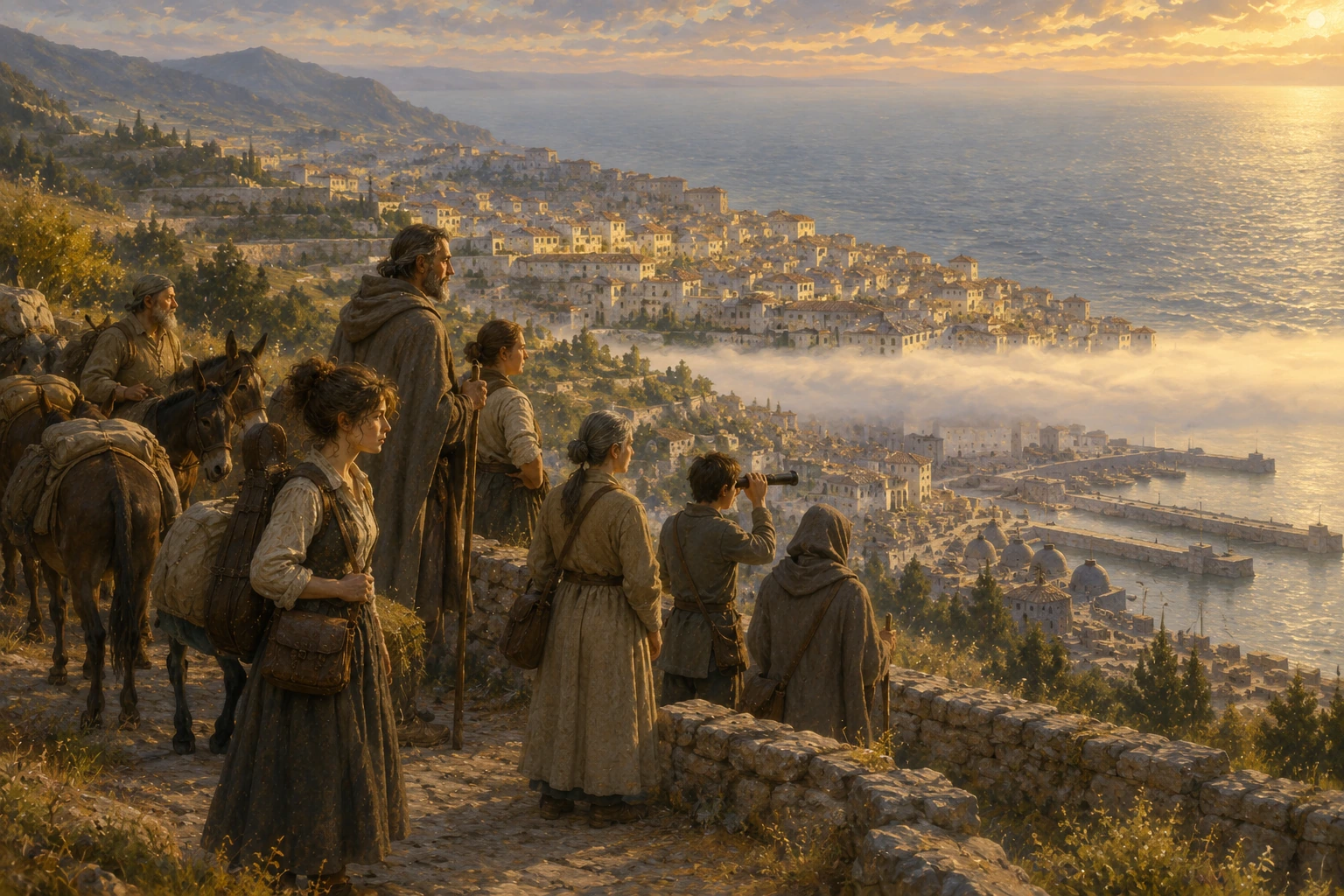
It was Pip, from the shoulder of a switchback, who saw the city first, travel-glass at his eye out of pure habit. He did not call out; he simply stopped with the glass still raised, and the stopping was loud enough that the whole string slowed and halted, one mule and one walker at a time, without anyone giving the order.
The road bent round the shoulder of a last hill, and the city came into sight all at once — not gradually, as if it had been waiting the whole time just out of the eye's reach, and had finally tired of waiting.
It ran down the long slope in wide falling terraces, street below street below street, like a hillside orchard run in ranks and built instead of planted — pale stone gone soft grey-gold since long before any of them were born, roofs mostly holding, never a spire anywhere to break the long patient roofline against the hill. At the water's edge stood the harbor: stone quays reaching out like long grey fingers, and behind them a cluster of squat round-topped kilns banked close as a whole street of ovens, cold now, and unmistakable to anyone who had ever watched a forge draw breath.
And over the whole slope, catching the westering sun in ten thousand small separate fires, the windows. Wren had thought, climbing all summer past sleeping towns with their shuttered and broken panes, that she had grown used to glass. She had not. Every house on every terrace wore its own share of the light and turned it back up the hill at her, so that the whole slope seemed, for one long unsteady moment, to be looking back.
Nobody called a halt. The company simply stopped, as it had stopped at the top of the Gray Stair and at the saddle of the Doors of Cloud, and stood there with the mules shifting behind them and nothing at all said.
"Glaissel," Luel said at last, quietly, into the silence the city had made of them all.
She said it as she said every true name: not as an offering to be admired, but as a fact restored. "The glassworks stood along the whole of that shore," she went on, nodding toward the cold kilns. "Sand barged three days up from the south, and the fire kept day and night the working season through, until half the windows of Meddan — the wool-halls, the road-houses, the high panes of Cael Meddan itself — had been born on that one stretch of shingle and sent east in straw and good patience. It was a loud city, and a bright one, and it smelled always of woodsmoke and hot sand."
That was all. The sentence came to its own natural end, and then she stood, and looked, and did not speak again for the better part of an hour — the longest stillness the company had yet kept from her. She came back to herself at the cookfire's edge after dusk and took a bowl from Dorrit as though no time at all had passed.
They made camp that first evening at a way-house on the ridge's shoulder above the city's uppermost terrace, no different in its bones from any way-house the road had shown them all year. Down on the lake, as the light went, a low white haze rose off the water and drifted into the lowest streets near the harbor, as evening mist does off any water anywhere, and nobody remarked on it beyond Dorrit's comfortable prediction, around a mouthful of bread, that it would burn off handsome by midmorning. There was, that evening, no reason to disagree with her.
It had not burned off by midmorning.
Wren noticed it first without deciding to, and it was some while into breakfast before the noticing rose far enough to be named. The lake lay bright and ordinary under a climbing sun, its surface working in the small hard chop a real morning wind puts on real water, and she could feel that wind herself, coming up the terraces to the company's bowls. Down by the harbor the white haze had not moved at all.
"That's not burning off," Bracken said. He had stopped eating, the particular squint on him that he kept for ground he meant to have an opinion about. "Look at the water. There's wind on it plain as a flag. And that stuff down there hasn't so much as leaned in five minutes' watching."
"It might be low ground," Iyene offered, though her own voice had already begun to lean Bracken's way. "Cold air pools. It happens on a river-flat before the sun clears the ridge — Dall itself does it, some mornings."
"Dall's mist lifts by the time you've said so," Wren said, and heard, saying it, how much she did not want to be the one to say the next thing, and said it anyway, because that had become, this last year, simply the shape of what the day-book asked of her. "This isn't lifting."
They watched a while longer, in the working silence the company kept for anything that wanted watching rather than talking about, and it was Dorrit who found the next piece.
"There's no birds down there," she said. The lake plainly had gulls, working the far shore in their ordinary wheeling clatter. "They've the whole width of that water to work, and they're keeping to the far side, same as if there were a fence down the middle nobody but them can see. Not one crossing over the low town the whole time I've watched."
Iyene had her instrument out by then, and gave the fog the rest of the morning — sighting along the low streets, marking, waiting, sighting again. By noon she set the instrument down and looked up with the expression Wren had learned to read as her most careful kind of certainty.
"It holds its edge," she said. "I have had it against the same street-line since first light, and it has not crept forward by so much as a hand's width, nor drawn back, in five hours of watching. Wind moves it not at all. Sun touches it not at all. It is not weather, in any sense I know how to survey."
It was Wren who found the last piece, and she found it not by looking but by listening, on a walk along the ridge's edge with Alder beside her. She had grown, this last year, into the habit of listening to a landscape the way she had once listened to a hive — for the ordinary hum underneath everything — and Glaissel, for all it was empty, had plenty of that hum to offer: wind working the broken tiles, water lapping the old quays far below, the hundred small settlings any long-empty town makes in a breeze.
And then, walking a stretch that brought her briefly closer to the fog's edge than she had yet stood, she heard none of it at all. It was not that the sound grew quiet, the way a sound grows quiet with distance. It simply stopped, at a line she could not have marked by eye but could suddenly, unmistakably hear — the ordinary hum of the whole hillside cut off clean, as if a curtain had been drawn across a doorway between one room full of noise and another full of none.
"Alder," she said, and stopped walking. "Listen. Not to the fog. To the edge of it."
He stood beside her a long moment, head tipped very slightly. "Yes," he said at last, quietly. "I hear it. Or I hear the shape where it stops."
"That's the wrongest thing yet," Wren said. "Fog you can't see moving, that's strange. Fog no wind will touch, that's stranger. But silence with an edge to it — I didn't know silence had edges. I thought it was only the absence of a thing, and an absence doesn't have a shape."
"This one does," Alder said, and something in how he said it told her the moment for careful observation had passed, and the moment for saying the true thing plainly had come.
He called the company together that afternoon and gave them the word the day had been building toward, in the same even voice he had used a year before at a coomb full of rime and mist, half a world away.
"This is the deep Quiet," he said. "Lying exactly where it has lain, by every sign we can read, for three hundred years — in the low ground, along the water, in the streets closest to whatever it is that draws it low. It lies the way deep water lies in a hollow, and it is there the way winter is there on a north face that never sees full sun. It will not climb this hill after us." He let that stand a moment. "That is the whole of what I will say for it. I would rather you heard where the sentence stops than what you might be minded to put after it."
Pip, sitting a little apart with his pencil for once entirely still, asked the question that had plainly been sitting in him the whole while he listened. "What's in there? Down in it. In the streets."
Alder looked down the long fallen terraces to where the white lay banked and patient over the harbor and the lowest lanes. "Streets," he said. "Houses. A great deal of patience. Nothing in that fog that wants finding, Pip, and nothing in it that will come looking for us if we do not go looking for it. What may be standing under all that time is another question, and not one I mean to answer from up here. We are not going to go looking for it."
Nobody argued the point. The not-wanting-to had been building since Bracken's first remark over breakfast, and Alder's naming of it only gave the day's unease a place to set itself down.
"It's not going anywhere," Bracken said, when the small silence had run its course, "and we're not required to either. I don't know that I've ever been gladder of a job that keeps a man's feet on high ground."
They had meant to give the ridge two days; it took three, and the third was not a working day at all. The work went forward, on the first two, with the steady thoroughness the company had brought to every mapping day since Aldern, only larger, because the thing being mapped was larger than anything they had yet stood over.
Iyene worked longest of any of them, building the great falling shape of Glaissel onto her sheet terrace by terrace. And when she came, late in the afternoon, to draw the fog's own margin, she did something she had not done once in Wren's whole year of watching her work: she checked her sighting a third time against three separate landmarks, and set the line down not as a told thing gathered from somebody else's report, but as an observed thing, fixed against streets she could point to and name.
"Lore became measurement today," she said, when Wren came to look over her shoulder — lightly, with real satisfaction under the lightness. "I have drawn deep ground three times on this journey, and every previous time from somebody else's honest telling. This is the first time I have had it from my own two eyes. It is the same ground. It is not the same kind of knowing it."
Pip had the whole of the first day for one drawing, and produced the largest thing of his young career — the city entire, terrace under terrace, the fog set down honestly as a pale wash along the lowest streets, neither hidden nor made more of than it was. Bracken spent the same day on the upper town's own order and came back with a plain verdict: carts housed under their lean-tos, wheels chocked, doors latched rather than forced. "Same story as Aldern, right up to this line" — he gestured at the hazed streets below — "and past it I'll not pretend to read anything at all. A closed door tells you the hand that closed it meant to. Down there I've no door I can honestly claim to have seen close."
Dorrit worked the upper terraces wherever the road's safe height allowed and came back at dusk with a gardener's harvest of report — courtyards gone to green tangle, fruit trees still bearing to nobody every autumn, a plum grown clean through a garden wall and thriving on both sides of the crack it had made doing it. She had the colour in her face she always got off good ground, and talked through the whole of supper, and Wren was glad of it.
Before that first day's work closed, Bracken called the company to the ridge's edge and ran the carrying-names drill through in full, exactly as he had run it before the wolf country and found reason, once, to be glad of the running.
"We don't need it," he said, when every name had come back clean and quick, Pip's included. "That's the whole point of drilling on ground that doesn't ask it of you. You want the answer sitting ready in your mouth long before the day comes that it does. This ground's not asking. Not one flicker, the whole while we've stood over it."
He set his line at the same time, and set it plainly, as he set everything: the market-terrace and no lower, four whole streets of good dry stone between the lowest of them and anything the white had ever lain in, and anyone who wanted an argument about it could have one with him in the morning. It was a sound line, drawn by a sound man, on ground where the danger was visible from a mile off and had not moved since the glassworks went cold.
The second day was Dorrit's, and it very nearly kept her.
She went down after breakfast and worked the terraces street by street as she had the day before, and by mid-forenoon she had got as far as the market-terrace and Bracken's line, and stopped there, because she had said she would.
It was from the market-terrace that she saw the balm.
She told it in pieces, and the pieces never quite made a whole. It grew three streets below her, in the crack where a doorstep met its sill — a green untidy handful, leggy and unpruned and perfectly, unmistakably itself. She had known it since she was four, when her mother showed her how you rub a leaf of it round an empty skep to make a swarm believe it has come home to somewhere it was already living. And balm does not grow wild, east or west; it grows where a hand has put it, by a door, because somebody wanted it near. Which meant that in a city long since asleep there was one doorway a woman had once come out of in the morning to pinch a leaf for the smell of it, and Dorrit Fallowmere could see that doorway from where she stood.
She went down one terrace. She always insisted she had meant only to go down one and look, and she believed it when she said it, and Wren believed her too.
The ground looked the same on both sides of a line she could not see, and that was the whole of it: the same grey stone, the same grass in the joints, the sun as warm on the third terrace as on the first and warmer, out of the wind. There was no cold to walk into and no wall to walk through. The only thing that changed was the sound, and the sound did not thin as sound thins with distance — it stopped; and by the time she noticed it had stopped, she had been walking in it a while, and had stopped noticing she was walking.
Up on the ridge, Wren put down her pen.
She had been sitting at the way-house step with the day-book open on her knee, listening to the hillside without attending to it — the tiles, the water on the quays a long way below, the hundred small settlings of a town in a breeze — and there was a hole in it: not the flat unmoving hole that had lain over the low streets since they came, but another one, small, inside the first, and moving downhill.
She was on her feet before she had decided to be. "Where's Dorrit," she said, and heard her own voice come out wrong, and did not care.
Bracken was up in the same second and counting heads before he had finished turning round. Iyene said, "Third terrace, an hour back, she called up"; Pip had the glass at his eye and was sweeping; and Wren said, "She's lower than that," and did not explain how she knew, and in the four minutes that followed it did not occur to anybody to ask her.
They went down the terrace stair at a pace Bracken would afterward call the worst-managed piece of ground he had ever taken a company over. At the market-terrace he stopped them all with one arm out, and the fog lay below exactly as it had lain for longer than any living tongue could number, with no shape in it and no sound out of it and nothing whatever to see.
"That way," Wren said. "Down and left. She's stopped."
Alder took the rope off Bracken's shoulder himself and put it round his own chest under the arms, and Bracken knotted it, fast and disgusted, and he and Pip braced. Nobody spent a word on what a rope was worth against a thing with no edge you could see, and Wren went down with him without either of them stopping to work out who had asked whom.
The cold came up through her boots at the fourth pace, out of the ground, as damp comes up a wall, and by the tenth her breath stood in front of her face and hung there. The street went on being a street — a doorway, a shutter, a broken pot with something dead in it — and the hush over it was not a hush but a flat nothing, a room with the far wall taken out.
Dorrit stood in the middle of the lane with her staff still in her hand and her head a little on one side, as though someone a long way off had said her name and she was working out whether she had heard it.
Alder's hand closed on Wren's hard enough to hurt.
And Wren did the ordinary thing — what anybody does when somebody they love is standing in fog forty feet off and not answering. She filled her chest and called out.
"Dorrit Fallowmere. Dorrit. Your mother was Prue and she kept the low garden at the Bridge. You put a two-winter beet into a seedsman's hand at Marlford and made him take it back. You fought Bracken Hale for a second jar of willowbark on a stable floor in Merrow, and you won. You're my cousin, and you came because you said I wasn't going anywhere on my own."
She got no further than that.
None of them could afterward give the same account of what came next, and Iyene, who wrote down everything, wrote down only what she was sure of: that Dorrit turned round. That was all — she turned round, in a lane where nothing had stirred since the fog first settled over it, and looked back up the street with her face doing something none of them had a name for, and took one step, and then another; and then Bracken was past Alder on the rope and had her over his shoulder and out at a pace that took no account whatever of the footing.
They came off the low street into the sun and the noise of the world arrived all at once — gulls, water, wind in a broken roof — so loud after the other thing that Pip sat down where he stood. Wren got four paces up the terrace stair and her legs went out from under her.
The cost of it was counted through the rest of that day and the whole of the next, and most of it was counted quietly.
Dorrit was cold to the bone and blue at the fingertips, and Bracken had her in every blanket the string carried before she had got her breath back; she came right by evening, in the ordinary way of it, and was on her feet by morning and sharp with anybody who fussed, which everyone took, correctly, for the best sign available.
Wren did not come right. She was grey to the lips and could not hold a cup; she slept eleven hours and woke worse, and lay the whole of the next day in the way-house with her arm across her eyes while the company packed round her and pretended not to watch. She was not injured anywhere Dorrit could find; she was spent, as a field is spent. Dorrit had two remedies for exhaustion and a third for shock, and knew before she opened the chest that none of the three had anything to do with this, and sat with her instead.
It was on the second morning, packing that same chest, that Dorrit reached for a word and found a smooth place where it had been. She had gone back up at first light with Bracken beside her and never out of arm's reach, and taken a cutting from a courtyard well above the line, because she was not going to leave a city without one; and she had the sprig between her fingers, and could smell it, and could not say what it was called.
She stood a long moment. Then: "Wren. What's this."
"Balm."
"Balm," Dorrit said, in the voice of a woman trying a stair in the dark, and put it in the press, and left it alone for two days.
She worked round it, and that was what Wren could not stop watching. Dorrit did not complain of the gap, or worry at it, or make a story of it; she went round it as a good walker goes round a bad patch of road — the one for a swarm, the doorway one, the green stuff with the square stem — and got on with her work, and was cheerful about it, and it was the most frightening thing Wren had seen all summer.
Bracken ran the carrying-names drill again that evening, unasked, and every name came back clean and quick and in order: Dorrit's own, her mother's, her office, no hitch anywhere in the line. He stood afterward with his hands on his hips, looking at the ground. "Well," he said. "That's told us nothing at all, hasn't it."
Iyene wrote down the hour Dorrit went below the line, and the hour she came out, and how long she had been in it by Bracken's reckoning and by her own; and further over, on a separate line, that the plant-name was gone by the second morning. She left the two facts lying where they fell. She had kept a book twenty-six years, and the whole of her method was that you write what happened and let it wait.
Bracken did not say I told you. Dorrit knew he had not, and knew he had wanted to, and thanked him for it by never letting on that she had noticed.
And once, that same evening, Wren caught him looking at her across the fire. It was not a long look. He had been close enough in the lane to hear what she said and see what happened after, and he looked at her now for about as long as it takes a man to decide against asking a question, and then went back to the picket-line.
She lay awake a good while. She had called a name into a fog; people did that, it was the plainest thing in the world to do — and she could not account for why she had been unable to lift a cup for a day and a half afterward, or how she had known where Dorrit was before Pip's glass could find her, or why, reaching now for the feeling of the thing, she found she would rather not. She put none of it in the day-book, and told herself that was because she could not have set it down honestly, which was true and left a great deal out.
Wren opened the Waybook once in all that while, at the way-house — the same building, she found, that Wystan's hand had drawn three centuries before. Beside the comb-mark stood a single figure: not a supper-count this time, but one word, alone, in the spikier old-tongue script no living reader could carry past its shape. She sat with it a while, two fingers held carefully beside the ink rather than on it, and got nothing back at all. Whatever he had wanted said about this place he had said in a language that went down with the city, and he had walked on the next morning regardless.
They climbed to the Fourth's crown in the last low light of their third day, by the short steep path Bracken had scouted that morning — a further shoulder of the same ridge, higher and further back than the camp, with the whole width of the lake and the whole falling slope of Glaissel laid out below.
Wren went up it slowly, and Bracken walked behind her the whole way without ever saying that was what he was doing. The crown had weathered kindly: the cradle stood only a little canted, its footing sound enough that Bracken pronounced it fit to trust without the half-day's labor the Fifth had wanted, and the basket's iron had held better here than at any hill since the Seventh.
Alder said the words. There was no household here to take the taper; he lit it himself, and the flame took the dry kindling and then the seasoned wood beneath it and climbed into a dusk already going violet over the great width of water below.
Iyene logged the fire standing, her book braced on her forearm. Then she turned back two pages and looked a while at the hours she had written there the day before, and turned forward again, and closed the book without adding anything to them.
The light reached the water first — a long unsteady gold path across the lake, trembling with the same small chop the wind had put there all day. And then, as full dark settled and the fire climbed to its proper strength, it reached further than any of them had thought to look for: down the falling terraces, along the harbor's stone quays, and out over the low pale banks lying still and patient across the lowest streets.
"Look what it's doing," Dorrit said, very quietly.
The fog did not stir. It did not brighten from within, or draw back from the light, or do anything at all a watching company might have half-hoped, half-feared to see it do. It lay there wearing the Fourth's new fire as it had worn nothing at all in three hundred years, and the light lay on it long and gold and gentle, the way lamplight rests on the blanket of somebody sleeping in a room you have come into softly.
Three days ago that would have been the whole of what Wren had to say about it, and she would have written it in the day-book and been glad of the sentence. She sat now with her back to the flame and both hands round a cup she could hold again, and looked down at the gentle gold thing the light was doing over ground that had reached up the previous morning and taken a word out of her cousin's head, and found the sentence would no longer go where it had used to go.
"It's not asleep," she said. "That's the whole of it. It's only that we can't see it doing anything."
She did not get an argument, and she did not get an agreement out loud either. Bracken got up after a while and went and checked the picket-line for the second time that hour.
Behind them the Fifth and the Sixth burned small and steady across the folded dark miles, the wake of stars grown to four full stitches. Nothing answered from anywhere over the water. Nothing had been expected to.
"Early start," Iyene said at last, closing her book against the cold. "Two days to the Third, if the ridge keeps its temper."
They went down off the crown by starlight, leaving the new fire to lay its light where it fell. Bracken took the first watch without being asked for it, and then, quietly, the second as well.