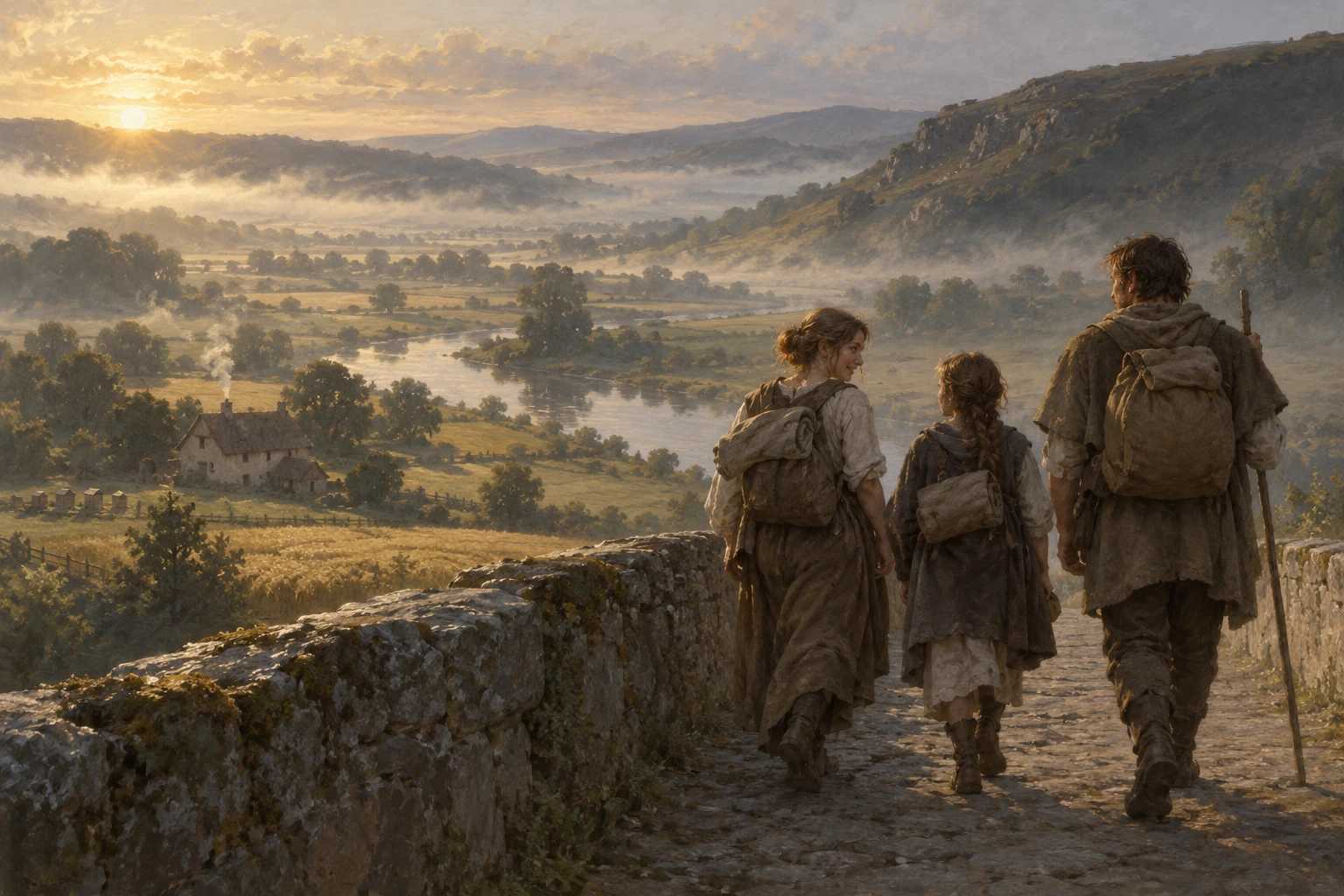
The Bridge at Morning
The house woke before the light did, which was its own kind of statement, in a family that had never in living memory risen before its bees.
Wren heard Granna Tansy on the stairs first — that particular tread that had never in twenty-three years missed a step in the dark. Then came the small domestic sounds that meant the kitchen fire was being coaxed up out of its night's ash: the scrape of the poker, the door of the range settling on its hinge, the kettle set down with the flat clunk it always made on the third ring of the hob and nowhere else. Wren lay a moment longer under the thatch, in the grey not-quite-light that came before dawn in that country, and let herself feel the day for exactly as long as it took the kettle to begin its first low mutter. Then she got up, and was slower on the stairs than she had any business being, and kept a hand on the wall going down.
Dorrit was already dressed when Wren came down, and had been, by the look of her, for some while: her hair bound back tight and businesslike, a stub of pencil behind one ear. "I've put the mittens with the whetstone," she said, without turning from the fire, "because Cob's mittens are wool and Hask's stone is oiled, and I will not have you finding that out for yourself somewhere wet. And I've counted the bread twice, because Widow Callow's idea of enough for two days on a road is generally enough for a week, so we're taking all of it."
"Good morning to you too," Wren said.
"It is morning," Dorrit agreed, "and I've no opinion yet on whether it's good. Ask me again once we're over the bridge."
Bread was counted, and mittens were sorted, and the kettle was watched. And if any of the three of them — for Granna Tansy came and went through the kitchen with the same unbroken competence she brought to a hive gone difficult — felt the day pressing up under the ordinary tasks like water under ice, none of them said so.
They ate standing, for the most part, at the corner of the table that had held every meal of Wren's life: bread, and butter, and the last of a jar of dark honey set aside a fortnight since, which had gone untouched until this morning, because Granna Tansy had said, when Dorrit reached for it early, that there was such a thing as saving a good jar for when it would be tasted properly. The bread went round and came back nearly whole, and the tea went cold in its cups, because there was always one more thing to see to before it could be drunk. Hers she drank anyway, cold, rather than tip it out — her mother's habit before it was hers, and an argument in that kitchen a good deal longer than Wren had been the one having it. Wren stood nearer the range than she needed to, and did not get warm at it, and Dorrit looked at her twice that morning and said nothing either time. By the time the grey outside the window had gone the particular thin silver that meant the sun was somewhere just under the eastern hills, the bags stood ranked by the door, three of them, waiting. There was, for perhaps the first time all morning, nothing left that wanted doing.
It was into that small unfamiliar stillness that Wren said, to no one in particular, that she would see to the bees before they left. She went out through the garden and round to the yard alone — that, at least, was a thing she had never in her life done any other way.
The bee-yard in that grey hour was hers entirely. The light had not yet found color, and the two rows of white-painted hives stood pale and ghostly on their stone footings, the three old skeps at the end of the row only shapes, humped and patient, like sleeping animals that had not yet decided whether the day was worth waking for. The only sound in the whole wide silence of the valley was the low, contained murmur that came up from under every lid, steady as a held breath — the sound she had fallen asleep to every night of her life, and would not, a small precise ache told her, hear again in quite that particular dark for a very long while.
She went down the row as she had been taught, a hand laid flat and light on each roof in turn, feeling for the small telling warmth of a hive settled and well. She murmured nothing in particular to any of them. The trick of it, as Granna Tansy always said, was to be the sort of person a bee could rely on, and a bee relied on steadiness, not speeches. The skeps she touched last, out of the same respect that kept them standing though they gave no honey worth the name. Then she came, at the end of the second row, to the seventh hive, and stood a moment before she touched it at all.
It was a hive like any of the others to look at — a little more weathered at the corners, the paint gone thin where forty summers of sun had had their way with it. But it was the one her father had started from a swarm he had walked two miles home in a skep held against his chest, the year before she was born. It was the one he had taught her to read, laying her small hand flat against the warm wood under his own, the way another man might teach a child to read a face: the low even hum of a hive content, the higher note of one uneasy, the particular held quiet that meant a queen newly settled and the whole colony holding still around her like a room holding its breath for good news. Wren laid her palm against the wood now, as she had laid it a thousand mornings, and felt under it exactly what she always felt: the hive awake, and well, and entirely indifferent to the fact that she was leaving it. Of everything the morning had asked of her so far, this was the nearest she came to being unable to do the next ordinary thing.
She did the next ordinary thing anyway. She took her hand from the seventh hive and went to the gate at the bottom of the yard — the one that had wanted oiling since spring, and that she had somehow, in the long business of a harvest and a summer and a book brought out of a shelf it had rested on for eleven generations, never got round to. She worked the little flask of oil she had brought for exactly this purpose into the hinge, until the gate swung, when she tried it, without a sound at all. It was not a large thing, but it would mean nothing to anyone who did not already know the gate, and everything to Granna Tansy, who would swing it inside the week and find it silent and know precisely whose hand had seen to it last. It left her, walking back toward the house with the empty flask in her pocket, dry-eyed and steady for the harder goodbye still waiting at the gate in front.
Granna Tansy was waiting there when Wren came round the house, small and dry and upright in the grey morning exactly as she stood every morning of the year, her stick set beside her the way Alder's was always set upright by a door. Dorrit was already a little way down the road with the bags, giving the two of them this last stretch of ground alone.
"You've oiled the gate," Granna Tansy said. It was not a question.
"It wanted it."
"It's wanted it since spring, and I've said nothing, because a thing left undone on purpose is sometimes the last thing a person has to give themselves before they can give the rest away." Granna Tansy looked at her a moment with the same steady, assessing look she gave a jar of honey held up to the light, reading it for exactly what it was, no more and no less. Then she said, in the dry, practical voice she used for matters she considered closed: "Mind the clasp doesn't sit in the damp. Oil it when you can, and if you can't, wrap it in wool before you wrap it in anything waxed, because wax sweats in a bag that's been rained on and wool doesn't. And don't let anyone tell you a book wants airing. It wants keeping dry and it wants keeping close, same as it's always wanted, wherever it happens to be kept."
"I know," Wren said, and did.
"I know you do. I'm saying it anyway." Granna Tansy's mouth moved, the smallest edge of a smile. "That's a grandmother's whole trade, saying the thing the other person already knows, so that it's been said by somebody besides themselves."
There was a silence then that neither of them moved to fill. And into it Granna Tansy reached out — not quickly, not with any ceremony — and laid her hand flat on the satchel at Wren's hip, over the shape of the book inside it, as a person lays a hand on a thing she has felt under her palm before and hoped never to feel again. She held it there a moment. Then, with the same slow, exact gesture, she moved her hand from the satchel to Wren's own, and held that instead, just as briefly, just as plainly, before letting it go.
"Go on, then," said Granna Tansy. "Dorrit's getting ahead of you, and that girl has never in her life walked slowly toward anything she wanted to be at."
"I'll write when there's a place to send it from."
"You'll write when there's a place, and not before, because a letter sent from nowhere is no comfort to anybody." Granna Tansy's hand found the head of her stick, settled there, and that, plainly, was that. "The bees will keep," she said, which was not quite what either of them meant by it. "Go on."
Wren went. She did not look back at the gate itself; but she carried the shape of her grandmother standing there — small, and dry, and upright, one hand on her stick and the grey light just beginning to find the color in her shawl — the whole length of the west road, and further than that.
The village, when they came down into it, was not asleep exactly, but it was quieter than Wren had ever seen it at this hour. The valley had given its great goodbye the night before at the Bridge, over ham and the Blessing, and had agreed among itself that a morning like this one belonged to a smaller company. It had stayed, on the whole, in its beds.
Not entirely. Hobb was up and out on the inn's front step with a covered basket balanced on one hip, steam still finding its way up through the cloth. Master Alder stood beside him with his ash stick in hand and his satchel already settled across his shoulder.
"Griddle-cakes," Hobb said, holding the basket out, "and mind — these are for the first mile, not the first hour, because I know your kind, walking and talking and forgetting to eat until the food's gone cold and sad in your hands." He was uncharacteristically unwilling to let go of the basket handle once Wren's hand had closed on the other side of it. "Good roads," he said at last, releasing it, gruffly. "And good custom, wherever it is you're bound, though I don't doubt they'll water down my honey trying to match it."
Widow Callow was there too, with a wrapped loaf held against her as another woman might have held a child. "There's a full one, and don't you dare divide it before noon, bread wants its first hours whole or it dries," she said, pressing it into Dorrit's free hand. Then she stood with her arms empty. "Your mother took a loaf off me the week before—" she said, and stopped, and told Dorrit again about the noon.
So Wren had the week before, and a loaf. It went in with the rest of what she had of her mother: four things, all of them habits, all of them out of other people's mouths.
The cobbler was there too, hands in his apron pockets, watching Wren's boots rather than her face. "Double-stitched holds," he said at last, with the satisfaction of a man confirming a fact he had never seriously doubted — which from the cobbler was practically an oration.
Whistle came trotting at Cob Hedley's heel, delighted by the novelty of an early walk. Cob had no business being out of his bed and had come anyway, his left hand wrapped and carried against his chest. He followed them out past the last garden wall to the low stone marker at the edge of Dall's own ground.
"Home," Cob told the dog, and that was all he said. Whistle sat and watched them go without him. Cob lifted his good hand, neither quite a wave nor quite not one, and turned back toward the sheep-walks without lingering over it.
The bridge, when they came to it, was the same bridge it had always been: the middle arch lower than the other two, the old flood-scar still faintly visible in the stone if a person knew to look for it, the river running low and brown and talking to itself exactly as it talked every morning of the year to nobody in particular. Wren had crossed it a thousand times in her life without once considering that a bridge might be two different things, depending on which direction a person meant to keep walking once she was over it.
She considered it now. West of the bridge lay the road she had always known simply as the road, because there had never been any other one worth naming. Up past the mill, up past Fallowmere, it ran out at last into sheep-track and heather, where the valley gave up on ambition and let the mountains have the last word. South of the bridge lay a road she had walked perhaps three times in her whole life, never past its first hour. It was this road, and no other, that Master Alder turned onto now, his stick finding the way ahead of him, his stride already settling into the long, even pace Wren would come, over the following weeks, to know as well as her own heartbeat — and to trust, on bad days, rather more.
They stopped at the crest of the first hill without a word exchanged about it, three people grown used enough to each other's habits to arrive at the same decision from three separate directions and call it accident.
Below them the valley of Dall lay out entire in the low gold light, gathered and complete, Fallowmere's grey thatch showing small and certain against the dark line of its orchard, and a thread of smoke standing straight up from the Bridge Inn's chimney, for there was no wind that morning either. And between the two, if a person knew precisely where to look, the two long white rows of the bee-yard showed as a scatter of small pale marks against the green, orderly as a hand of cards laid face-up — one of them a hive with a hand's warmth still remembered in its wood. Behind it all, and above it, the Cloudwall stood its long grey watch against the morning sky, patient as it had always been patient — the wall at the world's end that nobody in that valley had ever thought much about, because it had always simply been there, the fixed edge of everything. Except that now it was no longer the edge of anything at all. It was only the first of several walls she meant to walk through.
She looked at it the way a person looks, on a last morning, at a room she is leaving — not hurriedly, and not with any wish to memorize it detail by detail. She simply looked, once, all the way through.
There was one other room she had lived in, and it had not gone in. She went at it now, because she was leaving.
Cold. That first, and always that. A brightness that had come from the wrong side of something. A hand at her shoulder, putting her behind it. She turned them over and found what she always found: nothing underneath them to turn. No floor, no faces, no order for any of it to have happened in. It was not a room she had lost. It was three cold things and no room.
Nobody expects a woman of twenty-three to remember five. Everybody expects her to have been told.
Then, because a person cannot stand forever on a hilltop with her back to where she is going, she turned, and found Alder already facing south. It was not out of any lack of feeling for the view behind them — she had watched him take his own long look at it a moment before.
"That's Dall done properly seen off," said Dorrit, hitching her bag higher and setting off down the far side of the hill without any further ceremony at all, "and I've counted eleven kinds of hedgerow already just standing here, so I'll thank the road to keep up its side of the interest," and that, in its own entirely characteristic way, was as fitting a close to the morning as any blessing could have managed.
Alder walked at a pace Wren had never before had cause to think about — a pace that asked nothing sudden of anyone, and yet somehow, by the end of an hour, had carried them a distance she would not have credited a slow walk with covering. It was a walker's pace, kept like a promise, neither hurried by impatience nor slowed by tiredness: the pace of a man who had learned long ago that a road two years long is not won by running at its first mile. He talked, when he talked at all, about small things: the drainage of a field cut with a skill he clearly admired and said so; the age of a hedge by the thickness and mix of what grew in it; once, briefly, the name a certain kind of milestone had carried in the old tongue, given and then let go without any insistence that it be remembered. The rest of the time he was content to walk in a silence that left his companions, in consequence, unusually willing to fill it themselves.
Dorrit filled a good deal of it. She named every hedgerow plant they passed as automatically as another person might have counted her own footsteps: dog-rose, old man's beard going grey and fluffy in the ditch, sloe already blue-bloomed and a full month early by her reckoning. And she passed judgment on every farm they walked by, with the frank, professional interest of a woman for whom a well-kept field was a kind of moral position. "That's a farmer who loves his soil and can't spare it the time it wants," she would say, of one gate left hanging; or, of a garden with its rows straight as fiddle-strings, "Now that's someone who talks to her cabbages, and good for her, because it works." Wren walked between the two of them, the satchel's familiar weight settled against her hip, Widow Callow's bread going, as promised, undivided until noon. When Dorrit finally divided it, Wren ate the heel of hers first and the soft after, which was her mother's order of eating bread and had got into Dorrit as well, years back. And she found that the ordinary business of a road — new boots, however double-stitched, the sun climbing and falling, the particular hunger of walking further in a morning than she was used to walking in a week — left remarkably little room for the grief she had half-expected to be traveling with instead.
It caught her only once, sharply, when a bee — ordinary, brown, entirely unremarkable — crossed the road a hand's breadth from her face and was gone into a hedge before she had properly registered it. For the length of perhaps three steps she found herself unable to say anything at all, until Dorrit, who missed remarkably little, put a hand briefly on her shoulder and said only, "They'll keep, cousin. Granna said so and Granna's never wrong about a hive," and let it go at that, which was exactly enough, and no more.
A mile on, Dorrit said to the hedge rather than to Wren, "Callow nearly finished her sentence this morning."
"I know."
"Cold, and shouting up the road, and my mother had me out of our own door and down to Pell's before I'd got my boots on the right feet." Dorrit hitched her bag. "That's mine. That's the whole of mine, and you've had it since you were nine."
"Cold," said Wren. "That's mine as well."
They had been setting the halves side by side since they were girls, Dorrit's outside against Wren's inside, and it always came out the same: a cold night, a noise on the road, two funerals, Granna with a stick. Four things with the shape of a night in them. No night.
The evening found them at a low stone farmhouse a little back from the road, at a place called simply Elmcross, for the three old elms that stood over its gate. It was not an inn by trade, only a farm that had taken in walkers on the south road for so many generations that it had become one by habit. The woman who kept it — Bett, broad and weathered and entirely unsurprised by strangers, her husband Torvin somewhere out with the last of the evening's stock — set them at her own long kitchen table without ceremony. She fed them mutton and turnips that Dorrit pronounced, after due consideration, honestly earned. And when the plates were cleared and the fire built up against the evening's first real chill, she asked whether the fiddle strapped across the young one's back was for looking at or for playing.
Wren played, briefly and without much art required of her, three old tunes that turned out, to her mild surprise, to be nearly the same three known two days' walk to the north, with only the smallest changes to the words. Bett received the fact with the placid satisfaction of a woman confirming something she'd always suspected: that a good tune traveled better than most people did.
She meant to play a fourth. She had the bow up and her fingers set before she understood what she had set them for, and she put the fiddle down instead and said her arm was tired, which was not true and which nobody had any reason to doubt. Two days now she had gone at it the way a person goes at a knot in the dark, and it had not loosened by so much as a note, and she had begun to be afraid of the moment she stopped trying. Across the table Master Alder did not look up from the fire. He had heard her not play it, and he left her alone with it.
When the fiddle was put away and the last of the strangers at the long table had drifted off to their own rest, Alder drew his chair a little nearer the fire. He looked into it a while, in the particular quiet way Wren had already learned meant a lesson was coming — though never one delivered as a lesson.
"You'll have noticed," he said at last, "that a road is not simply a road."
"I've noticed my feet noticing it," Wren said, which got the small dry smile she had come, over these last weeks, to watch for.
"That too will pass, in time — or rather, it will stop announcing itself, which is a different matter." He nodded toward the door, beyond which the south road ran on invisible into the dark. "But I meant something else. Look at a road properly — not walk it, look at it — and it will tell you, plainer than any book, what the people who made it cared about. A road built for speed runs straight and thin, and doesn't trouble itself with who's walking it. A road built for care runs a little wide of the true line to spare a good field; it's crowned in the middle so the rain runs off into ditches somebody dug on purpose and maintains still, generations on; it's planted at the verge with trees that give shade in summer and fruit in autumn to a stranger who never paid for either." He was quiet a moment, the fire moving orange across the ink-stain on his first two fingers. "A road is the longest-lasting thing most peoples ever build — longer than their houses, very often longer than their language — and it cannot help recording what its builders cared about, because care, or the want of it, is laid down in the ground itself and stays laid down long after the builders are dust."
Wren sat with that a while, the fire warm on her face and her boots — double-stitched, and holding — stretched out toward it. She found herself thinking, not of the road outside at all, but of the satchel at her side, and the book inside it that had traveled, this first day, exactly as far as she had, no farther and no less.
"That's what it is, then," she said slowly, working the thought out as she spoke it, the way she might have worked a stiff comb loose from its frame. "The book. I've been thinking of it, all these weeks, as a sort of map — the roads Wystan walked, set down so somebody could walk them after him." She shook her head, a small private motion. "But a map only tells you where a road goes. This tells you — it tells you what he cared about, walking it. What he thought worth writing down, and what he didn't trouble to. Where he was careful, and where he was tired, and where the writing goes small because the light was going and he wanted to get it down before dark." She looked up, and found Alder watching her with an expression she had seen from him only once or twice before, at moments she had not, at the time, known to name. "It isn't a map at all, is it. It's a memory. His memory, carried forward far enough that somebody who never met him might come to know him by it."
"Yes," Alder said, simply, and did not elaborate.
They sat a while longer without much further talk, the fire settling toward its coals and Dorrit's breathing gone slow and even in the room beyond. At last Alder rose, banked the fire himself with the easy competence of a man who had banked a great many fires in a great many strangers' hearths, and bid her a good night — in the quiet voice that had, over these first weeks, already become one of the ordinary sounds of her days.
Wren sat a little longer alone, watching the banked coals hold their small steady red against the dark. She thought that a strange roof was a stranger thing to fall asleep under than she had expected, and a smaller one than she had feared — that this, tonight, and very likely tomorrow, and for a great many nights after that, was simply how it was going to be, until it wasn't strange any longer at all. She drew the satchel a little closer where it lay beside her, felt through the oiled leather the familiar shape of the brass clasp gone green at the hinge — and did not open it. She only rested her hand there a moment, the way her grandmother had rested a hand on it that same morning, in a road that already felt, from this distance, both a whole world away and no further than the length of one long day's walking.
Outside, south of Elmcross and its three old elms, the road went on into the dark, patient as it had been patient for longer than any family had kept any book, waiting on nothing in particular except the plain and certain fact of morning. And somewhere behind her, a day's walk north, the bees of Fallowmere murmured on in the dark, exactly as they always had, with or without a hand laid flat upon the wood to ask them how they did.