The College of Roads
Four days south of Marlford, the country began to change its mind about what it wanted to be. The corn gave out into water-meadow, and the water-meadow into orchard and market-garden laid out with a neatness that made Dorrit slow her step at every hedge to look, and the road grew broader and busier, until by the fifth morning it was less a road than a slow river of its own, cart following cart.
"You've gone quiet," Dorrit said, on the last morning, when the road topped a rise and something pale and vast lay along the valley floor ahead of them, smoking gently into a sky gone the soft grey-gold of early autumn.
"I'm not counting," Wren said, and found, saying it, that this was the part worth remarking on. At Marlford she had stared the whole descent and wanted to know how many Dalls the place came to, because a number was somewhere to put a thing too big to hold. She had no wish to number what lay below her now. She was looking instead at how it had been put there.
"That," said Alder, coming up between them with his stick striking the road in its old steady rhythm, "is Merrow."
He said it as a man says the name of somewhere he has missed without knowing he was missing it — not with excitement, which was not a thing Wren had ever seen him show about anything, but with a kind of settling, as though a weight he had carried a long way had shifted onto a shoulder better suited to it.
Merrow was grey stone where Marlford had been slate and timber, and its streets ran straight where Marlford's had wandered, as though someone long ago had drawn the town first and built it afterward — which Alder confirmed was very nearly true. That was the whole of the difference, and Wren had it inside a quarter-mile. Marlford had happened. Merrow had been decided.
"It smells different from Marlford," Dorrit observed, breathing in a great lungful of it at the bridge-head — river-mud still, and woodsmoke still, but under it now stone-dust, and hot metal from somewhere, and the flat mineral smell of a very great deal of water moving slowly past a very great deal of masonry.
"It smells like a place that's stopped growing wild and started growing on purpose," Wren said, and Alder, a step ahead, glanced back at her with the small private approval she had learned to watch for, which from him was practically an ovation.
The College of Roads did not announce itself. Wren had half expected something with a gate and a name cut over it in letters a hand high; what she got was a street Alder turned down without breaking stride, narrower than the ones around it and quieter, running between building-fronts that did not match each other in stone or age or roofline — less a single construction than a hedge grown up crooked over generations, each new planting shouldering in wherever the last had left a gap.
"It was a manor house once," Alder said, before she could ask. "Then a manor house with a granary bought and joined to it, and then the granary with a scriptorium built on behind, when the old King wanted his roads written down properly and the College was founded to do the writing. Every generation added what it needed and rarely troubled to match the stone. Visiting scholars complain that no two doorways in the place stand at the same height. I have never heard one of them mean it as praise, and I have never understood why not." He said it with the fondness he kept for a well-laid ditch, and Wren thought of Fallowmere — eleven generations under one thatch, a house that had stopped being a building and become a feature of the land — and knew, before she had set foot through the door, why he had never in three hundred miles sounded homesick for anywhere in particular. He had been walking toward this the whole time.
The door, when they reached it, was nothing grander than Fallowmere's own — old oak, silvered with weather, standing open on a stone-flagged passage. But the smell that came out to meet them stopped Wren a half-step over the threshold, from sheer surprised pleasure: ink first, sharp and mineral, fresh-mixed somewhere close by; old leather warmed all day into something almost like bread; the fine pale dust of paper worn soft by handling. And under everything, banked and patient, good lamp-oil, the kind that burns a long time without smoking, which told her before anyone said a word that people worked here after dark and had done for a very long time.
"Smells like your Waybook," Dorrit said, low, at her elbow. "The whole building does."
"It smells like what the Waybook is made of," Wren said, and found, saying it, that this was exactly true, and felt the strange settled feeling of having arrived somewhere her own family's furniture had been quietly pointing at as long as she could remember.
Clerks passed them in the corridor — a boy with an armload of rolled charts nearly as tall as himself, two women deep in an argument about a bridge's true width, an old man dozing in a chair by a window who opened one eye and said, "Alderin," with such open warm pleasure that it was clear he had been resting between one long task and the next, not sleeping. Every one of them knew Alder's face before he spoke, and greeted him as the valley greeted its own returning children: not with fuss, but with the easy certainty of people who had never doubted he would come back, only wondered when. He returned each greeting by name, down to the youngest clerk's.
Corridors gave onto other corridors, every wall fitted floor to ceiling with map-chests — long shallow drawers, hundreds of them, labeled in a clerk's careful hand. Wren thought of her own family's single squat volume on its single shelf between the clock and the unsmoked pipe, and felt a vertigo of scale: a candle-flame walking, for the first time, into a room built to hold a thousand.
There was, in one gallery they crossed without pausing, a broad desk set apart by a window, entirely bare but for an unlit lamp and a chair pushed neatly in — not untidy, not abandoned, but waiting, the look of a place kept ready for someone specific.
They found Iyene Sath before they were introduced to her, which was probably the most honest way anyone could have met her.
The sound reached them first, down a side passage and through a half-open door: two voices, one low and patient and one sharp and quick, going at each other over something with the particular heat of people who have had the same argument many times before and enjoyed it every time.
"—because a line drawn to suggest a slope is not a line drawn to measure one, and if you hatch that ridge as you've hatched it there, any surveyor reading it in ten years will walk it thinking it gentler than it is, and gentle is the one thing that ridge is not, I have walked it myself, Fenn, and it very nearly walked me—"
"It is a fair copy for the Crown's own hall, Iyene, not a working sheet for a man with a mule, and the hall wants a map that is handsome before it wants one honest about a slope nobody from the hall will ever climb—"
"Then let the hall hang something dishonest and call it art, and put my name nowhere near it," said the sharp voice, entirely without rancor, "because the day a map of mine tells a comfortable lie to a man who never has to test it is the day I take up basket-weaving, where at least a bad basket only disappoints the person who sat in it."
They came round the doorframe in time to see the point conceded, gracelessly but genuinely, a lean grey-haired man throwing up both ink-stained hands. "Fine. Fine. Steepen the ridge and tell the hall their handsome map is a week late because Iyene Sath would rather be right than liked." To which the woman at the drafting table replied, without looking up, "They may have both, if they're patient. I am only ever slow about being liked."
She looked up then, and saw them in the doorway, and Wren had her first clear look at the Cartographer-Royal of the realm.
She was tall — taller than Alder, built along leaner lines, with the spare unwasted economy of a woman who had spent forty years standing at drafting tables and walking hills. Her hair, iron-grey going white at the temples, was cropped short and pushed back with fingers that left a faint grey-black smudge there, put in so many times over so many years that it had become a second and truer hairline. Her draftsman's coat was oatmeal canvas gone dark and stiff with ink at both cuffs, its pockets bristling with pens and a folding rule. On a cord round her neck hung a small brass-cased lens, which she raised without seeming to notice she had done it.
"Alderin," she said, the sharpness in it changing key without changing tempo. "You've taken your own sweet time about the corn country. I had you marked for a fortnight ago and told Hollis to stop asking me about it, since asking was doing neither of us any good."
"Marlford had a fair on," Alder said, "and I have found, over a good many years, that arguing with a fair is a poorer use of a man's time than simply letting it finish."
"That," said Iyene Sath, "is the single most Alderin thing I have heard you say since you left, and you have been gone the better part of a year, so it's had stiff competition." She came round the drafting table at last, wiping ink from two fingers with a rag that lived, evidently, for exactly that purpose, and her eye went past Alder to Wren and Dorrit — exact, taking a full measure before troubling to be friendly about it.
"So," she said. "The keeper."
"Wren Fallowmere," Alder said. "And her cousin, Dorrit, who is coming with us and has already, I understand, been promised a place before I'd properly asked for one on her behalf."
"I asked him myself," Dorrit said, comfortably, before anyone could apologize for her, "on the grounds that somebody on this Survey of yours ought to know a blight from a bad summer, and nobody had mentioned you had anyone for the job."
Iyene Sath looked at Dorrit a moment — the frank clipped look of a woman deciding something — and then, unexpectedly, laughed: a short bark that seemed to surprise her nearly as much as it surprised Wren. "No," she said. "We hadn't. Bracken's been saying as much for a month and nobody with sense enough to fix it. You'll do. Come and tell me what you know about high-country forage before the week's out; I want it written down properly for once instead of guessed at by men who've never grown anything greener than a beard." And that was Dorrit made welcome: without ceremony, and completely.
Then the grey eyes came back to Wren, and the warmth in them did not vanish, exactly, but drew in a little: the caution of a hand told a thing is valuable and not yet shown proof of it.
"And you're the one with the book," she said. It was not quite a question.
"I am," Wren said, "though I'll warn you now, it doesn't come with a trumpet."
"Good," said Iyene Sath, the corner of her mouth moving before she got it back under control, and turned back to her drafting table to say one more sharp word about the ridge. It left Wren with the distinct, not unpleasant sense of having been weighed on a scale a good deal more exacting than the one that hung the ribbon-stalls at Marlford, and of not yet having been told the number.
The charter itself, Iyene said, waving a hand at it as settled business, wanted the Crown's own hand on it and would keep a few days — ceremonial and brief, mattering enormously to the Survey's standing and not at all to its actual work, the way a wedding matters enormously to a marriage and nothing whatever to the crops planted after it. There was a quartermaster still to attach, and an apprentice's seat still open, which she mentioned in the same breath as everything else; and something in the set of her mouth put Wren in mind of the bare desk and the unlit lamp in the gallery they had crossed, and of the two being the same waiting.
"That's a fortnight's business at the outside, and Bracken will have you both half dead from provisioning before it's done, so enjoy the College's beds while they're still soft under you. But none of that," she added, slowing, careful now, "is why I've had half the senior fellows underfoot all morning asking whether you'd truly arrived. Hollis is beside himself. He has been beside himself, on and off, for three hundred years, if you count it by the institution rather than the man, which in this building is very often the more honest way to count."
"He'd like to see the book," Alder said. It was not a question either.
"He would like," said Iyene Sath, "to have wept over it in private for an hour first, and has instead had the great discipline to wait for you and do it properly, in front of witnesses, which I have told him is the only sensible way to manage grief of that kind. Come. Bring it. And bring your cousin, because I want to see whether she's as unimpressed by all this as she looks."
"Bit of both," said Dorrit cheerfully, and Iyene laughed her short surprised bark again and led them out.
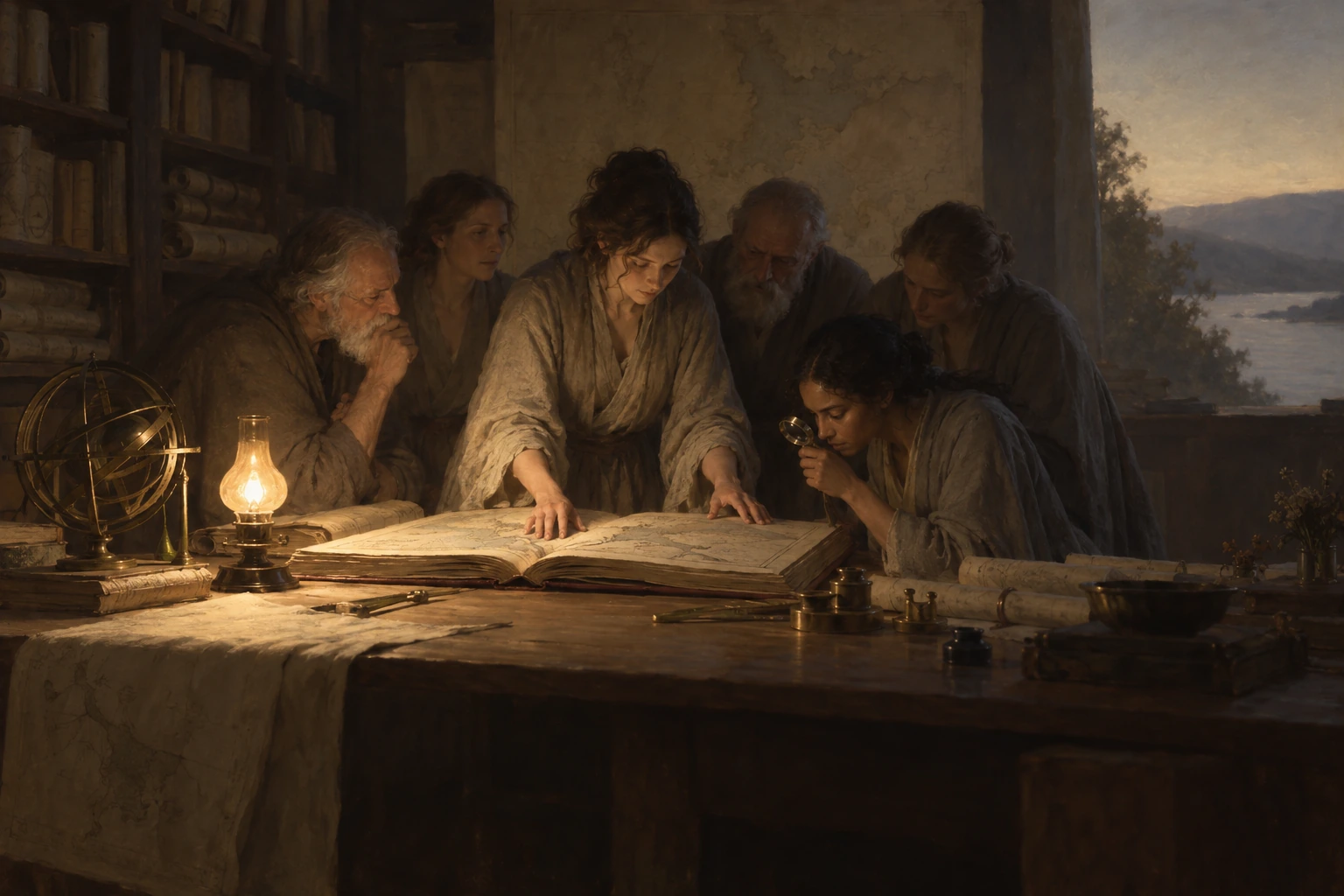
The map-room was not large — smaller, if anything, than Fallowmere's own front room — a room built to hold one thing at a time and give that one thing all its light. A single long table stood bare but for a spread of clean felt, and tall windows let in the grey-gold morning unobstructed. Around the table stood eight or nine scholars, old for the most part, in the same ink-marked coats as Iyene's own, and they fell silent all together, the complete silence of a room that has been waiting and knows the waiting is nearly over.
At their front stood an old man so thin and stooped that Wren's first thought was of a bent nail — Master Hollis, the College's senior archivist, whose hands, folded in front of him, shook very slightly with an age that his eyes, fixed on the satchel at Wren's hip, did not share at all.
"Cartographer-Royal," he said, "I believe we agreed—"
"We agreed you'd wait for me to bring them, and here they are, so consider the agreement honored in full," Iyene said, her voice easing at the end of it, and stepped back from the table to make room. Only then did the argument over the ridge-line an hour before make its full sense: a woman keeping her hands busy and her voice sharp on an ordinary quarrel, because some feelings want holding at arm's length until there is a proper table to set them down on.
Wren looked at Alder. He looked back with nothing in his face but the quiet steady confidence he had worn since the gate at Fallowmere, and said only, "Whenever you're ready. Not before."
She stood with her hand on the satchel's buckle. It felt a long time. It was probably no time at all. The room held itself very still. Wren undid the strap and lifted the Waybook out into the grey-gold light — chestnut leather dark with generations of the same oil, brass clasp green at the hinge — and set it down on the clean felt with both hands, more careful than she was with anything else in the world. All around the table she heard a sound she recognized from her father's grave: a great many people, all at once, remembering to breathe.
"May I," said Master Hollis. It was addressed to Wren, with a courtesy so complete it was very nearly humility. This was the moment the College had been founded to wait for, and it was hers to give or to withhold, and no one in the room would have thought the less of her for either answer.
"You may look at it," she said. "I'll turn the pages."
She opened it to a leaf near the middle — a road she'd looked at herself a dozen times on the walk south, its margin figures counted in days, a comb-mark for a way-house long since fallen — and turned it so the old man could see it without touching. She watched his eyes move over Wystan's spiky close hand, reading it entire in a glance and then going back, slower, for the particular grain of it.
"The hand," he said, very low. "I have seen it in three copies, each once removed from the last, and none caught the weight of it — the way it presses harder at the line-ends, as though the hand were tired and pressed on regardless—" He stopped himself, and looked up. "Might I be permitted to touch one page. Only one. I understand what will happen. I have wanted, for longer than is entirely dignified to admit, to see it with my own eyes rather than take it on faith from a document three copies old."
Wren looked at Alder once more, and this time it was not permission she was seeking but the shape of the answer. She found it already in his face — not concern, only the close warm attention he had first turned on her in the bee-yard at Fallowmere and had never quite taken off her since. He was watching her now, not the book, not the old man's trembling hand, but her own face, to see how she bore it.
"You may," Wren said, to Hollis, and held the book steady on the felt, and the old man reached out one age-spotted finger and laid it, with enormous care, flat against the ink of a single line.
She had watched it happen once before, in her own kitchen, in Alder's hand: the black going grey, and greyer, a pale cold bloom spreading from the point of contact like frost climbing a window-pane from a single breath, until the whole line and half the page around it stood washed nearly to nothing. It was a road erased not by damage but by absence — by the simple fact of a hand that was not a keeper's hand resting on paper that had never once forgotten the difference.
Nobody in the room spoke. Master Hollis lifted his finger away, and the color came back into the ink the way color comes back into a face, within a breath or two, the grey deepening back to black from the edges in, until the line stood as sharp and certain as it had a minute before. The old man looked at his own finger, and then at Wren, and said, in a voice gone entirely unsteady, "Three hundred years. I have given my whole working life to the copies of copies of a book I did not, until this morning, entirely believe still existed as anything more than a comforting story the founders told themselves. Thank you," he said, and it was not clear whether he was thanking Wren, or Alder, or the book itself, or some patient stubborn ancestor of hers long dead who had first thought to keep it oiled and dusted. "Thank you for keeping it so well."
"My family kept it," Wren said, and found her voice steadier than she'd expected. "I only carried it the last little way."
"Child," said Master Hollis, with the ghost of a smile breaking through the wet in his eyes, "the last little way is the only part anyone ever remembers to be grateful for. Keep saying it wasn't much, if you like. We'll go on knowing better."
He did not let go of her hand at once, and when he spoke again it was quieter, meant for her alone, though the whole still room heard it anyway. "You'll be told, before you've been here a week, that this College keeps roads written down for their own sake — a scholar's tidiness, and nothing more. It's a kind lie, and we've let it stand a long while because the truth wanted less telling than the lie did. We were founded by people who fled a silence they couldn't account for, and couldn't be sure had finished. Every mile anyone here has marked since has been marked against the chance that some day it would need walking again, in a hurry, by people with no time left to relearn it." His grip loosened, and the ordinary courtesy came back into his face the way color had come back into the ink. "I have kept that particular fear to myself the better part of sixty years, out of respect for people who'd rather not carry it before breakfast. I find, this morning, I don't mind you carrying a little of it with me."
There was, near the front board, one line every keeper was shown, and Wren — because it seemed exactly the moment for it — turned to it unprompted and held the book so the near scholars could see the plain unlovely hand, so unlike the careful spiky script of the roads themselves: I have set down what I could. Someone will want it. A young scholar with ink to the second knuckle, who had not spoken until now, read it aloud, once, quietly, her voice cracking on someone and mending before the sentence's end. The room held a plainer silence than the first — the silence of a promise finally collected on by the person it had been made to.
Iyene Sath had not spoken since the room fell silent. Wren, glancing across the table, found her standing a little apart from the others, the small brass lens raised to one eye, bent close over a page of coastline three away from where Hollis had touched, the folding rule laid along a line of drawn shore with exacting care, measuring some distance that did not, on the face of it, want measuring quite so urgently as her hands seemed to think it did.
"Iyene," Alder said, gently.
"I am measuring," said Iyene Sath, without looking up, in a voice gone thinner and quicker than the one that had won her argument with Fenn an hour before. "A map is a promise that the world can be known — that a person may walk into a country that frightens them witless and come home again with something true written down about it, for the next person's sake. I have made that promise on paper my whole working life without ever being entirely sure I believed it." She straightened, folding the rule away with hands that were not entirely steady, and looked — not at the book, but at Wren herself — for a long, held moment. "Your book believed it first. Long before I was fool enough to need reminding. I find I mind that a good deal less than I expected to." Then, before the moment could ask anything further of her, she was herself again, entirely, the crack mended so cleanly a person arriving a minute later would never have known it had opened — except that on her way to the door she paused, for no more than a breath, and touched two ink-stained fingers to the Waybook's closed cover, the way a person touches a doorpost on the way out of a house that has been kind to them.
They came to the College's mail-hold before the day was out — a low stone room walled floor to ceiling in pigeonholes, each labeled with a household's name, presided over by a round contented clerk — and Wren did two pieces of business there, one going each way. The first was the letter, carried folded and dry from a barn loft in the corn country through the whole roar of Marlford, which she drew out now and handed across the counter to go north with the next College post: Fallowmere, Dall, by the west road, written plain on its face in her own careful hand. The second was the clerk's ledger, where he took her spelling of the same address and wrote beside it, in a hand as neat as any in the building, held for W. Fallowmere, the Survey. Anything sent this far south, he told her, would find her here as long as the Survey stayed in Merrow, and follow her onward after, market to market, the same slow patient way her own letter would now travel home.
"Two directions at once," Wren said, half to herself, watching the clerk file the slip away into a drawer already thick with a hundred other households' names. "A letter going one way and an answer with somewhere to land, coming the other."
"That," said the clerk, comfortably, "is very nearly the whole of what a post is for."
Their lodgings that night were plain College rooms, with narrow beds and a good stove and, on one wall of the small common room they shared, a single enormous map of the whole realm, inked and hand-colored and old enough that its edges had gone the soft brown of a well-thumbed page.
Wren found Dall on it before she found anything else — a small dot, unlabeled, no larger than a full stop, tucked into the map's northeastern corner where the color-work gave out into plain uncolored parchment and the roads, thick and confident through the rest of the realm, thinned to a single hesitant line and then, a finger's width further on, stopped altogether. Beyond that line the parchment was simply blank — not shaded, not hatched, only blank, the honest admission of a mapmaker who had never walked far enough to have anything truthful to say.
She stood looking at it a long while, the lamp warm at her back, Dorrit already dozing in the room's one good chair with her stockinged feet toasting at the stove, and found the blankness did not frighten her nearly so much as it would have a fortnight past. It looked, instead, like work — a field not yet cut. Somebody would fill that corner in, and the somebody, she saw, looking at the small dot that was her whole valley, was very probably her.
Through the wall she could hear Alder's low voice and Iyene's quicker one, still arguing something — projection, or provisioning, or a coastline that might or might not have moved since Wystan's day — companionable, the sound of two people glad past saying of an old argument resumed. Wren sat on with the lamp low and the great blank corner of the map above her, and thought that a person could travel a long way from home and still find herself somewhere that smelled of ink and lamp-oil and old good work, and call it, for the night at least, a kind of arriving.