The Corridor
Ault caught him in the lower hall before his coat was properly off and asked, without any greeting first, how many boards the month wanted against last month's mark, at the mill's usual cut and no finer. It was not really a question for Marle, who kept no ledger of parish coffins and never had. Ault asked it of whoever crossed his path first most mornings now, the same way another man might ask after the weather, and Marle had learned there was only one true answer worth giving him. He did not know. Ault supposed as much and told him the figures anyway, because saying the sum aloud to somebody was apparently part of how the sum got done. Ault had kept the same trade for eleven years before any of this began, ordering board for three parishes' worth of ordinary deaths a season — old age, fever, a bad fall from a hayrick, the usual slow toll of a country at peace with itself — and nothing in eleven years of that trade had taught him to expect the arithmetic he was doing now, though nothing in his manner that morning suggested he thought the arithmetic itself owed him an apology for changing on him. Ten a season, near enough, this time last year, and the mill's own cut had covered it with wood left over. Fifty a season now, which the mill's cut had not covered the season before and did not cover this one either, so he had written twice already to the yards downriver for the difference, in his own hand, without troubling any office above him for a permission he did not expect inside a month. He did not say the number would keep doing what it had done twice running. He only went on toward the timber-yard with his tally-book under one arm, working out from the set of his shoulders what the boards would cost against what the yards downriver still had left to sell him.
Marle went up to the record hall by the back stair, the one that avoided the muster-lists queuing at the front doors since sunrise, and found Master Hollis already at the long table with a taper burning in full daylight. The map wanted more light than the hall's own windows gave it by nine in the morning, and had wanted it for months. The fair copy had not moved from that table since the spring Marle carried it in, because it could not be moved now, not with what a year had added to it. Hollis was working the eastern quarter with a fine pen, entering a name Marle did not recognize into a column that had grown three names longer since he had last stood at this end of the table. His hand shook doing it. Not the tremor Marle remembered from a year ago, which had shown itself only at rest, hands still against the table's edge while the rest of him spoke evenly enough; this was the hand shaking while it wrote, the down-stroke of a letter wandering half its own width before it straightened again, and Hollis waited each stroke out rather than fight it, patient with his own hand the way a rider is patient with a horse that shies at the same gate every morning and will go on shying at it regardless. He did not stop working to greet Marle. "You'll want to see the south quarter before you go," he said, and finished the name.
The south quarter was worse than the east, and Marle had known before he looked that it would be, because he had walked most of the ground the ink now stood for. The line ran down exactly where the King's Road ran, town for town, in the order the road itself gave them, and that was the single fact about the map Marle could not make himself stop noticing. Three centuries of the Survey's own dead had drawn this road true to the foot, graded it, culverted it, set milestones on it a child could read at night by feel alone, and the thing eating the country was using every mile of that work precisely as it had been built to be used. He had spent one whole winter proud of a stretch of line he had personally ruled straight from the province gate to Wintergarth's own gate. That line sat under ink now, and had for the better part of a year, and nobody in the hall had ever once suggested to him that the ruling of it had been the mistake. It had not been the mistake. A bridge is not the mistake when an army crosses it going the wrong way. Knowing that changed nothing about the particular cold way the fact sat in him each time he climbed this stair.
Merrow itself stood on the sheet as a plain unmarked circle, the one town on the whole line that carried no ink at all. Hollis's own hand had drawn a thin double ring around it the week the muster was called — not for emphasis, he said once, but because a mapmaker likes to know at a glance which of his own marks mean something and which are only counting. The stain ran to within two days' hard riding of that circle on three separate roads and had not touched it once in a year, and Marle had bought it that distance himself, on a lathered horse with his hat gone and three or four hours he had never got back. There were mornings he could stand at this table and let that fact sit in him with something close to satisfaction. This was not one of those mornings, because he had only to walk his eye a hand's width west of the circle to find Marlford, which his own book had listed the autumn before last as four hundred households and a market held twice weekly, and which Hollis's pen now carried in the same close, patient hand as everything else the road had taken. The mustered capital was a stone the current went round. Marle could see exactly where the current had gone instead of touching it, and there was no way to hold both of those facts in his hands at once and come away believing he had done anything more than move the trouble sideways.
The western third of the sheet carried nothing at all, past the last relay-point a working line had reached before the party carrying it went on out of contact with every office that kept a record of anything east of the mountains. Hollis kept that whole quarter blank on principle, he said once, rather than fill it with a guess dressed up as a fact, and the office above him had never yet asked him to do otherwise. Nobody at Merrow could have said with any confidence whether the seven people that blank quarter stood for were within a week of finishing what they had gone west to finish, or a year short of it, or dead already and simply not yet missed by anybody with the standing to enter the fact into a book. It was not a thing the hall discussed over the map, because there was nothing yet to discuss. It was only a shape the size of a country, an absence rather than a finding, and Marle had learned to let his eye pass over it the same unremarking way Hollis's own eye did, on its way to ground that could still be marked with something true.
"There's a returns board wants your eye too, while you're up," Hollis said, still not looking away from the column. "Fane asked for you particularly. Third door past the stair."
Fane was waiting at the returns board with a wax tablet in each hand and the look of a man who had slept somewhere other than a bed the night before, which by now described most of the office and drew no remark from anybody in it. A year had at least taught Marle the man's name, though half the hall still called him the Warden to his face and he answered to both without appearing to notice the difference between them. The board he wanted Marle's eye on was a plain list of the eastern provinces and their standing districts, each with a mark for the muster order sent and a second mark, where one existed, for the acknowledgment sent back. Riders had gone out inside the week, as promised a year ago, and most of the province had answered inside the month, the way provinces answer when the thing asked of them is not in dispute. A handful of districts carried no second mark at all. Fane ran his thumb down to the bottom of that short column without any particular weight in the gesture, the way a clerk runs a thumb down any list he has read often enough to stop expecting it to change. "That corner's had nothing," he said, meaning the valleys past Cheswick and the far side of them, Dall's own district among the unmarked, "not because anybody's refused it. Nobody's got there to be refused." There was no rider to spare for a fortnight's ride into a corner that had sent nothing worth answering in living memory, and no order coming to make one either. Fane said it the way he said everything on that board, as a fact entered because it was true and not because anyone in the room could do a thing about it, and turned the tablet over to the next province before Marle had finished reading the first line of it.
"The reason I wanted you," Fane said, "is that the first convoy west leaves the province gate inside the week, and nothing releases past it without a countersignature the stores-office trusts, and you're the only signature in this hall the road and the office both trust the same amount." He said it the way he said most things, as though it settled a question rather than asked one, which by Fane's own lights it did; he had not, in Marle's hearing, phrased a thing as a request when a plain statement would do the same work faster and with less argument attached to it. "You'll ride up with it yourself. Somebody needs eyes on what actually goes over that pass, not only what's promised on a manifest in a warm room two hundred miles off it, and your eyes have been over that road before. They know what to look for that a stores-clerk wouldn't."
Marle said he would need a day to close the winter's circuit figures before he could leave them properly finished. Fane said a day was what he had, and that was the whole of the conversation, and he was already reading the next province's mark before Marle had turned for the door.
He left with the convoy's advance rider two mornings later, on a horse from the College's own string rather than one of his own choosing, and the road took him south and west by the same stages his book already held from three summers back. The milestones stood exactly where his own hand had once set them down on a working sheet, in a house that no longer stood the way it had when he drew it.
A day short of the province gate the road ran through Perrin's Weir, eleven houses and a mill on a stream too small to carry its own name on any map Marle had ever ruled, and the smoke over it that morning sat wrong for the hour: low and steady rather than a breakfast fire's quick climb and fall. A woman at the mill-race told him plainly enough, without waiting to be asked twice, that they had lost two of their own in the night three days back and had sat with the bodies a full day and a night out of a decency nobody there had thought to question — the way it had always been done in that country, for the newly dead, until word finally reached them from the towns nearer the mountains of what a full day could cost a household that did not yet know better. They had burned the two of theirs before dawn that same morning, she said, her hands raw from wringing out the linen they had been wrapped in, and she did not expect Marle or anyone else to tell her whether it had been done right. There was nobody left in that whole country now who could tell anybody such a thing with any certainty. Marle wrote Perrin's Weir into his own book that evening, one line, the day and the count and nothing further, and rode on in the morning without going back through it a second time.
The province gate stood open and busier than Marle had ever seen it in his own years riding circuit through it — wagons queued three deep for the stores-clerks' seals, a company of foot he did not recognize drilling in the roadside ditch because the ground inside the wall was already given over to the wagons. He countersigned four manifests there before noon, reading each load against its own paper the way he had been taught to read a bearing against its own ground, and struck one line entirely before he let his name go anywhere near the sheet: forty stone of salt fish entered twice, under two different clerks' hands, an honest error and nothing more. The clerk who took the sheet back only made the correction and initialed it, without comment. It was the whole of what his name was worth to that office, and both of them understood the transaction without wasting a further word on it.
The Watch stood the same shape it had stood the spring he last rode down from it, and better kept than that, which told him more about the year between than any dispatch could have managed. The east course of the sheep-yard wall, mended once already before he ever first saw it and mended crooked in his own memory from that visit, now sat as true and square as any stretch of wall he had ridden past on a King's road anywhere, the paler stone of the old repair gone the ordinary grey of a season's weather on it. Forty-odd souls still, near enough the number his own book carried from before. The beacon shelf above the houses answered nine lamps a night the same as it had a year back, though the ninth had been relit, somebody told him without his asking, three separate times since the thaw, and had burned steady since. He walked the long way round the smithy out of a habit he had never quite unlearned, and found, past the sheep-yard's north gate, the row of graves exactly as his own book had them: nine close together, and a tenth apart by six or seven paces, older, its turf gone the same clean green as the ground around it. Kept clear of weeds and no better tended than that, which was its own kind of answer to anyone who thought to ask whether the Watch still remembered its own dead. Marle did not ask either.
Willem found him at the mule-lines before Marle had found Willem, already three orders into the morning's loading and not breaking the rhythm of it to say hello. "That crate goes on the second string, not the first — the first's carrying the grain, and I want the grain clear of anything that'll shift if a mule goes down." A hand moved the crate without answering him, because there was nothing in the order that wanted an answer. "Rope that one twice, not once. If it goes on the scree above the second bend, we lose the salt and the wagon both, and I'd rather spend the time roping it now than the day finding it after." The hand roped it twice. Only once the string was settled did Willem turn to Marle, wipe one palm down his coat, and say, "Assessor," flat and unsurprised, a man who had been told to expect him and had simply gone on working until the man himself arrived. Then he turned straight back to the mule-lines without waiting to see whether Marle had anything to add to that.
It took the better part of two days to load what the province gate's own paper called eleven wagons and Marle's eye called nine wagons and two carts pressed into service without anybody upstream troubling to correct the figure. Willem ran every hour of it the same way: short sentences, given once, obeyed without a second word from whoever received them, and no explanation offered for any order that did not need one to be followed correctly. He sent a boy back twice for a girth that had not been checked, and once for a hand who had wandered off to the smithy without leave, and both times the boy went and came back without anyone in the yard breaking stride over it. Harrol came down to the mule-lines only once that first day, her left hand inside its strapped glove exactly as Marle's own book remembered it, and used that hand to steady a rope coil against her hip while the other counted the coil's own turns aloud, fast and sure, the count never slowing for the fingers that could not close all the way round what they held. She gave Marle a nod that carried the whole of their acquaintance in it and no more. "Your hand still legible, Assessor," she said, "or has a year of counting the dead ruined it same as it ruins everybody's," and did not wait for an answer before she went back up to the map-room, where by Willem's own account she had not left the ledgers in three days running except to eat standing at the map-room door.
The work itself was plain enough to watch and hard enough to feel from twenty paces off. Mules stood nose to tail down the whole of the yard while hands checked girth and pad and hoof in the ordinary careful order any good muleteer learns young, twice over on the hindmost animals whose loads would answer worst for a hasty knot; wagons groaned under grain-sacks stacked higher than any single hand wanted to answer for if the road turned rough on the way up; and every third load or so somebody stopped, swore at a strap that would not sit true, and started the whole business of that one load over again rather than trust it to hold on a guess. The smithy ran hot the whole two days, re-shoeing what the winter's idle months had let go soft, and the smell of scorched hoof mixed with wet wool and river-mud until it was the only smell the yard seemed to have left by the second afternoon. The work went on without song and without complaint. It was simply the work in front of them, and the season gave them exactly as long to finish it as the season felt like giving, which this year was not long at all.
The wrong turn came on the third morning, and it was Willem's, and everybody at the Watch who had eyes for such things knew it inside the hour. The season was short and getting shorter — the pass would want closing within two months by every account the Watch kept — and every day the convoy sat at the eastern foot was a day it would not have on the far side of the crossing. Willem judged, against the plain advice of the hand who read the ice-bridge above the second way-stage for a living, that a crossing checked eleven days back was good enough to trust without sending a fresh look ahead of the wagons. The hand said the bridge wanted checking fresh, the way it always wanted checking fresh before the season's first heavy loads went over it, ice being ice and never twice the same ice two seasons running whatever a log from eleven days back happened to say about it. Willem heard the whole of that argument out, standing still for it in a way Marle had not yet seen him stand still for anything, and then weighed the day the checking would cost against the two months the whole convoy did not have to spare, and sent the wagons up without it. The hand who had wanted the ice checked said nothing more and went to ready his own rope. That was not because he thought it the right one.
The bridge held under the first wagon and gave under the second — not all at once, but enough — dropping a wheel through rotted ice into water that was mercifully shallow and murderously cold. The teamster went in after his own load rather than let it go, and came up with his forearm broken clean below the elbow, and half a wagon's grain went into the stream with him and was not coming back out of it. Willem was down the bank before anyone else had finished shouting. He did not once, in front of the yard or off it, say that he ought to have sent the man ahead to look first. He got the teamster out and splinted the arm himself with two lath-staves and a torn shirt while somebody ran for the Watch's own healer, and he set the rest of the convoy to salvaging what grain the current had not already carried off. When the hand who had asked for the fresh look said nothing at all about having asked for it, Willem said the only thing he said on the matter the whole of that day. "That one's mine. Get the rest of it moving." The men nearest him only bent back to the ropes. The convoy went on within the hour, one wagon light and one teamster riding rather than driving, and Willem walked the whole of the next stretch himself, on foot, at the head of the string, reading the ground ahead of every wheel the way another captain, once, had read a wall.
Marle wrote the loss into his own book plainly enough: the wagon, the grain, the teamster's arm, the day it cost. He added, because it was true and his book kept no column that would let him leave it out, that the crossing checked eleven days before had not been the crossing the wagons met on the day they reached it, which was the whole of what anyone could honestly say about it either way. He did not write that Willem had been wrong to weigh the season against the bridge. He had weighed it as any captain worth the post would have weighed it, and the season was not lying about how short it had become. He only wrote what the choice had cost, in the same flat hand he used for everything else in that book, because a ledger that recorded losses only when they could be blamed cleanly on somebody was not a ledger worth keeping at all.
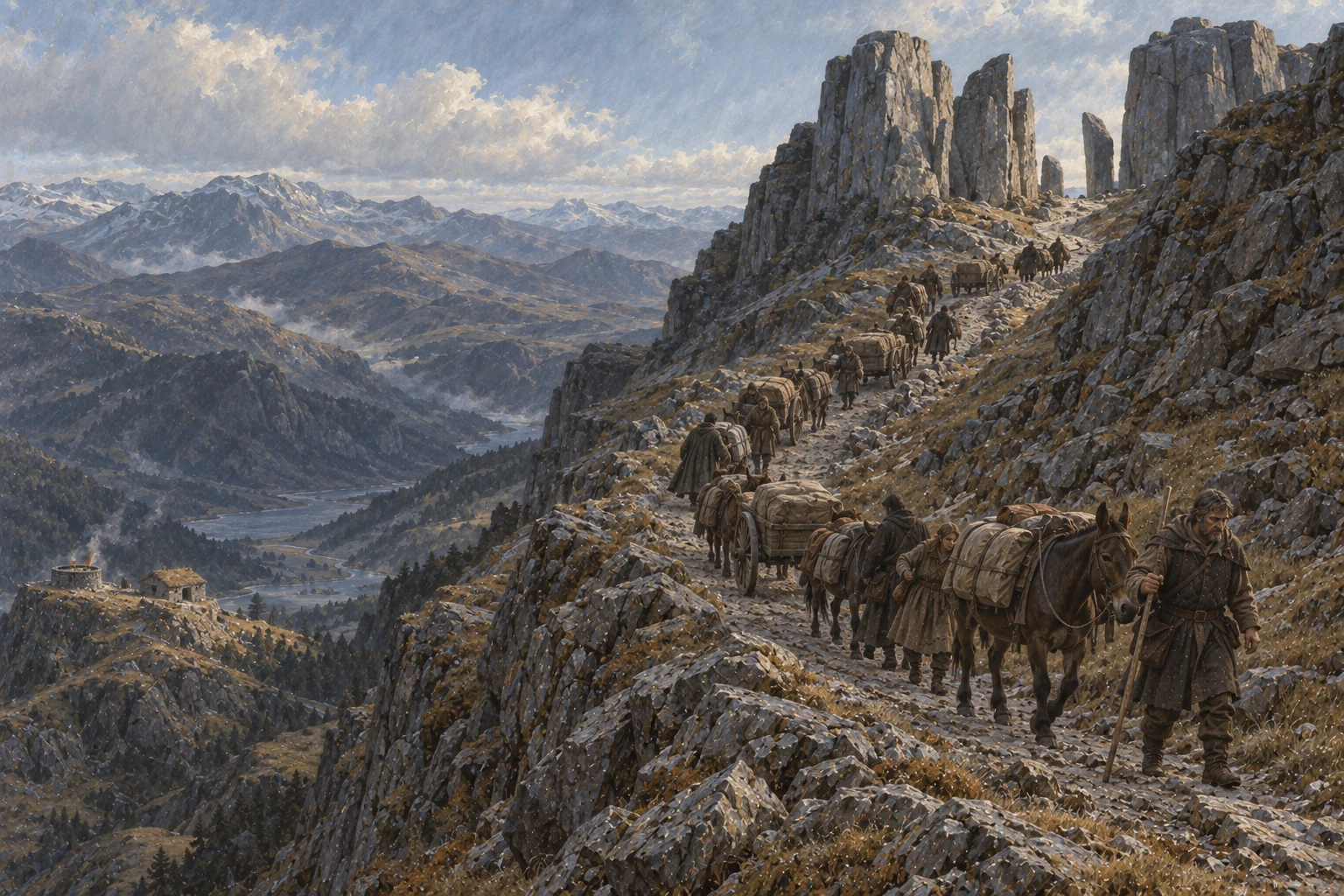
The convoy itself went up in three separate strings across the better part of a week rather than all at once, on Willem's own order, because a thousand steps of loaded mule and cart moving together left no room on the stair for anything coming down it in a hurry, and something coming down it in a hurry was still, after everything the Watch had learned since the corridor reopened, the one contingency nobody there had stopped planning against. Riders went ahead of each string to the first way-stage and came back the same day, empty-handed and unremarked-on when there was nothing to remark, and once, on the second string's morning, a rider came back early with word of nothing worse than a downed tree across the track, and four hands went up with axes before the string itself had finished loading and had the road clear again before noon. It was nothing anybody would have called drama, any of it, only a road being kept open by people who had learned the hard way what it cost to let it close on them unwatched, and Marle wrote each string's departure into his own book in the same three lines he wrote everything else in: the count, the load, the hour.
He stayed three days more than the convoy needed him for, countersigning what wanted countersigning and watching the rest of it with the particular idleness of a man whose whole trade is knowing what not to interfere with. On the second of those days he found Harrol at the smithy, of all places, turning a length of chain link by link through the fire with the tongs held in her good hand while her strapped one rested flat on the anvil's cold corner for balance. She did not look up from the chain when he came in, and did not stop the work to explain why a Watch captain was doing a smith's own labour with a fire crowded already by four other hands who could have done it faster and better. He asked anyway, because it was the kind of thing his own trade taught him to ask, and she told him, without being asked twice, that a captain who could not still do a smith's plainest work with one hand ruined had no business asking anybody else to make do with less than they had been given. She did not say it bitterly. She said it the way she had said everything else to him, once, at a long table with a map unrolled between them, as a fact entered because it was true. He asked after the ninth beacon lamp's third relighting, since he'd had only the bare count of it, and she said only that the ground below it had gone quiet again each time before anyone had needed to do more than climb up and see to the wick, and that a captain who chased every quiet ending back to its cause would never get another honest day's work done at all. He wrote that down too, later, in the evening, not because his book kept a column for it but because he judged, closing the cover on it, that some things were worth carrying even without a column built to hold them.
He stood at the Watch's own gate on the last morning and watched the tail of the convoy go up past the great standing stones toward the pass mouth — the same stones, the same worn steps beyond them that his own feet had come down a year and a season back, with a dead man's coat read at forty paces and three hours gone out of his life that had never come back to him since. The stones carried no mark for which direction had used them last. Frost heaved them the same whichever way a boot came down on them, and the same thousand steps that had once let the first of the dead walk east under Harrol's watch were the steps a live convoy was climbing west under Willem's now, loaded with grain and salt and a season's worth of nails for whatever the far side still needed nailing shut against the coming winter. There was no way to stand at that gate and call the road anything but exactly what it was: the only way through, in either direction, for anyone who meant to cross it at all.
He had thought, riding up, that seeing the corridor used for something other than harm might settle something in him that a year of ruling ink down the same line on a table two hundred miles off had left unsettled. It did not settle anything. The road did both because it had only ever been the one road, built to carry whatever was put on it by whoever reached it first, and there had never been a version of it that carried help west without having once carried the other thing east down the same worn stone. Marle stood at the gate a while longer than the morning's business wanted of him, watching the string go small against the mountain, and then turned back to find Willem and put his own name to the last of the day's paper before the light went.