The Cooper of the Western Road
Dorrit smelled it first: warm bread, unmistakable, on a wind that had given them nothing for four days but wet stone and standing water. She stopped mid-stride, drew a second long breath through her nose, and got the same answer back — yeast, and under it a hint of scorched crust, as real to her as the mud under her own boots. "There's no fire under that," she said, and started walking again before anyone could tell her she was wrong about it.
Bracken had already stopped. He stood with his weight settled onto his good leg, as he had taken to standing since Stanhope's door, and looked at a smoke that was not rising anywhere above the line of the next hill. "Might be a trick of the ground," he said. "Might be nothing at all." He did not sound as though he believed either answer.
Luel walked apart from the rest of them for the better part of a mile, head tilted as if listening to something under the road rather than along it, and came back to say only that the ground itself held nothing worth naming — no deep cold under it, no old lying weight of the kind that had taken Cob Hedley's green from him a lifetime and a country ago. "Whatever this is," she said, "it isn't the ground doing it."
They found the waymark an hour past noon: a squared post, mason-cut, tilted a few degrees off true where a hard winter had worked at its footing, the crossed stroke for water above a single word cut deep and unweathered by the standards of the road behind them — THISTLETON — and beneath it a distance figure worn nearly to nothing. Iyene knelt and read it twice with her fingers before she trusted her eyes, and set it down in her own book without comment. Wren, coming up behind her, felt the name settle into her chest and stay there, a small unearned weight, though she could not have said why a stranger's town should feel like anything to her at all, before she had so much as seen its roofs.
The roofs came into sight from the last rise before the road dropped: slate, mostly whole, catching the flat grey light without a single wisp of true smoke over any true chimney, though the bread-smell only strengthened as they went down toward it, thick enough now that Pip asked once, quietly, whether anyone else could taste it as well as smell it. No one answered him directly. The town sat in a shallow bowl of orchard country gone to seed, two long streets and a market square by the look of it from above, fences mended here and there in patches of paler, newer wood among the grey, a bell-post standing upright at the square's near corner with its bell still hung and still, as though a hand had swept and mended and kept the place right up until an hour ago and had only just now stepped back out of sight. Bracken read it exactly that way, aloud, before anybody had asked him to. "That's not three hundred years of anything," he said. "That's this morning's work, badly finished."
He set the order without needing to be told twice: mules held at the road's edge with Pip minding their lines, Luel and Alder forward on either side, Dorrit and Bracken flanking Wren, everyone paired at any point past the first house. They had done this before, in other towns, on other roads, and the doing of it had long since stopped requiring a reason spoken aloud before anyone moved.
The first street took them past a cooper's yard with no roof over it at all, open to the grey sky, a shopfront standing wide where a door must once have hung. A jut of surviving eave over the near corner had kept three centuries of weather off a patch of the floor beneath it, and there, pale and curled and dry as the day they were cut, lay a scatter of shaved oak shavings, thin as paper, wholly undisturbed. A half-hooped barrel stood in the middle of the floor, staved and ready, its bands driven partway up and stopped there, a mallet laid across a bench beside it as though set down between one blow and the next and not picked back up again. Iyene noted it in passing — cooperage, unfinished piece, tools present — in the same flat hand she gave every other doorway, and the company walked on without remarking on the barrel at all, the same as they walked on past every other ordinary thing that morning.
They found the rest of the town the same way, one shopfront and one yard at a time, and it was worse for being so quiet about it.
The market square opened out ahead of them soon after, wider than either street feeding into it, ringed by stalls whose awning-poles still stood upright though the cloth on most of them had long since rotted to a lace of its own threads. A dry fountain-basin sat at the center, rim carved in a plain running pattern, its bowl holding nothing now but three centuries of blown leaf-litter gone to soil. Benches lined two of the square's four sides, backs worn smooth at exactly the height a shoulder leans against, and a row of market-stones marked out pitches nobody had traded from in longer than any road behind them could measure. It was a town built for a good deal more than the seven of them walking into it, and every one of them felt the size of that difference before anybody said so aloud.
A woman sat at a loom close against a window two streets in, her hands moving steadily through the throw of a shuttle that was not there, through warp threads rotted to nothing decades before either hand had stopped, the frame itself sound and squared and evidently kept oiled at some hinge no living hand had touched in longer than any of them could reckon. She did not turn her head. At the smithy past the square, a broad back bent and straightened, bent and straightened, one arm swinging down onto an anvil in a rhythm so exact that Pip found himself breathing to it before he noticed he was doing it — no hammer in the hand, no ring of struck iron, only the fall of an arm and the small settling creak of a body that had made the same motion perhaps forty thousand times and saw no reason yet to stop making it. Further on, a broom stood in a doorway worked back and forth in short even strokes across a step swept down past its own stone to a groove worn the width of the bristles, dust rising in a thin curtain that neither lessened nor settled. At the town well a rope went round and round a windlass with no bucket left to draw, the crank handle worn smooth and dark where two hands had ground it down over some span of years none of them could have priced with any confidence. Near the ironmonger's a man knelt turning the same length of wire back and forth between two fingers, testing a temper that had gone out of the metal three centuries before he had, patient, uninterrupted, entirely alone in it. Behind a bakehouse door standing ajar, a pair of hands folded and turned a mound of dough that had gone to dust decades since, working it in the same four-part rhythm any baker keeps without needing to think about it — and it was here, Iyene said quietly, not stopping to write it down, that the smell they had followed the whole morning must first have been born, though none of them could say in what sense bread three centuries stale should smell of anything at all, only that this, unmistakably, did.
"They're not looking for anything," Dorrit said, low, at Wren's shoulder. "That's the part I can't — they're not even looking for the thing they lost." She left the sentence there, unfinished.
There was nothing in her yet with shape enough to be offered. What she had instead, walking that first street, was a weight settling into her the way cold settles into a low room before anyone thinks to name it cold — heavier by the yard, heavier by the doorway, until by the market square she had stopped trying to tell how much of it was the town and how much was only her own dread walking ahead of her own feet. She had heard valleys before, deep-Quiet ground and ordinary sleeping country both. She had never heard one hold this much, or hold it this quietly.
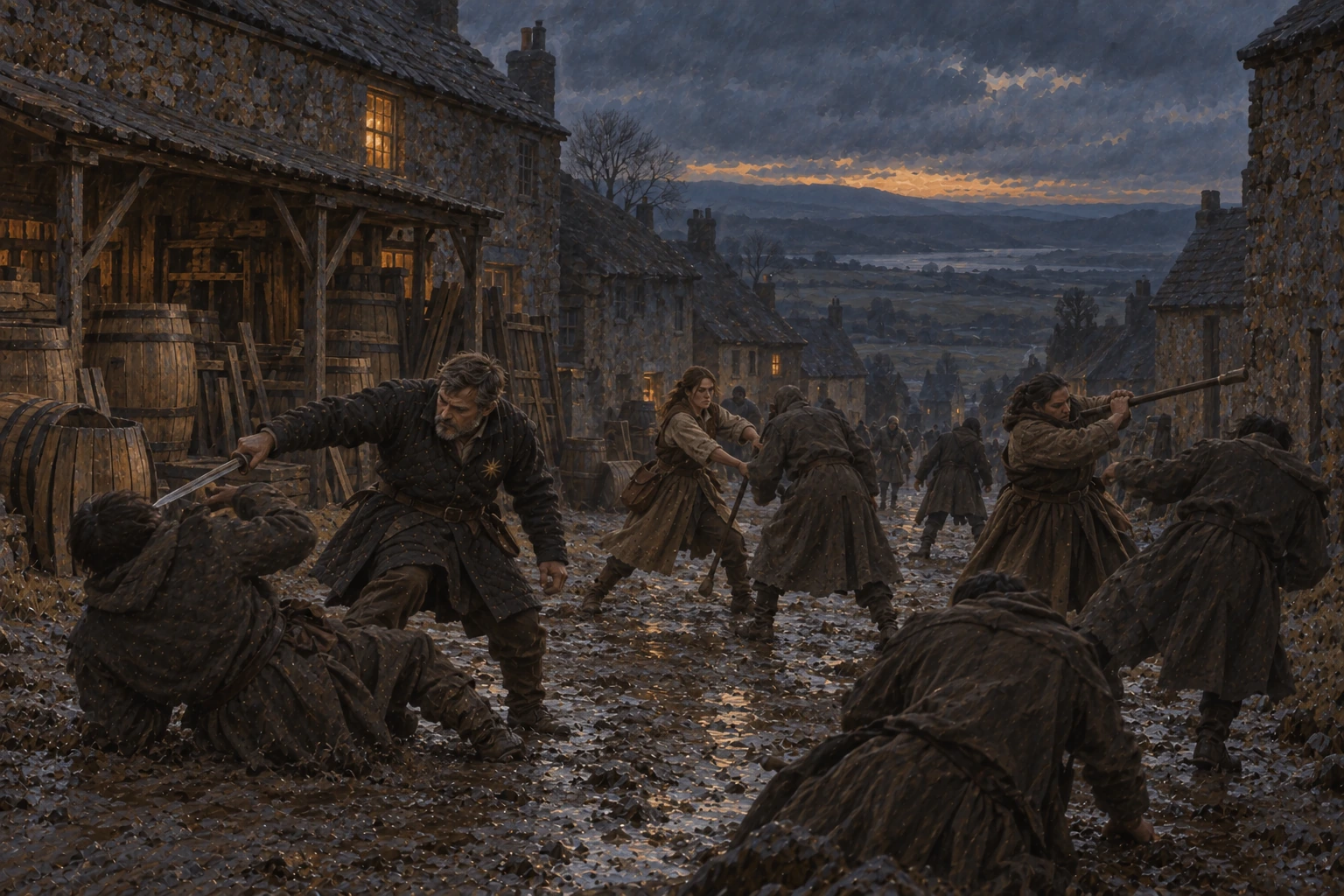
It was the sign over the draper's stall that swung first — an ordinary board on an ordinary bracket, weather-loosened, dropping three feet on its one remaining pin to strike the cobbles with a flat crack that carried the length of the square like a shot.
Every shape of work within earshot lifted its head at once.
"Down!" Bracken was already moving, blade out, putting his body between Pip and the smith's broad shoulders as they came round from behind the anvil at a dead flat run, a pair of tongs still gripped in one fist. Dorrit's staff took a woman with shears low across the ribs, without slowing the woman's stride by more than a half-step. Luel had a brand alight in either hand before Wren had finished turning, driving a third figure back off the cobbles toward the well's stone lip with two short economical strokes that looked, each time, like nothing more than a woman clearing space in front of her. Alder was already down on one knee at the square's near mouth, palm flat to the stone, an old-tongue phrase running under his breath at the pace of a man working rather than praying, and the ground around his hand took on the color of a held breath — a boundary drawn and closing, meant to keep whatever came off this square from reaching anyone standing behind it.
Pip had the mules back against the fountain-basin inside three strides, a hand locked hard on Suet's cheek-strap, and did not once let go of it, doing the single job Bracken had given him years and a hundred roads ago and doing it exactly, while the square went to noise and iron on every side of him.
"Now, Wren!" Iyene's voice, flat and carrying, from somewhere just behind Alder's shoulder, and a name came with it, read straight off a page held open against the wind — a smith's name, off the shop's own tally-board, found and copied not an hour before, in the ordinary, patient way a name survives three hundred years in a small town's own ordinary keeping.
Wren said it. She had no time to be gentle with it, no time to find the doorway feeling she would want later and had not now; she threw the name fast and hard, meant to catch, the way rope is thrown to a man already going under. It caught. The broad back straightened one final time, the tongs fell from a hand that no longer had any reason to hold onto anything, and what had been running at Bracken a heartbeat before stood a moment longer on legs it had forgotten how to use, then folded down onto the cobbles like a coat coming off a hook — no weight left in the falling, nothing fought against on the way down.
Two more came. Steel and iron and Luel's fire took them the honest way, without a name to spend on either — hard, ugly, over inside a dozen heartbeats, Bracken's bad knee buckling once under a driven blow he took rather than gave ground for, Dorrit's staff cracking a wrist that did not bleed and had no need to. When it was done the square held its old quiet again, four shapes down on the stone that would not be getting up, and the smell of scorched cloth from Luel's brands hanging over all of it like weather that had simply arrived and would take its own time leaving.
The square held itself still a moment, one not allowed, in the end, to become a long one.
"That's the last of what was close enough to hear the board fall," Alder said, still on one knee, still breathing like a man holding something up rather than merely kneeling. "There will be more that didn't hear it. Working, same as before." He did not say how he knew.
Bracken tested the bad knee once, weight rocked forward and back, and said nothing about what he found there either. It had cost him nothing new that morning — only what the door at Stanhope had already taken and never given back — and he would favor it the rest of the day the same as he had favored it every day since, without once making it anyone else's business to notice.
The second name cost more than the first, though nothing about the doing of it looked any different from outside. Iyene found this one on a lintel two doors down — a weaver's name, cut shallow into the stone above a door frame, in the particular careful hand of a household cutting a name it means to keep for good — and read it to Wren across a counter still scattered with carding-combs laid out for a morning's work that would never now come. Wren said it, and the woman at the loom two streets back stopped her shuttle-hand at last, turned her head toward a voice she had not heard in three hundred years, and went still in the stillness of a thing let down gently rather than dropped.
Wren's own hands were shaking by the time she lowered them. Not badly — a fine tremor, the kind that comes after carrying something heavy longer than the arms wanted to hold it — but Dorrit saw it anyway, and took Wren's wrist without asking, two fingers pressed flat to find the pulse there, her face giving away nothing about whether she liked what she found under them. She let go a moment after and went back to laying out her own kit on the counter's clean end, as businesslike as if she had only been steadying a jar someone had set too near the edge.
The third name was a woman at the well, and by then Bracken had stopped pretending he had any other reason to be standing where he was standing. He came and put himself at Wren's shoulder, close enough that his sleeve brushed hers, not touching her, not speaking, simply present — the plain nearness of a post to a fence that has begun to lean on it, neither of them saying so aloud. Wren said the name Iyene brought her — off the well's own coping stone, a dedication scratched half away by three centuries of weather — and the rope stopped turning, and the woman who had wound it every day of a life longer than the town's own silence sat down slowly on the stone lip and rose no more.
By the fourth name Wren was counting without meaning to. She could feel exactly where she stood against some floor she had not yet reached, as a wading foot learns the drop in a riverbed before the eye has found it. She kept this to herself. There was no one at that well who wanted to hear it, and nothing to be gained by making them carry it alongside her.
It was Alder who tried the fifth on his own, and it was not a foolish thing to try.
He had watched Iyene find the name — a draper's name, painted in careful, faded lettering above a stall two doors from the square, in a hand that had once taken plain pride in its own signboard — and he had watched Wren spend three names already that morning, each one costing visibly more than the one before it, and he had reasoned, in good faith and half aloud, that a true name correctly found ought to reach whoever it belonged to no matter whose mouth carried it there. He had believed something close to this once, on a green hillside a lifetime and a country behind him, and had been wrong then only about which names were the right ones to try. This time the name was right, and he knew it was right, and he said it himself, clearly, standing four feet from a woman folding cloth that had rotted from her hands decades since, in a voice pitched to carry and meant to be kind.
Nothing happened.
She went on folding. Her hands did not slow, her head did not turn, nothing in her acknowledged that a word meant for her had been spoken into the same air she stood in. Alder said it again, once, and got the same nothing back a second time, as flatly as the first.
He did not try a third time. He looked at Wren for a moment that lasted no longer than it needed to, and stepped back half a pace to give her the room to try it in his place.
Wren said the same name a breath later, in the same plain voice she had used for the other three, and the draper's hands stopped moving mid-fold, and she looked down at the cloth in them as though seeing it, and herself, and the shop around her, all at once, for the first time in three hundred years — and then she was not looking at anything at all.
It was Dorrit who asked it, out loud, in front of all of them, before the company had got as far as the next doorway. "Why not you."
Alder was long enough answering that Wren thought he might not. "Because I told her," he said. "Wren did not tell her. Something went through Wren and came out the other side, and I have stood beside it two years calling it the same work I do." He looked down at his own hands. "It is not the same work. I would rather have learned that somewhere with a roof on it."
The cooper's shop was where Iyene had spent the longest part of the whole morning, because it was the one place in Thistleton that had kept a proper book.
It sat on a shelf behind the bench, warped along one edge from some old rain, its cover gone soft as cloth — an order-book, page after page in a plain working hand, dates and casks and customers set down as any tradesman keeps his accounts, right up until the entries simply stopped a third of the way down a page, mid-column, as though the hand writing them had been called away to something and had meant, at the time, to come back and finish the line. Iyene read the last full page twice before she found what she wanted, low in the margin beside a half-finished tally: a name entered in its own owner's hand, the particular way a man signs a piece of work he means to stand behind — H. Sedge — and, further back, in fuller form, on the shop's own account-page for the year the writing stopped: Halvard Sedge.
She carried the book out to where Wren stood in the yard, held it open at the page, and read the name aloud, once, plainly, in the same register she had given every other name that morning and no differently.
He was there in the doorway of his own shop when Wren turned to look — had been there the whole time, she understood now, one of the shapes they had already walked past twice without either of them turning to look at the other, bent slightly forward over the bench as though a moment before he had set something down and meant, in a moment more, to pick it back up. He did not startle when the company's shadow fell across the floor. He did not startle at anything. He simply stood, in the fixed and patient posture of a working life that had never been told it was allowed to stop, hands loose at his sides, one shoulder canted from long habit toward the barrel he had left half-hooped in the middle of the floor.
Wren walked to within four feet of him and stopped there, because that was as close as the moment seemed to want her, and said what Iyene had given her to say.
"Halvard Sedge. Cooper. Of this town."
His right hand moved first, rising an inch off his side and turning palm-up, the slow, feeling motion of a hand that had planed grain ten thousand times before and had not forgotten how, whatever else it had forgotten. He looked down at it as though it belonged to someone else, and then, more slowly, as though it belonged to him after all. His eyes went next to the floor, to the pale curled shavings still lying exactly where three centuries of sheltered stillness had kept them, and something in his face opened like a door swinging back onto a room its own house had forgotten it still had.
He looked, once, toward the room behind the shop — no more than a glance, gone as soon as it came. Whatever he found there he kept, and the day kept it with him.
Then his eyes went to the barrel. He crossed the two steps to it without seeming to decide to, laid his hand flat against one unfinished stave, fingers spread over the work as a hand spreads over something it means to finish before the light goes, and stood a moment feeling the grain under his palm as though it might tell him, at last, what day it actually was.
It told him. Wren watched it happen as she had watched nothing else in her life — not a single visible change so much as a run of edges, one after another: his shoulders, braced forward over the bench in the shape of a man mid-task, settling back and down; his breath, which she had not until that moment realized he was not taking, arriving once, and then not arriving again; his face losing, all at once and without any grief showing in the losing, the patient forward-leaning look of a man who still believed there was a barrel to finish and a woman to call in from the yard once it was done.
Behind Wren the others had gone still without anybody telling them to. Bracken's hand had come off his hilt at some point without his seeming to notice it leaving. Dorrit stood with a roll of linen half unwound in her two hands, forgotten there. Iyene had stopped writing. None of them came any nearer than they already stood, and none of them spoke, and the four feet between Wren and the doorway held the whole of it, the room gone still enough that Wren could hear her own pulse in her ears.
He did not say the second name aloud. Whatever it was, it crossed his face and was gone, private and whole, and what it left behind him was not grief exactly, nor peace exactly either, but something closer to a man setting down, at long last, a tool his hand had simply stopped needing.
He remembered dying. Wren could not have said how she knew it, only that she did, in the same wordless certainty with which she had always known a hive gone quiet before her palm ever touched the wood — his hand rose briefly toward his own chest, not clutching, only resting there a moment, the plain unthinking gesture of a man checking an old wound out of long habit rather than pain.
So he stops.
He did not fall so much as settle, the barrel-hand sliding slowly down the stave as he went, until what sat against the half-finished cask in his own doorway was three hundred and eleven years overdue in the settling, and looked it, and was still. Wren stood over him, then made herself move on, because there was more town waiting than there was daylight left, and more names in Iyene's book than there would be Wren enough to spend on them.
No one in the company spoke his wife's name aloud. It had gone wherever the rest of him had gone, and belonged now to no living mouth at all.
She tried once more after that, a name Iyene brought her off a shuttered ironmonger's board two doors along, and her own voice would not organize around it. She heard herself begin the shape of it and lose the middle, as a swimmer loses the thread of a song two strokes short of air, and had to stop and start again, and lost it again, and by the third attempt Luel had a hand flat between her shoulder blades — not holding her up exactly, only there, steady, the correcting pressure of a hand that has set a yoke right on a shoulder before.
"You are not carrying it anymore," Luel said, quiet, close to her ear. "You are only holding it because your arms have forgotten they are allowed to let go." It was the same lesson, in different words, that had walked her the length of a through-road twice weekly with a full water-yoke across her shoulders — the hour a weight stops feeling like a weight is the hour it starts costing something a body cannot see going out of it.
Wren let her arms stop trying. The man at the ironmonger's went on turning his length of wire between the same two fingers, unnamed, uncalled, unfinished, working at a temper that would never come right and had never needed to.
Iyene closed her book. "Four," she said, flat, to no one and to all of them together, the number sitting bare in the cold market air exactly as she had left it. A beat later, from the same closed page, without looking up: "Forty-one." She did not explain what the second figure meant, because none of them needed the explaining — forty-one names found and copied that morning in her own steady hand, standing ready, and only four of them spent.
Bracken looked at the ground between his own boots. Dorrit looked, longer than was comfortable, at the man still working his ruined temper by the ironmonger's wall, but did not look at Wren at all, and that, too, said what it needed to say without a single word attached.
They left Thistleton by its western road an hour before dusk, past a lane of narrow weavers' cottages running down toward the old millrace that none of the seven had set foot in and none of them would. Doors stood open the length of it, and shapes moved inside more than one of them, patient, in no hurry the daylight could account for, at work on tasks that had stopped mattering three hundred years before any of the seven walking past had been born. One turned, briefly, toward the sound of their boots on the road — a head lifting at a noise half heard and half remembered — and then went back to whatever its hands had been at before the sound came and passed.
Nobody stopped. No one so much as suggested it. Bracken kept the pace he had set that morning, neither faster nor slower for what lay down that lane, and the mules went by it the same as they went by any other stretch of road that asked nothing at all of them.
Iyene had torn the page from her own working book before they cleared the square — thirty-seven names left in it, in her plain even hand, every one she had found and read and set down and would not now read out this day — and folded it once, and held it out. Wren took it on the first offer, did not read it standing there in the road, nor that evening either, and put it instead into the inside pocket of her coat, against her own chest, in the place the Waybook itself had never been made to ride.
The road climbed a little as it left the last house behind, curving north around the shoulder of a hill Iyene's book did not yet have a name for, and the light went the color it goes an hour before real dark, grey deepening toward the color of an old coin, the whole widening bowl of the valley below losing its edges at one steady rate. Wren walked with the folded page a flat, small weight against her ribs and left it there, untouched, and none of the six walking with her asked to see it, or asked her what she meant to do with it, or asked her anything at all.
They had cleared four names that day, out of forty-one found, out of some larger number the town had never let itself be counted at in the first place. That arithmetic went west with them down the darkening road exactly as it stood, uncorrected and uncomforted, and none of the seven walking under it made it lighter by calling it anything else.