The Watch on the Stones
The frost that had only spat at them the day before arrived in earnest the morning they left the Steading Lamp, and arrived to stay. It whitened the yard stones before the household was properly up, and turned the mules' breath and the company's own into small private clouds that hung a moment before thinning away. Tam Rush came out to see them off in his shirtsleeves despite it, unbothered. He pressed on Bracken a wrapped loaf still warm enough to steam, and told them all they'd have no trouble finding the watch — "straight on, and up, and you'll know it by the Stones before you know it by anything else." Maren gave Wren's arm a brief hard squeeze that said more than the two of them had managed to say all evening. Then the lamp and the long low house and its eleven generations were behind them, dwindling into the cold bright morning, and the road went up.
It went up properly now, in a way it had only been rehearsing before — no more of the long easy grades of the river-lands and the first sheep-hills, but a real climb, the valley narrowing until the slopes stood close enough that their own shadows kept the road in a blue-cold shade past midmorning. The last stunted trees gave out within the hour. After that there was only grass gone the color of old rope, and grey rock breaking through it in long knuckled seams, and sheep — real mountain sheep now, shaggy and self-possessed, that lifted their heads to watch the company pass with an interest Dorrit pronounced, after the fourth flock, "better manners than half of Dall gives strangers."
It was Pip who saw the first Stone, a little before noon, and called out in a voice that cracked with the effort of not sounding as excited as he clearly was.
It stood alone at first, well off the road on a shoulder of open ground, and Wren's eye slid past it twice before it properly arrived in her mind as a made thing rather than an outcrop. Taller than a man by a good head, it stood squared with a patience no weather had managed to soften in — how long? Centuries, certainly, standing with the settled, patient permanence of something that had never considered falling down. There was no mark on it that she could see from the road, no carving, nothing that announced itself; it simply stood, the way a good boundary-post stands, doing its whole job by being exactly where it was and staying there.
"That's the first of them," Bracken said, and there was something in his voice Wren had not heard from him before — not quite pride, not quite homesickness, but close kin to both. "There's more, all the way up. Waystones. Older than the road they're minding, older than near enough everything but the mountains themselves. You'll see the whole line of them from the yard, once we're up."
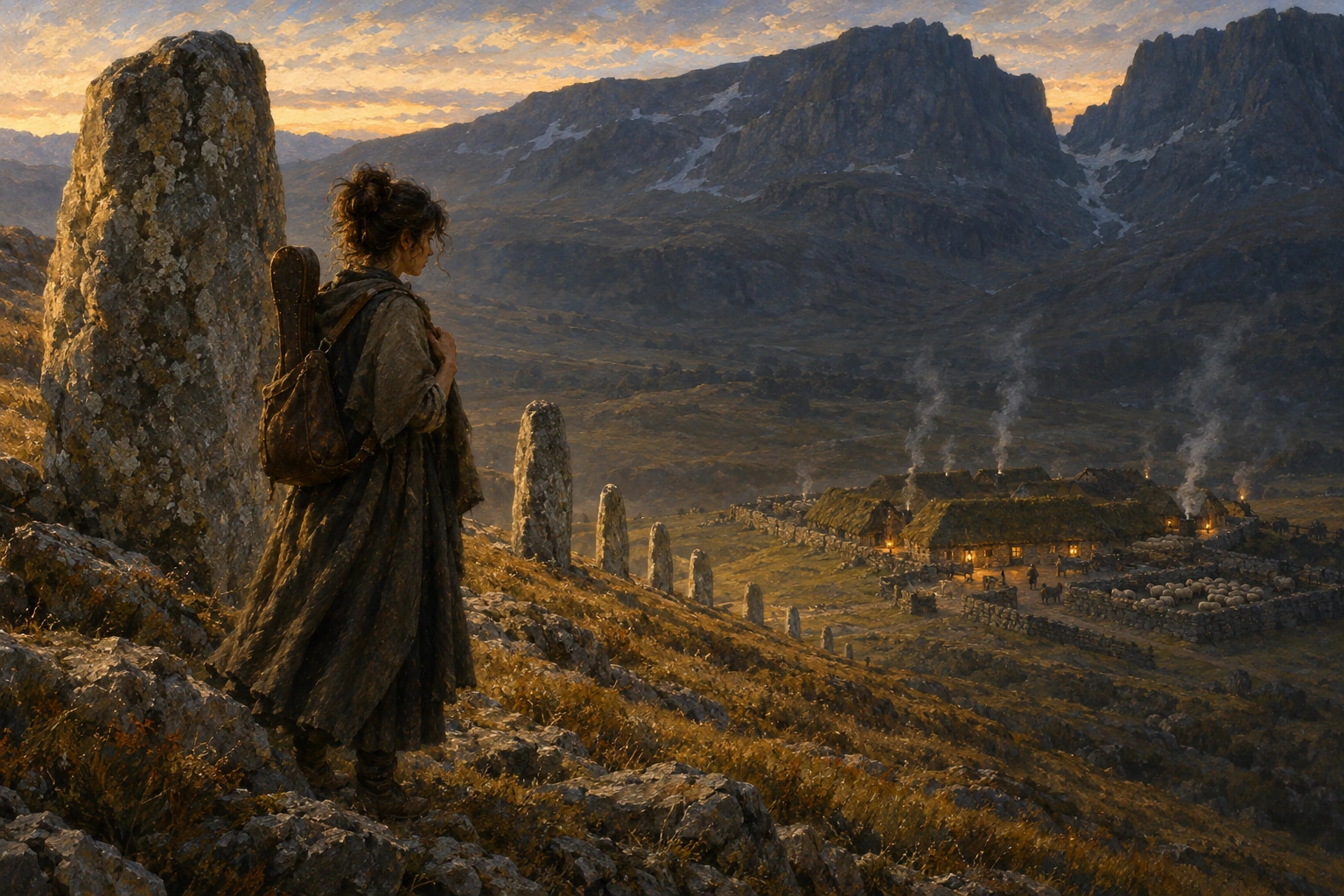
They did see it, an hour further on, when the road took a last long climbing bend and the valley opened out ahead of them into a wide stony shelf under the black shoulder of the pass — and there the Stones stood revealed all together, marching up the slope in a loose companionable line, each one leaning very slightly toward the next the way old ewes will single-file up a track they have walked every season of their lives, steady and certain of their footing. The line climbed on past where the eye could easily follow it, up toward a dark notch in the rock that could only be the pass mouth itself. She counted eleven before the angle of the land took the rest from her, and did not try to count further, because it seemed, somehow, a discourtesy to a thing so evidently not counted for anyone's convenience but its own.
Below the Stones, tucked into the shelter of the slope as a good farmhouse tucks itself against a hill rather than standing proud on top of it to catch every wind that passed, lay the watch.
It was nothing Wren had let herself picture, and she was glad of that now, because whatever she might have pictured would have been wrong. There was no wall run up tall and toothed against the sky, no gate worth the name, nothing that announced itself as a place built to keep anyone out. What she saw instead was a scatter of long low buildings, turf-roofed and drystone-walled, sunk so companionably into the fold of the hill that from this distance they read less as construction than as a kind of careful farming of the slope itself. There were byres and ricks and a walled yard where sheep moved in a pale slow river, a second smaller yard of picketed animals, and a low building with a smoking chimney set apart that she guessed, rightly, for the smithy. And strung along a shelf of open ground above the houses hung a line of iron-cradled lamps, unlit yet in the daylight but plain in their fittings — the beads on a thread she had seen from the inn's dark window two nights before. Close enough now to see for what they were, they were ordinary working lamps, kept by ordinary hands, and nothing more mysterious than that.
Smoke stood up from a dozen chimneys into the cold clear air, and somewhere below them a dog began to bark, and was answered by two more, and the whole scattered settlement seemed, in the space of a few strides, to wake up and turn its face toward the road.
A man perched astride the top of the sheep-yard wall, trowel still in one mortar-whitened hand, was the first to properly see them coming. He straightened up with the offhand economy of someone who has spent a working life on walls and does not startle easily, shaded his eyes, and called down into the yard below him in a voice pitched to carry without shouting — the voice, Wren thought, of a man used to being heard the first time.
"Company on the road! Seven and mules — no, more than mules, look at the lead one's rig—" A pause, filled with the barking dogs and a general stir below him. "That's a College mark, or I've gone soft in the eyes."
By the time the company had covered the last quarter mile the yard had filled. Children were shooed back from the road's edge by an older girl with the harried competence of someone left in charge. Watch-folk in plain undyed coats, not unlike the ones Corr and Ashen had worn at the inn, drifted out from the byres and the smithy with the curiosity of people to whom a stranger on the road is still, after all these years, an event. Dogs wove in and out of everyone's legs, sniffing at Nettle's hocks with more courage than sense, until Nettle set them right about that with one economical snap that sent the boldest yelping back, tail still wagging, entirely undeterred in spirit.
And then, from the doorway of the nearest long house, a woman came out wiping her hands on a cloth. She looked once, hard, the length of the yard — and stopped dead, the cloth forgotten in her hand, staring at Bracken with an expression Wren would not properly have known how to name, had she not, only the evening before at the Steading Lamp, watched Corr Ashwell wear something very like it across a crowded room.
"Hale," the woman said, in a voice gone suddenly unlike the flat one she'd clearly meant to use. "Bracken Hale." And then, recovering herself with visible effort, in a tone dry enough to strike a spark off: "I always did tell the recruits you'd turn up again like a bad debt. Nobody believed me."
"Harrol." Bracken had gone, Wren saw with some private delight, an even deeper color than he had managed for Corr Ashwell, and was standing very straight, and trying hard not to look as pleased as he clearly was. "You've a captain's coat on. I heard, but I didn't credit it."
"You'd have heard wrong not to," said the woman — Captain Harrol, Wren understood, watching her cross the yard with a long brisk stride that covered ground with no wasted motion. She was a woman somewhere in her later forties, weathered brown, grey coming in hard at her temples, dressed as simply as anyone else in the yard and marked out as captain only because the whole yard's attention had quietly rearranged itself around her. She took Bracken's hand and shook it once, hard, in the manner of someone closing a transaction rather than opening an embrace, though something in her face said the handshake was doing work her face had decided not to do instead. "Twelve years, and you didn't think to send word ahead so a body could have the good boots on."
"Wasn't certain there'd be a watch left to send word to," Bracken said, which drew a short bark of a laugh out of her, "seeing the state you lot were always in."
"There's a watch," Harrol said, "and it's in better order than it was when you left it, though I'll thank you not to say so where the old hands can hear, since half of them still think discipline died with your generation." She looked past him then, taking in the rest of the company with one measured sweep — the mules, the College mark on Iyene's coat, Luel standing quiet at the group's edge in her shifting grey-brown cloak. Luel drew not a flicker of alarm from Harrol's face, only a brief considering look that seemed to file the fact away rather than remark on it, and something in Harrol's whole bearing settled, visibly, into the shape of a woman receiving guests she has genuinely been expecting, rather than strangers she is obliged to be civil to. "And you've brought me a full College party up the last road in the kingdom, which I'll want the whole of before supper's out. Get your beasts stabled first. Then we'll talk."
Harrol's eye had gone to the arm inside his coat within the first minute of the yard, and she let it alone. What she did instead was rearrange her watch. Two of her own people found themselves detailed to the Survey's unloading without being told why, and every heavy lift that came near Bracken for the next three days turned out to have somebody already under it. Dorrit watched that whole arrangement go up around him and did not comment on it either, being at that time still not speaking to him about his shoulder at all.
It was in the stabling, more than anywhere in the yard's noisy welcome, that Wren watched Bracken come properly home.
He moved through the mule-yard the way a man moves through his own kitchen in the dark — without looking, without asking, setting Suet's lead on the third post from the gate as though he had tied it there every evening of his life rather than never before. When he had done it he stood a moment with one hand flat on the rail, running his eye down the picket-line with the pure unconscious habit of a man checking a thing he has checked ten thousand times, weight here, slack there, a knot tightened without seeming to decide to. A young watchman near the gate only grinned at a companion, and that was itself a kind of welcome — a place lets a man check its picket-lines unasked only when it has already decided he still belongs to it.
"You'll be the one they still teach the loading rules off," Harrol said to him later, over the ledger she produced within the hour and set, without preamble, directly into his hands — the watch's stores-book, its columns ruled in a careful old-soldier's script, and Bracken took it like a letter from home. "Since you'll be reading it over my shoulder anyway, before the week's out, I've saved us both the trouble."
"I taught you to load a mule," Bracken said, a little roughly, turning the ledger over as though it might contradict him.
"You taught me when I was younger than that boy of yours" — a nod toward Pip, hovering nearby with the transparent hope of being included in whatever this was — "and I've been teaching it in your own words to every fool recruit since, near enough word for word, because it's never been wrong." She turned to a young watchman restacking grain-sacks nearby, and asked him, without any particular ceremony, to say it back to her. The boy, caught by surprise, straightened up and recited, visibly embarrassed, "You don't load for the flat road, Captain. You load for the ugliest stretch of the day, and you check it there, not at the yard gate." He looked from her to the strangers, uncertain what he'd said wrong, while Bracken stood very still, staring at nothing in particular, visibly undone by the small precise fact of his own words walking around the world without him in the mouth of a boy he had never met.
He cleared his throat twice, and looked very hard at the ledger in his hands, and let the boy get back to his grain-sacks.
Old names came up gently over the same hour, as such names do between soldiers who once shared a fire and a captain and have not shared much since. Harrol asked after two or three by name, easy and unforced, and Bracken asked back the same, and most answers came warm — married, or moved down to easier country, or due back from the high pastures by dusk, wouldn't he like to see old Fen again. But two names met with a plainer answer, a small shake of the head, given without ceremony and received the same way, twelve years being twelve years, and no more to be made of it than that.
The charter came out in the low hearth-hall that made up the heart of the largest of the long houses — a good plain room, smoke-dark rafters, a fire built for warmth rather than show, benches worn smooth by generations of border boots. Harrol read it as Wren imagined a good captain read anything: slowly, all the way through, moving her lips very slightly over the parts that mattered, and then a second time over the clauses near the bottom.
"'A company of six sworn, and such guides as the road provides,'" she read aloud at last, and looked up, and let her eye rest on Luel a moment — not startled, not wary, only the look of a woman confirming a fact she had already half-suspected walking in the yard. Then she folded the paper closed again with the crisp competence of a woman closing a ledger she has finished with for the day. "Whoever drafted that clause knew this country better than most College hands manage to."
"She's sitting three feet from you," said Iyene, with visible and entirely unhidden pride, and Harrol gave her, in return, the smallest and driest of nods, the kind two professionals exchange when they have each recognized the other's work without needing to make a production of it.
A chair was brought for Luel before the reading was even finished — one of the watch's own women simply rose, without being asked, and set a plain solid chair nearer the hearth. Luel took it exactly as she had taken Tam Rush's chair the evening before, and nobody in the room so much as glanced twice at the small courtesy passing between them.
Quarters were assigned before the light went — a long low room for the women, another for the men, plain and warm enough, smelling of turf-smoke and clean straw. The shape of the winter to come was laid out with the same unfussed practicality Harrol brought to everything: the Survey would work the near borderlands while the season allowed it, mapping and asking and setting down what Wystan had once set down and time had since disputed. When the weather closed the high ground, as it would within weeks by the look of the sky, the company would winter down here, among people who had kept a fire and a spare bed ready, in one form or another, longer than anyone in the room could account for. The passes themselves would wait for spring, and it was only, Harrol said, closing the matter as she closed everything, "how the mountain does business, and the mountain doesn't take bribes."
It was old Orran, the watch's smith, who knew the basket the moment he laid eyes on it.
He had come out from the smithy at the general commotion of the company's arrival, wiping soot from hands gone permanently the color of the forge, and stood a while at the edge of things watching the unloading with the professional interest of a man who judges strangers by their gear before he troubles to judge them by their faces. When Suet was finally led past him, the iron basket lashed and half-uncovered on her saddle-frame, Orran's whole easy manner changed at once. He crossed the yard in three long strides and laid one broad hand flat against the ironwork, and left it there.
"I know this piece," he said, turning it a little on its lashings to catch the last of the light, running a thumb along a seam of old hammer-work with the particular tenderness of a craftsman recognizing another craftsman's hand across a very great distance of years. "Or I know its kin, near enough. There's a hand to this iron you don't see forged anymore — I've mended two of the line myself, years back, before the diggers got at the ground." He looked up at Bracken, and something in his weathered face had gone hard in a way that had nothing to do with anger at any of them. "Where'd this come off?"
Bracken told him, straight out, what the manifest had said and what it hadn't. Orran nodded slowly, as though confirming a suspicion he had been carrying a long while unconfirmed, and named — not the hill itself, for even he, it seemed, did not think of it by any name so much as by the shape of the ground — the ruin above the old road, a day or two's walk east of the watch, the last standing height of the eastern beacon-line before the chain climbed out of country the watch had ever properly kept. "Diggers came through there two summers back, maybe three. We knew what they were after the moment we heard of it — old iron and old stone, and a coin at the far end from some factor or other who never troubled to ask where a thing had stood before he bought it standing nowhere at all." He set his jaw, and there was a long moment where Wren thought he might say something with real heat in it; instead, when it came, it came flat and practical, a man naming a chore he had failed to get to. "We'd have stopped it, if stopping strangers with spades were the kind of order anyone had ever thought to leave us. Nobody ever did. It's not the sort of thing gets written down as a duty, watching over ground nobody living remembers owning."
Iyene had her pocket-book out before he'd finished speaking, and entered the whole of it in her small exact hand — the ground, the distance, Orran's own words on the iron-work, the two summers' remove — with the particular quiet satisfaction of a woman completing a sentence another party had left willfully unfinished. "There," she said, half to herself, closing the book. "That's what a manifest owes a thing, and never paid."
"It goes home," Alder said, and it was the only thing he said through the whole exchange, quiet and certain, watching the basket settle back against Suet's flank as the mule shifted her weight with the placid indifference of an animal long past being troubled by conversation. "When the Survey's own work takes us that way, and not before. There's no hurry to it now that wasn't hurry two years too late already."
Supper in the hearth-hall that evening was a proper border affair, long tables and a stew thick enough to stand a spoon in and bread still warm from a communal oven Dorrit had already, within an hour of arriving, made herself thoroughly at home in, she and the watch's cook, a broad warm woman named Enna, having reached the kind of instant wordless understanding that Wren had come to recognize as Dorrit's particular gift, so that by the time the meal was served the two of them were trading opinions on root cellars across the length of the kitchen like women who had known each other twenty years.
Pip, for his part, had found two watch recruits near enough his own age — a lanky, serious boy called Tolly and a shorter, quicker one called Dill, both of them clearly delighted to have a stranger to impress and impressed, in the event, back. The three of them fell into an earnest technical discussion of fire-management that Pip conducted with all the gravity of a man discussing matters of state, which Wren, watching from across the room, found she loved him rather more for than she generally let show. Somewhere in the course of it Nettle managed to close her teeth on the sleeve of a young watchwoman who had, by her own later cheerful account, been warned twice and gone ahead and offered a hand anyway "on a point of principle." Rather than take offense, the woman held the bitten sleeve up for the whole table's inspection with open pride, announcing to general laughter that she had now been personally bitten by Hale's famous mule, which she considered, on the whole, an honor.
It was over the second pass of bread that Pip, emboldened by cider and good company, asked the question Wren suspected half the room had wanted asked since they'd arrived: what, exactly, the watch had spent all these generations guarding.
Harrol did not answer at once. She finished what was in her spoon, and set it down, and looked round the table — at the Stones' shape sketched dark through the small window behind her, at the company's seven attentive faces, at her own people going easily about their evening — before she gave it to him plain.
"The road," she said.
Nothing more followed it for a moment, and Pip, visibly braced for more, looked briefly uncertain whether he'd been answered or gently put off. But an old hand near the fire's end, feet stretched to the heat, took the silence up before it could turn awkward, and said, without looking round, in the dry contented tone of a very old joke finally allowed its proper punchline: "I've swept a doorstep thirty years for guests that never came, boy. You'll forgive us if supper runs long tonight. We've been practicing."
The whole table laughed, warm and easy, and Harrol let it run its course before she went on, quieter now, in the tone of a woman making a proper report rather than telling a story. "We don't keep this place against anything," she said. "Never have, whatever the charters up in Merrow like to say about border duty. We keep it for something — for the road staying a road, and the Stones staying found, on the chance that someone, someday, would come wanting to walk it. Most of my life I'd have told you that chance was a comfortable fiction we told new recruits to make the cold nights feel like they meant something." She looked down the table at the Survey's seven faces, at the mules stabled like visiting dignitaries in the good stalls, at the small worn charter folded now inside Alder's coat. "I'll not tell them that anymore."
It was the same old hand who added, into his cup, not quite a joke this time: "First volume of that log, down the shelf there, ends its hard winter with a line nobody ever explained and nobody ever struck out, neither. Count what comes down the road in a bad year. Not all of it was owed a door." He drank, slow. "We went on sweeping the doorstep regardless."
The talk moved on past it, like a stone in the road it had decided not to lift.
It was Harrol herself, once the meal had settled and the room had gone soft with firelight, who gave them the rest of it. She offered it evenly, as a matter of report between chartered parties rather than as a confidence or a warning, in the same even voice she'd have used to read out the week's grain tallies.
"You'll want the watch's news, I expect, same as we'll want the Survey's, before the winter's out," she said, and nodded to a shelf along the hearth-hall's far wall Wren had noticed on coming in without registering what it held. There stood a long row of bound ledgers, dark with handling, each filled and closed and set beside the next, exactly as the travelers' books had stood at the Steading Lamp. "We keep a log here same as anywhere keeps a log — weather, traffic, anything worth a line. Some of those go back further than the watch has had captains to sign them." Iyene's whole face lit at the sight of it with an unmistakable, familiar hunger — the third unbroken written record this one road had offered her — and she said as much, quietly, to Alder, who only smiled and let her have the moment.
"The first thing, and the plainer of the two," Harrol went on, "is the green. There's been a green showing in the high passes the last handful of years — not every year the same, but every year some, and creeping earlier and further down than any hand before mine ever logged it. This year's the strongest yet, by a fair margin. We've the numbers to prove it, if your Cartographer-Royal wants them, and I expect she does."
"I do," said Iyene, with the fervor of a woman being handed exactly the gift she had not known to ask for.
"The second thing," Harrol said, and here, for the first time all evening, something in her manner slowed and grew careful — not fearful, Wren thought, watching her closely, but exact, handling it like something she meant to get precisely right and not one degree more dramatic than the truth allowed. "Lights. Twice this year, both times deep in the high west, both times on a hard clear night when a man could swear to what he'd seen and not be laughed out of the mess for it after. Logged both times, by two separate hands who'd never have agreed to see the same thing between them if they hadn't. Nothing's burned out that way in longer than any book on that shelf or any story handed down to it can tell me. I don't know what it was. Nobody here does. We've not troubled to guess past that, because guessing's cheap and the truth generally costs more, and we'd rather owe it the second than the first."
Iyene asked two careful, precise questions — the bearing, the duration — and wrote the answers down without embellishment. Alder asked nothing at all, only listened, his face unreadable in the low light in the particular way Wren had come to recognize as his listening face rather than his hiding one. And Luel, beside him, sat through the whole of it without once shifting her hands on her staff, and yet Wren, glancing her way without quite meaning to, caught something in her stillness that had not been there a moment before: a deeper quiet laid down over her ordinary quiet, the way a second held breath sits under a first.
It was Wren who finally asked it, plainer than she had meant to. "What do you think it means?"
Harrol did not answer at once, and when she did she had put the report-voice down. She turned her cup a slow half-turn on the boards without drinking from it. "I'm no scholar, and I've never had much patience for what the old books claim the mountain used to be. But I've stood this watch fourteen years, and ground gone dead frozen the whole of that time doesn't grow green on its own account, and nothing burns a light on a clear night with nobody left up there to strike one. Put those two together and it isn't two strange things happening near each other anymore. It's one thing, and it's moving." Her hand had gone still on the cup. "I've not been afraid of that pass since I was younger than your boy there. I'd rather own that I am now than have you all think I was only reading you the weather."
"Well," Harrol said, after a moment, into the settled silence, in the same dry voice she had used for everything else that evening, "you did come a long way to find something worth surveying. I'd be a poor host if I hadn't saved you a proper mystery for your first night under this roof."
It broke the quiet, as she'd meant it to.
Wren found the yard-wall after the hall had gone down to its last banked warmth, wrapped against a cold that had teeth in it now the fire's heat no longer reached her, her day-book under one arm and Dorrit's promise to follow shortly still ringing faintly behind her in the dark doorway.
The Stones stood pale above the sleeping houses, climbing away into a sky gone hard and thick with stars, the whole loose companionable line of them just visible in the starlight the way a fence-line is visible on a night with no moon at all. Not glowing, not strange, only patiently, ordinarily there — exactly where they had always been, and bound to go on being long after everyone presently asleep below them had followed the Rushes and the Fallowmeres out of the world. Below them, closer, the watch's own lamps burned their small faithful line along the beacon-yard shelf, strung and steady, the beads on their thread lit properly now instead of only guessed at from a dark window the night before, down the road.
Dorrit came out to her after a while with a blanket over her shoulders and the expression of a woman who had been sent.
"You'll freeze," she said, "and then I shall have to be interesting about it in front of a captain."
"Look at them, though."
Dorrit looked.
"Nine keepers in a valley nobody's heard of," Wren said, "and not one of them ever knew there was a watch at the far end of the road minding the stones the book was written about. And the watch never knew about us. Three hundred years, Dorrit, both halves of the same promise, and neither one with the faintest idea the other was still going."
"And now they're both under one roof eating Enna's supper," said Dorrit, "and you've the entire winter to introduce them to each other properly, and you will do it a great deal better once you've rested." She got a hand under Wren's elbow. "Come in."
Wren came in. But she stopped once in the doorway and looked back up the dark climbing line of the Stones toward the notch where the pass began — where a captain's own ledger said a light had shown twice this year, logged and unexplained. She wanted to stand in that notch and see for herself. She wanted it a good deal more than she was willing to admit to Dorrit, or to the page, or, that night, entirely truthfully to herself.