The Morning Side
Morning came to the way-house pale along the broken lip of the roof first, then gold, working its way down the north wall a hand's breadth at a time until it found the hearth and warmed the old ash there before it warmed anything else in the room.
Bracken had the mules loaded before the light reached the yard, a good hour earlier than the road wanted, and Dorrit ate standing with her back to the wall that faced the doorway. Twice in that first mile Alder began a sentence in the old tongue and finished it in the common speech, as though he had chosen to, and Wren, walking behind him, watched him do it the second time and kept her eyes on the road for a long while after. Pip looked back at the notch four times before the road bent and took it away from them, and counted the looks out loud on the fourth, which was how the rest of them knew.
Pip was awake before the light was, as he was most mornings now. He knelt at the hearth's mouth with the small iron rake that lived these days strapped alongside the cook-pot for exactly this purpose, and drew the cold ash forward in slow, even passes, working it out of the corners where three centuries of neglect had let it settle into something close to solid. He and his fire had come along and undone that in a single evening. He did not scatter the ash out the door; he raked it into a low, neat heap at the hearth's near corner, out of the draw's way, and left the firestones themselves swept bare and waiting.
"You leave a hearth clean," he said, to Wren, who had come to stand in the doorless doorway with her own pack half-shouldered, watching him without quite meaning to, "the same as you leave anything you mean to come back to. Doesn't do to leave your mess for whoever finds it next, even if whoever finds it next is nobody at all, for another year, or ten." He said it without any particular weight, and went on raking. A boy who had once needed telling twice which end of a fire-iron did the work had somewhere across a year of roads become the kind of person other people simply handed the fire to.
The rest of the packing went quickly, with a great deal less talk than the work might have seemed to want. Bracken went down the string mule by mule, checking each girth with the flat of his hand and each load against the tally in his own head. Over the grain sack he paused only once, to note — plainly, and only the once — that it rode lighter than a full loadout would have, and would go on riding lighter until they found somewhere to buy or trade or grow more of it. That was not, he said, a hardship worth mourning so much as a fact worth minding. "Bread'll want counting a little closer than it wanted counting climbing up," he said, to nobody in particular, resettling a strap, "and counted is all it wants. Not mourned." Suet took his share of the lighter load with his usual placid indifference to the whole business of being loaded at all. Barrow stood steady under Bracken's hands, as always. Nettle attempted, on principle, to shift her weight the moment the last strap was drawn, was told in three words exactly what Bracken thought of that, and subsided. Gable, who had slept through most of the notable events of his own recent life, woke in time to be loaded and not one moment sooner.
When everything that could be carried was carried, the fire's low red heart — banked the night before, not relit this morning — was given one last look by every person in the company in turn. Then they went out through the doorway.
It had no door to close behind them. That, Wren thought, watching Alder go last of all, one hand trailing briefly along the worn stone jamb the way a man touches a gatepost out of old habit rather than need, was very nearly the whole of the leaving's meaning. Somebody, three hundred years before, had built a house on this road that could never be shut against a traveler, coming or going. This morning, so far as any of them could tell, was the first in all that time that anyone had walked out of it by its own front door on purpose, in ordinary daylight, bound onward rather than away — precisely and only what a well-built house is for.
The road that took them from the way-house's threshold ran west and slightly north, along the valley's flat spine at first and then, as the shelf narrowed, beginning its own long, deliberate argument with the slope beneath it — an argument the road had been winning, Bracken reckoned within the first mile, for a very long time before anyone alive had come along to admire the terms of its victory.
"Look at that," he said, more or less to himself, crouching at a place where the road's edge dropped a hand's height to a stone-lined channel running off at an angle into the terrace country below. "Culvert, cut clean through the verge and angled to carry the melt off the road's own crown before it ever gets the chance to stand and freeze there." He straightened, and looked back along the way they'd come, and forward along the way they were going. "Whoever built this wasn't building for one crossing, or one company. They were building for every string that ever walked it after them. Same hand at this the whole road long, near enough — or hands taught the same lesson."
The road bore him out at every mile after that: culverts at every low turning, cut and angled precisely where the water would want them; verge-trees standing in a long broken double file to either side, planted once at even, deliberate spacing by somebody who had known exactly how far apart to set a windbreak so it would do its work without crowding the road it sheltered. Across three centuries of nobody pruning them at all, they had grown shaggy and wild, so that what had once been, Dorrit judged, a tidy avenue was now something closer to a green riot standing at very slightly too much attention. Everywhere the drainage still worked, too — that, more than any single stone of it, seemed to Wren the road's own quiet boast: three hundred winters unattended, and not once had a season's melt been let stand and rot the surface, because somebody long dead had cut the channels deep enough and angled them true enough that the road went on doing its one plain job with nobody left alive to thank it for the doing.
They found the first waymark a little before midday, at a place where a thin stream — swollen now with thaw, loud and busy and entirely pleased with itself — crossed the road in an easy, stone-paved ford. The stone stood where a waymark always stands, at the crossing's near shoulder, squared and honest and weathered the same soft grey as every waymark they had passed climbing up the far side of the world; and cut into its face, plain as any mark Wren had learned to read off Wystan's own margins, was a crossed stroke.
"Well," she said, and heard the small private pleasure in her own voice before she had quite decided to let it show. "A well-mark. Or — near enough one, for a ford. Water, at any rate."
Iyene was already down on one knee beside it, her lens out, her whole attention narrowed to the width of a single chisel-stroke, and it was several long, absorbed moments before she spoke at all. "It's the same mark," she said, at last, in the particular hushed voice she kept for facts that delighted her more than her ordinary manner generally allowed her to admit. "The same four, I'd stake my working sheet on it — and I'd wager the comb and the ring-and-rise and the doubled bridge-line are all out here somewhere too, waiting for us to walk far enough to meet them. But look at the cutting." She traced it, not touching. "Deeper strokes. A little more flourish at the crossing-point, where an eastern hand would have left it plain — the same word, cut by somebody who'd grown up cutting it and had the confidence to make it handsome as well as legible." She sat back on her heels, delighted in the dry, professional way that was, for Iyene, nearly indistinguishable from delight of any other kind. "It's the same language, spoken in a different accent. I don't know that I've ever had the privilege of watching a whole grammar go west in front of my own eyes in a single morning's walking, and I find I like it enormously."
Wren, crouching beside her, found her own hand had gone without asking to the satchel at her hip, and opened it — plainly, without ceremony, because the dark, sure ink that had so startled her at the saddle three days before had by now settled into simply being how the Waybook looked, no more remarkable to check against than the color of her own hand. Wystan's drawn ford sat exactly where the ground put it, the crossed stroke beside it inked as dark and certain as anything written yesterday. She held the page a moment beside the stone, matching one to the other, and found them the same mark exactly, only his smaller, and plainer — as though three centuries in open weather had cost the stone nothing at all, while the hand that drew its twin on a page had known, even then, that it was drawing something it would not live to see used.
Dorrit, meanwhile, had gone a little way off the road's edge, into the first of the long descending terraces, and was crouched over a low, gnarled, unmistakably deliberate shape half-buried in old leaf-mold.
"Apple," she called back, without looking up, in the tone of a woman confirming a private suspicion rather than announcing a discovery. "Old, and badly wanting a knife taken to it, and alive." She straightened, wiping her hands on her skirt, and looked back along the whole descending stair of terraces with an expression Wren had seen on her exactly twice before — once over the Fallowmere orchard the summer the plums came in heaviest anyone could remember, and once, briefly, over the terrace-stumps below the saddle, before she'd had cause to hope any of it might still be living. "These'll fruit again inside a season, with one honest year's pruning. Somebody ought to be told." She said it lightly, and then stopped, quite visibly, at the plain shape of what she had just said. "Somebody," she repeated, more slowly, "ought to be told. I keep saying that, and keep half-forgetting, every time I say it, that there might one day genuinely be a somebody to say it to, and not only a somebody who used to be, three hundred years gone." She looked at the tree a moment longer, and went back to reading it instead, which struck Wren, watching her, as its own kind of answer.
Pip had his notebook out and his pencil going nearly without pause, only steadier now than it had been at the saddle, and surer, and entirely without the small apologetic hovering that had marked his first weeks on the road out of Merrow. This was survey ground — new ground, unrecorded ground, precisely the office Iyene had been schooling him toward all year — and nobody thought any longer to ask him whether he needed leave to sketch a culvert's angle, or pace out the spacing between two verge-trees, or note, in his own small cramped hand beneath Iyene's larger one, the exact bearing of a waymark against the road. He simply did it, the way he laid a fire, and the company waited for him, as it waited for anyone whose office had come due.
Luel walked a little apart from the rest through the whole of the morning, not from any want of company but from the particular unhurried attentiveness Wren had come to recognize as her way of being fully present in a place rather than merely passing through it. Twice that morning she offered something unasked, in the mild, unweighted way she had only begun offering things since the Doors: once, pausing where a small grey-brown bird worked busily through the wet leaf-litter, she said only, "we called those hearth-wrens, for the noise they make of an evening, though I don't suppose that's any word you've a use for," and walked on before anyone could ask her more of it; and once, crouching briefly over a low grey-green plant just breaking through the melt, she named it, plainly, as a bread-herb, "good crushed into the meal, if anyone's short on flavor and long on patience," and took a small pinch of it, and tucked it into the pouch at her belt. Each naming got a small nod of the kind the company had learned, this whole year, to give a gift that did not want thanking aloud, and no more than that.
Alder walked last, the whole morning — not from any want of purpose, but because it let him watch the whole company go on ahead of him at its own several paces, each finding a separate piece of the morning to be glad of. Wren, glancing back at him, thought he looked less like a warden bringing up the rear of a charge he had sworn to see through than like a man who had, at long last, come home to a country he had spent his life only imagining. He had decided that the finest use he could make of the homecoming was to stand a little back from it, this morning, and watch everyone he loved discover it for themselves.
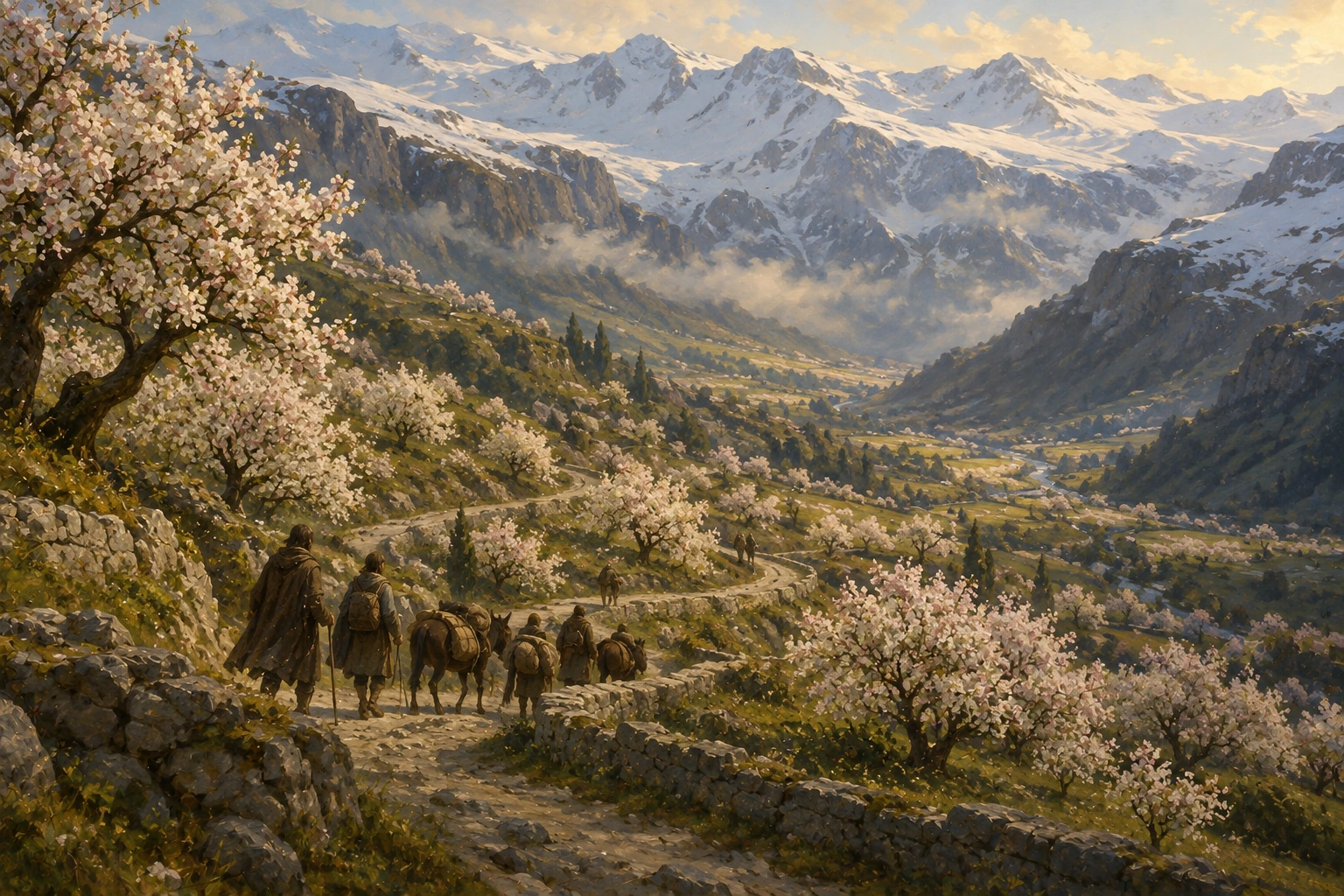
They came to it a little after midday, where the road bent around the shoulder of a low hill and the terraces below opened, all at once, into a wide bowl the slope had folded into itself long before anyone thought to plant a tree in it — and every tree in that bowl, this particular noon, stood in blossom.
It was apple, all of it, or near enough — the same hard little western stock Dorrit had already named twice that morning, grown thick and low and ancient along terrace after descending terrace. Every branch of every tree had given itself over, in the one brief violent week a fruit tree allows for the purpose, to white and the palest imaginable pink, so that the whole bowl stood dressed as if for a feast-morning nobody living had been invited to and nobody living had thought to cancel. Behind it, filling the whole northern rim of the bowl and half the sky, the higher slopes still held their winter entire — deep, settled, undisturbed white, exactly the wintering white Wren had first seen below the saddle, in no rush at all to give up its claim on the season. Spring had come up from the valley floor to meet them, tree by rooted tree, while winter still held every height above it, unbothered — the two of them sharing the same bowl of ground at the same hour with no more quarrel between them than there is between a fire and the cold room it is warming.
Nobody said anything for a little while. Bracken halted the string of his own accord at the bowl's rim, without being asked, and the company stood there together, in the road, in the blossom-light, and looked.
"They'll have picked it by their own timing," Luel said, at last, quietly, more to the trees than to any of them, "never any calendar — a hard little apple, sweetest the day of the first true snow. I told you that once, at the saddle, and did not tell you it looked like this, coming into bloom. I don't know that I had words ready for it, that morning. I'm not certain I have them entirely ready now."
They walked down into it slowly, keeping, without any of them saying so aloud, to the road's own worn line rather than wandering off among the trees — looked at, and loved, and let stand exactly as it stood, the same grammar that had kept them from stripping a beacon-basket bare or breaking a chisel-mark off a stone for a keepsake now applied, without a moment's debate, to a whole bowl of unguarded blossom that not one soul alive would have known was missing a single sprig of it. Dorrit alone stopped, near the bowl's low center, and took her small pruning-knife from her belt, and cut one short blossoming twig, cleanly, at a fork that would heal itself over by summer without the tree noticing the loss any more than a hedge notices a single trimmed shoot.
"Pressed, not taken," she said, holding it up a moment to the light before laying it flat between two pages of her herbal, careful of every petal. "There's a difference, and it's the whole difference, and I'll thank whoever taught me it, though I don't believe she ever once said it in so many words." She glanced, briefly and without making anything of it, toward Luel, who returned the glance with nothing more than the ghost of a smile, and closed the herbal's covers over the pressed twig with the particular satisfaction of a woman who has taken exactly one thing, and taken it properly.
They ate their midday bread sitting on the low terrace-wall at the bowl's western edge, with the blossom standing all around them like snow that had changed its mind about falling, and the true snow standing patient above it, and nobody was in any great hurry to be walking again.
The second day carried them on in much the same temper as the first had ended it, the road holding its westward line along a shallower stretch of valley now, the terraces thinning and giving way, mile by descending mile, to open meadow-ground gone rank and silvery with last year's grass, threaded everywhere with the loud, busy voice of thaw-water finding its own way downhill. The snow-line, which had stood along the road's own edge the morning they left the way-house, had by now drawn back uphill on both sides until it showed only in long pale streaks along the north-facing folds of the higher ground, retreating before the company at very nearly the pace the company itself was descending, as though winter and the Survey had agreed, without ever discussing it, to walk the same road in opposite directions and let the valley floor go to whichever of them arrived there first.
It was Pip, again, from the shoulder of a low ridge the road climbed briefly in the late afternoon before dropping to its evening's ground, who saw it — a single thin pale thread of smoke, standing straight in windless air far off across the folded country to the west-southwest, exactly where it had stood, thinner and farther, the morning three days before when he had first found it with his own small travel-glass at the saddle's northern lip.
"There," he said, and did not point with his whole arm, only stood, and let the rest of them come up level with him.
Iyene had the lens to her eye before anyone had finished arriving. "Nearer," she said, after a while, in her flattest and most careful voice, the voice she kept for facts too large to dress up in either direction. "A day's walking nearer, on my honest reckoning — perhaps a day and a half. Still steady. Still the one thread, and no other." She lowered the glass, and looked at it a moment longer with her own eyes alone. "Whoever tends it is tending it still," she said, "and has been the whole while we climbed a mountain and slept in a doorless house and admired an orchard, entirely without knowing any of us existed to be glad of them for it."
Nobody said very much beyond that. There was a held, glad quiet in the company for a little while, standing on the ridge with the light going long and gold across the country between them and the smoke — the same gladness Wren remembered from the saddle, only nearer now, and warmer for the nearness, and no more chased this evening than it had been chased that first morning.
"It's weeks off still, by the road we've got," Bracken said, at last, plainly, settling the matter without ceremony. "And the road's going that way regardless. We'll log it, and walk it, and let the one answer the other in its own good time." There was nothing in it to argue, and they went down off the ridge into the evening, the smoke logged in Iyene's flattest and most careful hand, and left exactly where it stood.
They made camp that evening on open ground for the first time since Merrow's own western road had turned to mountain under their feet — a broad, grassy shoulder above a bend in the valley's central stream, sheltered on its north side by a low stand of the same shaggy verge-trees that had lined the road all that day, and Bracken pronounced it, after one slow circuit with his flat assessing eye, "good ground, and dry, and near enough water without being fool enough to camp in its own bed," which from Bracken was praise enough to settle the matter entirely.
It was an ordinary evening's routine, near enough two hundred times repeated by now, and there was a particular, quiet pleasure in that ordinariness. Bracken picketed the string in a loose line between two of the verge-trees, checked each rope's give with his own hand, and pronounced the ground fit for four sensible animals to spend a night in without either of them arguing the point. Pip had a fire going before the last of the light was properly gone, small and true and patient exactly as he laid every fire, in open ground this time rather than a waiting hearth, and seemed to take a small private satisfaction in proving that the flint and the two hands worked exactly as well without three centuries of stonework helping them along. The stew went into Bracken's pot as it did most evenings — meal and dried meat and, this evening, a pinch of Luel's bread-herb, stirred in without comment and eaten with more of it than usual asked for. Iyene ruled a few last lines onto her working sheet before the light gave out, and stowed it, and said, to no one in particular, that a road behaved a great deal more honestly on paper than most roads had any right to. Watches were set in the order they had settled into weeks before ever reaching the Stair, without discussion. The whole camp felt to Wren less like a thing done for the first time on new ground than like a thing done for the five-hundredth time, in a place that happened, this once, to be somewhere new.
Luel took the middle watch, in her own fashion, sitting a little apart from the fire's full light, still, exactly as she sat every watch she had ever taken with the company. But partway through it, when the fire had burned to its own low steady heart and the rest of the camp lay sleeping, she began, very softly, almost beneath hearing, to hum — no tune the company had ever heard her give voice to before, no shape going anywhere in particular, rising and falling and wandering off after itself the way a stream wanders when it comes out, after a long confined stretch, onto open ground with nothing left to hurry it along. It was not the song-speech she had given them at the midwinter feast; it was not the lament, never sung whole in their hearing. It asked nothing of anyone, and seemed, so far as Wren — half-waking, and not troubling to wake the rest of the way — could tell, to want no listener at all, only the freedom of a first full night in her own country to let a little of herself out unwatched. The company kept its eyes closed and its breathing even, and let her have it.
Wren took the last watch again, by the same wordless understanding that had settled between her and Alder somewhere back around the saddle, and sat with her back against the smooth bark of a verge-tree, the day-book open on her knee, and looked out at a sky shifted just far enough from the one over Dall that she had to hunt a moment for the shapes she knew, and found them anyway, a hand's-breadth off from where memory kept them.
She wrote, in the plain steady hand a whole year of roads had given her:
We left the way-house two mornings back, fire out and ash raked clean — the first company in three hundred years, so far as any of us can tell, to walk out that door on purpose, going forward rather than away. Iyene says the western waymark we found today is the same grammar as Wystan's, spoken in a different accent, and I am glad the accent got the chance to survive at all, in stone, when the mouths that spoke it did not all get the chance to.
The smoke is a day nearer than it was at the saddle — one thread, steady, still weeks off by the road we have. We logged it and left it, because the road is going that way regardless.
The west has been keeping itself a long while, on its own, with no one to thank for the keeping. We are here to help it now, if it will only show us how — one road, one waymark, one blossoming tree at a time.
She closed the book on the finished page, and sat a while longer with her back against the tree, listening to the stream's thaw-loud voice below the camp and the mules breathing their slow separate rhythms along the picket line. Somewhere west of the ridge, unseen now in the dark, a single thread of smoke stood over a fire she had not yet met the keeper of. She woke twice in the night to check, without quite meaning to, that it was still there.