The Night of the City
"Not the square," Iyene said. "The chandlers' row, the narrow part, where two can hold what six would need in the open." She had not looked up from the fair copy since the horn first sounded, and she did not look up now.
The runner was Stanhope, young enough that the deep-delved pallor had not yet had time to become the whole of his coloring, and he read the sheet upside down without asking her to turn it, because her finger had already left the line she wanted and moved to the next. He ran. Behind him two more came for their own lines, and behind them a fourth, a Sereth girl who had ridden all night and would be riding again inside the hour, and Iyene gave each of them a street and a reason for the street and nothing else — no correction of anyone's salute, no comment on the state of anyone's boots, nothing that was not the war. When a Stanhope captain twice her age argued that the cistern square ought to be held instead of given up, she did not debate him. She turned the fair copy so he could see the ground draining toward the square from three sides at once and said, "Give it to them. They'll stand in three feet of their own dead by morning and never reach the row behind it," and he took the correction and went to obey it inside a breath, because a man could argue with her opinion and could not argue with a slope.
Wren stood at her shoulder with a lamp she had stopped being any use for, and understood, for the first time on the whole long road, exactly what the fair copy had always been for. It was not a record. It was an order given in advance, waiting three years for someone to need it. Pip stood a little further back holding the second lamp and a slate for messages nobody had sent him yet, his free hand pressed flat against his own thigh to still it before anyone could see it shake. Bracken went past him twice on his way to the gap, said nothing either time, and did not send him back to the Hall, which was answer enough.
"They're using our own roads against us to hold our own roads," Bracken said, from somewhere behind them, not stopping as he said it, a coil of chain over one shoulder and Suet's lead in his other hand though Suet had no business anywhere near this. "That's either very funny or it isn't funny at all."
"It's the second one," Iyene said, and sent the fourth runner off toward the cistern-house.
Word came back within the half hour that the third column, a mixed Ashcroft-and-Sereth unit posted to hold the tanners' bridge, had stalled at the wrong end of it and could not be reached by runner because the runner sent had not come back either. Iyene did not send a second runner. She went herself, on the leg Dorrit had told her a year ago she could slow but never mend, moving faster over broken cobble than anyone watching thought a ruined hip had any business moving, and stood in the open at the bridge's near end shouting the one correction that mattered — fall back to the second arch, not the first, because the first arch's footing had been undercut by the spring floods for longer than any map but hers recorded — until the unit heard her over its own noise and did it. She came back from the bridge with a graze along one forearm she had not stopped to notice taking and did not mention it again that night.
The horn had already sounded twice by then, and would sound a third time before the hour was out. Somewhere behind Wren, fire went up into the old iron baskets atop both gatehouse towers — baskets built into the stone by whoever had built the wall, and never lit in three hundred years, so that the first minute of their burning was mostly three centuries of dust going up bright and fast before the true flame settled under it. After that they simply burned, tall and steady, visible down every straight street with a line of sight to either tower, which in a city laid out the way this one was laid out meant nearly all of them. It was not a summons. Everyone who needed summoning was already moving. It was only the city telling itself, for the first time in longer than anyone living could account for, that it was awake.
The wall took Wren longer to reach than it should have, because every street between the merchants' yard and the gatehouse stair had someone running the other way down it, and she went against that current the whole distance with her elbows up, past a Stanhope woman carrying a child who was not hers and an Ashcroft man dragging a cart with nothing in it but tools, because tools were what he had thought to save. She had meant to look for one thing at the top of the stair and instead found herself looking, for exactly as long as it took to understand what she was seeing, at all of it.
The ground beyond the wall did not look empty. It had not looked empty for weeks of retreat and skirmish and grim arithmetic, and she had believed, in some private unexamined corner of herself, that she already knew what that meant. She had not known. Snow country ran from the wall's foot to the tree line a mile off, pale under a moon three-quarters full, and the pale ground was not still. It was moving without seeming to hurry — not a mass, not a wave, but individuals, thousands of individuals, each one walking at its own pace toward the same city, none of them hurrying, because none of them needed to. Three centuries had made that many of them, and three centuries had not once given any of them a reason to hurry. Every one of them had had a name once, spoken by somebody, in a room, or a field, or a doorway. She counted the fires along the outer dark for something to do with her eyes and gave up around the fortieth, said the number to no one, and went back down the stair before she was asked to look again. She did not look at it a second time that night.
They found Dorrit already working before the first true fighting had reached the second line, because a man had come off the outer wall with a spear-graze along his ribs that was bleeding more than it was dangerous, and because Dorrit had never in her life waited to be needed before deciding she was. She had the willow bark jar open on a barrel-head that served for a table, a strip of clean linen already wound once around her own left wrist to keep it out of the way, and the man's shirt cut open before he had finished explaining that it wasn't as bad as it looked.
"It's exactly as bad as it looks," she told him, not unkindly, packing the wound and binding it in the same four motions she had used at the steading and at Kelder and a dozen places that had never made it onto any map at all. "You'll fight again tonight. Not in the next hour."
Nine jars stood on the barrel-head at dusk, in the order she had always kept them, willow bark on the left where her right hand fell first, the numbing-leaf beside it, the black salve for burns furthest from the fire because heat spoiled it faster than cold did. She set the willow bark jar back at a precise distance from its neighbors — three others beside it, then a gap, then two more, the whole small chest laid out the way she laid out a seed-bed, so that her hand would know where a thing was without her eyes needing to confirm it. Wren, passing with water for the line, saw her do it. Dorrit had already begun counting, and the counting would not stop until either the wounded did or the jars did.
An Amarin woman of the handful who had chosen to stand with the muster rather than wait it out at the eaves brought her a second patient before the first man had finished lacing his own shirt, and watched Dorrit's hands the whole while with an attention that was not curiosity. "You do this the way you'd tend a garden that's on fire," she said, and it was not quite a compliment and not quite anything else either.
"It's the only way I know," Dorrit said, and did not look up from the second man's arm.
The staff leaned against the barrel within reach of Dorrit's right hand the entire time, iron shoe down, because she had learned at the steading's cellar door and again on Kelder's crown that a chest of herbs was worth exactly nothing to a wounded man if the woman holding it went down defending him with her bare hands instead.
Bracken held the chandlers' row alone for the length of time it took two hundred people to get past him and into the square behind, and he did it standing in a gap between two shopfronts no wider than a cart, exactly where Iyene's map had said the row would narrow, three years before anyone had needed the fact enough to go and check it.
He said four words the whole time. "Down." To a Stanhope man who had frozen at the sight of the first faded's face and needed telling twice before his knees obeyed him. "Move," to the column coming through behind. "Hold there," once, to whoever happened to be nearest the wall when he said it, and it was obeyed anyway. Every one of them was spent getting somebody else out of a mistake rather than on himself.
He did not swing wide and he did not swing twice. Each stroke was a decision already made before the faded reached the distance where the decision would have mattered, so that by the time anything arrived at the gap it met a blade already moving to the one place that would end it, and moved on to the next place without pause for the first to finish falling. A Stanhope woman named Brask, missing two fingers on her shield hand from some older winter, stood at the row's mouth passing wounded through behind him and watched the whole of it without once looking away, though she told Wren afterward, flatly, that she had wanted to.
Twice the gap filled faster than a single blade should have been able to answer, three and then four together, close enough that a lesser man would have stepped back to buy himself room. Bracken did not step back either time. He gave ground exactly as far as the width of the gap allowed and not a hand's-breadth further, and each time the press thinned again inside a dozen heartbeats, because there was nothing left in front of him to keep coming.
The row itself did the rest of the work. It had been a cart-track once, before the chandlers built their shopfronts to its exact width without ever thinking to widen it for their own convenience, and the company's survey had measured it to the hand three winters back for no reason anyone at the time could have named beyond thoroughness. Iyene had circled it twice on the fair copy and written one word in the margin: chokepoint. No one at the College had asked her why. She had not been able to say, then, why it mattered.
"I've fought in this war a year and I never saw a man do a thing like that," Brask said. "Not like it was hard for him. Like it wasn't a fight at all. Like sweeping." She said it flatly, not as praise. She sounded, if anything, like someone deciding, on reflection, that she was afraid of what she had just watched.
He was not touched. Not a graze, not a torn sleeve. When the column had cleared he stepped back from the gap the same half-pace, no faster leaving it than he had been going in, and picked Suet's lead back up from where he'd looped it round a hitching-ring, and the mule, who had stood the entire time with her ears flat and her feet planted and had not tried once to bolt, leaned her head against his shoulder as though nothing at all had happened, which for her, evidently, it had not.
Wren came through the gap a breath after the last of the column, following a Stanhope man who had gone down clutching his own leg and not gotten up fast enough, and saw the thing that had been reaching for him from the row's shadowed side before he saw it himself. She had time for one name and no more, and gave it — a stranger's, a soldier's, some chainman or drover three centuries dead who answered to being told he was dead the instant she said so, and folded without ceremony into the row's gutter. She did not stay to watch it happen. She had already turned to the next thing before the dust had settled, because there was a next thing, and because Bracken had taught her, on a fogbound moor a long stretch of road behind them now, that spending a breath admiring your own work was a breath the next person along did not have to spare you.
Three streets over, where none of the seven ever set foot that night, a Stanhope corporal held the joiners' yard with eleven people because the fair copy showed a well-head at the yard's center that had never been dug and marked on no living map but this one, and he had his people fight with their backs to a stone rim that could not be walked through by anything, living or otherwise. He did not know Wren's name and would never learn it. He knew only that the drawing his captain had handed him that morning had a mark on it his own eyes could not account for until he stood on the ground and found the mark was true, and that the ground it described had just kept eleven of his people alive. Word of it reached Iyene before the sun was fully up, and she said only that Wystan would have liked knowing his well-head still had work in it.
The square past the chandlers' row was where Luel had chosen to stand, and she had chosen it because it was the widest open ground between the wall and the Hall, and because what she meant to do needed room enough to be trusted before anyone could see whether it would hold.
She carried nothing. No blade, no stick, not even the coil of rope she had worn over one shoulder every day since the ford. She stood at the square's center with her hands loose at her sides and began, not loudly, a thing that was not quite song and not quite speech, in the old joint-tending shape Alder had named to the company in the Hall — the shape built for two peoples working one boundary together, Amarin voice and Meddani fire, because neither alone had ever been meant to hold a line this wide. No one in three centuries had tried to work it with only one voice. Luel worked it with one voice because there was no other voice in the city old enough to have learned the second half of it, and because there was no time left to explain to anyone why that mattered.
Partway through, without breaking the working's own rhythm, she named a well at the square's edge by a word that was not Aemuth and was not anything the company's chart had ever recorded — an older name for older stone, from before the square had a name Wystan could have written down at all, spoken as plainly as a greeting between two people who had not seen each other since before either of their grandparents was born. No one in the city could have corrected her. It was not offered as proof of anything. It was simply what came out of her mouth when the working needed a true thing to stand on, and the truest thing she had to hand happened to be older than the ground it was standing on.
The faded who came into the square did not fall. That was the wrongness of it, the thing that would keep Pip from sleeping that night regardless of anything else the night gave him to keep him awake: they did not fall and they were not cut and no fire touched them, and yet each one that crossed a certain unmarked distance from her stopped walking as though it had, in that step, forgotten the shape a walking person is supposed to make, and stood, and after a moment folded down into the snow the way wet paper folds, without violence, without a mark on it anywhere. She did this to eleven of them in the time it took Pip to cross half the square's width at a dead run to reach her side, because he had seen her standing alone and did not yet know she was not in danger, and by the time he reached her he had already gone still himself, several strides short of her, unable to make his legs carry him the rest of the way.
"Don't," Luel said, without turning, not sharply — the first thing she had said to any of them since the ford that was not a working. "Not closer. Not while I'm doing this." And Pip, who loved her, and who had spent three years thinking of her as the gentlest person on the whole long road, stood exactly where he had stopped and did not go one step nearer, because for the length of one working, in one square, in one city, she had stopped being someone it was safe to love without also being a little afraid of.
When it was done — when the square held nothing upright in it that had not been upright when she began — she let the shape go, set down rather than finished, rolled one shoulder as if it had stiffened, and asked Pip, in her ordinary voice, whether he had eaten anything since noon. He had not.
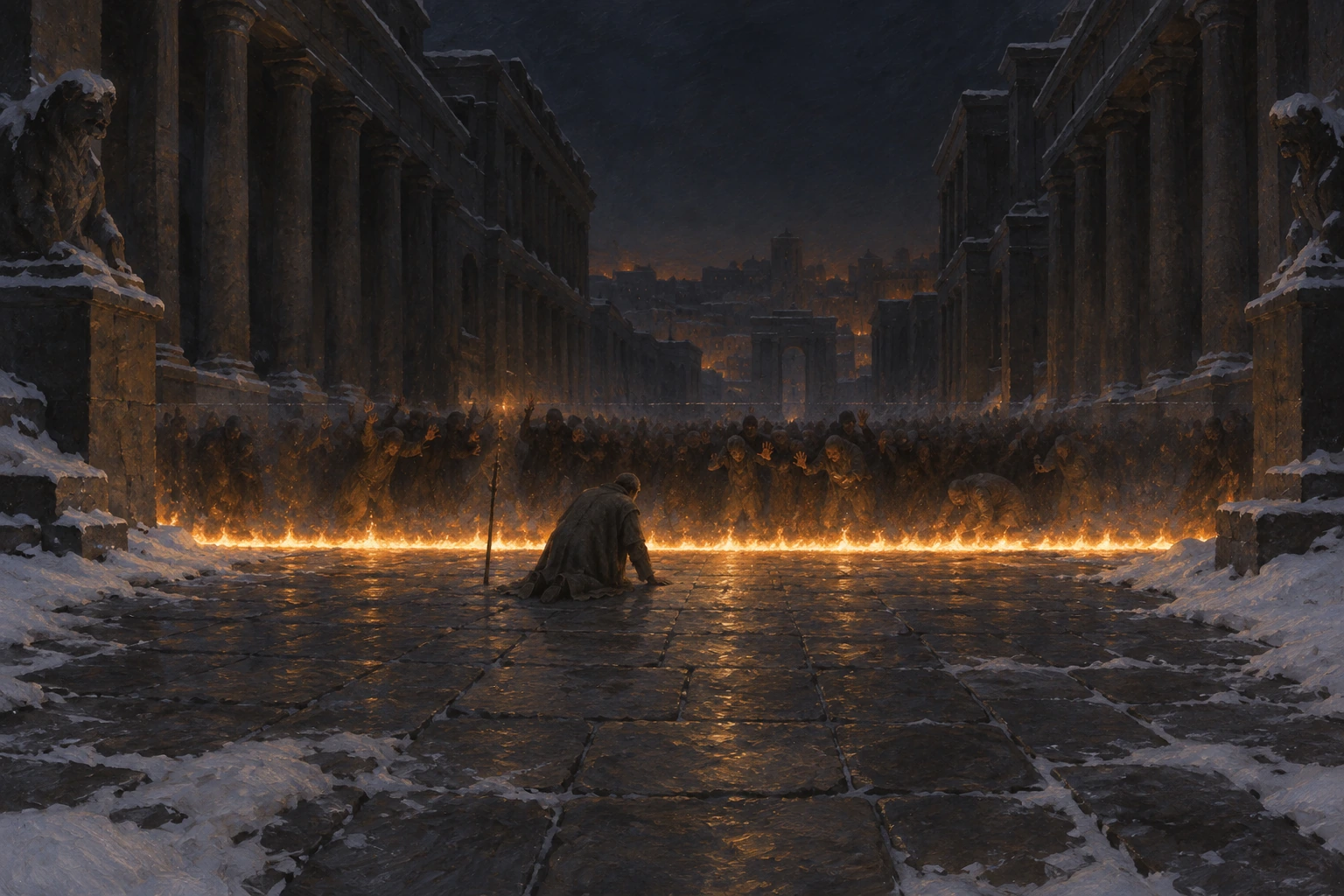
The avenue that ran from the square to Aemuth, and from Aemuth up the last broad rise to the Hall's own steps, was forty paces wide at its narrowest, and it was the one road in the city that could not be held by two people in a doorway, because it had no doorway narrow enough to matter. The retreat came up it in a ragged column three streets wide funneling down to one, Ashcroft's feet in front and Stanhope's iron at the rear turning to face whatever followed, and there was nowhere left behind them but the rise itself and the Hall at the top of it.
"That's forty paces of open stone with a colonnade down one side for cover and nothing at all down the other," Iyene said, meeting Alder at its mouth with the fair copy still under her arm, the only person in the city who might have argued him out of what he was about to do and choosing, visibly, not to spend the breath. "You've never held a line that wide. No one has. There's no beacon-hill this size."
"I know how wide it is," Alder said. "I don't know if it will hold."
He said it without weight added to make it sound larger than it was, and then he walked out into the middle of the avenue's width with the plain ash stick he had carried the whole length of the road without once needing to lean on it, and used its end to score a single unbroken line across the stone from the cistern-house wall on one side to the colonnade's first pillar on the other. Fire came up out of the score the way water comes up out of a struck spring, ankle-high, orange going white at its center, running the whole forty paces in less time than it takes to say so, and then it stopped rising. It did not gutter. It did not spread. It simply held its own height, as though some flat unseen hand were pressing it down from above and would go on pressing for exactly as long as it was needed, and nothing else.
The first of the faded to reach it did not slow before it arrived and did not choose to stop; it walked into the line's edge and stopped there the way a man walks into a shut door in the dark, with the particular confusion of a body that has not yet informed its own legs of the news. It tried the flame's edge a hand's width to the left. It tried a hand's width to the right. Behind it a dozen more arrived and did the same, testing the line's length the way water tests a dam, finding no gap anywhere along its forty paces. After a time — not fast, not panicked, because nothing in that gray country hurried — they began to turn aside, one and then a dozen and then what looked from the colonnade like most of them. They went the long way round instead, down toward the lower gate and the river stair, adding the better part of a mile to a night that was already longer than any of them had lived through the first time. Behind the line, the last of the column came up out of the avenue's throat and into the square proper, and a Stanhope sergeant who had not stopped moving in an hour stood still for exactly as long as it took to see what the fire was doing before he started moving again, faster, because there was suddenly ground to spare.
Brask had followed the column that far and stood now near the colonnade's first pillar with the Ashcroft woman beside her, a hay-fork filed to a killing point still in her two hands, and a Sereth boy no older than Pip a few strides further back, holding two horses that did not want to be held. All three watched the line take the avenue's whole width and hold it, and none of them said anything for the length of several breaths — which, from three people who had opinions about everything else that night, was answer enough on its own.
It held for the better part of an hour before anything tested it hard enough to matter. What came against it then was not one faded but a dozen together, arms and shoulders locked, throwing the whole weight of themselves against a stretch near the colonnade side as though enough of them leaning on a door might eventually persuade it, and for the first time since the line went up its white edge bowed — not broke, bowed, exactly as a green branch bows before it decides, one way or the other, whether to break.
Alder did not step back from it and he did not raise his voice. What he did was turn the same craft that had drawn the line to a different purpose entirely, without warning anyone he was about to, and put it into the dozen leaning bodies as lightning. It was not the clean disciplined light of a ward but a raw ungoverned branching thing, coming off the line itself and up through the press of them and out again into the colonnade's stonework hard enough to crack a pillar's foot. He spent it with none of the care he had used to draw the line in the first place — spent it, in fact, as though care were exactly the thing he had decided, in that instant, to do without. The dozen went down together and did not get up. The Sereth boy's horses reared hard enough to nearly take him off his feet, and he did not get them steady again for the better part of a minute. The Ashcroft woman's hay-fork dropped a full inch before she caught it. Brask did not move at all for the length of one whole breath, staring at Alder across forty paces of firelit stone with an expression Wren had no name for and did not ask her to supply one, because it was not admiration, and it was not gratitude, and it sat somewhere close enough to fear that the two were not worth separating.
Alder lowered the stick. He did not lean on it. His voice, when he spoke again, was the same voice he had used to tell Iyene he did not know if the line would hold. "Get me word if it bows again," he said, to nobody who needed telling twice, and walked back toward the square as though he had just finished checking a fence line rather than holding forty paces of a city against three centuries of the dead.
By the third hour past midnight, Dorrit's chest held four jars where it had held nine at dusk, and she had begun saying the count of what remained aloud to herself between patients, not for comfort, because nothing in her voice when she said it sounded like comfort, but because a woman who has run a bee-yard and a garden her whole life keeps an honest tally of what is left in a season whether the season is kind about it or not.
The black salve went on a Stanhope man's burned forearm, taken too close to Alder's line when the lightning found the colonnade's stonework. The numbing-leaf went to a boy whose collarbone had taken a blow it should not have survived and would need setting before it would need anything softer. The yellow-root went into a cup of hot water for an Ashcroft girl whose lungs had filled with the cold two nights running and who could not, at that moment, walk another step without it. Four jars became three, then two, then one, and Dorrit noted each departure aloud, the same flat notice she had once given a hive gone quiet, so that no one else needed to keep the count but her.
Twice more in that hour something came too near the barrel for her to trust to anyone else's blade. The first time she put it down with the flat of the staff before it had finished reaching for the boy with the collarbone. The second time the iron shoe caught it square, and the recoil split two knuckles on her own right hand against the staff's own haft. She did not stop working to admit the split knuckles hurt.
Bracken found Wren near the gap between the square and the last stretch of open ground before Aemuth, in the grey hour before the sky had decided which way it meant to go, both of them still standing only because sitting down had stopped, some hours back, being a thing either of them trusted themselves to get up from again quickly. He said what he had already told her once, on a fogbound moor a long stretch of road behind them now, so that this time there was nothing new in the saying of it, only the asking of whether she still meant her own answer.
"If it comes to it tonight," he said. "You know what I mean by it comes to it. You use me. I've not changed my mind since the moor."
Something was coming up the last open stretch toward them even as he said it — not a dozen, not a press, one faded alone, moving faster than the rest of that slow country ever moved, close enough now that the distance between deciding and acting had gone very small indeed. Wren had a full breath in which she could have reached for Bracken's offered strength and ended it the way her mother would have ended it, all at once, borrowing everything he was willing to give her to make certain of a single stranger's death before it was within ten strides of either of them. She did not take the breath that way. She reached instead for the one name the thing still answered to, said it plainly, without haste, the smallest working she knew how to make of it, and it folded three strides short of either of them, spending nothing of Bracken's at all.
"No," she said, once it was done, answering the actual question and not the smaller one the moment had just posed. "Not for that. Not for anything I can do myself with what I already have. If it's ever really down to nothing left in me and nothing left in the two seconds — then yes, and I won't waste the seconds arguing it with you. But not tonight, and not for that."
She had expected, some part of her, that saying it plainly would feel like relief, the way handing back a borrowed weight is supposed to feel. It did not. It felt instead like the harder of the two answers she could have given him — the easy one would have been to take what he offered and let the deciding be his instead of hers, and watching him take the refusal without argument, she could see he had known that too, and had offered it to her anyway.
Bracken looked at her for a moment that did not go on especially long, and did not thank her for the refusal and did not tell her she had done well, because both would have made it a smaller thing than it was. "Good," he said, which was the same word he had given her the last time, and picked his blade back up from where he had set its point against the stone while he waited to find out whether tonight would be the night his offer got spent.
The Sereth boy from the avenue found her not long after that, leading his still-jittery horses by hand because he could not trust them to stand tied, and asked if she had anything for a burn. She had the black salve, once. She did not have it now. She told him so plainly, and told him to pack the burn in clean snow instead until someone found him something better, and he thanked her and went to do it, because plain was better than nothing and both of them knew it.
The last jar went not long after that, on a Sereth rider brought in with a wound Dorrit looked at for exactly as long as it took her to know it was the only jar left that could do him any good, and that there would be nothing behind it for whoever needed the next one. She used it. All of it. Then she stood with an empty jar in her hand and two more wounded already being carried toward her across the square.
She did not send for more. There was no more to send for; the chest had come from Dall by way of three years and two winters, and whatever grew in this ground had not been gathered by anyone in three centuries and was not going to grow itself into bandages by morning. She set the empty jar down where the willow bark jar had stood at dusk, in the same precise place, because an empty space kept its order too, and turned to the two who were still coming, and did for them with her hands and her own spit-cleaned linen and the flat unmedicined pressure of her own two palms what she had, an hour before, been able to do with a spoonful of something out of a jar. It was slower work and worse work and it was the only work left to do, and she did it without once looking back at the row of empty jars to see how much worse it might have gone with something in them. The last man she bound up that hour caught her wrist for half a heartbeat before she pulled free for the next one, and that was the whole of the thanks anyone had time to spend. She had not asked to be thanked, then or at any other hour of that whole long night, and by the time the sky had properly begun to lighten she had stopped expecting it, which was not the same thing as minding.
Dawn found the seven of them on the Hall's own steps, in an order that had simply happened, unplanned and unremarked on: Bracken lowest, blade still out, because the last stretch of open ground still wanted watching; Dorrit two steps above him with her staff and her empty chest and her two ruined knuckles; Luel above that, quiet now, her voice spent to something Wren could hear only as a kind of held breath; Pip beside her, tremor and all, holding nothing but himself upright, which that morning was work enough. Iyene stood on the step below the door itself, the fair copy still under one arm and a graze drying dark along her forearm that would go unbandaged until well past sunrise; Alder at the threshold, unbowed, unleaning, exactly as whole as he had been at midnight; and Wren beside him, with four names still ringing faintly in some part of her that would need, later, and not now, to be counted properly.
Seven was the number a charter had sworn to, three years and a whole world of road ago, in a room none of them could any longer clearly picture, and it had not been seven in a long while — six for a season, then six and four Amarin who were none of them anymore, then seven again only ten days past, at a ford that had cost the company four of its own to buy the west its crossing. No one said the number aloud on the steps that morning. It was simply, for the length of that one dawn, true again.
Behind them, down the rise and past Aemuth and past the wall the line had held all night, a country was still standing that three hours ago no one would have staked much on. Ashcroft's tired feet still held the outer streets; Stanhope's iron still turned back what came round the long way from the river stair; Sereth's riders still carried word from wall to wall faster than anything the enemy had; and under all of it, held open in a woman's arm on the highest step, was the fair copy of a country the seven of them had spent three years learning to draw well enough that other people could hold it without them.
Below them the square was full of people who had not slept and did not look, yet, as though they intended to — Ashcroft foot sitting where they had stopped moving, Stanhope iron still standing because sitting had not occurred to them, Sereth riders walking their blown horses in slow circles to cool them, and here and there, threaded through all of it without any of them being asked to be there, an Amarin voice offering water to whoever was nearest, because that particular kindness did not require permission from any charter and never had. None of them looked up at the seven on the steps. They did not need to. The line had held, the square was theirs, and for the length of one grey morning that was the whole of the news anyone required.
The sun found the lowest step first, then the one above it, and it was some while yet before it reached the seventh and found all of them still standing there to feel it arrive. The door at their backs had not opened. Nobody moved to open it. It was enough, for that hour, that it had not been passed.