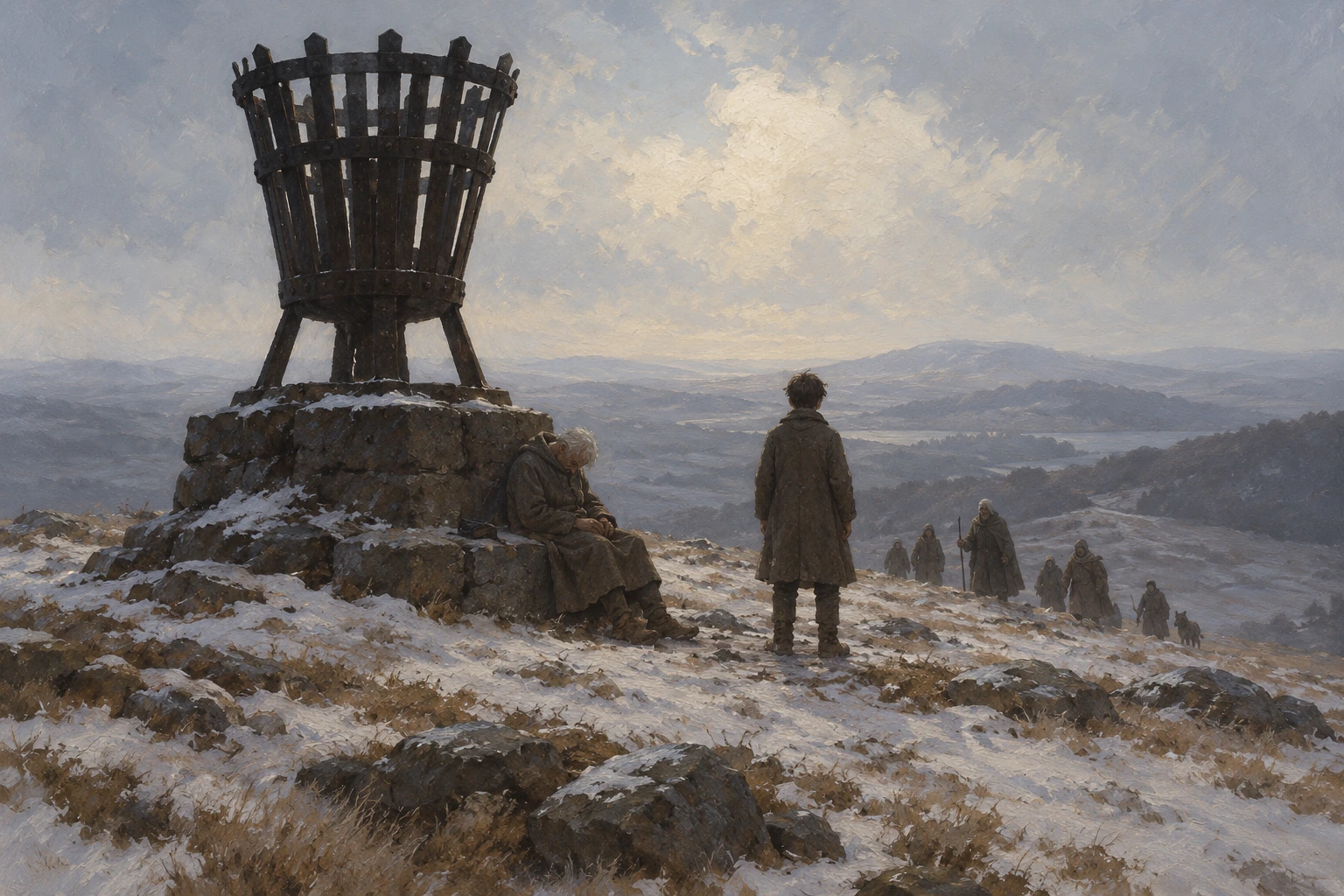
The Watch Death Kept
Bracken had the glass on Wakelow's crown an hour before they reached the climb. He held it there a long moment, and then he handed it to Alder, and Alder looked, and handed it on. No smoke stood against the grey run of the sky. No point of light watched for the evening that was still some hours off, though every one of the seven walking toward it had seen this particular hill's fire from this same stretch of road before, some of them with their own eyes and all of them a dozen times over in the telling of a man who had never, in a life spent almost wholly alone up there, thought to call it remarkable. They only kept walking, and where the road left the valley floor to climb, they left it too, single file now, mud to the ankle, the mules taking the grade in the same patient rhythm they took every grade that had ever been put in front of them.
The last of the road below the hill had gone over, as the whole country had, into the pale grey mud of thaw-time — not the black sucking stuff of autumn, but a colder, thinner mud that let a boot down slowly and then held it fast, so that every stride wanted a small decision made about where exactly to put it. Every one of the seven had made that same decision several thousand times since the season turned, and no longer thought about making it at all. The fields either side, white a month before, showed green now in patches ahead of their own dead grass, the new growth outrunning what the old had managed to rot down, and a wind came steady off the higher ground behind Wakelow the whole way up, cold enough still to want a collar closed at the throat even at the height of the day.
The silence that settled over the party on Wakelow's lower slopes was not a silence anyone was keeping on purpose. It was the silence of seven people with nothing between them worth saying aloud, climbing at a working pace because the day held a fixed number of hours of usable light and the hill held a fixed height, and both facts sat plainly enough in everyone's legs and lungs that neither one needed remarking on.
Bracken fell behind before the first quarter of the climb was done. His knee, taken three days before under a swollen door-prop that had nothing at all to do with this hill or the man on it, was strapped tight under his trouser leg and did not care which slope it was asked to climb. It never had. He took the grade in a hitching, deliberate rhythm that had nothing to do with caution and everything to do with a joint that would no longer do what the rest of him asked of it without being paid for first. He kept his own pace and let the party keep theirs, and by the second turn of the track the gap between him and the nearest of them had opened wide enough that anyone looking back could have set a watch by it. At the foot of the slope, before the ground had properly begun to climb, Dorrit had looked once at the strap where it showed dark above his boot and told him, in the flat voice of a woman who had set the joint herself and knew precisely what climbing on it would cost, "That'll cost you three days you don't have to spend, and you'll spend them anyway." Bracken said nothing back, and started up the slope.
Wren was little better company for the hill than her own legs were for her. Four days out from the worst spending of her life and still finding her balance short on level ground, she went up Wakelow the way a woman goes up a staircase with a fever behind her eyes — steadily enough, and paying for every step in a coin nobody else on that slope could see her spending, cold through her coat two hours before the air itself turned properly cold. The rest of the company kept their own pace ahead of her and let her keep hers, which on an open hillside, whatever it might have looked like from level ground, was the whole of the courtesy this company had ever shown each other.
Behind them, down the long fall of the beacon-line, two fires already lit that morning stood small and pale against the daylight distance, doing in full sun what any fire does badly in full sun — burning, and barely troubling to look like it.
Pip went up faster than any of them, the way he did most things that asked for speed and a clear task and nobody else's pace to mind but his own, and he cleared the last rise below Wakelow's crown a full quarter hour before anyone else was close enough to see what he had found there. The wind up there ran harder than it had lower down, funnelled by the shape of the crown itself into a steady push that had nothing to do with the season and everything to do with the ground beneath it, the same wind that had been finding that same stone for longer than the house below it had stood.
He stood exactly where he had stopped, at the near edge of the cold fire-cradle, and did not call down or come back for the others, and the hill kept whatever sound there might have been in him. When Iyene came up over the last of the grade with Luel a stride behind her, he was still standing there, and before either of them had finished getting their breath back he said the only four words the moment seemed to want. "He never got up."
Luel arrived a moment after and looked once at where he sat, and said only, "Facing it the whole while," and nothing more.
Rafe Rowan sat where the cradle's own stonework gave his back a wall to lean against, facing east, down the whole visible run of the beacon-line — the exact direction the company had always understood him to face, on the nights he had told them what keeping this hill was like from the inside of it. His flint and steel lay on the flat stone beside him, set down rather than dropped, close enough to a hand that would not be reaching for them again.
He had been that way since some night in the deep of the winter just past, and the cold that had kept him company through the months since had kept him decently. There was nothing on that crown that asked for a second look. None of them gave it one.
What the company did with the next hour of daylight was work, plain and immediate and without ceremony.
Bracken went to the woodstore before he had so much as set down his own pack, and stood in its low doorway counting what remained of it course by course, murmuring figures to himself that nobody else in the company needed and that he wrote down nowhere. "Full store," he said once, to the doorframe more than to anyone standing near it. "More than wanted burning."
Dorrit went past him into the house itself, ducking under the low lintel of the one room the company had made sound the summer before, and moved through it with the same flat professional attention she gave any patient she already suspected would not need much from her — touching nothing that had not gone wrong through neglect, setting right nothing that had gone wrong through absence instead.
Iyene took her book out on the open crown itself, in a wind steady enough to lean on, and wrote the day's date at the top of a fresh page in her own small even hand, and beneath it a line about the cradle's condition — cold, sound, its ash long settled and undisturbed. It was exactly the voice her book kept for any dark hill on the whole length of the line, because that voice was the only one the book had ever needed, and she reached for no other one now.
Alder stood longest at the fire itself and did nothing that any of the others could have named as doing anything at all — no word said over the stone, no hand raised, no craft spent that any of them felt the cost of — only a man standing in the place where a friend of his was, for as long as it took Bracken to finish his count and come back out into the daylight.
Wren did what her four days let her do. It was not much. She coiled the surplus rope the climb hadn't needed, kept to the lee side of what wind there was, and watched the other six move through the morning's work without finding, in herself, anything equal to joining it.
The house itself told its own story to anyone who walked through it on some ordinary errand that made the walking necessary rather than a thing done for its own sake, and over the course of that hour every one of them did. The one room the company had patched the summer before — new thatch laid over the old rafters, the single sound wall built up again with stone Bracken and Dorrit had carried to the crown themselves — stood exactly as they had left it, swept and dry, smelling of the same tallow smoke it had smelled of every evening they had eaten a meal inside it. The woodstore beside it, roofed and walled against a weather that had never left this crown alone for long, stood nearly as full as the day the company had finished building it, laid in against a winter that had, in the end, wanted less of it than any of them had cut. The rest of the house — the roofless rooms open now to a sky that had rained and snowed and thawed through them all winter with no hand left to mind them, the burned rooms whose blackened lintels the company had left exactly as found the summer before, and the low doorway at the gable end that none of the seven had ever seen opened in either of their two visits to this hill — stood precisely as it had stood then, weathered a season further and untouched by any hand since, and stayed as unentered now as it had been the day the company first climbed to it. Snowmelt had come down off the higher part of the roof all winter and worn a narrow channel into the ground below the eave, and a first green fringe of moss had already taken hold along the wettest of the fallen stone, doing to that ruin exactly what a season does to any ruin left alone with weather long enough. "Leave the roofless end be," Alder said, mildly. "It isn't going anywhere else this year either."
Dorrit's currant bush, re-potted and set against the south wall on that same summer visit, had put out a full season's growth, unpruned. It had grown anyway. The three rows she had turned over beside it had gone to seed and back to weed both. She looked at all of it for a long moment with her jaw set hard enough to show, and said only, "It wanted staking in June, and there was nobody here to stake it," before she went back inside to the room that needed her more.
The wood in the store told its own arithmetic to Bracken's eye alone, worked down from the near end first, course by course, exactly as he had taught it the summer before — which meant a man had gone on doing the work he had been shown for as long as there had been a man left standing on that hill to do it, each course drawn a little further down than the last, all the way to the narrow gap of unused wood at the very back that no living hand would ever now need to reach. A pot sat scoured and set upside down on the hearthstone, cleaned and put by for use on a morning that had not come. A lamp stood trimmed and half full on the sill of the one sound room, wicked and ready, waiting on an evening that likewise had not come, its wick cut clean and square in the same working way Bracken cut his own, learned or copied from him nobody could now say which.
It was Dorrit who found the sheet, folded once and weighted under the lamp's own base as though it wanted keeping safe from a wind that could never have reached it there. She opened it, read it standing, and read it aloud once, flat, to the room rather than to any one person in it. "A mark for every night, from the day they left."
She folded it back along its own crease, set it exactly where her hand had found it, and went to see what else the room wanted of her.
Bracken walked the crown's whole circuit before he would let the fuel be laid, and found nothing on it worth the walking — no track pressed into ground that the season's own thaw had not made itself, no mark on stone or turf that spoke of anything at all beyond ordinary weather doing to unwalked ground exactly what weather does. "Nothing's crossed this ground since the melt," he said, and Luel, a few strides off, said only, "Nor before it," and that closed the matter.
Pip laid the fuel the way Bracken had taught him to lay it on every dark hill since the fourth week of the whole Survey, small dry stuff first and the split wood built up around it in a shape that let the wind do half the work for him, and Bracken stood over him without a word, because there was nothing in it to correct. Rafe's flint and steel came off the stone into Pip's own hand, worn to a shape smoothed by a single grip and no other, and it sat awkwardly in his and struck badly for it the first time, the spark falling short and dying in air gone damp with the day's thaw. "Wants a drier catch," he said, and struck again, closer in against the tinder. The second spark held. It grew from there, taking its usual quarter hour to become a flame no different in the making from forty others the company had lit this same way the whole length of the beacon-line behind them.
Alder gave it no charge and no formula when it caught, because there was no dark hill here waiting on one and no charter left to discharge — only a fire that had never in its own memory gone out being made, this once, by other hands than the ones that had always made it, to go on doing exactly what it had always done. "Mind the wind's quarter," he said, to Pip more than to anyone else. "It'll back round after midday, this time of year, on a hill open as this one."
Below the crown, on ground that had been Rafe's own dooryard for as long as the house had stood on it, they laid a second fire out of wood the company had cut for him with their own hands the summer before, wood he had not lived to burn. It was built as any working fire is built and lit as any working fire is lit, with nothing said over it and nothing done to it beyond the building and the lighting themselves. Dorrit, laying the last split length onto it, drew a breath as if to say something the work itself did not call for, and spent the breath instead on lifting the wood into place.
Iyene wrote her line in the standing form, the same three words she had written over every dark hill the whole length of the line, without pause and without comment.
Lit once. Keeper wanted.
The afternoon went the rest of the way into evening while both fires settled from their first eager catch into the steadier, quieter burn a fire keeps once it has decided to go on burning. The company ate what Bracken had carried up rather than anything drawn from Rafe's own stores, standing, without ceremony made of it either way. Dusk came early on that open ground, as dusk comes early wherever there is nothing higher than the hill itself to hold the light a while longer.
The company stood the whole of that night on the crown in the rota Dorrit's sheet had given them without ever meaning to give it — first watch to last, in the same order the marks had run night after night through a whole winter kept by one man, and now ran, for one night only, kept by seven. It was ordinary work of a kind the company had done down the whole length of the beacon-line a dozen times before. Wood came up from the store below in armfuls against a cold that climbed off open stone faster than any fire could put it back; boots stamped for warmth on ground still holding the day's thaw; a stick went into the flame at the hours when a stick at a time is all a fire wants and nothing more will do it any good. Few of them spoke through much of it. Every one of them had stood colder watches than this one, down safer roads than this one, and the cold itself was the least of what kept the crown quiet through the dark hours.
Iyene took the first turn at the fire itself, feeding it small and steady, as she fed any working fire she was given charge of, and used the hour to walk the crown's edge twice over with her own lamp. Pip took the second turn, and spent most of it splitting kindling smaller than the fire strictly wanted, working the wood down into pieces that would catch fast and burn even, because it was work his hands knew how to do without asking anything of the rest of him. Luel sat through the whole of the night as she sat through every night the company had ever kept a watch, unlisted on the rota and never absent from the fire's light. Dorrit took a turn with her wrists wrapped against the cold as she wrapped them against any long night's work, and spent most of hers carrying wood rather than watching anything, because carrying wood was the one part of the work that did not ask her hands to sit idle in the cold and think. Bracken stood his own turn on the leg Dorrit had strapped twice now, planted rather than pacing, and fed the fire from where he stood without once shifting his weight off the good side of himself more than the work required.
Somewhere in the second hour of full dark, Dorrit knelt by Bracken's leg at the fire's edge and worked the strap loose enough to look at the joint beneath it, and did not like what she found there any better than she had liked it at the foot of the hill. "It's worse for the climbing," she said, flat, refastening the strap tighter than it had been. "It was going to be worse regardless. You've only decided which day it happens on." Bracken said, "That side wants taken up half a turn," and let her take it up.
The stars that night stood out plainly over open ground with no weather between them and the watcher, thick toward the middle hours and thinning again as the sky began, very slowly, to consider morning. Alder took a turn at the fire without being asked and gave it back without comment when his hour was done. Nobody in the company slept more than an hour or two at a stretch, and none of them had expected to.
Wren wrote in her day-book during the second watch, because the second watch had always been hers to write in and there was no reason on this hill to change that now. She set down the date and the hill's name; that the fire below the crown was relit, and by whose flint it had caught; the tally-sheet, in a single clause, and where its marks had stopped. Then, once, she copied out the line Rafe himself had given the company at this same fire, word for word: a watch shared is a watch a man can die still keeping, instead of only dying at. She closed the book on it and did not open it again before the light came up.
The cold found her before it found the others; these four days, it always did. She kept her place at the fire's edge anyway, feet numb inside her boots well before numb feet were worth mentioning to anyone, and stood her hour out to its end like everybody else on that rota.
It was well past the middle of the night when Bracken spoke again, to no one in particular and to Iyene most of all, in the careless half-voice of a man testing a thought he had not yet decided to have. "Somebody could keep this one going," he said, looking at the wood rather than at her. "Not forever. Just — kept." He did not say the word himself. Everyone at the fire heard it just the same.
Iyene did not look up from the flame either. "Six of us cannot do what seven can," she said, "and a fire kept here closes nothing that needs closing," and that was the whole of her answer, given once, in the same flat working voice she gave every other figure that had come to her that whole winter — and she was right, and she knew exactly what the rightness cost him, and gave it to him anyway.
Nobody else spoke. Alder did not settle it one way or the other, and Dorrit, across the fire, kept her eyes on the wood in her own hands rather than on either of them. Bracken said only, "Aye. I know it," and fed the fire instead of the argument, and kept doing that for the rest of the night.
Once, near the turn of the night, somebody looked east from the crown's own edge and saw, small and far apart, exactly the fires that had always stood there and none that had not, and looked back to the wood.
Dawn came up grey and ordinary, the way any dawn comes up over an open hill in mud-season, thin light finding the wet stone before it found anything else worth finding on that crown. The wind had eased some time before first light and left the morning still enough to hear the fire clearly for the first time since it had been fed. The company broke camp at first light without a word wasted on the deciding of it, the loads going onto four backs in the order they always went, buckles drawn tight in the same sequence they were drawn tight every morning of the Survey, straps checked twice on the mules and once, out of habit rather than need, on Bracken's own knee. Suet, Barrow, Nettle, and Gable were brought round from the flat ground below the crown, and took the track down at the same patient pace they had taken coming up, mud to the ankle again within the first dozen strides, the whole party spread out along the slope the same loose way it had climbed it, Bracken again last and slowest and minding it not at all.
Pip stacked a full night's wood beside the cradle, cut the summer before and close to hand.