The Last Inn
Hewett's dust hung on the southern air a long while after the cart itself had gone out of sight. After that there was nothing on the road but the seven of them, and the climb.
Bracken knew the second day's stretch by name before they reached it — the Long Shelf, the border watch had always called it, from his own years patrolling this road — and had warned them the evening before, mildly, that it wanted respect rather than fear: a mile and more of the King's Road West cut into the flank of a steep fell, the ground falling away sharply below into a scree-choked gully and rising just as sharply above, the frost having a way of working under a shelf's outer edge that no traveler's eye could catch until the ground told him so itself. Iyene admired the retaining wall's old mortarless coursing as they came onto it, stone fitted so exactly it had held generations without complaint, until Bracken, walking ahead with his eyes on the ground rather than the stonework, called back that admiring could wait until they were off it.
It happened without warning of any kind — no crack, no groan of settling stone, nothing a person could have watched for and known to step wide of. One moment Nettle was picking her way along the outer line with her usual sour composure; the next, a full stride's width of the old shelf simply let go beneath her hind feet, frost-heaved and rain-loosened together, and went down into the gully in a long grey slide of scree and broken wall.
Bracken had been at the string's head, testing nothing because there had been nothing yet to test. He was back along the shelf and past two mules before Wren had properly understood what she'd heard, and had Nettle's lead in both hands and his own boots braced against the good stone behind him before the mule's hindquarters had finished going out from under her. She screamed — an ugly, un-mulelike sound none of them had heard from her before and none of them wanted to hear again — and scrabbled, and for three or four long heartbeats hung half over the edge on nothing but Bracken's grip and whatever purchase her own forelegs could find in crumbling stone.
He held her. He would have held her regardless of what it cost him, and it cost him a great deal: something in his shoulder gave with a sound she felt more than heard, a wet, wrong give entirely unlike the crack of the falling wall, and he did not let go of the rope even then, taking the whole of Nettle's scrabbling weight on an arm that had stopped, from that moment, working the way an arm is meant to work. Dorrit had him by the collar an instant later, and Pip had the second lead, and between the three of them and Nettle's own furious, ungrateful will to live, the mule came back up onto sound stone with a lurch that put them all down in a heap against the inner wall.
Nettle stood shaking, ears flat, one flank scraped raw. The pannier on her outer side had not come up with her. It had gone into the gully with the wall — grain, a wedge of hard cheese bought new in Merrow's market and only half gone, and, wound in oiled canvas at the pannier's bottom where Bracken had packed it for exactly the trip it was never meant to make, the second coil of good rope. One to use, and one to lose, he had told Pip, in a stable yard a hundred miles south, and the road had taken him at his word.
Nobody said it wasn't so bad. Nobody said they'd manage. Bracken sat back against the inner wall with his ruined arm cradled against his chest and his face gone the grey of a man doing careful, silent arithmetic with pain, and for a long moment the whole company simply stood in the cold with a mule shaking beside them and a gap in the road's edge where solid ground had been an hour before.
"Let me see it," Dorrit said, already at his side with her chest half open.
"It'll keep." Bracken did not look at her. "Get the mules off this shelf first. I'll not have another go the way Nettle went while we're standing about my arm."
"Bracken."
"I said it'll keep, Dorrit." It came out harder than anything Wren had heard him say to any of them since Merrow, flat and short, a man's voice with all the courtesy stripped off it by pain he wasn't troubling to hide anymore. Dorrit's face went still in a way Wren recognized — not from hurt exactly, though there was hurt in it, but from the particular stillness of someone deciding, on the spot, that being reasonable about this would not be won standing on a half-collapsed shelf with four mules still to move. She closed the chest without another word, and went to the mules instead, and did not offer again.
They got the string off the Long Shelf within the hour, walking each animal singly along the inner line with a hand on every lead, and made a cold camp a mile on at the first level ground the road offered, well short of anywhere Bracken would ordinarily have called a good stopping-place. It was there, with the light nearly gone, that Dorrit finally got the coat off his shoulder and her hands on it, and worked without a word the whole time, which from Dorrit was a verdict in itself. The joint had not come fully out of its socket, she judged, working it by careful feel in the last of the light — but something in it had torn or badly wrenched, and there was no mending that on a mountain road with what she carried, only binding it close and still and hoping the mending did itself, slowly, the way such things generally had to.
"You'll carry nothing on that side," she told him, "and you'll not lift with it, and you'll tell me the day it feels different, better or worse, because I mean to know either way." She did not soften it, and she bound the sling tight without telling him he had been a fool to hold on, or brave to hold on, or anything else that would have turned the moment into something easier to carry than what it clearly was. She only worked, quick and sure, her mouth a flat line the whole while, and when she'd finished she stood and went to see to the fire without being asked, and did not sit near him that evening, though there was room enough.
Bracken did not apologize that night, for the yard in Merrow or for the shelf or for anything at all, and the space between the two of them where their old easy back-and-forth usually sat was not going to mend itself by morning simply because morning generally mended things in this company. Some hurts wanted longer than an evening. She wrote it down later, more starkly than she wrote most things: Bracken's shoulder hurt badly on the Long Shelf, saving Nettle, and the spare rope's gone into the gully with half the wall. Dorrit's bound it, and is right to be short with him, and neither of them is ready yet to say so to the other.
On the third afternoon, an hour or so short of dusk, it began to snow.
It was not real snow — nothing that would have troubled a shepherd, nothing that lay — only a scatter of dry flakes borne sideways on a wind with a genuine bite in it, here and gone again within the half hour, the year's first. Every one of the company found some reason to stop walking for a moment and simply watch it happen, much as people stop to watch the first swallow or the first ripe plum — not because the thing itself is large, but because it is a marker, and the mind likes markers. Bracken pronounced it, with the satisfaction of a man whose long-held opinion has finally been vindicated by the sky, "About time," and left it at that, which from Bracken was itself a kind of ceremony.
They saw the lamp a full mile off, while the light was still going out of the sky behind the western ridge in long grey-gold bands. It stopped every one of them for a second look, the same way the snow had: a single steady point of yellow, low down in a fold of the land where no light had any business being, burning on with the calm insistence of a thing that has burned there every dusk for longer than anyone walking toward it has been alive. Iyene, walking with her lens forgotten around her neck for once, said only, "There," in the tone she used for a well-drawn hillside, and let it stand as her entire opinion.
It was the last lamp on the road. The border watch lay somewhere beyond it, unlit yet, a handful of days off still. This one light, burning between the empty climbing miles behind them and whatever waited ahead, felt — to Wren, walking the last stretch with her hood down so the cold could get properly at her face, the way she always wanted it at the end of a long day's walk — less like an inn's sign than like a hand left out on a sill for a child come home late.
The sign itself, when they came under it, proved to be a painted storm-lantern, the kind a shepherd carries against weather that means business. It had been repainted so many times over so many years that the older colors showed through at every worn edge — a rim of blue under the black, a ghost of red under the blue — so that the whole board was less a single sign than a small stacked history of every hand that had ever thought it worth keeping bright. Beneath it, carved into the lintel-stone in old, worn, entirely legible letters: THE STEADING LAMP.
The yard smelled of woodsmoke and wet stone and, faintly, of bread. A broad, easy-going man came out to meet them before Bracken had so much as got Suet's lead-rope properly in hand — big through the shoulders, slow in his movements as large calm men often are, wiping his hands on an apron that had once been white.
"Tam Rush," he said, looking the company and the mules over with frank, open pleasure, "and welcome to it, whoever you are and wherever you're bound, though I'll own I can guess the second part, there being only the one road left to be bound on from here." His eye caught the College mark stitched small on Iyene's field-coat and widened a fraction, and he did not ask about it, which Wren thought said something good about him before he had spoken another word.
He and Bracken fell into the stabling with the immediate, wordless understanding of two men who had each spent a life reading animals rather than people. Tam's eye went once, and only once, to the arm Bracken was keeping close against his own side inside his coat, and he said nothing about it beyond quietly taking the heavier end of every job that came to hand for the rest of the evening — one countryman doing for another, without either troubling to name the favor. It went smoothly enough until Nettle, offered a friendly hand by one of Tam's grown sons, closed her teeth with great precision on the boy's sleeve and let go again at once, entirely satisfied, having made her opinion of strangers known for the evening.
"She does that," Bracken said, with the weary dignity of a man long past apologizing for it. "It's nothing personal. She'd bite the King himself, charter or no."
"So would half the watch, going by the stories," said a voice from the doorway. By the time the company had got itself and its baggage properly indoors, the tale of Nettle's welcome had somehow travelled ahead of them into the long room and set two men by the fire laughing before anyone had been introduced at all.
The long room took Wren the way deep water takes a swimmer who has only known shallows: all at once, entirely, past resisting. Heat first, real heat, banked and thick and smelling of good burning turf; then the smell of bread, and under it wet wool drying somewhere near the hearth, and under that the sweetness of a stew that had been minding its own business over a low fire since noon. Boots stood in an untidy honest row by the door, a dozen pairs at least, and the company's own joined them one by one — Wren peeling off wet leather with the small, private, disproportionate happiness of a woman who has walked in it since dawn — until seven more pairs stood steaming gently among the rest. It was, she thought, the first roof any of them had slept under since Merrow, and her whole body seemed to have been waiting to be told that fact before it would properly believe in walls again.
Tam Rush, crossing to see to the fire, checked mid-stride at the sight of Luel — not with alarm, nothing so crude, but with the particular stillness of a man remembering a manner rather than learning one. Without a word to anyone, he went to a chair set apart near the hearth's best corner: old, plain, its arms worn to a soft shine by hands long since gone, kept, Wren saw at a glance, in a state of polish that owed nothing to ordinary innkeeping. He drew it a little nearer the flame and set it straight.
"It's been a while since it was wanted," he said, to Luel directly, as though continuing a conversation rather than beginning one, and stood back.
Luel inclined her head, taking her time, and took the chair with the same plainness it had been offered in, and settled into it as though she had sat in it a hundred times before, and expected to sit in it a hundred times again. Nobody in the room explained the chair to anybody, and nobody asked to have it explained. It was simply there, as the lamp in the window was simply there — one more old kept thing this house had never troubled to stop keeping. Wren, watching it happen, thought that down in Dall, Luel would have been a wonder walked in out of a story nobody quite believed anymore. Up here, at the last house before the mountains, she was only a neighbor whose chair had been waiting for her. That, Wren decided, turning back to the fire's welcome heat, was the truer of the two ways to see her — and a small sad thing that the lowlands had somewhere along the road forgotten it.
Supper filled the long room by slow degrees, as suppers do in a house used to feeding whoever the evening happens to send it. Tam's wife Maren presided over the kitchen end of things with an authority that put Wren forcibly in mind of Widow Callow at the height of a Dall fair-day — quick, exact, entirely unbotherable, capable of directing three pots and a griddle and a grown daughter's traffic through the room without once raising her voice above the level required to be heard over it. A high shepherd, down off the tops for salt and rope and a night under a roof before the weather turned properly, ate alone and companionably at the room's far end, exchanging weather-talk with anyone who passed near enough. And by the fire, two men in the plain undyed coats of the border watch sat with their boots off and their feet toward the heat, easy and loose-limbed, glad of somewhere good to be.
It was one of these — a lean, weathered man a little past Bracken's own years, who had been half-turned toward the door since it opened, a soldier's old habit of watching the door long after the habit has stopped meaning anything — who came up out of his chair before introductions had properly begun.
"Hale? Bracken Hale, by the—" He caught the word before it left him and let it go unfinished, the way a man catches a cup before it tips, and crossed the room instead and took Bracken by both shoulders, laughing outright. "It is. Corr, man — Corr Ashwell, twelve years gone and more, the old company under Yarrow, before you took your discharge and I was fool enough to stay in — you don't remember me."
"I remember you eating my rations," said Bracken, going, to the visible delight of the whole room, an unmistakable shade of red under his weathering, and submitting to being thumped soundly on the back — the blow landing square on the shoulder still aching under his coat, though nothing in his face let Corr see it — with the resigned dignity of a man who knows there is no dignified way to be recognized by an old comrade in front of an audience. "You were a bad soldier and a worse cook, Corr Ashwell, and I see age hasn't improved either failing."
"It hasn't," Corr agreed, entirely happy about it, and hauled him bodily toward the fire, where his companion — younger, quieter, introduced simply as Ashen — made room and grinned at the whole performance without needing to be told what it meant. The two of them, it emerged over the next quarter hour of easy, tumbling talk, were bound down-country on leave — the first either had taken in two years — full to the brim with plans for home fires and waiting families and nothing at all, so far as either let fall, of watch business past the ordinary. There was a broken boot-heel, a captain's grumble about the mule-train's grain ration, the misery of a border winter's first real cold snap — which Ashen described with such feeling that Dorrit laughed aloud and asked whether he'd rehearsed it.
Once, over the second pass of Maren's bread, Ashen's eye fell on the iron shape lashed and half-covered on Suet's saddle-frame, glimpsed through the open door where the mules stood picketed under the eave. He asked after it with the mild, unweighted curiosity of a man passing time rather than pressing a point. Bracken told him, in three flat sentences, what it was and where it had come from and where it was bound. Ashen said, "Good iron, that, whatever it was for," and reached for the salt, and the matter was entirely closed.
It was, Wren thought, watching the room settle into its evening shape around the long scrubbed table — Bracken flanked by his old comrades, Pip wedged happily between Dorrit and the shepherd, Alder and Iyene deep in some low argument over the fair copy's accuracy on the last stretch of road — the first time since the charter supper at the College, all those compressed weeks and a whole autumn ago, that the company had sat down to a meal indoors, at a real table, among people who were not themselves. Something in her chest that had been quietly braced against the cold and the climbing and the long empty road since Merrow seemed, without any particular ceremony, to let go.
The fiddle came out, inevitably, before the plates were properly cleared — Tam Rush having spotted the case under the bench and asked after it with the frank hope of a man who has not had music in his own long room in longer than he cared to say. Wren, warmed through for the first time in weeks, took it up and played — properly this time, for a real room, that filled in around the music as water fills a jar. Dorrit called for the Bee-Wife's Round and had the whole room in it inside a verse; Corr and Ashen gave back a loose-jointed marching song full of grumbling about boots and a sergeant long dead. Pip, ambushed into the second round by Dorrit's arm rather than any invitation, turned out to have a clear, unexpectedly full voice that made three separate conversations stop to listen. He went a fierce red at the finding of it, and could not look anyone in the eye for a good five minutes, though he smiled the whole while he didn't.
Later, when the lamps had burned low and amber, it was the shepherd who asked whether the southerners had a song of their own worth the hearing. Wren looked, without quite meaning to, toward Alder. Alder gave the smallest nod, and she drew the first slow notes of it up out of the dark wood, and the room, sensing this one wanted quiet rather than thumping, gave it that.
Go safe, go far, and go you well, with the wind behind your feet; may the road rise easy under you, and the strangers you meet be sweet.
She sang no more of it than the one stanza. It felt, in the moment, like the whole and proper measure of what a room of strangers deserved of a thing that belonged, at bottom, to Dall and to leave-takings she had sat through all her life. The borderlanders received it better than she had quite let herself hope: not as a curiosity, but with the attentive stillness of people hearing a cousin of a tune they already half knew in their bones. Corr murmured, when it ended, that his own grandmother had sung something with that same turn in it, though he'd long since lost the words.
And once, on the last held note, under the fiddle's own line, Wren caught — so low it might almost have been the fire settling, had she not known by now what to listen for — a second voice moving a third beneath her own, warm and low and entirely unlike anything the room could have made; and she did not turn to look, because she had learned that much of the courtesy by now, and when the note ended the second voice ended with it. Luel, in her chair by the fire, sat exactly as still and exactly as pleased as she had the whole evening.
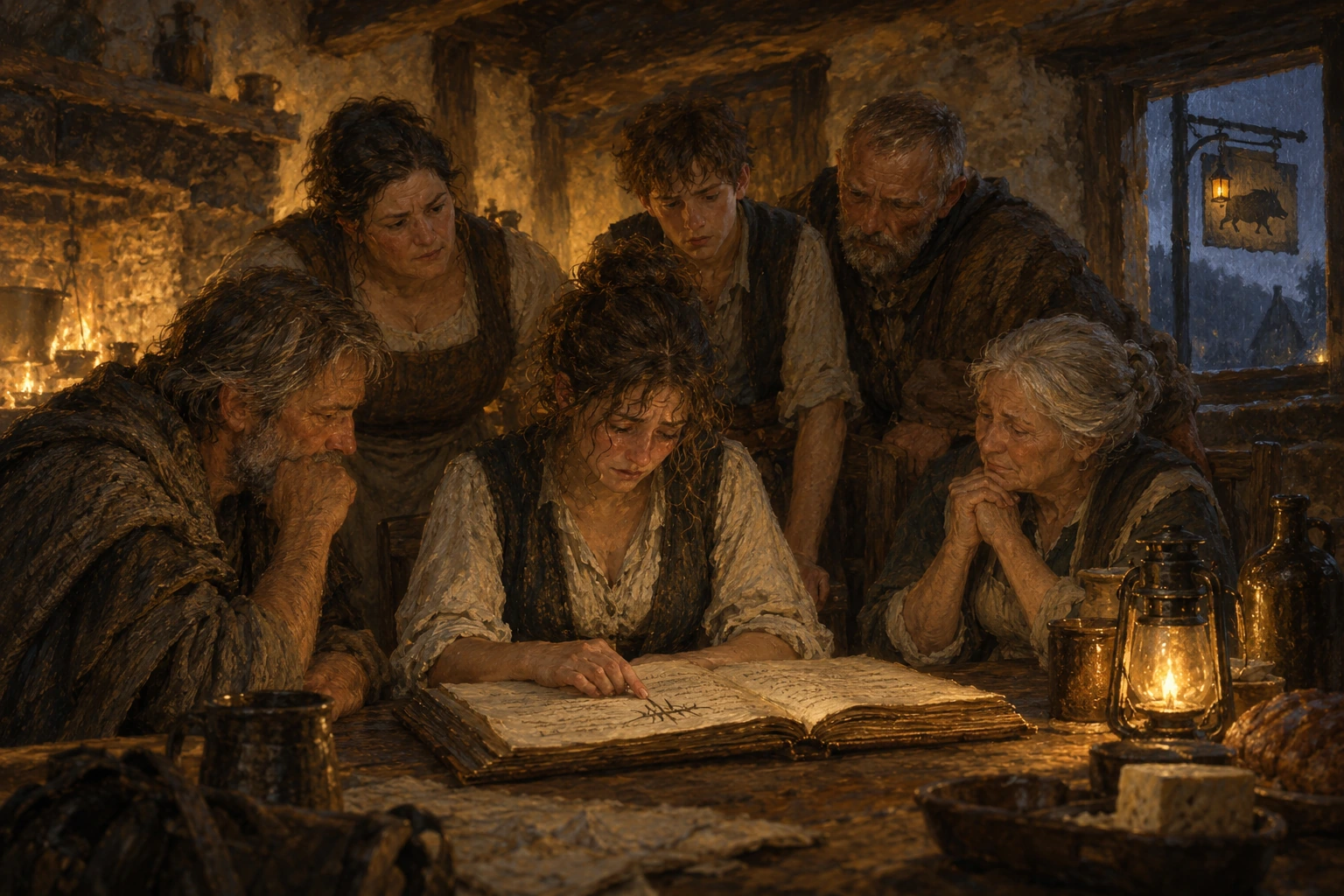
It was Tam Rush himself who brought out the book, once the room had thinned to its last contented handful and the talk had gone soft and slow, as talk does past a certain hour. It was a stout volume bound in worn brown board, kept on its own shelf just inside the door where every guest's eye would fall on it coming in. Behind it, ranked close along the same shelf, stood a whole row of its fellows, thicker with age the further back the row went — the oldest bound in something that had once been leather and was now closer to the color of the turf-smoke that had cured it over two centuries of winters.
"Every soul that's slept under this roof since it had a roof worth the name," Tam said, setting the current volume open on the table with the settled pride of a man handling something he has handled ten thousand times and never grown careless with, "goes down in this, or one of its elders. Family rule, older than my father, older than his."
"You keep the filled ones," Maren said, passing behind him with a tray, not stopping, saying it the plain way a thing gets said once it's worn past feeling like a saying at all. "Someone always comes wanting a name."
Wren's hand, dipping the pen Tam offered her, went briefly still over the page. She said nothing of it, and the moment passed as quietly as it had come. But the sentence sat down inside her next to another one she had known since she was six years old and had never heard spoken outside her own family's door. She thought, signing her own name under Iyene's, that some things did not need to travel between two houses to be the same true thing — said twice, three hundred years and a hundred miles apart, by two people who had never met and would have liked each other very much.
Iyene signed first, in a hand as exact as her hatching, giving her full style — Iyene Sath, Cartographer-Royal, in service of the Survey by charter of the Crown. Tam read it upside-down with open, unembarrassed pleasure, and said he'd not had a Cartographer-Royal's name in the book since his grandfather's day, and would frame the page if his wife would let him — which Maren, passing again, said she would not. Alder signed beneath her, simply, only his name; Bracken signed with his left hand, slow and careful, the right arm still bound close under his coat, and offered no word of explanation to anyone who hadn't already had the shelf explained to them by supper, which by now was the whole table. Pip signed with his own left hand beside Bracken's, his splinted fingers still too stiff to trust with a flourish, and looked, for a moment, faintly proud of the plainness of it anyway; Dorrit herself signed with her usual disregard for the line provided, and did not look up at either slow left-handed line above her own, though Wren, watching, thought she wanted to. And Luel, when the pen came to her, did not take up letters at all. She set the pen down again after a moment's consideration and instead drew, small and neat and quick, a single mark of her own beside the blank where her name might have gone, and returned the pen. That was all of it. Wren, glancing at it once before the page turned, found she did not want to know badly enough to ask — only to have seen that it was hers.
It was when the current volume was closed and set back that Tam, warming further to his subject now the College guests had shown themselves properly appreciative, drew out instead the oldest of the row behind it — heavier than the rest, board-bound and iron-cornered, its first pages gone the deep even brown that only centuries of turning will give a leaf.
"This is the founding book," he said, laying it open with both broad hands, careful in the particular way large men are careful with small old things. "Every Rush that's kept this house — and I'm the eleventh — has had the showing of it to somebody worth showing it to, and I don't get many I'd call worth it, this far up the road. You'll want to see the start of it, being the sort you are."
He turned the leaves with a slowness that felt, to Wren, entirely correct, and stopped some way in, at a page grown thin and dark at its folded edge, dense with names in hands long faded — drovers and shepherds and one whole page of a border company long since disbanded. And there, a third down the page, in a spiky, familiar, upright hand she had known since before she could properly read, plain among all the ordinary names around it as a single true note held under a chord:
Wystan Fallowmere.
And beside it, small, in the margin's white space, in the same hand, not a date, not a word, only a figure: a small, plain 2.
Wren sat down.
She did it without deciding to, the bench meeting her before she had properly registered reaching for it. She was aware, distantly, of Iyene's sharp indrawn breath beside her — not at the name, which meant nothing to a Cartographer-Royal, but at the page itself, at an unbroken written record running back generations in a country that had changed its kings and its coin and its roads and had, somehow, never let this one shelf go. And she was aware of Alder, who had not moved toward the book at all, watching her instead — the way she had noticed him watching her before, at the Waybook's own showing in Merrow, further back than she had words for.
She had known what that small 2 meant since a hayfield in the corn country — two suppers, not two miles — and here it was again, Wystan's own hand doing the very thing she now did without thinking, in the very room where she was standing to read it. He had reached this hearth, most likely slept in this very room, and thought it worth a night's rest and a signature and the same small true number he set beside every true thing: not because it had ever been hard to write, but because he had already, by then, been a man who counted suppers rather than miles for longer than he could remember not doing it. She was not learning something new about her ancestor. She was watching him, for one unrepeatable moment, be exactly the man she already knew him to be.
Someone will want it. She had read those words a hundred times in the front board of a book he had made with his own hands, and had never, until this moment, felt quite so precisely and so personally addressed by them.
She reached out, when she trusted her hand again, and laid two fingers lightly in the margin beside the ink — never on it, the old keeper's care too deep in her now to set aside even here, in a stranger's book that owed her nothing and would fade for nobody. She held them there a moment, the stillness of a hand laid flat, listening for what moved beneath it.
"Friend of the family?" Tam asked, gently enough, visibly puzzled by the quiet that had fallen over his table and wanting only to be helpful about it.
"Something like that," Wren managed, and found it was, in the largest sense she knew, entirely true.
"We've always kept them," Tam said, closing the book at last with the same slow care he'd opened it, seeming to feel that some further explanation was owed even if he couldn't guess what shape it wanted, "because the road keeps its names, or nobody does, and it seemed to my grandfather's grandfather a poor sort of house that couldn't manage the same courtesy a road manages for free." He looked round at them all, faintly bemused by the depth of the thanks he was getting for it, and simply pleased regardless. "Glad it was worth the showing."
"It was," Alder said, and something in the plainness of it made Tam Rush color slightly and busy himself with the shelf, the way a man does when he has been thanked more than he knows what to do with.
The letter had been waiting for her since the yard — a single folded sheet gone soft at its creases from travelling market to market half a season behind her — and Wren found a quiet hour for it late, the room gone down to its last banked warmth, only Dorrit still awake beside her at the table's far end.
Wren —
The bees are down for the winter and doing as they ought — all but the two old skeps, let go easy rather than nursed past their season, which I have always held to be a kindness and not a failure. The miller's knee has called three storms since you left and got two of them right, which has made him unbearable at the bridge.
Your letter came up from Merrow in good time and was read twice, once for the news in it and once for the hand it was written in, which I was glad to find hadn't gone soft with all that fine College copying.
The book is where it should be. So are you. Write when there is something worth the paper — you will know.
— G.T.
Dorrit — the goat got into the flax again, and this time I let her, out of pure spite, since you weren't here to stop me. — G.T.
Dorrit laughed outright at the goat, loud enough that Maren looked over from banking the fire and smiled without asking why. Wren thought that her grandmother, seventy-nine and alone now in a house eleven generations deep, had said everything a person could want said across half a country in five plain lines, without once coming near enough to sentiment to embarrass either of them. She put the letter into the satchel's outer pocket — the book's own compartment was for the book alone, and some things did not want to travel together even when they had, in their different ways, come from the very same house.
Wren sat a while at the small window of the room she shared with Dorrit, her day-book open on her knee, and wrote what the evening had asked to be written — the founding volume, and the name, and the small figure beside it. Then she blew out the candle and leaned a moment at the glass before she let herself sleep. Up the long dark climb of the valley, small and steady and very far off, burned the first lights of the border watch: not many, not bright, only the ordinary lamps of ordinary men keeping an ordinary night's watch on a road that had, for as long as anyone could remember, led nowhere anyone could go, and Wren went to bed, and slept, and did not dream of mountains at all.