The Cold Coomb
They went two days further east than the Hob, into ground none of them had walked before and none of them, by the look of Iyene's maps, had walked in three hundred years — low folded country, thin-grassed and stony, worth a modest honest stretch of new country on the working sheet and little more. On the morning of the third day Alder looked a long while at the sky, in the particular way he had of reading it that was not quite Bracken's way and not quite Wren's grandmother's either, and said only, "That'll do us for this loop," and turned the company around.
The season had begun arguing for him already, and turning was answer enough.
It came on by degrees too gentle to name a single morning for: hoarfrost thick and white on the grass now by every dawn, not melting off till well past noon; the sky gone the pewter color Bracken said, without much ceremony, meant the year had stopped pretending; the stream-noises that had run alongside the company all autumn thinning and going shy, water finding less and less of itself uncovered to talk with. Nettle grew a coat like a hearth-rug and bit exactly as much as she ever had, which Bracken took as evidence that whatever else the winter meant to do to the world, it meant to leave Nettle's opinions alone.
They came down off the unwalked ground on the second homeward morning and struck, by early afternoon, the old road they had climbed out on — or near enough, for it forked here, a thing none of them had troubled to notice going the other way. One arm ran on over an exposed shoulder of bare rock, scoured clean by wind but for a stubborn low heather; the other dropped away to the left, into a fold of ground Iyene's map showed only as a shaded hollow with no name written in it at all.
They might never have taken the second arm, had the first not been standing, when they reached it, entirely full of fog.
It was not an ordinary morning mist. It sat on the shoulder in a solid grey collar, unmoving in windless air otherwise clear on every side of it, and Bracken studied it with the flat, unhappy attention he gave weather that had made up its mind before he had.
"Rime fog," he said. "Freezing on everything it touches. I've seen a shoulder like that turn a good boot-track to glass inside the hour."
Alder stood at the fork a good while, longer than the choice wanted, in the stillness he kept for weighing things that were not simple even when they looked it. "It's called the Cold Coomb," he said at last, to all of them. "By the watch, at least — I doubt it ever had a better name that's still living. It's the old original line, the road this fork was cut to spare people from having to take. The watch doesn't use it, not from fear so far as I ever heard, but because there's nothing up there to graze. That road up there will not kill anyone careful on it. It might very easily break a leg on someone who isn't, two days from anywhere a broken leg wants to be. The coomb is shorter besides, and sheltered the whole way, out of exactly this weather. I'd take the coomb. But I want you to know a little of what's in it first."
They ate standing at the fork, bread and hard cheese and the last of Wren's dried plums, and Alder told them what wanted telling.
"The coomb is what the old lore calls a quiet place," he said. "Not haunted — that's the wrong word, and a wrong word is hard to get out again once it's in. Nothing there watches you, follows you, or wants anything from you. What pools in this one is a thinness in memory — not the memory of what happened here, but the small daily furniture of it. Names, mostly."
"Names," Pip repeated, in the tone of a boy filing something for later.
"You may find a name goes missing on you — someone's, or a word's, or, at the deepest part of it, your own. It will feel like trying to remember a dream after you're properly awake, and the harder you grasp for it the more it slides off just past reach."
"What doesn't it touch?" Iyene asked, in the same flat professional appetite she brought to river depths and frost-heave.
"Love. Recognition. Bracken will still know how to load a mule in there, though he'd be hard put to tell you the word for the thing he was loading. You will always know each other. You will simply, here and there, briefly, not be able to say so."
"Any real danger," Bracken asked, in his quartermaster's voice, "or only the strangeness?"
"Only the strangeness, walked properly. The one true danger is that it's restful. A thing that lingers too long in a place built for thinning can forget to trouble itself back into being entirely itself. It isn't a danger to a company that keeps walking, keeps talking, and stays together." The dry ghost of a smile came into his face. "We will out-talk it. Say names — your own, each other's, the mules' — often, and a little formally, the way you'd count coin you meant to be sure of. Hold a hand if you want one held. Nobody walks alone. Nobody hurries."
"And the mules?" Pip asked, glancing back at Suet, dozing against Barrow's flank.
"A mule doesn't carry a name around behind his own eyes," Bracken said, before Alder could. "What a mule's got to lose is his footing, and I've walked these four over worse than any coomb. It's ours I mean to watch."
"What would you have me note, going through?" Iyene had her pen out already.
"Everything you'd naturally think to note," Alder said. "When it starts for each of you, how deep it runs, and in what order it lets go again."
"Then I shall have the honor," Iyene said, with the gravity she gave any first, "of keeping the first field notes in College history on forgetting."
They finished the bread, shouldered the packs, and turned left off the fork, down into the fold of ground the map had no name for.
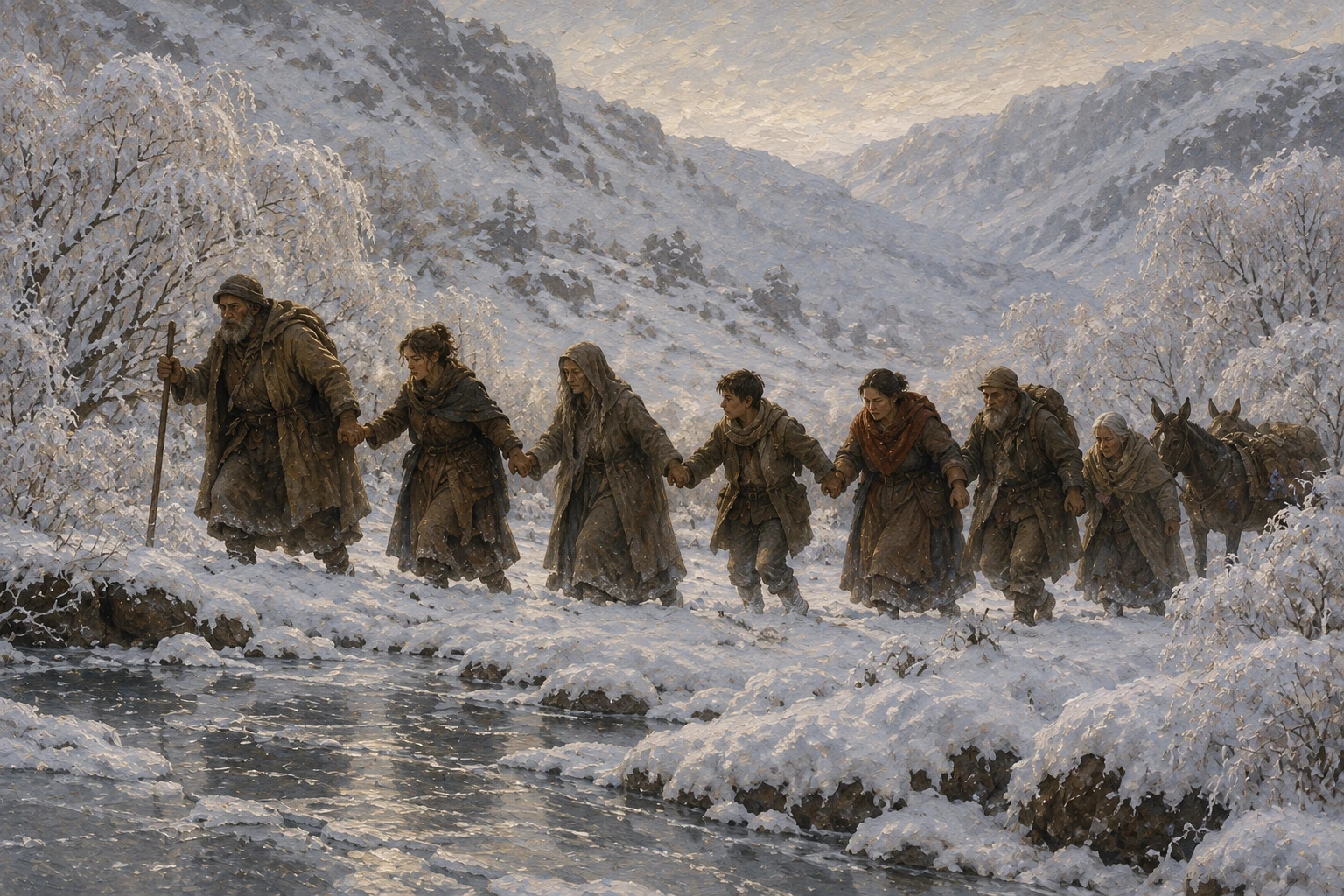
The mouth of the coomb was marked by nothing more dramatic than a change in the grass — coarse hill-grass giving way, within a dozen paces, to something finer and darker, cropped short by nothing Wren could see, running down to a line of frost-furred willows standing along a streambed like old women in white shawls, bent a little toward the water and toward each other.
It was, Wren thought, one of the more beautiful places she had ever set foot in, and she was faintly ashamed of how surprised she was by that, as though a strange place had no business also being a lovely one.
The coomb ran narrow and deep between two shouldering slopes, sheltered from whatever wind troubled the ground above, the light inside evenly soft, the sort she associated with heavy cloud, though the strip of sky visible above the rim was perfectly clear. The willows wore their frost like good wool, combed straight by nothing but their own patient hanging; the ground beneath them was carpeted in a moss so fine and uniform that Dorrit made a small helpless sound of botanical longing two steps in, and had to be gently reminded this was not a halt for admiring moss. The stream ran alongside the road the whole visible length of the coomb, and ran silent — not dry, for the water still moved beneath a clear skin of ice thick enough to show every stone on the bed below, but sealed so cleanly that not a syllable of its ordinary chatter reached the ear. It was, Wren thought, exactly the hush of a heavy snowfall settled over a farmyard at home, the deep-muffled quiet in which every ordinary sound seemed folded away somewhere safe, waiting, rather than lost. She had loved that hush all her life, and found, a little to her own surprise, that she loved this one too, on first meeting, before it had done a thing to earn either her love or her caution.
At the coomb's mouth, where the road first properly declared itself between two lines of standing stones no taller than a knee, Alder stopped the company while Wren drew the Waybook, and opened it to the place his finger found. Wystan's road ran through the coomb exactly as the ground did, in the fine grey line he gave every road he trusted. Beside it, in the spiky old-tongue hand that ran under the whole book like a second, quieter voice, stood a short line of writing — no figure, no evening-count, no mark of any kind Wren had learned to read.
"I can't read this one," she said.
"No," Alder agreed. "Nor fully can I. Enough of the old tongue to know the shape of a warning from the shape of a blessing, most days, and this is neither, quite — or perhaps both, and I don't trust my own guessing of it. I won't guess at this one, Wren. Some lines want leaving exactly as dark as they are." He looked at it a moment longer. "He knew this ground. The road tells us that much without the words. It will have to be enough for today."
Wren closed the book over the unreadable line. Luel stood a little apart, her staff planted and her dark eyes on the willows, and offered nothing.
"Together, now," Alder said, and they went in.
It began so gently that Wren was three sentences past her own first slip before she noticed it.
She had turned to say something to Dorrit and reached, in the unthinking way one reaches for a familiar tool off a familiar shelf, for her cousin's name to put at the front of it, and found, where the name should have been, a small clean absence — not a wrong word, not confusion, simply the exact shape of the thing that ought to have been there and was not, the way a missing tooth leaves a gap the tongue keeps finding. She looked at Dorrit and there was no fog there at all: the broad shoulders, the garden-brown hands, the particular tilt of the head that meant she expected to be teased and meant to enjoy it, a whole life's knowing exactly who this person was — all of it present and whole. Only the word for it had gone soft and grey.
"You," Wren said, and laughed, "— I know precisely who you are. I simply can't hand you your own name. Give me half a breath."
"Dorrit," said Dorrit, holding it out to her like a dropped glove. "Now you owe me a favor."
It went on mild and specific through the coomb's first stretch, and, once the alarm wore off, faintly comic rather than anything worse. Dorrit, a little further on, turned to call Pip's attention to a fallen branch and got as far as "boy — you, the fire—" before the rest slid away entirely, and laughed at herself — a real laugh, though smaller than Dorrit's laughs generally came out, as though even the laugh had to travel a little further to reach the air. "Oh, you know who you are," she finished, waving at Pip, who did, and grinned back without the least offense.
Pip's own turn struck him mid-sentence, over sighting angles, and left him with his mouth open and an expression of pure, injured outrage. "I have lost the word for the instrument," he announced. "The brass one, with the legs, that I have used every day since Merrow. I know precisely what it does. I cannot tell you what it's called, and I find I am considerably more insulted than frightened."
"Theodolite," Iyene supplied, amusement warming her flat professional note.
"Theodolite," Pip repeated, with the fervor of a man reclaiming stolen property, and wrote it down walking, in a hand rather less neat than usual.
Bracken, meanwhile, had simply begun talking to the mules, and did not stop. "Mind the stone there, Suet — good lass — Barrow, quit your fussing, it's ice and not water — Nettle, leave the willow be, you've had your breakfast — Gable, you're doing finer than the rest of us." Nettle, as if to prove a private point, seized a low frost-willow switch in her teeth and worried it loose with an air of settled, stubborn principle, precisely as she'd have done on any ordinary morning, and Bracken laughed outright — the first real laugh since the willows closed around them. "Their names stay put better said out loud," he told Dorrit, who'd asked whether he'd lost the thread of a conversation with anyone who could talk back. "Same as anything does, I find. Nothing wrong with her a fog's going to fix."
They kept the talk going in relays after that, deliberately — Iyene naming willows, moss, ice, stones, glad of a task that fit her hands so exactly; Dorrit naming everyone at last night's fire, half a game now and half not; Pip reciting the names of every instrument in his kit, slowly, like a boy saying his letters. Under all of it, so low Wren noticed it only when it once briefly stopped, Luel walked the whole coomb humming — no tune with words behind it, only a low warm wordless thread of breath more than voice, rising and falling as gently as if it were a property of the coomb's own air. The names came easier wherever that thread was nearest.
By the coomb's deep middle, where the willows drew close overhead and the hush deepened again by some further unmeasurable degree, the company had drawn into a loose knot without anyone proposing it. Dorrit's hand found Wren's, warm and certain even where its owner's name had gone soft twice already; Pip walked between Bracken and Iyene, a hand loosely in each, looking rather younger than sixteen and not minding it at all.
It was there, in the deepest and stillest stretch, that Wren reached for her own name.
Some ordinary private thought prompted it, the ordinary internal naming any person does a dozen times a day; and she found, where the word had simply always been, the same soft grey absence she had met three times already that morning, only larger, and closer, and for one long moment entirely hers. She did not panic. She stood entirely certain of everything that mattered — the hand in hers, the road under her boots, the whole particular shape of the life she had walked out of Dall to live — and only the small bright label gathering it all under one word had gone quietly out, like a candle set down in a draft too soft to notice until the flame was simply no longer there.
"Wren."
Alder said it before she had said anything at all, quietly, without breaking his stride, in the tone of a man handing something back rather than asking a question — and then said one further word, so low and brief that Wren could recover nothing of it — not its sound, not its length, not which of the old tongue's soft consonants it might have begun with. What she kept, entire, was not the word but its warmth — small and sudden, nothing to do with the cold clean air around her, the particular feeling of a coal passed glove to glove on a winter morning, cupped and careful and gone the instant it had done its work.
There was no light. Nothing glowed; nothing stirred the willows. Alder simply took her free hand — his own warm and dry and entirely ordinary, a hand that had struck ten thousand campfires and would strike ten thousand more — and turned, not straight along the road's line but a little aside from it, a gentle curving step the rest followed without deciding to, as naturally as water finds the easier of two channels down a slope. Wren felt it more than saw it: a sense of walking along the warm side of the air rather than through its coldest deep, a long slow curve around some low, still, unseen place rather than across it.
Within a hundred paces her own name came home — quietly, the way a cat that has been out all night simply appears again at the kitchen door, unconcerned that it was ever thought missing. Wren, whole and hers, settling back into the space it had left as easily as it had gone, and she found she was smiling before she had properly decided to.
"There you are," Alder said, mild as ever, and let go of her hand only once the ground beneath them had begun, by slow certain degrees, to climb.
Wren was still smiling, still finding, for the pure pleasure of it, that her own name answered when she reached for it, when Dorrit's voice reached for something else and did not find it.
"Wren." Dorrit's hand tightened first; her voice came after, oddly light, the voice of someone who has not yet decided how frightened to be. "Wren — where's Pip?"
It was not, at first, alarming to hear, in a place where a name going missing was the whole ordinary business of the morning — but Dorrit was not fishing for a word. She was turning full around on the road, at the space where a smaller hand had been a hundred paces back and now plainly was not.
"He was between us." Bracken's voice came flat and fast, no fear in it yet, only a quartermaster's arithmetic come up one short. "At the last name I said, he was between us."
The knot of them, drawn close around Wren as her own name thinned toward its worst, had tightened without anyone deciding it; and somewhere in the tightening a hand at its far edge had simply come free, the reaching that held it already gone to something nearer and more urgent.
Alder did not raise his voice, and that told Wren, more than anything Dorrit had said, how much this mattered.
"Nobody runs," he said. "Running loses the line, and the line is the only thing that will find him quickly. Back down the road we came by, together, saying his name the whole way. Hold hands now, all of you, and do not let go again for any reason at all."
They went back calling him in turn, quietly — Dorrit, then Iyene, then Wren herself — each name going out into the frost-furred hush, and none of them answered.
They found him before fear had properly finished arriving, though at the time it did nothing at all to shorten the distance.
He was two dozen paces back along the curve Alder had walked them around, a little off the road's own line, where the willows leaned their frost together over a low flat stone half-sunk in the moss. Pip sat on the stone with his knees drawn up and his notebook open across them, his pencil resting loose between two fingers exactly as it rested when he was thinking rather than writing, his back straight in the unconsidered way of a boy who has not been told to sit up. He looked, from ten paces off, so entirely ordinary that Dorrit's whole body seemed to let go of its held breath at once — and then, from five paces off, wrong in a way none of them could yet have named — a familiar room in which a clock has quietly stopped, noticed only long after the stopping.
He was not looking at anything. Not the stream, not the willows, not the notebook on his own knee, not the seven people converging on him with their held hands and their held breath; his eyes rested somewhere a little past all of it, open and mild, set on a middle distance at the end of a very long, very satisfying day, with nothing left that wanted doing. His face held no fear in it, and no confusion, and that — Wren understood only slowly, walking the last few steps with her heart going harder than it had gone anywhere yet that whole quiet morning — was the entire and only wrongness of it. He looked exactly like a boy resting at the end of harvest, and nothing else about him was wrong at all.
"Pip." Dorrit was on her knees before the stone before anyone had told her to be, her voice pitched low and utterly steady, the voice she used for a frightened animal, though nothing about him looked frightened at all. "Pip, love, look at me."
He did not look at her. He did not look away either; his gaze simply continued past, incurious, uninsulted, as if she had spoken a word in a language he had once known well and had, for the moment, comfortably set down.
"Pip Sandover." Bracken's hand came to rest on the boy's shoulder, gripping just hard enough to be felt; there was nothing beneath it but an ordinary shoulder, warm through his coat, breathing slow and easy as a boy breathes in his sleep. "Bracken here. You know my voice."
Nothing in him answered to it — not a flinch, not a turn of the head, not the smallest narrowing of that mild, level, peaceful gaze. His pencil did not so much as tremble.
Wren made herself look at the notebook lying open across his knees. It was turned to a fresh page, ruled and waiting exactly as Pip always ruled and waited before he trusted a page with a line — and it held nothing on it at all. No word, no figure, not even a first uncertain mark. He had sat down, evidently, meaning to note the willows, since he noted everything that meant to be noted, and had simply — here, at the exact center of a place built for the shallow-rooted thinning of small daily furniture — set the noting down along with everything else, and gone on sitting, comfortable and entirely, terribly at rest.
No cold came off him. No shadow lay over the stone or thickened in the willows above it, which continued exactly as they had continued the whole morning, frost-furred and patient and entirely themselves; nothing in the whole hushed, lovely hollow had reached for him, or gripped him, or wanted him in any way a hand could have fought. That was the whole and only danger of the place doing exactly what Alder had promised it would do, only further than any of the rest of them had let it go: it had not taken Pip. It had only, very gently, very restfully, stopped asking him to trouble himself back into being entirely Pip at all, and he — sixteen, tired in his good bones with a long morning's honest walking, sitting down for a moment among willows as lovely as any he would ever see — had simply, quietly, agreed.
They closed around him at once, without deciding to — Bracken's hand steady on one shoulder, Dorrit gripping his near hand hard enough to whiten her own knuckles — until there was no part of the boy left untouched by someone who loved him.
"Pip Sandover," Dorrit said, low and fierce, "son of the bookbinder's shop by the bridge-market in Merrow, who once corrected nine senior fellows without meaning to insult a one of them. I have got your hand, and I am not letting go of it."
"The fire's yours, lad," Bracken said, over the top of her, even and steady. "Every night on this road it's been yours to lay and light. Who keeps the fire, Pip?"
"Theodolite," Iyene said — the very word she'd handed him back not two hours since. "The brass one, with the legs. Come back and be insulted about it again."
"Enna's bread," Dorrit went on, not breaking the rhythm, "that she presses on you alone, because she trusts a growing boy to eat it properly. Come back and grow."
Luel came down beside them, her hum brought closer and lower than Wren had heard it anywhere that morning, settled over the boy's stillness like a hand laid flat over a small hurt.
It was not enough. Wren felt it not be enough — and then a look passed between Alder and Luel, held a half-breath longer than any look at that fire had yet been held, and Alder came down on one knee and took Pip's free hand in both of his, and spoke the word.
It was the same word Wren had heard at her own worst moment, no more recoverable than that one had been — but slower now, and longer, low enough that she felt it pass through the ground beneath her own knees; and when it had gone, Alder's face had gone the color of the frost above him, his free hand found his stick and gripped it white-knuckled, and for the better part of a minute his breath came short and careful, a man who has carried a heavier load up a shorter hill than he expected, and the company let him have that minute unwatched — save Luel, whose dark eyes stayed on him the whole while.
Pip came back all at once rather than by degrees — his eyes found Dorrit's face and held there, and the pencil that had not moved in longer than any of them wanted to reckon slipped from between his fingers into the moss.
"...theodolite?" he said, small and bewildered, as though he'd missed the first half of a question.
Dorrit's laugh came out of her broken clean in half, laugh and sob arriving in the same breath, and she had both arms around him before the second half was out. Bracken found urgent business with Suet's girth-strap.
"I sat down to note the willows," Pip said, into Dorrit's shoulder. "Did I note the willows?"
Wren closed the notebook herself, gently, over its own waiting blankness without showing him the page, and told him only that he had sat down very comfortably indeed, and that they had come to fetch him back to keep doing it properly, among people, where the noting could wait.
The stream found its voice again before anything else did. Wren heard it mid-stride, a small bright chatter of running water where a moment before there had been only ice-sealed hush, and the sound of it — ordinary, unremarkable — struck her with a gladness so out of proportion to a mere noise that she laughed aloud, and was not the only one.
The rest came back exactly as Alder had promised — feeling returning to a foot gone numb from sitting wrong too long: first a strange busy prickling, names crowding back almost too fast to catch, and then, within another dozen paces, simply themselves again, as though they had never been anywhere else. Pip said "theodolite" three times running for the pure pleasure of having it. Dorrit said Wren's name and Pip's name and Bracken's name in one triumphant breath, like a woman counting coin back into a purse she'd feared briefly picked, and found every coin present and true.
They came out of the coomb's lower mouth into full daylight, the sky wide again, the willows thinning to scrub and then to nothing, the road climbing gently toward open ground — and it was only there, with the sun properly on all of them, that any hand in the company let go of any other. Pip walked the whole last stretch between Bracken and Dorrit, a hand in each of theirs, and made no complaint of it, though he was sixteen and would ordinarily have called the arrangement beneath him. Dorrit, for her part, kept walking well past where she'd have ordinarily called the halt herself — there was a lightness in all of them, a giddy hard-won relief that wanted spending on motion, and none of them pretended the morning had been anything less than what it had been — and they walked it off together, laughing rather more than the road strictly warranted, until the light began to lean toward evening and Bracken called the halt himself.
The name-round began, as most good ideas at that fire seemed to, with Dorrit, and it began as a joke and ended as something rather more than one.
"I propose," she announced, once the fire was properly caught, "that we say every single name at this camp, out loud, once through, in a proper order, so nobody can claim by morning that anything was left where it oughtn't to be. Mine first, since it went missing oftenest, and I'd like the satisfaction of hearing it back a dozen times before I sleep."
"Dorrit," said the whole company, more or less together, and it grew, by the third round, thoroughly out of hand — full names, then invented titles besides, each grander than the last, until Pip was Master Pip Sandover, Apprentice Cartographer and Keeper of the Theodolite (Recovered) — accepted with a small solemn bow, still pink about the ears, and immediately spoiled by asking, in his ordinary ravenous voice, whether supper was any nearer done — and Bracken named each mule with a ceremony that had no earthly business attaching itself to livestock: Suet the Steady, Barrow the Bridge-Doubter, Nettle Who Bites On Principle, and, last, Gable — who dozed peacefully through the whole proceeding, one hip cocked, both ears at half-mast — Gable the Long-Suffering, Dean of the Picket Line, voted by unanimous acclaim to have shown the truest wisdom of the entire company by sleeping through his own naming.
The laughter ran long and easy, the particular kind that comes after a fright properly outlived rather than merely survived — a graver thread under it now than the last time such laughter filled that fire — and it was some while before Alder spoke again, quieter than his usual, and the company heard him now as a man handing down hard-won craft rather than comfortable philosophy.
"You did that well," he said, simply. "What got the seven of us through whole was talk kept going, names said, hands held when a hand wanted holding, and nobody left to sit alone and find out how restful the quiet felt. That is the whole of the craft, and it is not new — you have all been practicing it since Dall, without ever calling it by this name." He looked, for a moment, at Pip, who looked steadily back, if a little pink about the ears at being looked at. "It did not want him. I'll say that plainly, so you carry the right fear out of this valley and not the wrong one. Nothing in that coomb wanted anything. That is the whole danger of it — a want can be argued with. The Quiet is not an enemy, and that matters more than it sounds, because you cannot fight a thing that isn't fighting you. There's nothing in it to strike at, nothing that wants anything from you badly enough to be talked out of wanting it. You don't argue with fog. You keep your fire lit, and your names said, and you walk out the other side still knowing who you love. That is all the war there is in a coomb. I have not stood in the deep country, and I will not tell you tonight what is true a hundred miles west of here."
Iyene had her working sheet out before he finished. "Onset order," she read back, half to herself. "Names first, shallow before deep. Recovery: sound before naming, naming in relay, and the deepest-taken name recovering first of all." She closed the book over it. "I believe this may be the first working field notes ever kept on this condition, in the whole history of my College."
"The west has known ground like that a long while," Luel said, into the small silence after, measured. "Not as a danger to be fought, any more than Alder has told you. As one knows wet ground — you learn, over time enough, simply where not to build a house, and teach your children the same knowing, until nobody quite remembers why it was first learned, only that it holds true." The firelight lingered in her dark eyes a breath longer than it lingered anywhere else at the circle, exactly as it always did. "That is the whole of what I have to give you on it tonight."
Dorrit only nodded and reached for the kettle, and let the silence after Luel's words sit where it fell, which was, by now, simply how they spoke to one another.
Wren sat a little apart from the fire's main talk after that, her tea gone lukewarm, turning the day over — a frame held up to the light, to see whether it wanted lifting again.
She thought about the word she could not remember, and found she could not even recall whether it had been long or short, soft or hard, though she could have described its warmth in more lasting detail than she could most words she'd ever actually kept. It was the same reaching she did now for the tune, and got nothing back from, and had stopped mentioning to anybody. She set that quietly beside another thing she carried and had never quite found words to close around: the old ink in the Waybook's margins, pale as frost-haze to every eye but hers, dark and sure the moment her own hand held the page, for reasons no one living had ever fully explained. Two things she could not read, could not repeat, could not carry home in any shape her tongue could manage — and both of them, for all that, entirely and reliably hers.
She thought, too, briefly, of the color gone out of Alder's face when he gave that same warmth a second time and further, and his hand hard on his stick; she had not known, until that afternoon, that a coal passed glove to glove might cost something of the hand doing the passing. Some kindnesses, she decided, are like some names: better left exactly as quiet as the person keeping them prefers.
They broke camp early the next morning under a sky gone the hard clean blue Bracken called proper winter weather at last, and walked the whole short day downhill, the ground easing by degrees as it had roughened by degrees on the climb up, until, in the last low light of afternoon, the mountain's long folded shoulder opened out below and showed, small and steady, a string of lamps burning along a low turf roofline in the deepening blue of the valley floor.
"Home enough for the winter," Bracken said, with real satisfaction, watching the lamps.
They came down the last miles in the easy quiet of a company that has walked a long way and is glad, without hurry in the gladness, to be nearly done walking it — the mules' bells the loudest sound on the darkening hillside, the first far smell of woodsmoke reaching them well before the watch's gate did, and somewhere below, unmistakably, supper being kept warm for people expected.
Wren wrote her day-book entry that night by the watch's own good fire, and kept it short.
A thing written is a thing kept, she wrote, at the last. I have walked the quietest place I ever hope to walk, and I am glad, tonight, of every ordinary loud thing in this room.
Outside, the first hard snow of the year had begun, steady and entirely ordinary, settling white and silent over the sleeping roofs of the watch, over the picket line where four mules dozed head to tail, over the whole close-kept, well-lit, thoroughly named little country the company had come home to; and within, by the fire, seven people who had walked out of a quiet place sat late into the evening, warm, fed, and entirely, comfortably, unmistakably themselves.