The Second Fire
They left Stanhope's fold of hill on a morning so clear that the Third's own flame, banked low for daylight, showed only as a heat-shimmer above its cradle, and struck west along a shoulder of open upland with the wind steady and warm out of the south. It was full midsummer, the days gone long and gold, and the count, Iyene's pocket-book confirmed at the noon halt, stood at four behind them and one unnamed thing ahead that was not, strictly, dark at all — a fire that burned longer and oftener than any showing-custom could account for, watched from Stanhope's high vent, unwalked in any memory Stanhope kept. They let it come to them in its own time.
It came to them, as it happened, on the second night.
They had made camp on a bare saddle with nothing much to recommend it beyond a spring and a windbreak of old thorn, and Wren was on the second watch, feeding the fire by handfuls, a trick of Pip's she'd picked up without either of them meaning to teach it, when she looked west out of habit — the same idle look she had given the dark a hundred nights running — and found the dark looking back.
It was low on the horizon, and small, and entirely steady: no flicker, no guttering, nothing of the nervous shifting a night fire gives when the wind gets under it. It burned as a star burns, except that it sat too low and too orange to be any star Wren had been taught the name of, and it did not move the whole hour she watched it — until Bracken came to relieve her, and she pointed at it without a word, and he looked a long while himself before he said, quietly, "Well. There it is, then."
By morning it had gone with the daylight; it was there again the next night, closer by a full day's certain walking, and there again the night after, closer still, until by the fourth evening it no longer needed pointing out. It simply stood on the horizon ahead of them the last hour of every day, waiting to be dark enough to be believed in.
The road itself began doing the small quiet thing roads in this country had done twice now on the approach to a tended hearth, though at a fraction of the scale. Here the sign came thinner and further apart, the range of one pair of legs rather than a household's — a ford-stone reset, a snare-line honestly empty, one stretch of thorn hedge trimmed square where every other for a day's walk had gone wild.
"One man's work," he said of the hedge, on the last morning. "Not a family's. You can feel the difference in it — a family tends outward, all the ways it can reach at once. This is somebody minding a single line, there and back, because there and back is as far as there's anybody to go."
It was on that same morning, over the cold bread and cheese of a hurried breakfast, that Iyene set her pocket-book on her knee and did the sum aloud, mostly for her own satisfaction, though the whole company was listening by the second sentence.
"Sereth stands as the Seventh, by the old count," she said. "We have lit the Sixth, the Fifth, and the Fourth ourselves, this past month, and the Third with them, with Stanhope's own people the first up out of their hill to see the doing of it. That is four fires behind us on a line that runs, by every telling we have had of it, hill to hill in one unbroken order from Kelder's height, where the lament says the first was ever lit. Which makes whatever we are walking toward this morning, in the plainest arithmetic there is, the Second."
"The ordinal names wear thin the nearer you get to the ends of a count," Alder said. "But not every hill lost its name. Kelder never did. Ness Fell never did." He looked, without quite meaning to make a show of looking, at Luel. "Nor, I think, did this one."
Luel had said very little all morning, which was not unusual; but she had been watching the low smudge of smoke on the horizon — visible now even by daylight, a thin grey thread standing straight up in the windless morning — with a close unblinking attention that was.
"The lament had three names in it that never wore down to numbers," she said, at last. "Kelder, first-lit. Ness Fell, that caught the word before any rider could have carried it. And the one that held its watch so well it burned a long time, burning alone." She was quiet a moment longer, and then she said the rest of it plainly, without any weight laid on the saying beyond what the words already carried on their own. "That is Wakelow."
Nobody answered her for a little while. There did not seem, just then, to be anything that wanted answering.
They reached the foot of Wakelow's climb in the last low light of the following evening and went up it slowly, in the quiet a company falls into when it understands that whatever waits at a hill's top deserves to be arrived at rather than rushed. The hill was nothing remarkable — no falling terraces, no lamplit stair, only an ordinary shouldered height of turf and grey outcrop, the kind Dall itself had a dozen of, distinguished from every other hill on that dark horizon by one thing only: it had not gone out.
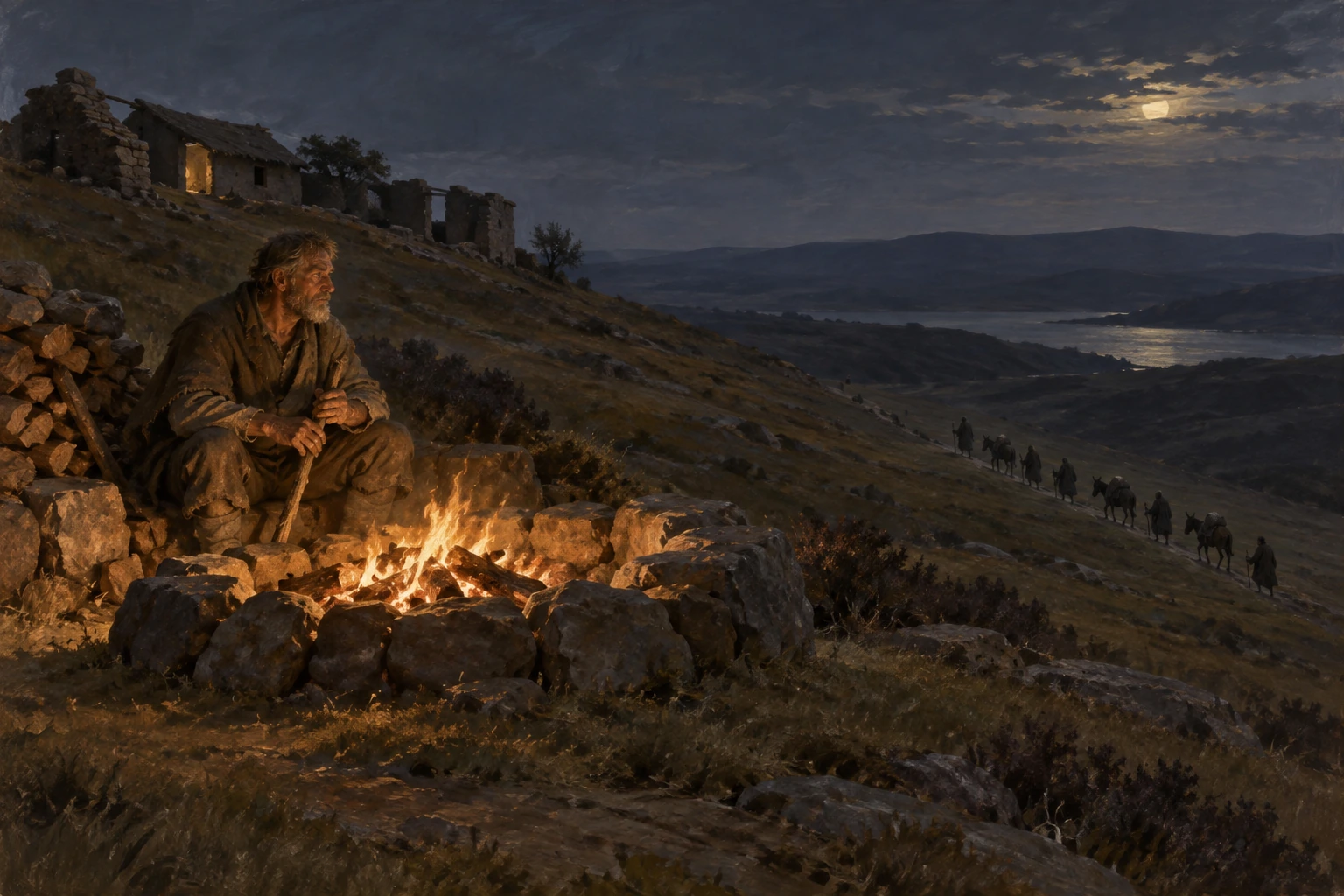
The fire showed properly as full dark came down: not the compact burn of a beacon-basket freshly relit, but a broad, low hearth-fire built in a ring of fitted stones on a shelf just below the true crown, banked high, burning with a confidence that had never had to wonder whether it would be fed. Beside it, small against the wide dark of the hill, a figure sat upright and unmoving, watching them come up the last of the slope — a man who had watched four new stars climb his own eastern horizon in the course of a month and had had ample nights to reckon, correctly, what they must in the end be walking toward.
He rose as they came within hailing distance, slowly, with the care of a body long used to its own joints — an old man, spare and weathered the color of the hill's outcrop, in clothes patched so many times that the patches had begun to need patching — and gave them, in a voice worn thin with disuse but not unsteady, the old grammar in a form none of them had heard: shorter than Fenna's, shorter even than Edda's, worn down as a phrase wears down when only one mouth has said it, alone, for a great many years.
"Who walks the line," he said, "and carries fire enough to answer it?"
Alder gave it back to him whole — the charter, the College, Iyene's leading of it, the whole company named in turn, Luel last — exactly as he had given it at every threshold this line had offered them. The old man listened without moving, his head tipped slightly, the way a man listens to a tune he half remembers and is working out, phrase by phrase, whether he has it rightly.
"Then the charter's not dead either," he said, when Alder had finished, "any more than this fire is, though I'll own I'd stopped expecting to hear either one said out loud again in my own lifetime." He looked round at them all, one face at a time, and his own face — old and tired, and glad in a way that plainly surprised him — settled, by the time his eyes came back to Alder, into something very near a smile. "My name's Rafe. Rafe, of what's left of the Rowan keeping, which is to say only Rafe, this good while. Sit you down. I've fire enough for all of you."
There was little enough at the fire by way of supper — a thin porridge of oats stretched with dried root, a handful of hard early berries, water from a spring lower down that Rafe fetched himself, waving off Pip's offer to go for him — and Bracken opened the company's stores alongside it: bread, cheese, the last of a smoked shoulder out of Stanhope's larder, set down as plainly as if it belonged there. Rafe ate with the care of a man who has never had food enough to waste any, and thanked them once, simply.
Dorrit had gone through Rafe's own scrap of garden before she sat down, as she went through every garden, and came back with a short list of what would carry him to spring and one gap in the middle of it that she stepped over without slowing. She had stopped saying I've lost a word four days ago. She had begun saying the doorway one instead, and Wren had stopped being able to hear it as nothing.
It was Dorrit, predictably, who got the telling started — not by asking outright, but by nodding at the fire itself, banked high and steady behind him, and saying, "That's a deal of wood, for one pair of hands to keep finding."
"It is," Rafe agreed, and watched the flame settle a while, and then began, in the plain register of a man who has told himself this account so many times that saying it aloud, at last, costs him almost nothing beyond the strangeness of an audience.
"My people kept this hill since before there was a count to number it by," he said. "Rowans, the lot of us, back further than anybody troubled to write down, because a name on a page never yet kept a fire fed; hands did that, and wood did that." He turned a stick in his hands, not feeding it to the fire yet, only turning it. "There was a whole household here once. Stock in the fold below, a garden the size of a fair field, more Rowans under one roof than I could rightly count you now. The frost took the stock first. It took the garden slower — through the failed years and the half-failed years, until my grandfather's own father was growing more heather-root than anything a body could call food, and calling that harvest, because a harvest is whatever gets a house through to the next one."
He was quiet a moment, and none of them pressed him, and he went on of his own accord, exactly as Edda had gone on at her own hearth a month and a world ago.
"It's the wood that thins a family faster than the food does, out here, if you want the honest shape of it," he said. "A fire like this wants feeding every night of every year, and a hill like this only grows so much timber, slowly, and every generation cut a little further from the crown than the one before it had to, because the near wood was already spent keeping their own grandparents warm and lit. My grandfather cut two full valleys over by the end of his keeping. I've cut three, some winters, and carried it back myself, because there's been nobody these thirty years to spell me at the carrying."
"And when the wood ran short entire," Bracken said — gently, not pressing, only naming what plainly wanted naming — "what then?"
Rafe looked at him a moment, and nothing in the look flinched from the asking. "Then you burn what a house can spare that isn't needed to keep a man dry," he said. "Furniture first — my grandmother's whole dower chest went into this fire the winter I was nine, and my father set the axe to it himself, quiet, no speech made of it, because speeches don't keep a fire fed either. Then the outbuildings: we'd no stock left to shelter by the time I was grown, so the byre went, board by board, over three bad winters, because a byre with nothing living in it is only lumber feeling sorry for itself. I've burned the greater part of my own house these last years — the wing my grandparents raised their whole brood in, the room I was born in — one room at a time, keeping back what one man needs to sleep dry and cook a pot of oats, because there's little sense warming four empty rooms when there's a fire on the hill above owed the wood a good deal more than any empty room is."
"And the aloneness of it," Dorrit said, quietly — she alone, Wren thought, would have asked it so directly, and she alone could have asked it and had it land as kindness rather than intrusion. "How long has it been just you?"
"Nineteen years, near enough, since my father died," Rafe said. "My mother went the winter before him. She was never strong after my youngest sister, who didn't live past her own second winter, nor did the two brothers born before me; that's an old grief now, worn smooth, and I'll not make more of it tonight than it's earned. There was a woman once, when I was young enough to be thinking of such things — Rue, from a holding two valleys east that thinned out entire before either of us was much past twenty. She went east through the last passable stretch of pass, the year I was too proud, or too dutiful, or too young to know the difference, to go with her and leave the fire untended. I've had thirty years since to wonder which of those it was." He set the stick, at last, into the flame, and watched it catch. "So: nineteen years alone at it, out of something near sixty of tending it in all, boy and man both. Not the worst nineteen years a body could name. The fire's company enough, some nights, if you've learned the trick of talking to it, though I'll own I'd about given up expecting anybody to talk back."
"Why keep it at all?" Alder asked — the question the whole company had carried up the hill the last four days, put now with the gentleness he kept for questions that mattered too much to ask carelessly. "Your own charge — did it never permit you to let it go, as the showing-fires nearly did, those hard years at Sereth? Anyone east of the mountains would have missed it clean, and never known Wakelow had gone dark with the rest."
Rafe turned the question a long moment, looking for the true shape of the answer rather than the quickest one.
"There's a difference," he said at last, "between a dead line and a thinned one, and it took me the better part of my life to work out the shape of it properly, so I'll not blame you for asking. A dead line, somebody has to replace, if it's ever to be had back at all, and after enough years nobody troubles to remember there was ever a break in it — that's a mercy of its own kind, but it's not the same as the line itself surviving. A thinned line, though — however far down to just one pair of hands it's worn — can still be rejoined. You don't have to replace what's still breathing. You only have to reach it. I did not know, most of these nineteen years, whether there was anybody left in the world minded to do the reaching. But I knew that the reaching couldn't happen at all, not ever, if I let the fire go dark waiting to find out. A dark hill can't be found. Only a lit one can." He looked round at them all again, slow, and did not try to keep the plain wonder off his face. "So I kept it. Feed the fire, keep the hill, and outlast the dark — that's the whole of the charge, cut into the lintel-stone of the room I burned two winters back, though I'd had it by heart long before I burned the stone it was cut on. I've said some version of it to myself every night for nineteen years, mostly to have something worth saying out loud on an otherwise silent hill. I never let myself believe I'd live to say it to anybody who'd walked up out of the dark to hear it."
It was Wren who spoke next. She had known, climbing the last of the hill with the fire growing larger ahead of her, that this part would fall to her — not because anyone had said so, but because she was the one who carried the day-book, and the day-book was where the thing she meant to give him had first been written down.
"You should know something," she said, "that no one has ever been able to tell you — the ones who could see your fire could not walk to it, and the ones who could walk to it did not know to look. You were seen." She told it plainly, as Harrol had first given it to them at her own hearth-table: the border watch keeping its log since before anyone living was born, and two sightings entered the year the Survey first came through — both deep in the high west, both on hard clear nights, logged by two watchmen who had not conferred, with nothing in that whole watch's record having burned out here in three hundred years. "They didn't guess at what it was. They wrote down what they saw and let it stand as a wonder rather than force it into an answer it hadn't earned."
She paused, and found that the next part was harder to say than she had expected, though she had turned it over in her own mind every evening since the fire first showed itself on the horizon.
"And there was a night," she said, "on a ruined hill above the border watch, when I had the second watch of the whole company, alone, and I saw a light — low, and steady, held for three or four breaths and gone before I could be entirely sure of it. I fixed the bearing against a star, the way I'd been taught, and wrote it in this same day-book I still carry, and told no one until morning, because it didn't feel like a thing that wanted alarm, only a thing that wanted remembering. We logged it as a maybe. It has stayed a maybe in my own mind every night since, through a whole year of road." She looked at him, and did not look away. "I don't think it's a maybe any longer. I think what I saw, that night, alone, on a hill three hundred miles east of this one, was you."
Rafe did not say anything for a long moment. His hands, Wren saw, had gone still in his lap, the stick he had been turning forgotten between them.
Beside her, quietly, Iyene turned a page in her own working sheet, found the entry she was looking for, and said, in the plain unornamented voice she kept for facts too large to need decoration, "We logged another light too, at Sereth, the night we relit the Seventh — west-by-south, bearing approximate, extinguished before moonset, source unconfirmed. I wrote it down exactly as honestly as I knew how to write an unconfirmed thing." She closed the book gently. "I don't believe it's unconfirmed any longer either."
"Nor do I," Alder said, which was, from him, a full sentence.
Then Luel rose from her place at the fire's edge and stood a moment looking down at Rafe with an expression Wren had seen only twice before — once at the Singing Ford, once over Glaissel's darkened water — a stillness deeper than her ordinary stillness, the look of someone about to give away a thing that had cost her people a very long grief to keep and a longer patience to be willing, at last, to part with.
"There is a song," she said, "made three hundred years ago by people who watched your fire from a very great distance and could do nothing for it but watch, and count the years, and in the end make of the watching a thing that could be carried east and sung, because a song travels where feet cannot. It has been sung, this year past, at more than one hearth on the far side of the mountains you have never seen. I did not know, composing it, whether I sang a grief already finished or a faithfulness still, somehow, ongoing. I know now." She did not ask leave this time. She gave it — a gift, not a taking, as she had told them once already.
Kelder first, and then Ness Fell, and the small hills, one by one— but Wakelow held its watch so well it burned a long time, burning alone.
The old man sat very still while she said it, and when the last line had settled into the dark and the fire's small crackle had taken back the silence, he put one hand briefly up to his face and took it away again — not weeping, Wren thought, so much as checking with his own fingers that his face was still doing the ordinary work of a face and had not simply come apart under the weight of what he had been given.
"Three hundred years," he said, at last, very low. "All that while I thought I was keeping something no living soul would miss if it went out — a thing that had outlived everyone who might once have been owed it, kept out of stubbornness more than sense, some black nights, and there was nobody to tell me I was a fool for it but myself, and I told myself often enough for two." He looked at Luel, and then round at all of them, slow, as though counting them the way he must once have counted his four new stars. "I have kept a fire my whole life on the plain understanding that I was invisible to the entire world, and it turns out I have been watched, and reckoned, and sung about, on the other side of a mountain range I will die without ever having crossed. I don't rightly know what a man does with news that size. I'd rather just sit here a while and have it, too large to hurry through."
Nobody hurried him.
It was Bracken who spoke next, when the fire had burned down and the old man's breathing had steadied, in the voice he had used once already this year in a square in a town called Woldsend — not that formula, this time, only its shape, turned deliberately the other way about.
"I've stood a good many watches in my life," he said, "and relieved a good many more, and there's a form for it that says a watch is closed and a man may stand down. I'll not say it to you, because I don't believe it's the truth of your case. You're not done keeping this fire, and I don't imagine you'd thank me for suggesting it. A keeper doesn't stop; I've known enough of them this year to be sure of that much. But there's a difference between a watch a man keeps because there's no one else, and a watch he keeps because he's chosen to go on keeping it in company. The line runs east of you now, hill after hill, clear to the mountains, and a cairn-post running letters hand to hand behind every fire of it, and keepings all down that road that know your name and will go on knowing it. Your watch is not relieved. It is shared. Keep your fire — you do not keep it alone. Not any longer. Not from tonight."
Rafe sat with that a long while, the fire between his hands throwing small moving light across a face that had gone, for the length of the silence, entirely still.
"A watch shared," he said at last, slowly, turning the words the way he had turned the stick earlier, testing their grain, "is a watch a man can die still keeping, instead of only dying at." He said it once, and did not repeat it, and none of them asked him to, because it did not seem, in the moment, a thing that wanted repeating so much as a thing that wanted simply to be allowed to have been said.
Iyene, very quietly, opened her working sheet a final time, and wrote, in the same plain hand she had used for every fire this whole act, three words that inverted, without needing to say so, every entry that had come before them.
"Burning," she said, writing it. "Keeper found."
They climbed the last short pitch to the true crown a little before midnight, at Rafe's own asking — he went up slower than any of them, finding holds in the dark by long habit rather than sight, and would not be helped past the offer of an arm at the steepest turn, which he took more for the courtesy of it than any need.
The crown was bare rock and short turf, open on every side. Rafe got his breath, then turned, without being asked, to look back east: the direction he must have looked a thousand nights running, long after sense had told him there was anything there worth it.
Four fires stood strung along the eastern dark, small and steady and unmistakably alight, each holding its own station on its own hill — the Third nearest and brightest, the Fourth beyond it, the Fifth and the Sixth beyond that, fainter with distance and entirely certain: a chain of small stars laid along a horizon that had shown Rafe Rowan nothing but unbroken black, in that direction, every night of his sixty years at this fire, and his father's and grandfather's before him.
He was quiet a long time, and none of them expected otherwise.
"I have looked east off this hill every night of my life," he said finally, very low, "and there has never, not once, in all that while, been anything at all to see. I used to tell myself the not-seeing didn't matter, because the keeping wasn't done for the seeing. I believe that was true. I believe it still. But I'll not pretend to you that this isn't a different thing entirely from believing it."
They went back down by starlight and Bracken's sure feet, to the warmth below.
Wren wrote late that night, by the fire Rafe had kept alight nineteen years alone, the old man himself asleep at last a few feet off — the first sleep, she suspected, he had allowed himself in longer than he would say, in the certain knowledge that five other pairs of eyes were watching the dark on his behalf.
We have spent this whole month lighting fires on dark hills and calling it our chief work. Tonight we found the far end of it, waiting at his own fire. His name is Rafe, last of a keeping called Rowan, and the fire he kept — burning the greater part of his own house to feed it — never needed our lighting. It needed our company. A dead line, he told us, can only be replaced; a living line, however thin it has worn, can still be rejoined.
She closed the book and built the fire up instead of banking it. Rafe's had not sunk to sleeping-embers since before anyone living could say, and she had no wish to be the one who began it; so she went down to the rick twice for more wood, and had the flame standing tall against the four small answering lights on the hills behind by the time the old man woke to check it.