The Mending That Isn't
The medical kit came apart into three piles on the yard's hard ground, and Wren was the one counting jars, not because Dorrit had asked her to but because somebody needed to know what the night had cost before they walked away from the one place that might still have more of it. Rimewort, dried and cut fine, went into a fourth pile by itself, and the fourth pile had nothing in it. Dorrit had used what she carried down to the last pinch on Ede's arm and then on Rill's shoulder, three steepings deep, and there had never been a fifth in the roll to begin with. She said so once, flatly, more to herself than to anyone else, the way a woman states a fact she has already finished being angry about because there is no version of angry that puts more of the plant back in the jar. Then she went on sorting the rest of it — willow bark, the fever-root, the little packet of clean bandage linen the household had pressed on her though she had tried twice to refuse it — as if a missing jar were no different from any other kind of missing.
It was, Wren thought, watching her cousin's hands move through the piles with the same sureness they always had, whatever else had gone out of the rest of her. Two years of watching those hands work had taught Wren the difference between deciding not to look at something and genuinely not seeing it, and this morning Dorrit was doing the first, carefully, jar by jar.
Wren did her own hair standing by the well, working the plait by feel with fingers gone half-clumsy from three winters of never having needed the practice, because someone else had always done it before her. It came out crooked at the crown and she did not go back and fix it. Dorrit had braided it every morning since the first week out of Dall — a habit that had started as nothing more than keeping hair out of a working woman's eyes and had gone on being useful long after it had stopped being only that, the two of them standing back to back at first light while the rest of the company found its boots, no words required on either side because none had ever been. This morning Dorrit stood twenty feet off with her back to the well, cutting the willow bark into lengths with a knife she did not need to look at, and did not turn.
There was nothing to remark on, if you had not been watching for it, and only two people in that yard had been.
Bracken came through with the tally of what the steading could spare and what it couldn't, working from a list he had made in his head rather than on paper because paper cost weight too, and he set the whole business of leaving in motion with the same unremarkable competence he brought to everything that needed doing. Ferrit helped him load the string. Ossen stood by the gate with his hedging-hook still through his belt from the night before, as though he had not yet worked out that the fight was over and did not entirely trust the yard to confirm it. Wend crouched by the fold fence a while, saying nothing to the two surviving ewes, and then got up and went to see if Sael needed anything carried, which she did not, and stayed near her anyway.
Sarl came out to see them off with a sack of dried peas over one shoulder that she set down at Alder's feet without asking whether they wanted it, and a second sack after it, and stood there while he tried, once, to tell her it was more than they needed for the road ahead. She looked at him the way a woman looks at a stranger who has misunderstood the size of a debt. "You buried my husband's neighbor beside him this morning," she said. "You'll take the peas." Alder took the peas.
The old woman from the loft came down last, moving slow on a hip that had clearly given her trouble longer than one bad night could account for. She pressed something small and wrapped into Ede's good hand rather than into anyone in the company's, a last lesson passed along outside of any of them, and Wren understood it for what it was without being told what it contained: something of Crake's trade, kept a generation past the boy who should have carried it forward. Ede closed her fingers over it and did not open them again while the company was still in the yard to see.
Wren caught Bracken's eye going once to the fold and once to the near field before he turned it back to the road, a soldier's habit of counting what a place could still lose before he had to leave it to whatever came looking next. There was nothing left in his face by the time he shouldered his own pack that any of the household could have read as reluctance, and that, too, she thought, was a kind of craft — the same discipline, differently spent, that let Dorrit sort jars this morning as though a missing one were only ever a matter of arithmetic.
They left the steading a little after the sun cleared the ridgeline, ten walking and four laden, and the road took them almost at once out of sight of the roofs and the two new mounds of turned earth beside them, without ceremony and without waiting to be asked whether anyone was ready. Sael did not play. She had not played since the fighting started, and the company had not asked her to, and the reel that had come whole out of the eaves three days before stayed in its case on Ferrit's back, unopened, a silence with its own particular weight now added to all the others the company was carrying west.
The morning itself gave them nothing to complain of, which felt, to Wren, like its own small unkindness — a clean sky, a hard bright cold that turned every breath to a short-lived cloud, the road firm underfoot instead of the mud it had every right to be this late in the year. Weather did not know what a night owed a place, and went on being fine regardless. Somewhere behind them a rooster she had not noticed at the steading crowed twice and stopped. Wren caught Pip's head come up at the sound before he remembered where they had left the birds that made it.
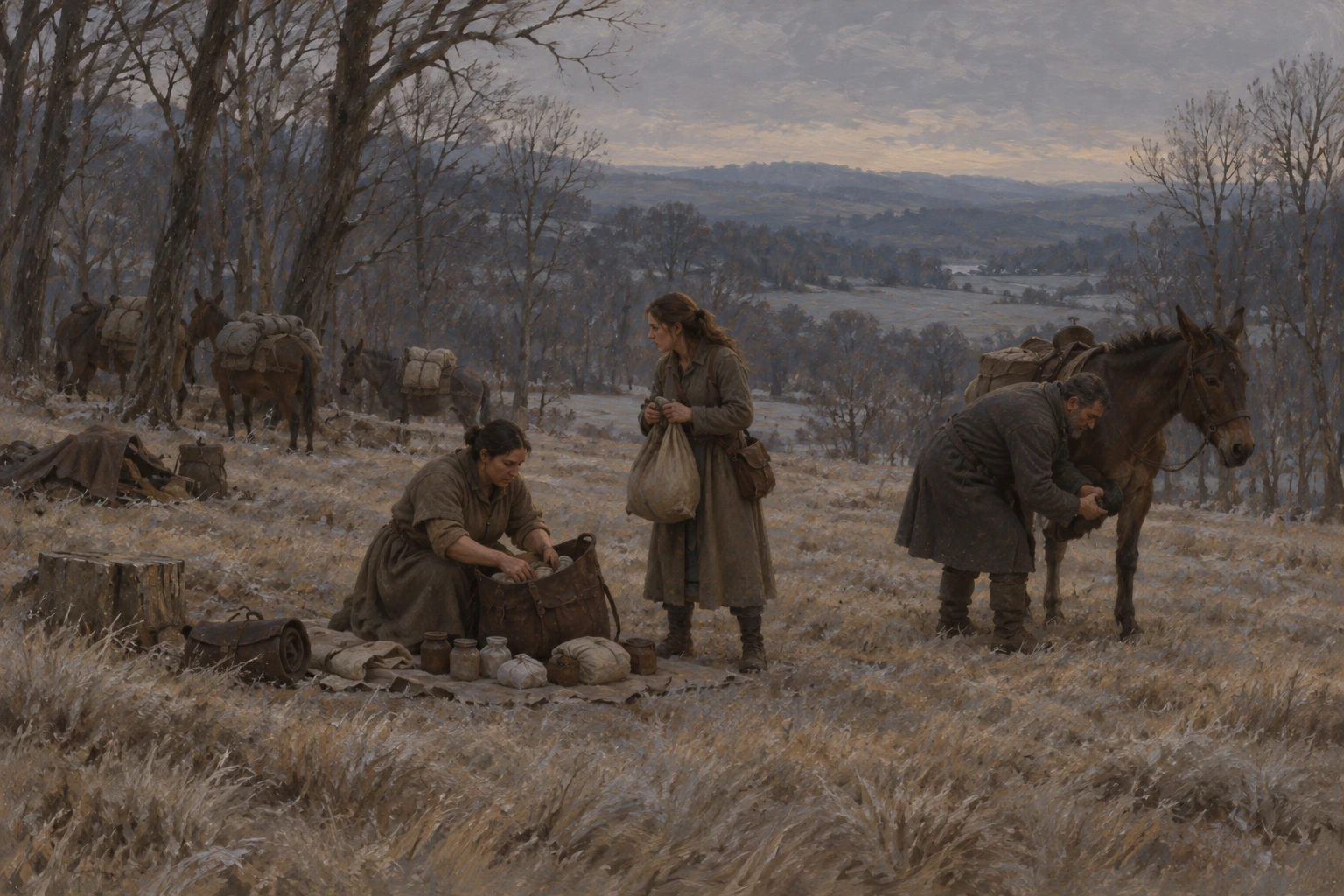
They stopped at midmorning to redistribute the loads, because Barrow had begun favoring his off foreleg somewhere in the night and Bracken wanted the weight off him before it turned into something worse than favoring. It was ordinary work, done a hundred times since Dall — panniers unbuckled, contents weighed by hand and eye, grain moved from one beast to another, and the two sacks of peas the only genuinely new problem the morning had handed them, because peas were heavy and the road ahead was long and somebody had to decide what earned its place and what did not.
Bracken knelt in the road dust with Barrow's hoof cradled against his knee, running a thumb along the tendon above the fetlock, patient about it in a way that told the whole company more than his face did; a man who expected to find a stone bruise did not take that long over a joint that was only tired. Nettle, tied off a few feet away, put her ears back at nothing in particular and then forward again, and Pip went to stand near enough to her that she could lean her head against his shoulder if she chose to, which after a moment she did.
"The second sack goes," Wren said. She had already worked it in her head while Bracken was still cutting Barrow's girth strap loose — the peas against the miles, the miles against what Nettle and Gable could carry between them without adding to Barrow's trouble, the whole small sum done and settled before anyone had asked her opinion of it. "We keep enough for a week and leave the rest with — " she stopped, because there was no one left at the steading who needed feeding less than the company did, and finished it differently. "We leave the rest at the next place that has mouths for it."
Dorrit was crouched over the medical kit, refitting what remained of it into a single pannier now that there was less of it to carry, and she did not look up. "You worked that out fast."
"It isn't a hard sum."
"No." Dorrit set the willow bark down and squared it against the pannier's edge with more care than the task wanted. "You're good at the ones that aren't hard. You know exactly what's worth the weight and what isn't. You worked that one out standing by a spring-house, too."
Pip, coiling a lead-rope a few feet off, went very still without stopping the coiling — hands busy on purpose, giving the rest of him nothing to explain. Bracken did not look up from Barrow's foreleg, though his thumb stopped its slow circling of the joint for the length of one breath and then went on. Alder, a little apart with the fever-root in his hands, did not move at all.
"Say what you're saying, Dorrit."
"I am saying it." Dorrit stood, and there was nothing raised in her voice at all, which was worse than if there had been; a shout could have been about the peas, or the road, or a night's bad sleep, and everyone in the clearing would have been able to pretend, for another hour or a day, that it was. This was not shouted, and so nobody could pretend anything. "You stood thirty feet off a dying man with the exact tool in your hand that would have kept him breathing, and you ran the numbers, the same numbers you just ran on a sack of peas, and you decided he didn't earn the weight. I had one pair of hands last night, Wren, and I put both of them on a man who was already gone before I ever reached him, because I was thirty feet the wrong way myself and couldn't be in two places any more than the rest of us can. That's the whole difference between what happened to me and what happened to you. I didn't get to choose which thirty feet."
"I know I chose." It came out of Wren simply, without heat, because there was nothing else honest to put in its place. She had the rest of it ready behind her teeth — Cael Meddan, the thirty-seven names she had left standing in Thistleton, the country behind the budget that made the budget a mercy rather than a cruelty, every figure of it laid up and orderable and, she still believed, sufficient to answer the accusation on its own terms. She left all of it where it was. Saying it would have made her right, and being right was not, this morning, standing in that clearing with Barrow's hoof lifted between them and two new graves a mile behind, the thing she most wanted to be. "I knew what I was doing when I did it. I'm not going to stand here and tell you I didn't."
"And Bracken." Dorrit said it flatly, almost as an afterthought, though nothing about the way she had been waiting to say it suggested it was one. "You'll let him spend himself on your account the same as you wouldn't spend yourself on Crake's, and somehow that's the arrangement the rest of us are meant to find easier to live with."
Bracken's hand, on Barrow's leg, went still again, longer this time.
"That's mine to answer for," he said, without looking up. "Not hers."
"It's both of yours. I'm not dividing the bill." Dorrit picked the pannier back up, settled it against her hip, and looked at Wren for the first time since the argument had started, a look that held no more heat in it than her voice had. "I'm not saying you were wrong, Wren. I keep trying to find the place where you were wrong and I can't find it, and that's the part I can't forgive this morning, if forgiving's even the word for a thing where nobody did anything you can point to. You had a country behind that budget. I know you did. I just buried a man an hour after I put both my hands on him and watched the white finish traveling anyway, and there isn't a version of this morning where I have room left over to be fair about it."
"I don't need you to be fair about it."
"Good," Dorrit said. "Because I'm not going to manage it today."
She turned and carried the pannier to Nettle, and buckled it on, and that was the end of it. Not because either of them had run out of things that were true, but because Barrow's foreleg still needed wrapping and the road still had to be walked, and a country a great many days west of that clearing was still dying at whatever rate it had been dying at before the two of them had stopped to have this conversation over a sack of peas.
Luel had not spoken through any of it, standing a little apart with the second sack of peas already shouldered as though her own hands had decided the argument's outcome before Dorrit had finished making it, and when Bracken straightened up off Barrow's leg she handed the sack across to him without comment, which was as close as anyone that morning came to declaring a verdict.
Nobody spoke for the better part of an hour after that. Ferrit walked with the reel-case on his back and his eyes on the road in front of him, careful in the particular way of a young man who has just watched two older women say something true and terrible to each other without either of them raising a hand, and has understood, dimly, that this is a different kind of danger than the one he came prepared for. Wend, on the column's other flank, kept close enough to Bracken to ask him, low, whether Barrow would hold to the next water, and got a short answer, and seemed grateful for having had somewhere safe to put his own unease.
Wren walked near the front, beside no one in particular, and did the arithmetic anyway, privately, where it could do no harm to anybody. She turned the peas and the miles and the thirty-seven names over once more, confirmed the sum came out the same as it had in the clearing, and put it away again unspoken, because being right in her own head changed nothing about what she had said aloud, which was the only part of it that had needed saying.
Alder walked at her shoulder for a stretch without speaking, which he did sometimes when he judged a silence more useful to her than anything he could put inside it, and she was grateful for it in the particular way she had learned to be grateful for the things he did not say. Behind them Dorrit's staff struck the road at the same steady interval it always did, neither faster nor slower for the morning's argument, a sound Wren had stopped consciously hearing months ago, as unremarked now as her own pulse, and certain to be missed the instant it stopped.
The ground turned bad an hour past noon, the particular kind of bad the company had learned to feel in the soles of their feet before their eyes found any reason for it — a hollow between two low rises where the frost had not properly let go all summer, and the grass grew the wrong color for the season, pale and flattened as though something heavier than snow had lain on it for a long time and left recently. No birds crossed above it, though there had been birds enough all morning on either side. Gable balked at the hollow's edge and would not be led into it, planting all four feet and laying his ears flat, and Bracken's hand on the lead-rope did nothing to change his mind.
"Leave him," Wren said. She was already walking forward past the mule, past Bracken, out onto the pale grass itself, and nobody moved to stop her, because by now they all knew the particular stillness that came over her when she had heard something the rest of them had not. She stood at the hollow's center a moment, head slightly turned, and then said a name — not aloud, not in any voice the company could hear, but Wren felt it leave her the way she always felt it leave her now, a small clean expenditure with a shape to it, borrowed rather than her own, laid down into the ground like a peg driven to hold a rope. The pale grass did not change color. Nothing visibly happened at all. But Gable's ears came up, and he crossed the hollow at a walk with no more urging than a slack lead, and the company crossed behind him, and on the far side the grass was ordinary grass again and stayed that way.
It had taken her four heartbeats, start to finish, where a year ago it would have taken forty and left her grey and wrung out for the rest of the day. She noticed the difference the way she noticed most things about herself now — sideways, and a little late, and without any particular pride in it.
There was something else in the hollow, farther down and fainter, past the reach of the small working she had already spent — not a name close enough to take hold of, only the general cold pressure of one somewhere off to the south that no living person's trouble had put there. She could have gone looking for it. Two years ago she would not have been able to feel it at all, and a year ago she would have gone whether it was wise or not, because not going would have felt like leaving somebody down a hole. This morning she felt the pull of it and found, underneath the pull, very little that wanted to answer. She walked on past the hollow's far lip with the string. It was the ease of the walking on that stayed with her the rest of the morning, and not the thing in the hollow at all.
Alder had watched the whole of it from beside the string, and said nothing until they had gone perhaps another quarter mile, the hollow well behind them and the company strung back out into its ordinary walking order.
"That's the best I've seen you do that," he said, not turning his head, in the same voice he might have used to remark on the weather holding. Then, after a silence just long enough that another man might have let it be the whole of the compliment: "It isn't the same thing as it getting easier."
He did not explain what he meant by it, and Wren, hearing an old teacher's caution against carelessness in a moment of skill, took it for exactly that and nothing more, and said only that she'd been careful, and he said, "I know," and let the subject go. He did not look at her again for some while after, which was not unusual in itself, except that when he did, later, in the last hour of light, it was with the particular attention of a man doing sums of his own — the kind that had nothing to do with grain or miles, and that he had no intention of showing to anyone, least of all to the one they were about.
They made camp that evening on a shelf of dry ground above a stream too shallow to be worth crossing to, and the work of the evening went as it had gone every evening since the eaves — fire, water, the mules seen to before anyone sat down, Luel walking the perimeter once with Ossen at her shoulder because Ossen had taken, since the steading, to shadowing whoever went last into the dark. Bracken put the last of the fresh mutton the steading had pressed on them into the pot with the peas that had earned their weight after all, and the smell of it went up thick and good into cold air that had nothing else in it worth smelling, and for a little while, sitting close around one fire with food coming, the company looked almost like what it had looked like before the fighting, which fooled nobody and was welcome anyway. Pip had his sketch-book out and was drawing Nettle's head lowered over the stream, slow and careful about it in the particular stillness he kept for drawing and nothing else, and gave no sign of caring whether anybody was watching him do it.
Dorrit and Wren worked the same fire without incident, which was its own kind of answer to anyone still watching for one. Dorrit passed Wren the water skin when Wren's hands were full of kindling, the way she would have passed it to Bracken or to Pip or to anyone else standing where Wren happened to be standing, and Wren took it, and there was nothing wrong in the exchange and nothing in it, either, that had not been in it for any other two people at that fire.
When the meal was done and the light nearly gone, Dorrit came around behind Wren where she sat writing the day into the book, and for a moment — no more than that, a half-second's habit not yet fully unlearned — her hand came up as though to gather the loose hair at Wren's neck the way she had every morning and most evenings for three years. She stopped it before it reached. Wren felt the movement start and end without ever touching her, and neither of them said anything about it, and Dorrit's hand went instead to the strap of her own pack, adjusting a buckle that did not need adjusting, and that was the whole of the moment, gone as quickly as it had come.
Wren finished the day's entry with a steadier hand than the morning had promised her — the peas, the hollow, the ground still to be covered before Cael Meddan stopped being a place on Iyene's chart and became a place they had actually reached. She wrote nothing about the hair. There was nothing yet to put in the column for it, only a thing that had happened every day for three years and had, on this one day, simply not happened again, and the day-book had never been the place she kept the things that were only absences.
She closed the book and went to see to her own bedroll, and around her the camp settled into its ordinary shape for the night — Bracken on first watch with the mutton-pot scoured and set to dry, Luel a shadow at the tree line, Sael sitting with the reel-case across her knees but not opening it, Wend already asleep against a pack the way only the very young and the very tired manage. Ossen took the second watch without being asked for it. Alder sat a little apart from all of it, awake long after there was any working reason to be, watching two things at once that nobody else in the firelight had yet learned to see, and said nothing further to anyone that night about either of them.
In the morning they broke camp before full light. Barrow's foreleg had come sound again overnight, or sound enough; the peas that remained rode light on Nettle's back; and the company went on west, ten walking and four laden, because there was nowhere else the road went, and no version of the morning's argument that changed where it had to end.