The Relic Road
The company went out from Sereth's yard in a morning still grey with the last of the night's cold, and if there was anything left to be said about a leaving after eleven generations of a door kept open, it had all been said the evening before, at the fire, and nobody meant to say it twice. Liss packed the last loaf into Gable's near pannier with her own hands and stood back, arms folded; Edda said only, "Mind the fires you find, the way you'd mind the ones you leave," which passed, in that house, for an embrace, and was taken as one. By the time the company gained the first ridge north of the valley, Wren, glancing back once because the road allowed it just there and would not allow it again for a good while, saw the two smokes still rising side by side above Sereth's shoulder — the hearth's and the beacon's, small now with distance, and at that remove not quite distinguishable one from the other, which struck her as exactly right. Then the road bent behind a stand of white birch, and Sereth was gone, and the company faced west onto ground that none of them but Garron had ever set a boot on.
For the better part of three days after that the road held to a rhythm Wren would come, before the province was done with them, to think of as the new music of it: not the King's Road's long straight certainties, and not the blind guesswork of the weeks before Sereth, but a walking made easy by a man who knew, without consulting anything so formal as a map, exactly what lay round the next bend and why.
"There's a fork ahead," Garron said, on the first full morning, well before the fork itself was visible to anyone else. "Left goes down along the water to a good steading — sweet well, my grandmother always said, sweeter than ours, though she'd never say so where our own well could hear her. Right's the shorter road but it climbs, and wants watching after rain, on account of a shale slip a little above the crossing that never quite settles." He said all of this in the same easy tone Bracken used for a mule's temperament. "We'll want the right, the ground being dry. I'd not answer for it wet."
"Noted," said Iyene, already writing, and then, a half mile on, when the shale slip proved to be exactly where he had said and exactly as unsettled, she looked back at it over her shoulder with the look of a woman watching a sum come out even. "You've walked this road a great many times, Master Hazel."
"Twice a year my whole life, near enough, and my father before me, and I'll wager his mother before him, though nobody thought to write any of that down until you came along asking." He said it plainly, a fact stated the way he stated any fact about a fold-gate or a lambing date — but Wren, walking a little behind, saw him glance back once at Iyene's book, filling steadily with his own road in her small exact hand, and saw something cross his face that was neither Edda's told-not-shamed honesty nor a child's plain wonder, but some new thing partway between: the strangeness of watching an ordinary walk to the sweet-water steading become, stroke by careful stroke, a permanent thing.
"It's only the road," he said, later that same day, when Pip asked him — with the frank and slightly apologetic directness of a boy who has learned that most people forgive being asked anything if you look sorry enough while asking it — whether it felt strange, being drawn.
"It is," Iyene said, not looking up from her measuring-cord, "and it also isn't, which I find is generally true of most things worth doing twice."
Garron considered this for the length of about forty paces, which Wren was coming to understand was his usual unit of consideration, and then said, "My mother's kept a charge on a hearth-beam a hundred years cut and near three hundred years older in the keeping, and I never thought there was anything strange in a door being minded that long. I don't know why a road minded the same way should feel any different. I expect it doesn't, really. I expect it's only that I never watched anyone do the minding before." He looked down the long green fold of the valley ahead of them, the road threading through it exactly where his own feet would have put it without a map to tell them so, and added, in the tone of a man arriving somewhere he had not quite meant to arrive, "It's a fair thing, watching your own ground get written down properly for the first time. I hadn't expected that."
Iyene's measurements and Garron's memory disagreed once that first day, and amiably: on the distance to a ruined mill-race he swore was "an hour's walk, an easy hour," which her paced cord made closer to an hour and three-quarters, until Bracken pointed out, mildly, that Garron's easy hour likely dated from a lighter pack and a younger pair of legs than the company was presently carrying. Nobody took offense on either side of the disagreement, in the same warm, needling, entirely companionable spirit Wren had watched Alder and Iyene practice on each other the whole length of the eastern road — charter against lore, memory against measurement, each conceding an inch and keeping a foot, and laughing about it by the second concession.
Pip drew as he always drew now, on the standing leave Iyene had given him back at Aldern, filling page after page with steadings and ford-stones and the particular grey lichen that grew, Garron told him, only on stone that had stood dry a very long time; and Alder walked mostly with Luel at the rear of the string, the two of them talking in the low, half-untranslated way that had become its own kind of music to everyone who no longer expected to understand all of it. Bracken and Garron, between them, worked out an arrangement for watering that spared Nettle her usual opinion of the whole procedure. It was, on the whole, exactly the kind of road the company had learned to be grateful for: easy, well-fed, agreeably argued over, and going somewhere.
They found the tracks on the morning of the third day — not as a shock, but as a thing that had been there for some little while before anyone said so out loud.
It was Bracken who stopped first, at a stretch where the road ran wide and level between two low banks, and crouched without a word to look at the ground.
"Cart," he said. "More than one. Heavy-laden." He walked a few paces along the ruts, reading them closely. "Two wagons, maybe three, and a string of pack-mules besides, driven with sense: no skidding, no dragging, no wheel run up on the bank to save a bad line. Whoever's driving these knows his business." He straightened, and looked down the road, west and a little south, and then back the way they had come. "Days old. Four, five at the outside — the rain two nights back would have softened anything older, and it hasn't."
"Outbound or in?" Iyene asked, already crouched at the rut's edge herself, her own eye running the same line Bracken's had.
"Outbound, loaded heavy the whole way we can see. They didn't come out here empty and fill up as they went — the depth's the same at the start of what we can trace as it is here." He crouched again, studied a mule's neat, evenly spaced print pressed deep beside the wheel-track. "Good animals, well shod, walked careful under the weight. Whoever's running this outfit has done it before and means to keep doing it."
Garron had gone very still, in a way Wren had not seen him go still before — not Luel's old stillness, the kind that meant something ancient lifting its head, but a plainer, harder thing, the stillness of a man looking at a fact his whole life had never had room for.
"Nobody's driven a cart on this road," he said at last, "since before my grandmother's grandmother was a girl. Nobody's driven a cart on this road at all, that I ever heard of, not once, not in any generation's telling of it, because there was never anything left this far west worth the trouble of a cart to carry it." He looked at the ruts a while longer. "That's not sign of somebody lost, or somebody passing through. That's sign of somebody working."
"It is," Iyene said, and there was no heat in it, only the flat, exact tone she used for a bridge whose soundness could not be prettied past what it actually was. "Chartered work, if I had to guess, and I do have to guess, because we've no way yet of guessing wrong." She closed her pocket-book on her thumb to mark the place, and looked west along the ruts with a kind of clean, forward-leaning attention, the look of a woman recalculating a whole day's plan in the time it took to draw one breath. "We're not the only party this thaw has let into this country. I had rather hoped we might be, and I notice I am not in the least surprised to find we aren't."
Wren, walking a little apart with the satchel's familiar weight at her hip, found herself thinking of the two charters read side by side under Harrol's lamp at winter's end, and of Marle's mules waiting at the watch for a train that had not yet come up when the Survey went first through the pass; and she wondered, once, whether these were that same train's own tracks, arrived at last by some slower road round the broken places the Survey had crossed by the pass itself. The ground in front of her had no answer in it either way.
"The road forks a mile on," Garron said, in the tone of a man returning to work because work was the one thing usefully done just then. "River road bears south from there, easier grade for a heavy wagon, though longer by the mile. I'd guess that's the way they came and went, whoever they are. This road keeps on west and higher, and comes, in its own time, to matters that are none of this morning's business." He stopped there, exactly, and went to check Barrow's off-side strap.
Bracken rose and dusted his knees, looking at the ruts once more with the plain, unhaunted regret of a man assessing damage rather than mourning it.
"Right," he said. "We'd best see what they left."
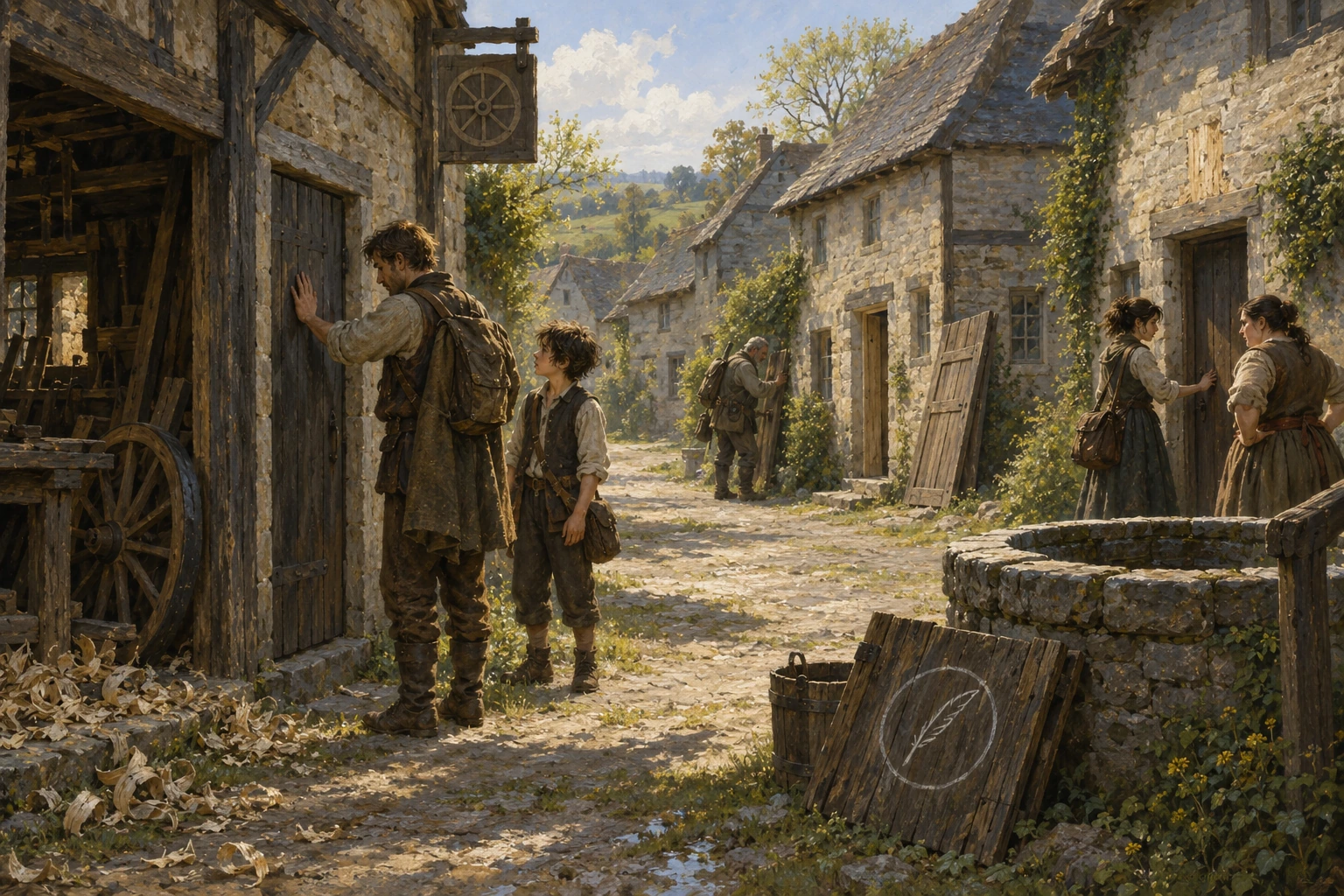
They found it an hour on, where the road widened at a crossroads into what had plainly once been a small, busy place: five or six houses of stone and dark timber, a well with a worn stone lip, and at the crossing's corner a low, wide-doored building that could only ever have been a wheelwright's shop, its yard still scattered with pale curled wood-shavings too old now to be anything but a kind of soft grey moss underfoot.
Garron did not name it at first. He stood at the crossroads' edge a long moment, looking down the short street with his hands loose at his sides, and when he did speak it was only one word, low, in the register Wren now knew for a fact-stating rather than an invitation to ask further.
"Sarnholt."
The name stood on its own, and the company went in on foot, quiet, as they had learned to go into any western place — feet wiped though there was no threshold left worth wiping them for, voices kept low though there was nobody left to disturb.
It read differently from Aldern within the first dozen paces, and everyone felt the difference before anyone named it. Aldern had been asleep: doors on their latches, dust lying in even snow-like drifts, a whole town's worth of things left exactly where a leaving hand had set them down. Sarnholt had been asleep the same way, once — the same deep dust still lay along every untouched sill — but it was no longer entirely asleep, and the difference showed in a hundred small, workmanlike details that none of them found easy to look at for long.
The first house on the street had lost its door-hinges: not broken off, not wrenched, but drawn cleanly with a proper tool, the door itself set carefully aside against the wall rather than left to fall. Inside, pale rectangles stood out plain against the dust-darkened walls where furniture had stood a long while and now did not — a dresser's ghost, a bed-frame's ghost — and chalk marks, faint but legible, still clung to the floorboards where each piece had been tallied before it went out the door.
"Careful work," Bracken said, crouching to look at one chalk mark, his voice as flat and unwilling-to-be-anything-but-honest as it had been over the ruts. "See how the numbers run — one to eleven, no skips, no crossings-out. Whoever tallied this counted once and counted right the first time." He straightened, and there was nothing in his face that Wren could have called anger, only the particular weariness of a man reading a job done well in a cause he could not approve of. "It's the same care Hewett gave his own cart-load, a year and a world back. That's what makes it worse, if you want the truth of it, not better. A careless thief you can be angry at clean through. This isn't that."
The second house had lost its carved house-mark from above the lintel — pried free with the same careful competence, leaving a raw pale scar where the mark had shielded the grain from years of weathering, the absence sharper than the mark itself could ever have been. Dorrit stood under it a long moment, then said, quietly, to nobody in particular, "That's not theft the way theft usually happens. That's a man doing careful work on somebody else's grief, and never knowing it was grief he was working on."
The third house was the wheelwright's shop itself, and it was there that the company found the thing that stayed with all of them longest.
The shop had been thoroughly worked: every finished fitting gone, every keg of good iron nails gone, the best of the seasoned timber-stock gone from its racks, all of it tallied in the same neat chalk hand on the same swept floor. But at the bench nearest the window, a wheel stood half-built on its spindle — spokes fitted on one side and not the other, the rim not yet drawn round — and beside it, laid down exactly as a careful hand lays down a tool it means to pick up again within the hour, lay a spokeshave, its blade still faintly bright under three centuries of dust.
"Left because it wasn't worth the taking," Garron said, very quietly, looking at it. "Half a wheel's no good to anyone. You can't sell half a wheel." He reached out, and did not touch it, only held his hand a little above the rim the way Luel had once held her hand a little above the whittled horse at Aldern. "Somebody set this down meaning to come back to it after his dinner, or after the frost broke, or after whatever it was that never came, and it's stood here every day since, half a wheel and a good shave laid down proper, waiting on a dinner that was three hundred years ago."
"That's the whole difference, isn't it," Dorrit said, low, "between what they took and what they didn't. They took everything with a price on it. They left the one thing in this whole shop that still had a person in it."
It was into the silence after that that Garron went, without any word to announce it, and began to close the doors.
He did it plainly, and without hurry, and without a single word wasted on it: the wheelwright's door first, lifted back onto its stripped hinges as best it would sit and drawn shut; then the house with the missing lintel-mark; then, one by one, up the short street, every door the diggers had opened and left standing — not forced, most of them, only opened and left open by hands that had not known, or had not troubled to ask, what a closed door in this country had once meant to say. He latched what would still latch, and where a latch was gone he simply set the door to and stood a moment with his hand flat against it, the way a man tests whether a thing will hold, and then moved on to the next.
The company came in behind him: Bracken taking the far end of the street, Wren and Dorrit the near houses, Pip trailing after Garron with the gravity he gave any task he had privately decided mattered. They worked without talking. It took the better part of a quarter hour, eleven doors set right in a village that had held perhaps thirty souls at its fullest, and when the last door — the wheelwright's own, left for himself on purpose — clicked home under his hand, he stood a long moment with his palm flat against the wood, and said, to the door and not to any of them, the only words he spoke the whole time.
"There. Latched again. It's little enough, but it's what I've got."
Iyene worked through the whole of the afternoon with the particular cold thoroughness Wren had come to recognize as its own kind of tenderness — the tenderness of a woman who believed, all the way down, that a thing properly recorded could not be entirely lost. She logged Sarnholt in both books, condition and memory, exactly as she had logged the mended gate at Aldern and the beacon-basket's provenance before that: what had stood, room by room, insofar as the chalk-tallies and the pale ghost-shapes on the walls could tell her; what was gone, and by whose hand, so far as the sign made plain; and the consignment mark she found chalked on the lid of a crate too split to be worth the carting — a quill drawn small within a plain ring, and beside it, in a clerk's tidy hand, SARNHOLT — LOT THREE — FORTY-ONE PIECES CONSIGNED. She copied it letter for letter, the way she had once copied Factor Quill's mark off Hewett's manifest, "because a thing noted is a thing that can be answered."
"It's lawful," she said, that evening, at the fire, in the same plain tone she had given the tallies all afternoon. "Every stick of it. Quill's standing purchase, a real charter behind it, a crew that counted its tallies once and got them right the first time. I could no more have that lot arrested on the strength of what we found today than I could arrest a man for buying bread honestly at a baker's counter." She turned her cup a half-turn, as Edda turned hers. "The paper that emptied those rooms is real paper. It's tempting, standing in a place like Sarnholt, to want a villain to be angry at, and there isn't one to be found here — only a lawful trade working exactly as its charter allows, in ground that trade was never built to understand. The answer to a real charter isn't anger. It's a better claim, arrived first. A town mapped, and chartered, and living outranks a salvage claim in every court that will ever matter to the College, for exactly as long as we're the ones who get there first to make the claim stick."
She did not say it as a speech, and nobody treated it as one; but it was the resolve from Harrol's map-room at winter's end, grown up from a fireside vow into a plain working method — borne out within the hour, when Iyene and Garron bent together over the map and reworked, in a quarter hour's quiet arithmetic, the shape of the days ahead: earlier starts, a route bent to favor the steadings and keepings Garron knew still stood tended over the ones already emptied, the beacon-hills moved up the order wherever one could be reached and lit before any train reached it first.
"It's not much of a weapon," Garron said, looking at the reworked line on the map, "against carts and coin."
"It's the only weapon a charter's ever been able to give me," Iyene said, "and I have found, over a year of testing it, that it is a good deal sturdier than it looks."
The evening fire, once the map was put away, warmed back into its ordinary shape, the day's harder weight set down without being denied.
It was Garron who asked the question the day had earned, turning his cup in his hands, as his mother turned hers. "What does your College do with it, then. All this we're writing down. What's it for, past the writing?"
"It's for exactly what you watched Iyene say it was for, at Sarnholt, not two hours past," Alder said, before Iyene could answer, though he said it gently, the way a man passes a question along to the person who has already earned the right to answer it best. Iyene inclined her head, accepting the pass, and gave it to him plain.
"A town on a living map is a town somebody can come back to," she said. "That's the whole of what a chart does, in the end — refuse to let a place be forgotten twice, on purpose, by somebody who'd have to look at the chart first and choose to. Aldern taught me that, and Sarnholt's only taught it harder." She looked at Garron across the fire. "It's the opposite kind of taking. They took what could be carried off and sold. We take nothing at all, and in exchange the place goes on existing somewhere that isn't only memory, which memory, on its own, has a way of letting slip."
Bracken, mending a strap by feel more than by firelight, said what he said without looking up, in the same unhaunted, working voice he had used over the ruts that morning. "The men driving those carts aren't monsters, mind. Good drivers, careful loaders — the kind of crew I'd have been glad to hire myself, in another life, for an honest job. That's not meant as a comfort. It's the whole reason going first matters. You can't shame a monster into stopping. A decent man doing a lawful job will stop, every time, the day a better claim reaches the ledger before his does. We're not racing villains west. We're racing paper. And paper, unlike villains, can always be beaten by better paper, got there first."
Garron considered that the length of about forty paces' worth of silence, which by now the whole company recognized as his true unit of thought, and then said, "Then I suppose we'd best keep walking early."
"We generally do," said Dorrit, comfortably, and reached for the bread, and the talk turned, as it always turned by that hour, toward smaller and warmer things.
When Bracken came to set the watch, he offered the first turn to Garron as a matter of course, and Garron took it with a short, surprised laugh. "There's never been a watch kept under my mother's roof in her whole life," he said, settling his coat by the fire's edge. "I find I don't at all mind standing one out here, on a road with no roof over it at all. Different rules, I suppose, once you're past your own door."
"Different roads, different roofs," Bracken agreed, and went to his blankets, and the fire burned low and companionable behind him, for a company that had learned, room by empty room if it had to, what it meant to keep a door.
Wren wrote it up by the last of the firelight, with Garron a still dark shape at the fire's edge and the road's long silence pressing softly in on every side.
Three days out from Sereth, and the road gave us Garron's whole country by inches — which fork serves a day's-walk range, which well runs sweet, which slope wants watching after rain — and gave Garron, too, the strange new sight of his own ordinary roads becoming a permanent thing under somebody else's careful hand. He had never minded a road being written down before, he told me, because he had never watched anyone do the minding.
On the third morning Bracken read cart-tracks into the road itself — two or three heavy wagons and a good mule-string, days old, laden outbound, driven by a crew that knew its work and did it carefully. No Hazel telling of this road, in any generation, has ever put a cart on it before now. I found myself wondering, once, whether these were the very tracks the Assessor waited on at the watch at winter's end, and I have no way to answer the wondering, so I have set it down honestly unanswered.
The tracks led us to Sarnholt — a wheelwright's hamlet, small, kin to Aldern's own wood-fair country — worked over lawfully and carefully: iron fittings drawn clean, house-marks pried from their lintels leaving raw pale scars, the best furniture tallied in chalk numbered once and correctly, one to eleven, no crossings-out. What made it hardest to look at was not what was taken but what was left standing open behind it — doors latched shut generations past and opened now by hands that did not know, or did not stop to ask, what the latching had once meant to say. In the wheelwright's own shop a half-built wheel stood on its spindle with the shave laid down beside it exactly as its maker set it down, worthless to any cart because unfinished, and so the one thing in the whole street the diggers left with a person still in it.
Garron closed every door they had opened, one by one, up the whole short street, and said nothing while he did it, and one thing only when the last door — his own, left for himself — clicked home: "There. Latched again. It's little enough, but it's what I've got." We none of us thought it little.
Iyene logged the whole of it in both books, and found and copied, on a split crate too poor to cart, the Factor's own ring-and-quill mark and a clerk's neat tally beside it: forty-one pieces, lot three, Sarnholt. She said the plain working truth of it at the fire after, and I set it down near her own words: the paper that emptied those rooms is real paper, and the answer to real paper isn't anger, it's a better claim, arrived first — a town mapped and living outranking any salvage claim, for as long as we're the ones who get there before the next cart does. She and Garron reworked the road ahead by lamplight on the strength of it: earlier starts, the kept places favored over the emptied ones, every beacon-hill moved up the order wherever we can reach it first. Not a grim resolve — a practiced one, at last: the vow we made at Harrol's own table at winter's end, grown up into a working method.
At the fire after, Bracken said the truest thing said all day: that the men driving those carts are no monsters, and that this is exactly why going first matters as much as it does — you cannot shame a decent man out of a lawful job, but a better claim, got there first, beats him every time. Garron took the first watch of his life kept on an open road rather than under a kept roof, and laughed to find he didn't mind it. The fire burned low and ordinary after that, and the road tomorrow is the same road as today: ours, a little further on, by charter, and by keeping, and by being the ones who go first and close the doors again behind us.
Across the fire Garron sat the first watch of his life kept out of doors — careful, attentive, and entirely unnecessary — and Wren went to sleep within sound of it.