The Relic Cart
Three more days of climbing, and the world climbed with the road.
Grass gave way, by slow degrees, to a shorter, wirier grass, cropped close by sheep that stood in loose grey clusters on the high ground and watched the company pass with the mild, total indifference sheep reserve for anything that is not grass or a dog. The frost came earlier each night and left later each morning, until it stopped, in any real sense, leaving at all, and simply thinned by noon into a damp that darkened the stones of the road and dried again before evening brought it back. The air had a bright, scoured quality to it, the kind that Wren associated, from the high pastures above Dall, with weather too cold to hold anything in it but itself — no haze, no softness, every far thing suddenly near enough to count its stones.
Seven walked differently than six had. It was a small thing, and Wren noticed it before she could have said what sign had told her — the column simply hung together in a new shape, settled a beat after some structural change in the air only the company itself could name. Luel walked nowhere in particular and so, in practice, walked everywhere by turns. An hour beside Bracken, listening while he talked to Suet about her opinions of the road. A stretch beside Dorrit, the two of them trading names for the low scrubby plants that grew where the heather gave out — Dorrit delighted every time Luel's word for a thing turned out to mean, translated, almost exactly what Dorrit's own grandmother had called it, only older. A while beside Pip, who asked no questions at all on the second day, which Wren privately thought was Pip's own quiet way of proving he had learned something at the ford after all — that, and the fact that his splinted fingers still made the holding of a pencil a slow, deliberate business better saved for the evening fire than for talking over. She sat with whoever held the fire each night precisely as she had promised, unlisted and uncomplaining, and Bracken had stopped, by the second evening, trying to talk her out of it.
"She'll wear herself thin," he said to Wren once, low, the first night, with the particular gruffness of a man worried about a thing he has no authority to forbid.
"I don't think she wears down like we do," Wren said, and Bracken considered this, and grunted, and let it go, and by the third night was leaving her the good log without being asked, exactly as he left Gable the light loads: not because either needed the kindness, but because it pleased him to give it.
The mountains stood nearer with each evening, close enough now that Wren could pick out, on the clearest mornings, pale threads of old snow lying in the high folds where the sun never quite reached to take it. Somewhere beyond them, still unseen, was the border watch, and beyond that the Gray Stair, and beyond that a country none of them had walked since the passes shut. The road they were on, empty since the last shepherd's steading below the Singing Ford, ran on ahead of them into all of it, waymarked and faithful, exactly as it had every day since Merrow. It was Dorrit, of all of them, who noticed the pattern first, and said it lightly, as she said most things she had not fully decided were worth worrying about: that every ill-feeling patch of ground they'd crossed since Merrow — the sour hollow before the Fenwater, the stretch above Elmcross where even the mules had hurried — had lain off the King's Road itself, on some forgotten spur or cart-track nobody kept anymore, and never on the road proper, however old and thin it ran. Iyene wrote it down anyway, in the margin rather than the body of her notes, where she kept things suspected but not yet proved.
It was on the fourth morning of that climb that the road stopped being empty.
They saw the dust of it a long way off — a queer sight after so many days of nothing. Bracken, at the front, stopped dead and shaded his eyes and said, in the tone of a man reporting a comet, "Something's coming." The whole company, without discussion, gathered a little closer together, the way people do at an unexpected sound in a quiet house — not from alarm but from simple sociability.
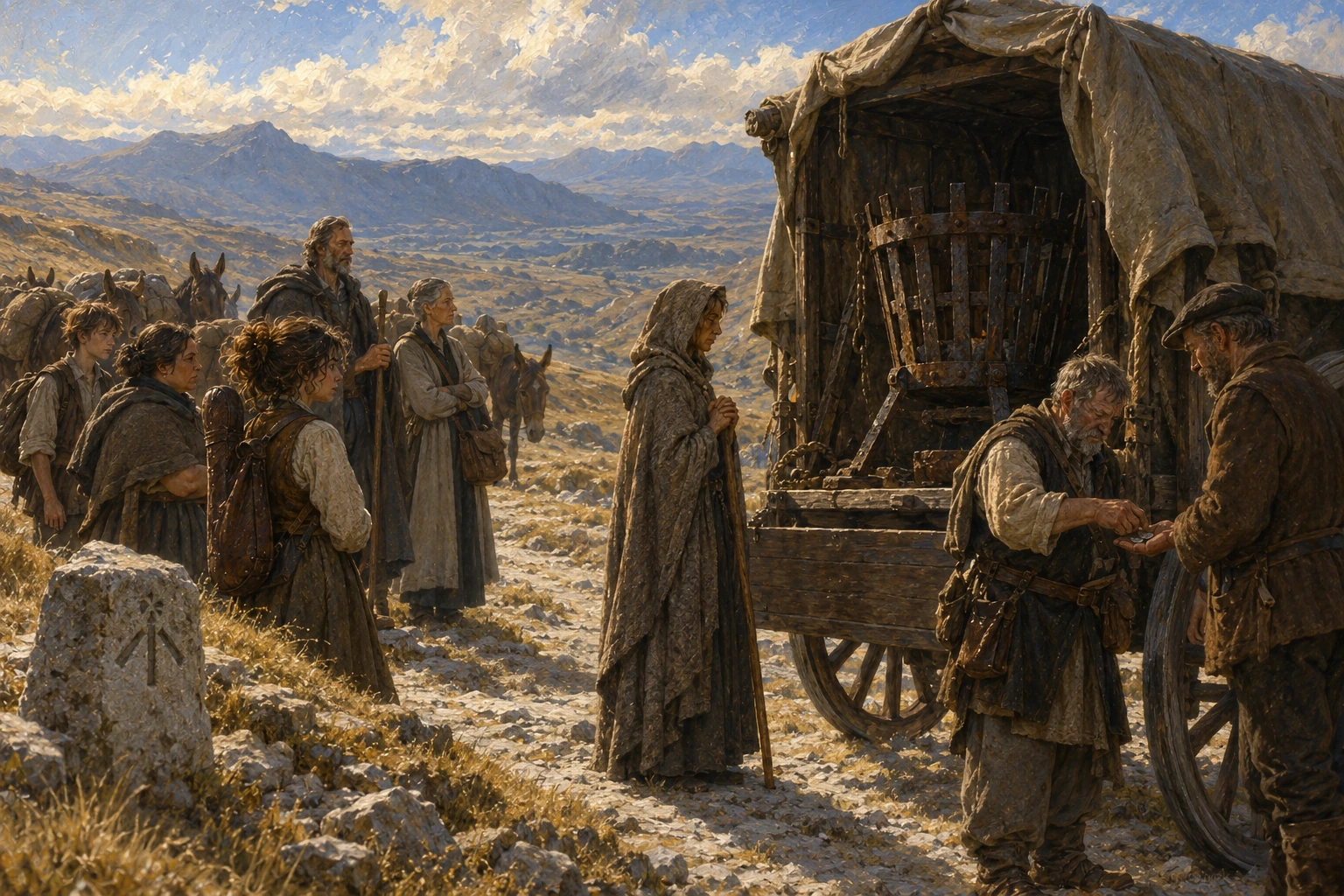
It resolved, over the better part of a mile, into a cart — a heavy, honest, unlovely wagon, high-sided, drawn by two broad well-fed mules that clearly thought little of the grade and less of the company blocking their road. It was driven by a big man in a brown coat with a boy beside him no more than fourteen, and loaded, under a lashed tarpaulin gone pale and stiff with weather, with something that shifted and clinked as the wheels found the road's ruts.
"Road's wide enough for both of us," the carter called out while he was still forty paces off, in the cheerful, slightly too-loud voice of a man who has gone some while without anyone to talk to and means to make the most of the chance now one has arrived, "which is more than I can say for the last stretch I came over, and I'll tell you about that free, since nobody's charged me yet for the pleasure of the telling."
He drew up level and set his brake and looked the company over — mules, packs, the seven of them — with an open, cataloguing curiosity that held no more menace in it than a farmer's glance at another farmer's fence, and touched two fingers to his hat-brim.
"Hewett," he said. "Carting out of Merrow, this trip, and glad of the company on an empty road, which this one has been the whole way north of the crossing. My sister's boy, Sim." The boy, perched on the board beside him with the varnished stillness of the very young trying to look older than they are, nodded once, gravely, and went back to studying the mules' ears.
Introductions went round with all the thoroughness road-law required of two parties meeting on an empty stretch — names, direction, the courteous fiction that neither side was in any particular hurry, though both obviously were, in the way that people with somewhere to be always are and never quite say so. Bracken produced bread and a twist of the good cheese without being asked, because a shared midday on an empty road was, as far as he was concerned, simply owed. Hewett produced, in exchange, a flask of something sharp and homemade that he pressed on Bracken alone, correctly reading him for the one man present it would be no discourtesy to press.
"You'll have come the long way round," Bracken said, nodding at the mules, "if you're carting out of the border country and I've read your dust right."
"The long way round is the only way there is, this season." Hewett said it without much heat, the grumble of a man airing an old grievance for the pleasure of the airing rather than any hope of remedy. "Crossing south of here's gone under — some kind of drowned bridge, they tell me, though I've not seen it myself and don't care to. Four days round by the north ford, and four back to find this road again, and my mules no happier for it than I am, though they complain less, being mules." He looked from Bracken to Iyene, deciding who among them actually held the reins. "You'll know the crossing, maybe, coming down from that way."
"We know it," Iyene said, dry, "rather better than most," and let it go there, which Hewett, unpressing, did too, in the manner of a man who has learned that the north ford's detour is a subject everyone on this road shares and nobody much wants to linger over.
The news traded easily after that, as it does between strangers glad of the exchange: the border watch fed and quiet, no trouble worth the name in a decade, the passes still shut fast above it as they had been shut since before Hewett's grandfather's time. Word of the south — Merrow, the College, the harvest — carried the other way, Hewett accepting each fact with the pleasure of a man who will dine out on it for a month at the next inn that will have him. Dorrit made him laugh twice within the first quarter hour, which she generally managed with strangers inside of ten minutes and privately considered a matter of professional pride.
It was Sim, not Hewett, who first drew Pip's eye to the load — a boy's interest finding a boy's interest across a stranger's cart the way water finds the lowest ground — nodding at the tarpaulin with the pride of someone allowed, for the length of one journey, to be part of something a man's work.
"Old stuff," he offered, when Pip asked, clearly delighted to be the one telling rather than told for once. "Iron, mostly. Some carved bits. Dug up west of the watch, out past where anybody farms now — there's men make a trade of it, going through the old broken places with a spade. We carry it down to Merrow for the Factor." He said the last with the unconscious weight of a boy repeating a phrase he has heard often enough to have stopped hearing it.
"Where," Alder said.
It was one word, and it came out of him wrong — flat, fast, stripped of the courtesy that rode along with nearly everything he said, first to the road and then to whoever stood on it. Sim, enjoying himself enormously not a breath before, blinked and took an actual half-step back, the way a boy steps back from a dog he has just realized is not, in fact, asleep. Pip, at Sim's shoulder in the easy comradeship of the last quarter hour, went still in a different way than his usual stillness — his eyes going to Alder and staying there, the ready warmth gone out of his face for three long heartbeats.
"West of the watch," Sim said again, faster now, glancing at his uncle. "That's — that's all anybody tells me, sir, honest. I don't ask past that. Nobody asks past that."
Alder looked at him a moment longer than the answer wanted. Wren, watching, saw something in his face she had not seen in three hundred miles of road — not anger only, but something gone entirely still and entirely cold, a door held shut on a great deal that was not, she understood all at once, built to stay behind it forever. Then, as quickly as it had come, it folded back under the ordinary courteous weather of his face, and he turned back to the cart as though the moment had not happened at all, which was somehow worse than if he had explained it. Pip kept half a pace further from Alder's side for the rest of that halt than he had kept all morning, without seeming to know he was doing it.
"Factor," Iyene said, mild as milk, into the small silence that followed, and reached, without any particular hurry, for the manifest tucked under the tarpaulin's edge.
Hewett made no objection to the manifest being read — it cost him nothing, being a document he carried openly and had answered a hundred idle questions about already on the road. Iyene read it the way Wren had watched her read a badly hatched hillside: not angrily, at first, only with a narrowing, professional attention that grew more exact with every line.
Old iron, hinge-work, three sound; latch-pieces, a dozen, mixed condition; one carved lintel-stone, weathered, cracked corner; assorted fittings, weight approximate. Each entry carried, in the same clerkish hand, the same thin provenance, repeated down the page like a line worn into a step: dug west of the watch. Not a farm's name, not a hillside's, not a household's — the whole of a vanished country reduced, entry by entry, to one compass bearing and a spade.
"An object without its place," Iyene said, half to herself, in the flat precise voice she used for a genuine grievance rather than a passing one, "is a word without its sentence. You can still read the letters. You've lost everything they were for." She set the manifest down with the exaggerated gentleness of someone declining to let a real anger show itself in her hands, and looked, for the first time since the cart had stopped, faintly, deliberately tired.
Hewett, watching her, took no offense — he had, Wren thought, the particular equanimity of a man who has heard educated people say hard things about his honest living before and long ago stopped taking it personally, since the pay had never been affected by it. "It's only old iron to the men who dig it," he said, not unkindly, "and I'll not pretend I lose sleep over a hinge's history, ma'am, begging your pardon. It's a fair trade and a fair price and nobody the worse for it that I ever heard — the old stuff's worth nothing to the sheep, and the sheep are what's up there now."
Bracken had gone, meanwhile, to the tarpaulin's edge, with the proprietary interest of a quartermaster assessing any load within reach of his hands, mules or no mules. It was Bracken who drew the corner of the canvas back another foot, and went still.
Under a tangle of hinge-iron and one long grey lintel-stone carved, faintly, with a running border no one now living could read, sat an iron basket — wide, deep, the iron gone dark and pitted with weather but whole throughout, its four squat legs still sound, its rim still true, made by hands that had built it to outlast the hands that built it. It needed no manifest entry to be known for what it was. Every soul at that cart's tail had sat, four nights past, at a fire and heard its whole history sung to them entire.
Nobody spoke. Wren heard, with a clarity that seemed to belong to the silence rather than break it, the small ordinary sounds a stopped road makes — a mule shifting its feet, a curlew somewhere off in the sheep-ground, the tarpaulin's stiff canvas settling where Bracken's hand had left it. Pip's face had gone entirely still, stiller than it ever went over his own work; Dorrit's hand had found Wren's sleeve at some point without either of them noticing when. Iyene did not move at all.
It was Luel, at last, who broke it, and broke it quietly, and once, and no further.
She had come to stand at the cart's tail without anyone marking when, and looked into the basket a long moment with the same stillness she had given the wing-mark in Wren's book, four nights back, though nothing in her face this time asked to be read as grief. She only looked, the way a person looks at a face come upon unexpectedly a long way from where they last saw it.
"I saw this lit once," she said, "from a long way west of here."
Nothing more. She did not touch it. She stood a moment with both hands on the head of her staff, and then walked back up the road to where the mules were, and the company let her go.
"What's your price on it," Bracken said, into the quiet, in the flat working tone he used for weighing a pannier — not unmoved, Wren thought, watching him, but moved in the particular way that turned itself, in Bracken, directly into practical usefulness rather than words.
Hewett named a figure — fair, by the sound of it, no higher than the iron's bare weight and the manifest's standing rate would fetch. Bracken looked at it, and looked at the basket, and did the sum Wren had watched him do over every load since Merrow: coin against grain-money, need against want, weight against the long road still ahead — all of it laid out loud and plain, because that was how Bracken did his figuring, trusting the doing of it in the open more than any private conclusion.
"Double it," he said, "and I'll have it off your cart within the hour and no argument from either of us after."
Hewett blinked, and looked at the basket again as though trying to see in it whatever these strangers so clearly saw, and did not find it, and shrugged — a rueful, unoffended shrug, the shrug of a working man handed better terms than he'd have thought to ask for and seeing no reason on earth to question his own good luck. "It's only old iron," he said again, mildly, "but it's your coin, and I'll not argue a man out of spending it kindly. Sim — help the gentleman get it down."
The coin changed hands in the open, counted twice by Bracken's own insistence, the manifest amended in Hewett's clerkish hand with a line struck through and initialed. It was there, watching the amendment made, that Iyene reached for her own pocket-book and copied, without comment, the mark that stood at the manifest's head above every entry — a quill, drawn small and exact, set within a plain ring — and the name beside it, written out in full: Factor Quill, Merrow, standing purchase, westish goods, fair weight and prompt pay.
"He's a good man to sell to, if it's any comfort to you," Hewett offered, watching her write with the same open curiosity he'd given everything else that morning. "Pays on the spot, no haggling worth the name, never once tried to shave a weight on me in six years' carting for him. Wants anything westish, the older the better, and never asks past the one line on the paper where a thing came from. Some buyers want the whole story with the goods. He never has. Makes the paperwork simpler for men like me, though I'll own it makes it simpler for the diggers too, and I couldn't tell you if that's a kindness or not."
"Noted," Iyene said, closing the book, in a voice that gave away nothing of what she had just written it down to answer. Wren, watching her, thought of nothing so much as a cartographer marking a feature on an empty stretch of map — not out of anger declared, but out of the older, colder habit of a woman who believed that a thing once located could, in its own time, be dealt with.
It was only afterward, walking the load back to the mules, that Wren noticed — always a beat late, the things closest to her — that at no point in the whole long halt had she brought the satchel forward from where it rode at her hip, though she carried it every ordinary hour without a thought. And she noticed that Dorrit, the entire time, without a word exchanged between them, had stood at Wren's shoulder on the side nearest the cart — solid and unremarkable as a gatepost, exactly where a body would need to pass to see what hung there. Neither of them had decided it. It had simply happened, the way two hands reach at once for a falling jar. Wren thought, walking away from it, that this was perhaps the first time in eleven generations the book had been kept from a stranger's sight by nothing more than two women's own instinct, arriving before either had thought to name it.
Sim helped lash the basket up onto Suet's broad back with the serious pride of a boy trusted with real work, and waved, once, unselfconsciously, as the cart creaked and turned and took up its own road again south and east — the mules leaning into the pull, Hewett's voice already raised in some tuneless carting-song, the tarpaulin settling back down over what little was left to hide — and the company stood a while in the road and watched it go, small and diminishing against the long grey climb, carrying east, in a stranger's own cart, hinges and latch-pieces and one carved stone that had each of them once fastened a door or graced a doorway in a country whose name its own diggers no longer troubled to learn.
They made an early camp that evening, the light going fast and the frost coming down hard and clean out of a cloudless sky, and it was over the fire — Bracken's stew, Dorrit's fever-root, the ordinary business of a day's ending — that the talk came round, as it inevitably had to, to the cart.
"I've handled a great many objects out of place in eleven years," Iyene said, turning her spoon without eating from it, "quarry-marked stones moved for a wall, a boundary post dragged off its true line by some farmer's grandfather with more strength than patience. It offends the craft in me, and I get over it, because a moved stone is still a stone and the world forgives it eventually. This is a different offense." She looked into the fire rather than at any of them. "Every entry on that page had the same one line where a place ought to have stood. Not because the diggers are cruel — I don't think they are, any more than that carter is — but because nobody troubled to ask them to be anything else. A whole country, and all anyone thought to record of it was the weight."
"It's not remembering," Alder said, quietly, into the small silence that followed, "whatever the Factor calls it on his manifests. I said once, at a fair a long way south of here, that a thing bought is not the same as a thing kept, and I've had a good while since to turn the difference over properly." He turned it over now, aloud, taking his time, the way he turned any hard thing over before he set it down. "A neighbor keeps a thing because it was given, or found, or made, and keeping it costs her something — a shelf dusted, a story retold so it doesn't wear thin, a place held open in a house or a memory whether or not anyone comes to see it there. A magpie keeps a thing because it shines. Both of them end up, in the end, with a nest full of bright objects. Only one of them was ever keeping anything at all." He glanced, briefly and without ceremony, toward Suet, dozing at the picket-line under her new iron weight. "The Factor is not unkind, so far as any of us has heard, and I'll not make him a villain in my own head for the sake of a tidier feeling. He is only a magpie with very good manners and an excellent memory for weight."
Luel, who had listened the whole while with her usual patient attention, offered only the smallest addition, and offered it lightly. "My people have a word for what your Factor does," she said, "though I'll not give it to you in my own speech, and you would not want it there if I did — it carries a great deal that your tongue has no shelf built for, and I've no wish to hand you a word you'd only misuse trying to be kind with it. I will tell you it is not a cruel word. It does not need to be. It simply means taken, and not missed by the taker — which, I find, is very often worse than a word that means cruelty outright, because at least cruelty knows what it has done."
There was nothing in it to argue. It was Wren, unexpectedly to herself, who said the thing that had been sitting in her since the cart's dust first showed on the road.
"We're going the other way," she said. "Toward the same country he buys pieces of a bearing at a time. We're not going to buy it back a hinge at a page — we're going to give it back what we can carry, starting with one basket that's riding home tonight instead of toward a market it never asked to reach." She said it without heat, the plain unadorned way Granna Tansy stated a fact that had already settled itself and needed no argument to stand up.
"No," Alder said, and there was something in the single word — settled, quiet, entirely without heat of its own — that closed the matter for the evening as plainly as a door pulled to. "It doesn't want anything cleverer than that."
They redistributed the loads by lamplight before turning in, Bracken going about it with his usual grumbling thoroughness — the basket wanted balancing against Suet's grain-sacks, a strap re-cut, an evening's honest work that he complained through from start to finish and would, Wren knew by now, have complained through twice as loudly had anyone offered to spare him it. Suet stood patient under the new weight the whole while, ears loose, entirely unbothered by most things the world saw fit to load onto him.
"Good back on him," Bracken said, giving the mule's neck a final approving pat, "and a fine, dull, biddable temper to go with it. He's the one to carry a thing that only needs carrying steady, and not minded, and not hurried — he's got the patience for boredom that the rest of this string sorely lacks." Suet, for her part, showed no sign of finding the honor especially large, which Bracken seemed to consider the surest proof he'd chosen rightly.
Wren copied one thing only into the book that night by the last of the fire: the name, in full — Factor Quill, mark of a quill in a ring — because a thing noted was a thing that could, someday, be answered.
The frost came down harder as the fire burned low, and the mountains had lost their outline altogether by then, and were only the place where the stars stopped — nearer now than they had been even the night of the wing-mark. Bracken had begun, without anyone remarking on it, to speak of the border watch not as a distant destination but as a place now properly ahead — a handful of days, no more, before its own fires would show along this same climbing road. Somewhere on the far side of all that waiting stone, unnamed on any page in Wren's keeping, a ruined hill stood with an empty stone cradle where a basket much like the one now riding Suet's steady back had once burned its last watch. The basket rode on tonight, patient under a patient mule, going home by a road it could not have known to hope for, at the pace of a company in no hurry at all to arrive anywhere without it.