Marlford Fair
They had known the fair was coming for the better part of a day before they saw the town; it was the way Wren knew a swarm was coming before she saw it — not by any one thing, but by the gathering hum of many small things agreeing.
It began with the road itself. The south road had been, for six days, a decent ordinary road — wide enough for two carts to pass with a civil word, empty enough that they'd gone whole mornings meeting no one but a boy with a dog and a man mending a stile. On the seventh morning it began to thicken: a cart of apples, then two carts together loaded with hurdles and a crate of indignant geese, then a husband and wife each carrying a goose under one arm like a very ill-tempered loaf of bread. By midmorning the road had grown a second informal road along each verge, worn pale and bare by feet that had chosen not to fight the cart-ruts, and Wren found herself doing a sum without meaning to, reading the traffic of the thing to know, before she ever saw the thing itself, roughly how large it must be.
"There's a fair on somewhere ahead," she said to Alder, not as a question.
"There is," he agreed. "Marlford, most likely, and it'll be their big one — the harvest fair, the year's fair, the one the small fairs are practice for. We're timed well for it, though I'll not pretend that's entirely an accident." Which was about as near as he ever came to admitting he had arranged a pleasure for somebody.
Dorrit, who had spent the last mile totting up the geese, said, "That's eleven geese we've passed since breakfast, not counting the goose that bit the littlest boy, which I don't blame it for, being a goose, carried by a boy, on a warm morning, a long way from home. Eleven geese is a great many geese for one road. I begin to be excited, and I would like it noted that I do not excite easily."
"Noted," said Alder.
By noon the traffic had gone from a road's worth to something closer to a small steady river, all running one way; and toward midafternoon, coming up over a low rise with a mile still to go, Wren saw the smoke of it first — not one chimney's worth, or ten, but a whole grey haze standing over a shallow valley ahead of them, and under the haze, as they came down the last slope, the town itself.
Marlford sat where two rivers met, spanned by a stone bridge with five arches that Wren counted twice because she did not, at first look, believe the number; and the town went on past both banks in streets that did something she had never seen a street do, which was go somewhere. In Dall the lanes went from a house to a field, or from a field to another field, or, in the case of the west road, from the valley to the rest of the world by the one fixed route everyone had always taken. Here they forked and forked again and disappeared round corners into more town, and the roofs went on past the point where her eye expected roofs to stop, and kept not stopping, until she gave up trying to hold the shape of the place in her head and simply let it be larger than she could hold.
"How many Dalls is that," she said, half to herself, working it the plain honest way a farmer works a field's yield, "would you say. In houses. Four? Five?"
"Nearer eight, I'd think, and that's not counting today," Alder said, "because today there'll be half the shire in it besides, come in for the fair and going home again tonight or tomorrow. Same as your own valley — it empties itself into the fair-field for a day and fills up again after." He glanced at her, a smile at the corner of it. "It surprised me too, the first time. It still does, now and again, though I try not to let it show, on the theory that a Warden oughtn't to gawp in public."
"You're gawping a little now."
"I am doing no such thing. I am taking careful professional note of the bridgework." But he was smiling, and did not stop looking at the town as they went down toward it, which made the strangeness of the place sit easier in her: if a man who had walked this road forty times could still find it worth a long look, a girl on her first crossing needn't feel foolish for staring. So she stared, the entire descent to the bridge.
The bridge itself she crossed slowly, on purpose, feeling the stone of it under her boots, with the two rivers running fast and full beneath, brown with the season. On the far bank the noise of the fair came up to meet them all at once — drovers calling, a smith's hammer, a man singing out the virtues of ribbon, geese, dogs, cartwheels, a fiddle tuning up badly two streets off; and under all of it ran the deep hum of several thousand people talking at once, larger than any sound Dall had ever made, and with opinions about ribbon.
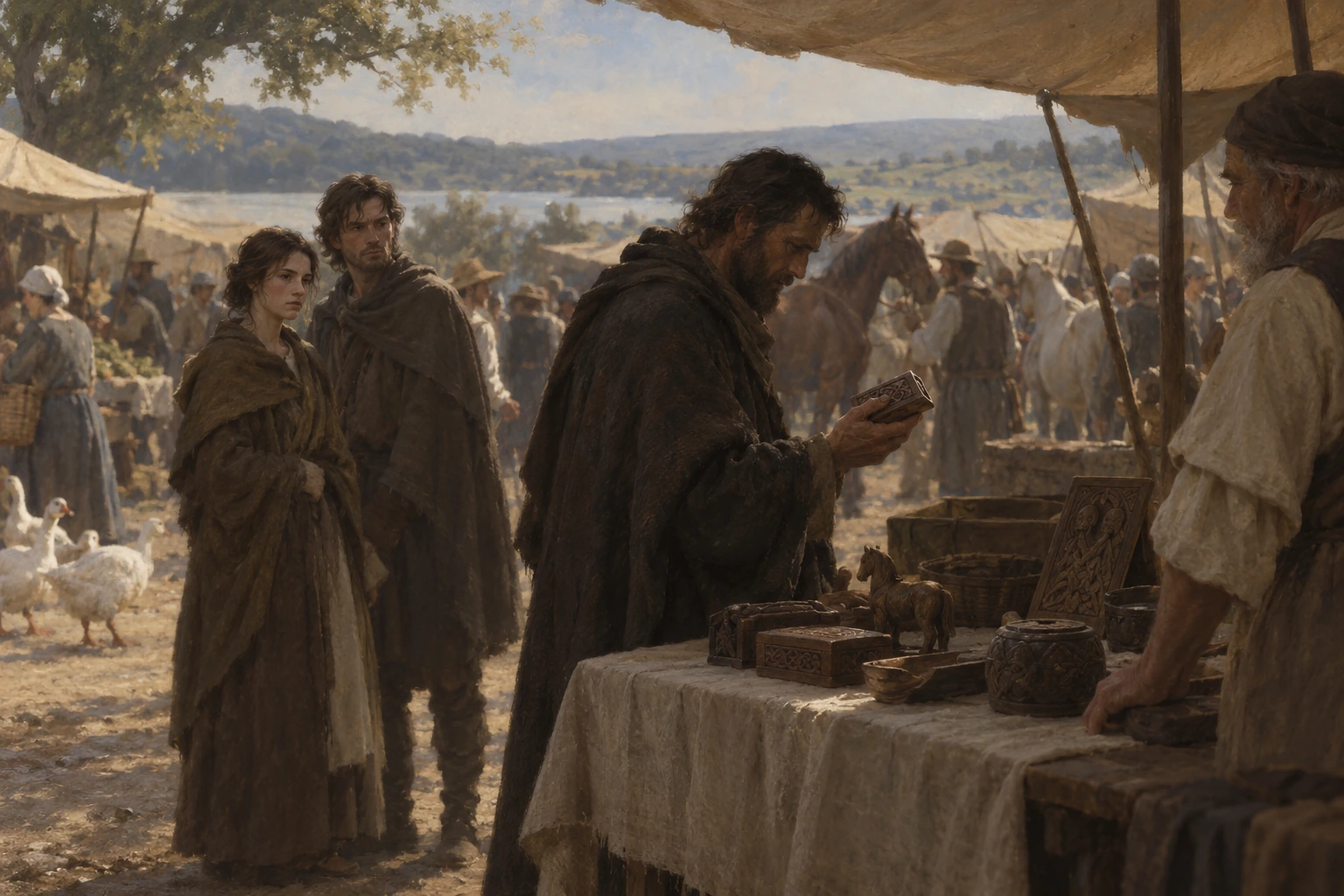
The market square, when they reached it, was not so much a square as a country of its own: stalls in rows and rows going off in every direction, awnings of every color the dyers of a whole shire could produce, the ground gone to mud and straw and trodden cabbage-leaf under thousands of feet. The press of people was so thick in places that Dorrit took Wren's sleeve without being asked and did not let go of it, on the grounds that losing a cousin in a crowd this size was a full day's work to put right and neither of them had a full day to spare.
"Right," said Dorrit, planting herself like a woman surveying a field before she'd decide where to put the beans. "First order of business is that I am hungry, and I intend to be fed by something I have never eaten before." They found it three rows in: thin batter folded round chopped apple and a dark sharp spice the seller called market-red, seared on a flat iron and handed over too hot to hold. Dorrit pronounced it not entirely to be trusted and finished every bite of it anyway.
It was Dorrit's part of the fair that showed Wren something she ought to have expected perfectly well, having known her cousin their whole two lives.
The seedsmen and simplers kept a quieter row at the fair's western edge — trestles of paper twists and small clay jars and bundled dried stalks laid out with a neatness that had nothing showy about it. The moment Dorrit came within smelling distance of it she changed: not louder, if anything quieter, but entirely and unmistakably in her own country. She went from stall to stall with her seed-papers already out of her pocket, and within ten minutes she was deep in an argument with a woman twice her age about whether a blight that had troubled the eastern shires that spring answered better to ash or to a wash of soured milk; and Dorrit was comfortably winning it, and the woman, rather than taking offense at being bested by a stranger a third her size, was writing something down.
"Soured milk," Dorrit reported afterward, deeply pleased with herself. "She'd had it from her mother that a blight of that kind wants ash, and ash is very well for slugs and does nothing whatever for a blight, and I told her so, and she took it a great deal better than most would. I count that a very fair morning's work."
It wasn't that Dorrit had changed. It was that Wren, who had spent twenty years thinking of her as the loud one, the funny one, the one who filled a silence before anyone else got to it, had never before stood anywhere large enough to watch her be, within ten minutes of any stranger who grew things, simply the expert in the yard.
It was somewhere past this, drifting back through the crowd with no particular aim beyond finding where the ale was good, that Wren first heard her own valley's name said by a stranger, and stopped walking.
It came from a knot of men by a cider-stall. One of them was saying, comfortably, third-hand, that up north past the shires, in some valley or other under the mountains, the old pass had opened clean through for the first time since the Frost, and folk were already walking it and finding the roads on the far side paved and whole. Here the teller dropped his voice for effect, though not so low that Wren couldn't hear every word: a city stood empty on the other side, the gold still sitting in it, untouched these three hundred years, waiting for whoever got there first.
Wren stood quite still, with her cup of cider going warm in her hand, and listened to this happen to her own summer.
She thought of Cob Hedley coming down off the high pastures with old Whistle at his heel and his boots still wet from it; of the single narrow tongue of green grass no wider than a lane, which was all anybody had actually claimed to see; and here it was, three shires south and however many tellings on, grown a whole paved road and a whole city of gold in the carrying. Not one of these men had the smallest idea that the young woman at their elbow had heard the first telling of it from the shepherd himself, in her own valley's inn, before it had been anywhere at all.
She held her tongue, and found it a strange and not entirely comfortable thing to be the only person for two rivers' width who knew the plain shape of what everyone around her was busy reshaping; and there was nothing to be got by correcting cider-stall gossip except the trouble of explaining how she came to know better, and that was a door she had no wish to open in a market square.
Alder had heard it too. She saw him hear it, saw the small stillness come into him that she was learning to read as plainly as weather. "It'll have grown a good deal more gold in it by the time it reaches the capital," he said, once they'd walked on out of earshot, "and lost most of what was true along the way. That's what distance does to news. There isn't malice in it, mostly — only distance."
They came on the trestle at the fair's quieter end, past the cloth-merchants and the tanners, in a row given over to buyers of one kind of settled, respectable trade or another: a man buying old coin, a woman buying lace by the yard for a house Wren couldn't picture. Between them stood a bare trestle table under an awning of good grey canvas, with a hand-lettered notice pinned above it that read, in a clerk's careful even hand:
WESTISH GOODS BOUGHT. Old letters, carved stone, family pieces from before the Frost. Fair price, coin on the table.
The word snagged in Wren's ear the way a burr snags in wool — westish, not western, not old-Meddan, a small ordinary-sounding word doing duty for something that oughtn't to be spoken of so plainly, over a trestle, between the lace-woman and the coin-man, as if it were cloth or coin itself.
The man behind the table was neither villain nor grand personage to look at — a soft-spoken fellow in a decent brown coat, ledger open before him, a purse at his belt no fatter or thinner than any honest tradesman's. He was, at that moment, being altogether courteous to an old woman who had set down on the trestle, wrapped in a piece of faded cloth, a small carved box no bigger than two fists together; and it was worked all over in a knotted pattern Wren had never seen, and somehow, looking at it, felt she almost had.
"My man's family's," the old woman was saying, not unhappily, only plainly, as you'd say a fact about the weather. "Come east with their people in the bad years, so the story goes, back when there were still folk coming through at all, and it's sat in a drawer of mine sixty years doing nobody any good, and my knees are past the stairs this winter, and silver's silver." The buyer turned the box over with real care; admired the carving aloud in a way that seemed to please her; named a price that made her blink and then nod; counted it out into her hand coin by coin; wished her well of her knees. It was, start to finish, an entirely decent transaction between two entirely decent people, and Wren found she minded it terribly anyway.
The buyer counted the coins a second time, from habit rather than distrust, and looked up already reaching for his next courtesy — some closing kindness for the old woman, the sort a decent tradesman keeps ready as a cobbler keeps a spare lace. He did not finish it. His eyes had gone past her, for no reason Wren could see, to Alder, standing a little apart, and something crossed the man's face that had no business among ledgers and fair prices — the swallow of someone who has walked into a familiar room and found the air in it changed. It lasted no longer than a held breath. He finished his sentence a beat late and a shade too bright, and did not look toward Alder again.
He looked at Wren instead. It was not a stare, and it was over almost before it began: her face, and then down to the worn oiled satchel at her hip, and then up and away — the glance a buyer gives a lot he has not been invited to bid on. He sat, and drew the ledger toward him, and did not write anything while they were still standing there.
Her own hand had gone to the satchel without her sending it; she made herself take it away again and stand with her hands loose at her sides like anyone idling past a stall. Three feet from a man who bought westish goods for coin on the table, the most westish thing in that market square sat quietly against her ribs, wrapped in oiled cloth and eleven generations, worth no coin at all because no coin would have meant anything.
It was the different quiet in Alder that she noticed most, once they'd walked on. She had learned his silences by now — his listening-quiet, his working-quiet, the quiet he wore like a coat when he was choosing which of several true things to say first — and this was none of those: this one sat heavier, and lasted longer, clear past the tanners and out to where the crowd thinned toward the horse-lines. It cost him something to carry it as lightly as he was carrying it.
"That word," she said at last, when the quiet had gone on long enough that she judged it wanted breaking. "Westish. I never heard it before today."
"You'll hear it more, the nearer we come to the capital. There's a market for such things there — old letters, old carving, anything with the Frost years on it — and a whole court of collectors grown comfortable on the buying and selling of it. None of it's unlawful, and most of the men who do the actual buying, like that one, are exactly what they seem: decent enough, paying a fair price for a thing freely sold." He paused. "But a thing bought is not the same as a thing kept, Wren, and I've never yet met the collector who could tell me the difference, or much wanted to." And then, in the same breath, he asked whether she thought the pie-woman might still be serving, because he found he wanted another, market-red and all. Wren let the subject go where he'd put it.
The evening gathered them in at the Blue Boar, a broad low inn near the bridge with every table full and a fire going though the night wasn't cold enough to need it, purely for the cheer of the thing. There was a fiddle already in one corner, played by a stout grinning man who clearly considered the evening his own, and it was Dorrit — of course it was Dorrit — who got Wren's own fiddle out of its wrappings and into her hands before she had properly finished supper, on the grounds, loudly stated, that a Fallowmere who could play and didn't was a waste of good gut.
"You could at least let me finish the potatoes," Wren said, over the case already open in Dorrit's hands, and lost the argument anyway, partly because it was Dorrit's oldest and best, and partly because she had wanted to play the whole meal through and would have sulked a little if nobody had asked her to.
She played a reel she'd played every harvest supper of her life, and the room did not know it, and stumbled charmingly trying to follow; in exchange the fiddler taught her one of his, three times through slow before she had the shape of it. Somewhere in the fourth or fifth tune traded back and forth she caught, under another name and with a different turn at the end of the phrase, Down Along the Dall — the tune with her own valley's name sitting in the middle of it, which she had believed since she was old enough to hold a bow was Dall's own and nobody else's. Here it was, played by a stout shire fiddler who had never heard of the place and called it something else entirely, and it gave her a small quiet ache of pleasure: a thing she had thought was only hers turning out to be shared, and loved, a long way from home.
Late, in the narrow room over the stableyard that she and Dorrit had between them, with Dorrit already breathing slow and even, like the tide, Wren lay and listened to the last of the fair going home under the window — cartwheels, tired children, somewhere down the street a man singing very badly and very happily about nothing in particular. She let her hand rest, as it always came to rest in the dark, on the satchel laid close beside her on the bolster.
She thought of the small carved box on the trestle, sold for silver that would see an old woman through one more winter's stairs, and of the book under her hand that had no price on it anywhere because nobody had ever thought to ask what it was worth, only what it was for. Listening to the singing go ragged and fond into the distance, she found she did not mind the size of the world nearly so much as she had expected to. Only that she meant to hold what was hers a good deal more closely, having seen today exactly what strangers would pay for what wasn't.