The Map on the Table
Marle carried the circuit-book against his ribs, inside two layers of oilskin, because a case could be trusted to fail exactly once and he had long ago decided it would not be at a time of his own choosing. The map case rode outside it, strapped flat to his back the whole way down, and he had stopped twice on the last morning of the descent only to feel along its seams with his thumb for damp, the way a man checks a debt he has already paid, simply to be certain the paying had held.
The Watch on the Stones came up out of the last of the snow low and grey and unannounced, and he had it fixed and counted before he learned its name: forty souls or near it, long turf-roofed houses sunk into the hill's own shelter, a sheep-yard walled in drystone, a smithy set apart with its own smoke standing straight up in air that had no wind left in it to bend. He noted the smoke because a forge burning that hard at that hour of an unremarkable working morning was either a forge with more work than hands to do it, or a forge somebody had decided to keep lit past any need his own trade could account for. He set the observation down that evening as a single unglossed line, exactly as he set down everything he could not otherwise explain.
A beacon-shelf ran above the houses on the hill's own shoulder, iron-cradled lamps strung along it in a line he did not count until somebody told him, unprompted, that the count mattered. Nine on the shelf answered every night since the thaw. One, at the eastern end, had been relit three separate times since midwinter. He wrote nine and one, the same numbers as the graves. He did not remark on the likeness of the two counts to anyone in the house, because a likeness was not a fact, and his book kept no column for it.
The east course of the sheep-yard wall was new work laid into old, and it did not match — paler stone, set by hands in more of a hurry to have it holding than to have it handsome. He had assessed enough mended walls in twenty summers of circuits to read a rushed repair from a patient one at forty paces, and this was a rushed one, and he wrote that down too, without a guess attached as to why.
There was a patch of yard past the picket fence that nobody had turned over since the frost went out of it, black under the new grass coming up green everywhere around it, roughly the size of a modest bonfire and shaped like nothing a bonfire was ever shaped like. He walked past it once on his way to the hearth-hall. He did not walk past it a second time, choosing the longer way round the smithy instead, and entered no reason for the choice in his book because none of his columns had a place for it.
Nine graves stood in a row along the yard's north side, flat stones, plainly cut, no two of them settled to quite the same depth. A tenth stood apart from the row by six or seven paces, older by a season at least, the turf on it gone properly green where the nine beside it were still bare dirt gone to early weed. Marle did not ask whose grave that was, and he counted all ten regardless, because counting was the whole of what his office had ever asked of him, and entered the number that night under the day's date in the same plain column he used for everything else he was sent to render an account of.
The sheep-yard held fewer animals than its own walls were built for. He counted forty-one head against pens sized for twice that. A grazing count was not strictly his office either, and he entered it anyway, because an assessor who only entered what he was asked for was not much of an assessor.
Captain Harrol was already speaking before either of them had quite stopped walking toward one another in the hearth-hall doorway, as though a whole winter spent holding one sentence together had worn any patience for a greeting entirely out of her. "This goes to Merrow, whole and unopened, and you'll want to be gone within the hour if you mean to make the Last Inn by dark." She did not carry the paper herself. Willem had it already, folded into a stiff square inside an oilskin of his own devising, and it was Willem's hand, not hers, that closed it into Marle's before Marle had fully got his own hand free of the strap of the case.
Harrol's own left hand stayed inside a strapped glove through the whole of their dealing, two fingers of it set stiff under the leather in a way that changed nothing about how she used it. She reached for the sealed paper, took hold of it, and let it go again with that hand exactly as she would have with the other. Marle set down what he saw of it that evening and nothing more, because a man in his trade learns early that an injury not offered for inspection is not his to inspect.
"I sent a man east with the autumn word," Harrol said, once the paper was stowed, "and had nothing back. Not a line. Not even a wrong one." She gave it the same flat, finished delivery she gave every other figure he had heard from her since walking into the yard, and moved straight on to the next thing wanting said. "You'll tell them at Merrow that, word for word, if they ask you to account for the winter twice."
She asked him one question only, and asked it the way she might have asked after a shipment of nails: had anyone come down off the high country on the far side of the Stair, in all the months since the pass shut behind him, any word out of the deep west at all, by any road or any hand. Marle told her the truth, which was that he had none. He had left seven people walking away from a house called Wintergarth the better part of two winters gone, and had heard nothing of them since — not because there was particular reason to fear the worst of it, but because no road existed yet that could carry word so far and bring an answer back inside a year. Harrol took the answer exactly as she had given her own question, without a flicker in her face that a man watching for one would have caught and set down as anything. "Thank you for telling me plainly," she said, and turned to give an order to somebody waiting at the smithy door.
Willem said almost nothing through the whole of it, which Marle noted also, because a man who says almost nothing in front of his own captain is either a man with nothing to say or a man keeping careful count of what he has decided not to say, and Marle had spent twenty years failing to tell the two apart from the outside. At the gate, drawing the girth strap through a second time though the horse had not moved since the first, Willem said only, "Ride wary past the ford," and stepped back to let the animal be brought round.
Thirteen days lay between the Watch and Merrow's own West Gate by the reckoning he had been given and had already checked twice against his own book before setting out: three to the Last Inn, four on to the Singing Ford, three more to the crossing men still called the Drowned Bridge though no bridge had stood whole there in years, and three last into the capital. He made the Last Inn on the evening named for him and within the hour named for it, and noted the fact with something close to satisfaction, because a road that still kept its own old figures was a road that had not yet forgotten how to be one.
He passed one holding on the fourth day past the Last Inn that his own book placed, on last year's circuit, as eleven households paying a fair reckoning in wool and barley both. He counted four chimneys smoking of the row he remembered as eleven, and two dogs, and no children anywhere he could see in a season when children are generally the easiest things on a farm road to spot. Nobody came out to look at a stranger riding through, which was itself worth noting in a country where a stranger riding through was usually the best entertainment a working week had to offer. He did not stop to ask why. He entered four chimneys against eleven households, dated it, and rode on, because a discrepancy properly recorded was worth more to his office than a guess wrongly comforted.
It was somewhere between the Ford and the Bridge that his own book began to trouble him in a way no circuit-book had troubled him in two decades of keeping one. He knew, from eleven summers of rendered returns before this one, that a rider's circuit ran short for reasons a clerk could always find and generally chose to believe: a lamed horse, a washed ford, a man who had simply quit the trade without troubling to say so. He knew, from his own book and no one else's, that eleven circuits had gone out east of the province gate two summers back and four had come home short — one a week late, three not at all — and that his clerk Mercer had entered all four as ordinary attrition, because it is the account a clerk reaches for first and is generally allowed to keep. Riding the very ground those four circuits had covered, alone, on a hired horse, with the light going out of a country he had once assessed as merely thin in people rather than emptied of them, Marle found he no longer believed ordinary attrition explained the quiet the way it once had on paper. He did not write down what he believed instead. He had nothing that would stand as a figure, and a man in his trade did not enter a feeling into a book kept for facts.
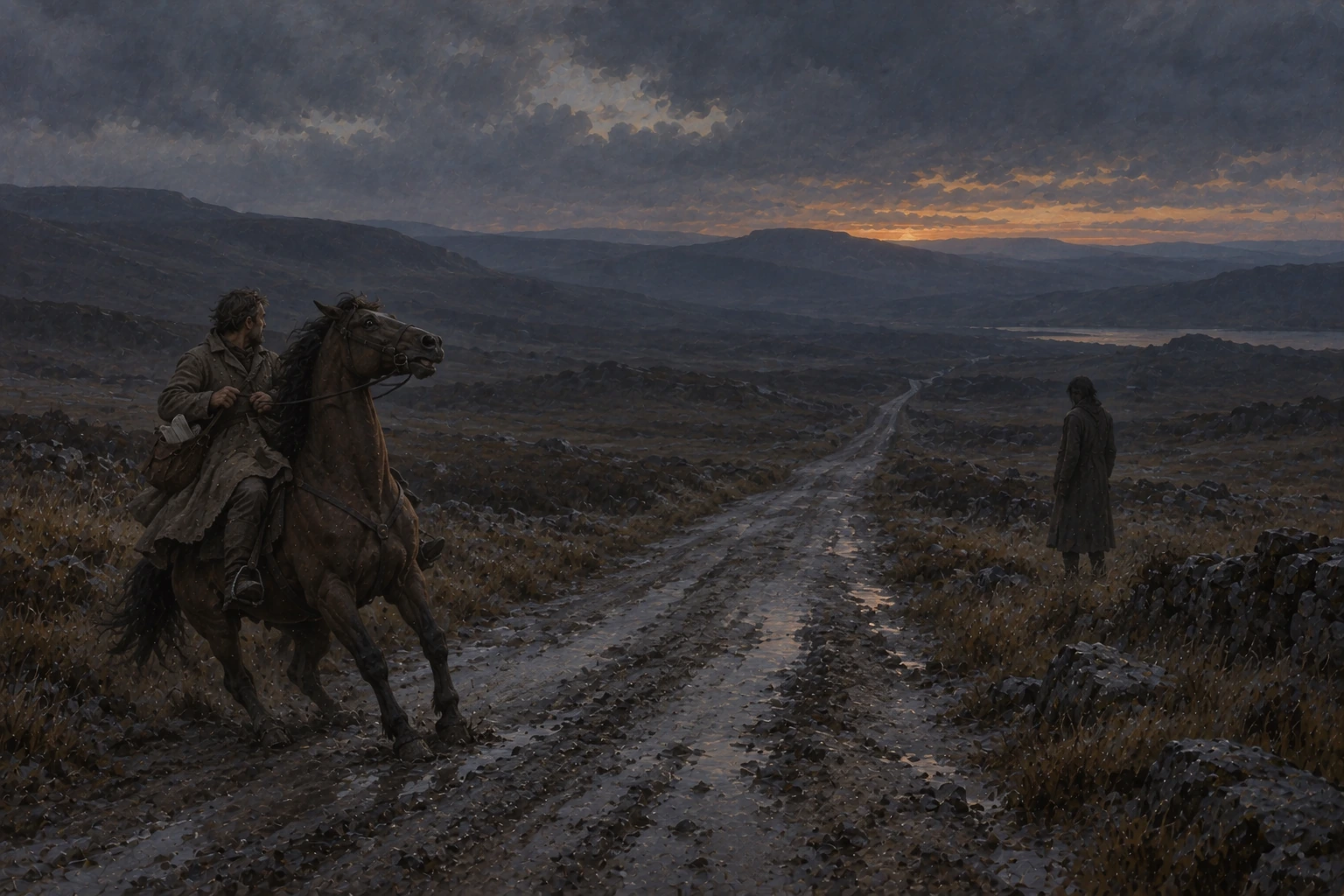
The thing came onto the road at an hour he would prove afterward unable to name with any confidence, on a stretch his own book told him should have cost four hours and had, by the time he next thought to look up at the sky, cost very much longer than that. The horse knew first. It went sideways under him without warning on open, level ground, ears flat back, and Marle had no more sense in that first instant than to hold on and let the animal choose the direction, which it did before he had finished asking himself what there was left to decide. He saw, for less time than it takes to draw one full breath, a shape standing at the road's near verge that held the wrong stillness for anything living and the wrong shape for anything decently dead, and after that he saw nothing at all but the horse's own neck and the road unspooling beneath it faster than any road had ever gone by beneath him.
He did not look back a second time. He did not draw the short knife he carried more for the look of the thing than for any use he had ever put it to. He rode badly, both hands knotted into the mane rather than the reins, trusting an animal he had owned eleven days to want its own life at least as much as he wanted his, and it proved trust enough. When the horse slowed at last of its own accord, lathered white at the girth and blowing hard enough to stagger, full dark had come down around them with no memory in him of when dusk had ended, and the Bridge crossing he had reckoned four hours off was already standing under its own feet.
He came into the crossing missing his hat and his second glove, and some three or four hours he could not afterward account for by any figure he trusted enough to enter in his own book. The crossing-house keeper looked once at the horse, once at Marle's bare head, and asked nothing beyond whether he wanted the fire built up or left as it stood. Marle told him left as it stood, because a man who asks nothing of a stranger riding in half-dressed at that hour is a man who has seen enough strangers ride in badly to know better than to ask, and Marle judged that a kindness worth more just then than any fire the house could have built for him. He searched his saddlebags twice by lamplight, methodically, the way he searched any load he was asked to certify, and found nothing else gone but those two small things and the time itself. He entered the gap the only way his trade had ever taught him to enter anything he could not otherwise explain: as a discrepancy, dated, unresolved, with no theory offered against it. It sat in his book beside the four short circuits from two summers back, in the same column and the same hand, and though he wrote nothing connecting the two entries to one another, he found, riding on the next morning with the sun well up and the country settled again on both verges of the road, that he no longer believed the four short circuits had been ordinary attrition either.
He ate in the saddle most days. He slept less than the road allowed and rode anyway. Neither fact seemed worth a column of its own, so he kept it in his head instead.
He rode the last three days into Merrow in the loose company of a grain train coming up from the south, glad of it in a way he did not examine too closely, and told the train's own people nothing of the stretch between the Ford and the Bridge beyond the plain advice that a man riding it alone should keep to daylight if the season allowed him the choice.
Merrow itself stood exactly as its own maps had always shown it, which struck him, riding past the granaries and under the clock-tower's long shadow on a market morning like any other, as a stranger thing than any one quiet hamlet he had passed to reach it. Nobody in the crowded street gave the map case on his back a second look. He found that harder to account for in his own book than almost anything else the crossing had shown him, and let it stand unaccounted for.
The West Gate took his charter, Harrol's paper, and his name, in that order, and passed all three up the College's own chain fast enough that a clerk was waiting at the outer door before Marle had fully found his feet again after a horse he was glad to be rid of — waiting to take him straight through to the roads-record hall rather than to any room where a travelling man might reasonably have expected supper first.
The record hall was built for ledgers, and it showed the instant Iyene Sath's fair copy came off Marle's back and out of its case. The long table there was made for stacking bound returns end to end, not for a single sheet drawn to the width of half a country, and the sheet took the whole length of it and more besides, curling at both ends the moment the case's straps let go, wanting its old rolled shape back with a stubbornness three careful weeks at Wintergarth had never quite cured out of it. Somebody weighted the near corner with an ink-stand before Marle had finished laying the rest of it flat. Somebody else weighted the far corner with a paperweight shaped like a boot-heel that had plainly never sat on a map in its working life before that evening. A third weight was wanted in the middle, where the vellum still wanted to buckle up off the table under the memory of its own tube, and Marle, unasked, set his closed circuit-book down on it, because it was the heaviest thing he had to hand and a book, in his estimation, was made for this use as often as for any other.
Master Hollis came to the table last, among nine or ten who had already crowded round it, and stood a full minute simply looking down at the whole of the west rendered at once for the first time in three hundred years before he said a word to anyone in the room. His hands, which shook now at rest in a way Marle understood they had for some years, went briefly still against the table's edge. He touched nothing. He looked first at the coastline, then at the mountain country, then — longer than at either — at one stretch of road he had once drawn wrong by four or five miles on a fair copy of his own, checked eight years back by a surveyor who had never set foot near the ground it claimed. "Well," he said, in the voice of a man setting down a debt he had carried so long he had stopped expecting anyone to come and collect it. "There it is, then." Then, in an entirely different voice, he asked for a second lamp to be brought nearer the western quarter, and the room went back to being a room with work in it.
A cup went down on the sheet's western half, set there without thought by a clerk whose name Marle never caught while both the man's hands were occupied with a second document, and Marle moved it himself, without comment, to the bare table beyond the map's own edge. It came back within the hour, set almost in the same spot by the same hand, and Marle moved it a second time and said, in a voice that surprised him rather more than it appeared to surprise the room, "Not on the sheet. Anywhere in this hall but the sheet." The cup did not come back a third time.
Mercer stood at his elbow through most of it, ledger open along his forearm, entering the room's decisions in the same disciplined hand he had once used to log four short circuits as ordinary attrition. He asked Marle once, quietly, whether he wished his own name struck from the endorsement page now that strangers were reading it aloud in a room he had never expected it to reach. Marle told him no. A signature struck after the fact, he said, was a worse thing than a bad signature honestly kept. Mercer wrote nothing down about that, because his ledger had never been built to hold it.
The attestation itself was read aloud by a College officer whose office Marle did not catch amid the general business of the hall, standing at the table's head with the fair copy's own endorsement page raised to the second lamp. Marle knew every clause of it before the man's mouth had finished shaping the first, having drafted it himself over three sittings the winter before and cut two clauses from his own hand before he let Iyene Sath's pen anywhere near a fair sheet. I attest to the following, and to nothing beyond it — his own opening, and hearing it come back at him in a stranger's reading voice, in a room full of strangers, produced in him a specific discomfort that had nothing to do with pride, pride never having been the thing he felt about a sentence written to give away as little as the law would still accept as sound. I do not endorse the ground. I endorse the sheet, the road under my own boots, and nothing further. The officer set the page down, looked once round the table, and said that a countersigned survey from a chartered party, drawn under the King's own peace, need not sit in a chest awaiting confirmation the way an unbacked claim would have had to. It stood, from this hour, as evidence of the west's present state. It had taken three sittings and two cuts to write eleven sentences that a room full of strangers would believe inside a single reading of them, and Marle, listening to his own words settle a hall he had never expected to stand in, found himself thinking only of the one clause he had not cut and now wished he had — the line naming the stretch of the province road he had personally walked, which he would, given the sitting again, have narrowed by half a mile at either end, having since remembered one stretch of it covered at a dead run in the rain that he had never afterward been entirely easy attesting to on foot.
The muster was ordered before the lamps needed lighting a second time. A plain, quiet-voiced man whose title Marle caught and whose name he promptly lost in the general press of the hall stood at the table's foot and gave the whole timetable in much the same working register Harrol had used to hand him a sealed letter three days into a winter she had not troubled to describe: riders out to every province within the week; each province's own muster returned within the month, sooner from the near shires, later from the far ones, with no promise offered that any of them would beat their own season's roads; the whole gathered force fit to move within two months of this evening, and sooner only if the provinces answered faster than any province in living memory had ever answered a call it had not already seen coming, the arithmetic itself going entirely unchallenged the whole time he stood there giving it. The man said, once and plainly, that it was a season's start behind the trouble it now answered, and that nothing in his own office could shorten the season a letter needed to cross a mountain, and let that stand as the whole of an apology that was, in the end, no apology at all — only a fact stated once and left to be exactly as true as it was going to be, whatever anyone in the room made of hearing it.
There was no cheering, and no weeping either — only a clerk somewhere behind him, blowing on cold fingers and going on writing — and that was the whole of the room's reaction, which Marle judged the correct one.
The hall itself did not stop for any of it. Clerks came and went behind the table's business the whole time, carrying unrelated returns to unrelated shelves, because a College built to keep three centuries of everyday roads in order did not close its own doors for one extraordinary sheet, however widely it was unrolled. Marle gave his own written account twice more before the evening was out: once to a scribe copying it fair for the College's own chest, and once more to a second scribe copying it again for a rider already saddled to carry a copy south. He signed both the same way he had signed the first, because a signature given twice was worth exactly as much as a signature given once, provided a man meant it the same both times.
The mail-hold, two days later, was where Marle went to answer a question of the College's own rather than any of his: what word of the muster, or of the trouble behind it, had reached the country's own far corners, the ones no road of consequence ran through. It was, in its own way, precisely his trade — an accounting of what had gone out against what had not, checked against the pigeonholes' own labels rather than against any living person's grief.
The clerk who kept the hold's registers pulled, among a dozen others, a letter addressed north out of a small valley in the far south-east that Marle had never had occasion to assess and knew only as a name at a map's edge, sent up the regular post the autumn before and held here since for a relay that no longer ran, there being no longer a road west of the province gate a private letter could safely be trusted to travel. Marle did not open it, and would not have opened it unasked. The hold's own board still carried Willem's name chalked at its head, under a heading three years old that read simply RELAY, EAST, a column of dates trailing off some months back with nothing entered beneath the last of them. Nobody had rubbed it out. Marle asked the clerk once whether the board would be kept as it stood or corrected to match the season's actual traffic, and was told, with no particular feeling attached to the answer, that a board was corrected when there was something to correct it to, and not before. The clerk read out only what the hold's own procedure required be read out, to establish that the far south-east had, by any road the College could account for, been told nothing at all of any of it — not the winter dead at the Watch, not a muster now three days old, not the word Harrol had sent that never arrived or the word Marle himself had carried that had.
What the letter contained beyond that bare fact came to him secondhand, and in far fewer words than the hold's own clerk had needed to establish the first part of it: an old woman in that valley had been urged by her own people, in the usual way old people are urged by younger ones, to come away and winter nearer her kin, on account of her hip and her years and nothing else — nobody in that valley having any more reason than the valley itself to know a war was being fought a season's hard riding to the north of them. She had declined. Her reason, given short, in her own hand, was that her granddaughter knew where to find her.
Marle had spent a season in a house among that granddaughter's own friends, and knew, better than any clerk in that hold could have known it, exactly whose grandmother the letter meant. He entered the fact of its existence into his book that evening under the day's date, in the same column and the same hand as the graves and the four short circuits and the hours he still could not account for, and set down beside it nothing that was not a fact — not the woman's name, not her reason, not what he privately took the reason to weigh. Weighing it was not his office. His office was to establish what had, and had not, reached the country's own far corners, and the letter he had just been shown proved exactly one thing, entered now correctly into a record that would outlast his own understanding of why it mattered: that corner had not been reached, by this or by anything else, though nobody in it yet had cause to know it should have been.
The fair copy itself stayed at the College, rolled at last back to its old shape and slid into a felt-lined drawer built to a size no ordinary sheet had ever needed, in a wing marked for roads west, under a label a clerk wrote out fresh that same evening in a hand Marle judged competent but unremarkable. He watched it go into the drawer. The case that had carried it he left there too, unasked for, though the case was his own property by any fair accounting of who had paid for it. A case that had done its work was, in his experience, better left with the thing it had carried than kept against the next thing it might.
He rendered the circuit two nights after that, in the room the College had given him, by a single lamp he trimmed himself rather than call anyone for at that hour. It was, by every reckoning his trade possessed, the strangest circuit of his working life, and he set it down exactly as he had set down every one before it: the date at the head of the page, the distance in the first column, and in the second, the number of days the ground had actually cost him measured against the number the road's own old figures had promised. Thirteen promised. Fifteen spent, by his own honest reckoning, once the hours at the Bridge crossing he could not otherwise place were folded into the day they had been taken out of.
He wrote the two numbers side by side, the way his office had taught him to write any figure that disagreed with another figure, and added no note beside them as to why they disagreed, because he did not know why, and a column in his book had never been the place he put down what he did not know.
He closed the book on the two numbers, and did not add a third.