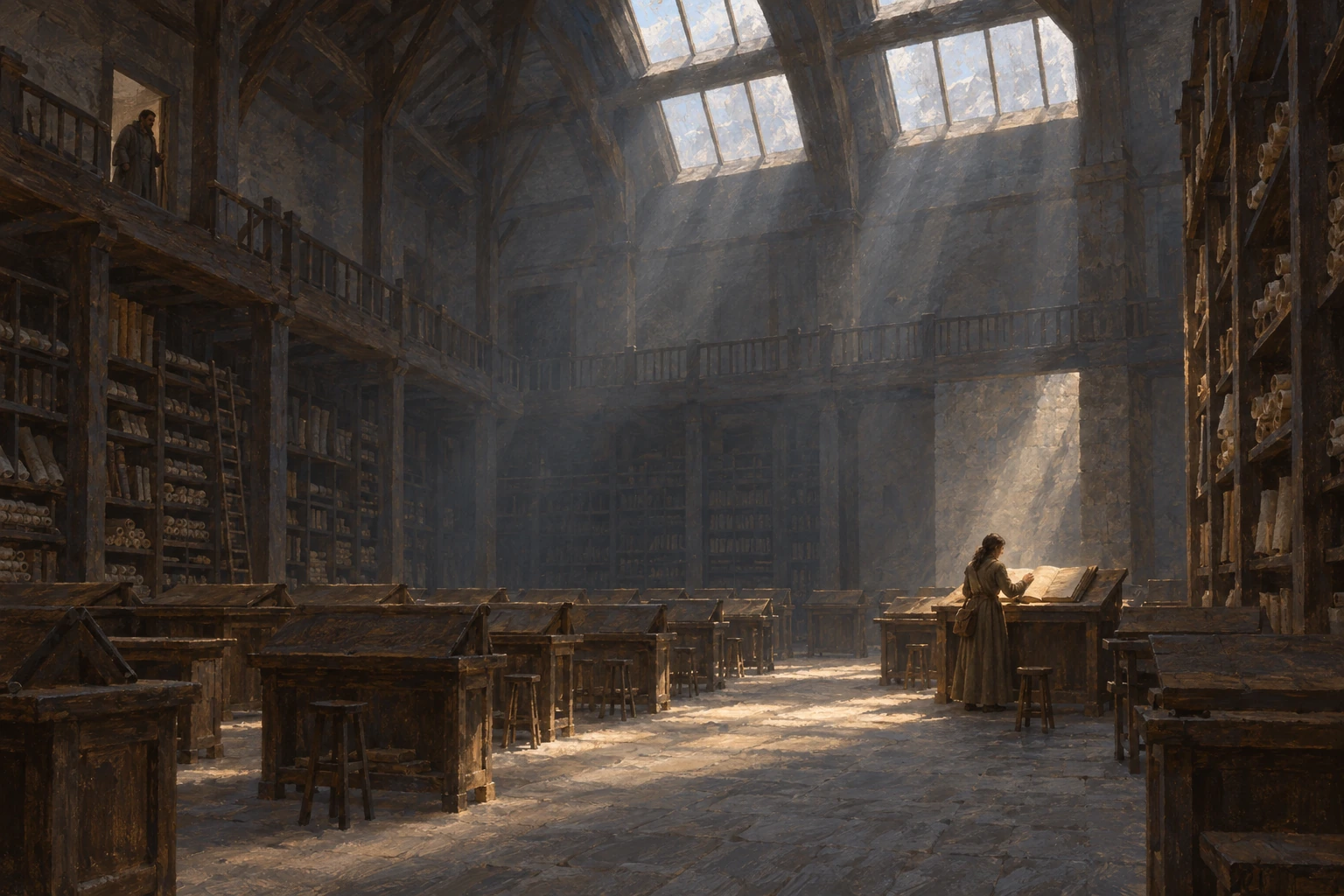
Winter in the Hall
Mirra Voss came up from Aemuth's lower street with two questions, and put the first to Alder and the second to Wren, in whatever order they happened to be standing, and never noticed she had done it that way instead of asking one person twice. Her roof had come through the autumn with a beam sprung at the ridge, and she wanted to know whether the Hall's own stores had timber to spare before the passes shut for good, and whether anyone thought the shoring would want doing again come the thaw. Alder told her the timber was hers for the asking, three lengths, seasoned, from gallery stock that had sat untouched upstairs for three centuries. Wren told her the shoring would hold through one thaw and probably a second, but not a third, and that she should send word before the water came up rather than after, not after the beam had already told her so itself. Mirra Voss thanked them both together, the way she might have thanked whichever of two Hall clerks happened to be nearer the ledger, and went back down into the square with her timber chit folded in her mitten and her opinion of the matter entirely settled.
It went unremarked. There was nothing in it to remark on. It was the fourth such visit that week, and the fifth counting the boy who had come about the well-cover, and by now the whole of Aemuth's resettled corner had stopped troubling itself over which name went on which line of a request, because the answer came back the same either way, in whichever voice happened to give it.
The Hall itself held the cold better than any of the resettled houses below it, being built of thicker stone and older intention, and the company had moved what remained of the winter camp indoors properly in the second week of the new year: bedrolls along the north gallery where the standing desks gave some shelter from the draught off the skylights, the last of the good firewood stacked by the drafting table, Dorrit's satchel hung from a peg that had held a surveyor's coat for three hundred years before it held hers. Frost came up on the inside of the lower windows most mornings and had to be scraped clear before the light was any use for reading, and the well in the yard below wanted breaking every second day, and none of it was spoken of as hardship, only as the ordinary business of a cold country in its coldest months. The wood held out. The tea did not, most weeks, but the wood held, and that was the arithmetic that mattered most through the shortest days.
The roll of names still hung inside the great door where it had always hung, two hundred and eleven lines now, every one of them carrying a second ink. Gilbert Rudge's line had waited longest of any of them and was no longer waiting. Dorrit had checked it twice more since that night, out of a habit she had not quite broken, and each time it read exactly as it had the once: chainman, third gallery, second rank, and beneath it, in her own recent hand, the single word that closed it. She did not check it a third time that week. She had started keeping her hands busy with other things instead, and the roll hung where it hung, whole at last, and asked nothing further of anybody who passed it.
Below the Hall, Aemuth's square was filling in slowly, house by house, rather than all at once. Families who had gone south with the muster's warning were trickling back up the road now that the fighting was done and the passes still stood open a little longer, finding their own doors standing shut exactly as they had left them, latches undisturbed, nothing broken but time. A market had started up again against the south wall, three stalls and then five, selling mostly what the muster's own stores could spare — dried fish, tallow, wool carded rough — and the company bought from it the same as anyone, in coin the Sereth relay had brought with the tallies, and stood in the same short lines as everyone else waiting their turn. Nobody in the market treated them as anything other than the household that had opened the Hall back up. That, more than any speech, was the measure of how ordinary the winter had already made them.
A Sereth rider came in on the ninth day of the month with dispatches that had taken most of the winter to reach that far west, riding the southern relay because the Stair had shut behind the company in autumn and nothing had crossed it since. Most of what he carried was tallies — grain moved, roads cleared, a count of wagons fit to travel once the thaw allowed it — and Bracken read the tallies the way he read any tally, standing at the drafting table with his arms folded, checking sums against his own memory of what the roads could bear. It was near the bottom of the second sheet, among the ordinary business of the corridor's winter, that the line sat: the east wall had a new captain now, had had one since midwinter, the change made necessary in the usual way changes of that kind are made necessary in a war. The dispatch gave the name once, plainly, as a fact rather than as news that needed softening. Harrol.
Iyene was not in the room to read it over his shoulder, being still out on the west roads that winter with the muster's own wagons, past Aemuth's furthest camp, turning three years of a survey's own charts into a working supply line for an army that had not existed when the charts were drawn; her last word back to the Hall had been four lines about a bridge deck needing relaid before the thaw and nothing about herself at all, which the company had come to read, correctly, as meaning she was well enough to complain about a bridge instead.
Bracken read the line twice. He did not read it a third time. He set the sheet back on the table, square with its own edges, and went on checking the wagon count as though the number underneath it had not changed at all, though it plainly had, and though everyone in the room could see that it had, Dorrit most of all, who had known him longest of any of them still standing.
He did not say anything for the rest of that morning. He went out to the stable yard where the two remaining mules were kept and checked their feet one at a time, unasked, the same feet he had checked the day before and found sound then too, and stood a while at the yard's low wall looking east at nothing in particular. A man he had served under once, a long time before any of the company had known him, had written Bracken's name into a letter the year before, in a hand Bracken still had folded somewhere in his kit; he did not go and look for it that morning, and did not say why he didn't.
The mules did not need the attention he gave them, and he knew it, and gave it to them anyway, running a thumb round each frog and each shoe in turn with the same unbroken patience he had given the same two feet on a hundred quieter mornings, because a task with a right answer at the end of it was a kindness a man could still give himself on a morning like this one, whatever else the day withheld. When he came back in for the midday meal he ate what was put in front of him and answered Dorrit's question about the wagon count in exactly as many words as it required. He was not asked anything else. He had held that same wall himself, once, under a different captain, and the company had learned, across three years, that the kindest thing to give Bracken that morning was the ordinary run of the day, unadjusted, with nothing set aside for grieving that he had not asked to have set aside.
There was other paper in the same bundle, and it was evening before anybody got to the bottom of it. Thomasin had written from Ashcroft in a round careful hand, four sides of it, mostly the roof and the lambing and a long grievance about a neighbour's wall. Near the end, in the same tone she had used for the wall, she reported that Marta Coyle was well, and strong again, and had taken to asking most weeks to be shown Ashcroft on the map: where it sat, what roads ran to it, whether the hills behind it were as good as people said they were. She asked it pleasantly. She was interested.
Wren read that page twice and put it with the others to be answered, and answered it herself that same evening, and what she wrote back was mostly about the roof.
He stood his own watch turn that night in Pip's stead without being asked to take it, and Pip, waking to find his own watch already stood and his own name never called for it, said nothing about it in the morning, only fed the mules before Bracken could get to them first.
The dead of three years, when Wren set them down that same evening in the day-book she still kept out of a habit she had never been told to break, took less than half a page.
Tolly. Rafe Rowan. Sael. Wend. Ossen. Ferrit. Harrol, now, on a wall she had never seen, months gone before the word of it reached her.
She wrote each name on its own line, the way the Hall's own roll wrote its names, and did not write anything under any of them beyond what a second column asked for. No eulogy. No summing. A name, a line, and the next name under it.
Tolly had died in a doorway a long time ago now, before any of the rest of it. Rafe Rowan had died alone on a hill, facing east, his fire cold. Sael, Wend, Ossen, and Ferrit had all four died at the same ford, in the same hour, holding the same crossing. Harrol had died on a wall, guiding a stone down, struck from a side nobody watching had thought to watch. Seven deaths, seven different grounds, and one book old enough to hold every one of them without needing a new page for it.
She thought, briefly, of Gilbert Rudge, three centuries dead before she ever spoke his name, and set his line down too, because a name spent was still a name owed a place in the book that had cost it. And under that, smaller, in a hand she had to steady twice to keep even: the woman at the barricade. The boy. The third one, the one that had gone for Ossen's throat, three days before Ossen went to the ford himself and did not come back from it either. Three names she had taken back rather than given, in the one night she had used her mother's craft and not her own — names she had never learned and never would, and had carried anyway, the debt owed whether or not anyone ever learned to spell it.
That was the whole of the accounting. Eight lines, one page not even filled. She closed the book on it and did not reopen that page again that week.
Pip finished the fair copy of the whole roll on a morning of hard frost, all two hundred and eleven names set out again in his own hand on a fresh sheet meant to be pinned beside the original rather than replace it, the tremor showing in every stroke of it and none of the strokes any less legible for that. He brought it to the drafting table where Alder and Wren were working through a stack of the Hall's older tallies and set it down between them without asking which of them ought to see it first, since it plainly wanted both.
Alder read down the left column and Wren read down the right, and between them they caught nothing wrong with it — no name misplaced, no rank transposed — and it was Wren who said so and Alder who nodded, and Pip took the single nod for both of their answers and did not ask which of them it belonged to. He pinned the copy up himself, beside the original, low enough that a shaking hand could reach it without a stool.
"It'll want redoing in ten years," Alder said, "when this one's faded past reading. Somebody's copy always does."
"I know," Pip said, and went back to his stool, and did not say anything further about whose hand that somebody might turn out to be, and neither did either of the two people still bent over the tallies.
The fiddle had come out of its case twice since the Hall's own doors had shut behind them for the winter, and both times it had gone back in unplayed past the first few bars.
The first time was a night in the second week, with the fire down to coals and Pip already asleep on his side of the gallery, his bad hand curled loose against his chest the way it curled now whether he was awake to notice it or not. Wren took the fiddle out, more from the wanting of the shape of it in her hands than from any plan to play, and drew the bow once across the open strings to hear that they still held their tuning. They did. She set her fingers where they had always gone for the old reel's opening phrase, the one Tansy's mother had taught Tansy and Tansy had taught her, four notes she could have played half-asleep a year before any of this had happened to her, and got as far as the second note before her hand simply stopped, not from any pain in it and not from any decision she could have named. She sat a long moment with the bow lifted clear of the strings, listening to the fire settle in the grate, and then put the whole instrument away again, case latched, and did not try a second time that night.
The second time was further into the month, in daylight, with Dorrit sitting near enough to hear and pointedly not looking over. Wren played four bars of something else instead — a jig she had picked up off a Stanhope fiddler outside Aemuth's gate the autumn before, nothing that belonged to anyone in particular, nothing that owed a debt to any hand but her own two — and got through the whole of it cleanly, if a little slow, before she set the bow down and flexed her fingers, which had gone stiffer over the winter than she liked to admit. It was not the reel. It was not even close to the reel. But it was four bars played all the way through without her hand refusing partway, and when she looked up Dorrit was watching her now, openly, with an expression that asked nothing and offered nothing and simply watched.
"That's the most I've heard out of you since the ford," Dorrit said.
"It's not much."
"It's more than nothing." Dorrit went back to whatever she had been doing with her hands, which was very little, since her chest had stood empty of anything worth doing since the last night of the fighting, every jar spent and none replaced, the rimewort gone since a mountain called Kelder that felt now like it belonged to somebody else's winter entirely. "Play it again if you've a mind to. I won't ask you for the other one."
Wren did not play it again that afternoon. She put the fiddle back in its case, carefully, and left the case open on the shelf instead of shut, which was the first time since the ford that she had left it any way but closed, and a small thing to have decided, and she noticed herself deciding it.
Luel sat further from the fire than she used to, which had not, at first, seemed to mean anything, until it had gone on long enough that it plainly did. She still took the night watch she had never been rostered for; she still heard things in the walls of the sleeping city that none of the rest of them could hear; but she had stopped correcting Pip's pronunciation of the old words he tried out on her most evenings, three or four wrong now for every one she once would have caught, and when Bracken asked her, mildly, whether a particular stretch of the western road still froze first at the culvert the way it always had, she told him she did not remember, in a voice that held no distress in it at all, only the plain report of a fact she happened not to have any longer.
She was lighter than she had been. Lighter was the word that came, and it sat uneasily, because a person could not tell, watching her cross a room now with a step that used to carry three centuries in every fall of it and now simply carried Luel, whether they were watching a mercy or a theft. She did not seem to be looking for one, and nothing in her manner asked anybody else to go looking on her behalf.
The dozen and a handful of Amarin still quartered in Aemuth's lower buildings had kept, all that winter, to a rhythm the rest of the company had learned not to interrupt: no fixed hour for waking, no fixed hour for sleep, work done in bursts and rest taken whenever the work allowed it, exactly as Luel herself had always kept it. They mended their own gear, tended their own dead in whatever fashion the dead were tended among them, and asked the Hall for nothing beyond a dry roof and a share of the market's thin stock, which was given without question and taken without ceremony on either side.
It was Luel who told them, on an evening in the same week the Sereth dispatch arrived, that the Amarin who were left had decided to go home in the spring — not all at once, not as a single procession down a single road, but going, the whole scattered remnant of a people three centuries reduced to a company of one guide and a scattering of kin further west, turning their faces back toward ground that had been theirs before any Meddani ever cut a road through it. She said it the way she said most things now, without ceremony and without much weight behind the words, sitting on the low bench near the fire with her hands loose in her lap and her eyes on the coals rather than on anyone listening.
"There's nothing left here that wants tending that the fire-line won't tend itself now," she said. "And there's a great deal there that hasn't had anyone to tend it in longer than any of you have words for."
It went unargued. Alder asked only when, and she said spring, once the passes opened, and that was the whole of the deciding. It had not been executed in the telling; it had simply been said aloud, once, plainly, to people who had a right to hear it settled.
The company's watch on the west road had run through the whole of the fighting and most of the winter after it on the same rota it had kept since the muster first arrived, two to a shift, four shifts a day, and it wanted no small effort to keep it fed and warm through the coldest weeks. A young Stanhope officer came up to the Hall in the third week to ask whether the rota could be cut in half now that the whole line stood joined from Kelder to the eastern basket and nothing had crossed the ward since the night it closed. He put the question the way Mirra Voss had put hers, to whoever answered first, and it was Alder who answered first: that the rota could be cut, that the ward itself did the greater part of the work now and always would.
It was Wren who added, before the officer had finished thanking Alder for it, that the culvert crossing on the lower road still wanted its own watch kept whole regardless, because the ward's own line ran a hand's breadth wide of true there and always had, a fact she had noticed in the second night's warding and never yet found reason to mention, since nobody had asked and nothing had come of it. The officer took both halves of the answer as one answer, because it was one answer, and went back down to see it done, without pausing to ask which of the two he ought properly to thank for it.
Alder had aged very little that anyone standing in the same room with him from one year to the next could have pointed to. He was not a young man, and had not been young by anyone's reckoning in longer than most of the company could imagine, but he wore whatever great stretch of years he actually carried the way a well-kept tool wears use: worn smooth in the grip, not worn thin. His hair had gone no greyer over the winter than it had been the autumn before. His hands on the drafting table were exactly as steady, setting a chart square against its own edges, as they had been at the charter table three years and a whole country ago. He looked, most mornings, like a man arriving somewhere rather than a man leaving anywhere, and in this one case the look was not a trick of the light.
He said so himself, once, standing at the tall window above the square with a cup gone cold in his hand and the lamps not yet lit against the early dark. "My order came out of this city," he said, to nobody in particular and to Wren in particular both at once, since she was the only one in the room to hear it. "Refugees of it, three centuries back, who never thought of coming home, because there was no home left standing to come to. I've walked toward it the better part of my whole life without knowing that was the direction I was walking in." He did not say anything further about it, and did not need to; he drank the rest of the cold tea, set the cup down, and went back to the leaf he had left half read.
He worked at the drafting table most days now, and Wren worked beside him, and the two of them had fallen without either deciding it into a division of the reading that had assigned itself: he took the leaves that wanted the old tongue's ear, what remained of it to him, and she took the leaves that wanted a keeper's eye for a hand three centuries dead, and between the two halves the whole page generally came clear faster than either of them alone could have managed it.
Supper that month was taken together most evenings at the long drafting table itself, chart-weights pushed aside to make room for bowls, because the smaller table in the north gallery had never been meant for six and the six of them had stopped pretending otherwise. Dorrit did most of the cooking, on the theory that a woman with an empty medicine chest still had to be good for something, and Bracken did most of the fetching, since the market's thin stock wanted carrying up three flights of stairs and his knee, if it minded the climb, had stopped saying so aloud. He came up the last flight one evening with a full basket riding on his bad side and a small paper twist of dried apple balanced on top of it, which nothing in Aemuth's thin market sold, and set the twist down at Wren's elbow on his way past to the stores. Pip laid the table without being asked and cleared it the same way, his hand steadier with a stack of bowls than it was with a pen, for reasons nobody in the room had ever worked out and nobody had tried very hard to. Luel ate little and said less, but ate, and that had become, without anyone deciding it should, the evening's one measure of whether the day had gone as well as a winter day could go.
It was at one such supper, the fire down and the last of the bread gone round twice, that Alder mentioned the officer's question about the rota, and Wren mentioned the culvert in the same breath, and the talk moved on from there to the spring roads without either point needing to be said twice.
The verse came from the Amarin themselves, on the last clear night before the month's worst weather closed in, sung as a body rather than by any one voice leading the rest — the whole surviving remnant of them, some dozen and a handful more, gathered on the Hall's own steps where the snow had been swept back to bare stone, with Luel among them and not in front of them. The night was still enough that the sound carried the whole length of the square without effort, and the few Meddani households still lighting windows at that hour came to their sills to listen rather than to see. It was not the lament they had sung at the beacon-line's oldest hill, and it answered nothing that had come before it. It was simply their own leaving-song, given fresh and whole in the common speech the way their other songs had always been given, never a rendering of anything closer to their own tongue than that. The cold that night was hard enough to catch at the back of the throat, and none of them wore more for it than they usually did, standing bareheaded on the swept stone the way they had stood every night watch the company had ever kept with them.
We came down out of a country that never asked our leave, and we are going back to one that never asked us to go. The road we built is somebody else's road now, and it will hold, whether we walk it or not.
We buried what we buried at the water and at the wall, and we are not carrying it with us, because it would not travel. It stays where the ground took it. That is what ground is for. We are not asking anyone to remember the names for us.
There is a house at the far end of this, if the house still stands. There is a hearth, if anyone kept it lit. We are going to find out, and we are not asking company, and this is the last thing we mean to sing about it.
It went unanswered. It was not sung to be answered. The Amarin finished the last line together, in the same flat unraised voices they had begun in, and stood a moment on the swept stone in the cold, and then went back inside out of it, the way any group of tired people goes inside after a long day's work, without further comment from any of them. Wren watched from the gallery window above. It had not asked to be judged either way, and she let it stand as it had been given, unturned and unanswered, exactly once.
Dorrit went through what remained of her chest one more time before the month was out, more from restlessness than from any real hope of finding something she had missed in the last four such searches. There was nothing in it. There had been nothing in it since the last jar went to a Sereth rider in the grey hour before the ward closed, and every day since had confirmed the same emptiness without adding anything new to say about it. She sat with the chest open on her knees a while, running one finger along the row of dividers built for jars that were not there, and then shut the lid and went to see whether the boiled linens wanted changing on the two Ashcroft men still recovering from frostbite in the lower gallery, because there was still that much use left in a pair of hands even with an empty chest behind them.
Pip's hand shook taking the linen roll from her, as it shook taking most things now, a fine constant tremor that had not worsened over the winter and had not eased either, and Dorrit steadied the roll without comment until he had it settled, the same steadying she had given a hundred smaller things for him since the night the Hall first opened. Neither of them said anything about the shaking. There was nothing left to say about it that the last two months had not already said, and Pip, for his part, had stopped waiting for anyone to say it.
One of the two Ashcroft men asked, that same afternoon, whether the Hall could spare anyone with a steady hand to help him write a letter home. Dorrit sent Pip in with the paper anyway. His hand shook through the whole of it. The letter went out the next morning regardless, folded twice, addressed in a script the man swore he could still read fine, and it was not written over in a cleaner hand by anyone.
The Waybook had sat, all that winter, on the drafting table's near corner, where Wren had set it down the first evening the company moved indoors and where it had stayed, closed, through every reading and every dispatch and every visit from the square below. It had not been moved, and nothing about the matter had needed asking.
She carried it, on a morning near the month's end when the light through the skylights came clean and cold and without any particular occasion attached to it, the length of the great hall to the standing desk nearest the north wall — the one the Hall's own oldest ledgers still called, in a margin note two centuries faded, Wystan's own, the desk he had worked the earliest leaves at before the book was ever bound whole. There was a plain reading-stand fixed to it, empty for exactly as long as the book itself had been carried away from the room it was written in: eleven generations, twenty-one years of that stretch her own, twenty-one the whole of what her mother would have had if the counting had gone the way it should have gone.
She set the book down on the stand, open to nothing in particular, the way it had sat open on countless tables across three years of road. The cover was heavier under her palm than it had ever felt on the road, though nothing about its weight had changed, and the desk's old wood took the sound of it settling with the same small groan it must have made three centuries before, for a hand long since dust. Dust lay along the desk's far edge in a fine unbroken line, undisturbed since whatever last hand had worked here, and her own hand, setting the book down, was the first thing in a very long while to trouble it. Her own hand stayed flat on the cover a moment longer than the setting-down itself required. The wood under her palm had gone warm the way it always went warm for a keeper's hand, and stayed warm a moment after, the way it had every single time since Fallowmere's own gate, and would not, after this, again.
She took her hand away. It was the hardest thing she did that entire month, harder than the fiddle, harder than the day-book's short page of names, and it took her most of a minute standing at the stand with her hand an inch above the cover before she managed it cleanly, in one motion. The book stayed open on its stand after that, in the room it had been written in, the ink standing dark and clear the way it always stood for a true keeper's hand even after that hand had gone. Dust would gather on the desk around it, in time, the way dust gathers on anything a building keeps rather than uses. She did not stay to watch it start.
She had not been asked to bring it there, and no one spoke of it afterward — only Alder had seen her carry it down, and he had not followed her the length of the hall, waiting instead at the gallery door with his stick set against the frame, in no hurry to be told what had taken so long.
"It's done," she said, coming back out.
"I know," he said.
They went back to the drafting table together afterward, because there was still a winter's worth of the Hall's own record to put in order before spring, and the work did not stop being work simply because one particular weight had come off it. Alder took up the leaf he had left half read; Wren took up the ledger beside it, checking a column of names against the roll by the door out of habit rather than need, since the roll no longer had a gap anywhere in it for her to fill. The fire in the near hearth wanted feeding and she fed it without rising fully from her seat, one more of the hundred small tasks she had learned that winter to do without breaking off from a larger one.
The fiddle stood open on its shelf across the room, where she had left it the day she played the four clean bars, and she looked at it once, briefly, over the top of the ledger, and then went back to the column of names, because there would be other evenings for it, and this was not one of them, and there was still work enough on the table in front of her to fill the whole of this one before the light went.
Outside, the last of the day's light was going flat and blue across the square, the way it went every afternoon that far into winter, and somewhere below the window Aemuth's returning households were bringing in whatever the thin market had given them to bring in, and none of it asked anything further of the Hall above them. Alder read on beside her, unbothered by the quiet, in no more hurry than the book on its stand two rooms away. He had said the whole of it once, a week earlier, without looking up from the page: that his order had been made by people who walked out of this city with nothing left to carry, that he had spent a long life on roads pointed at a place he had never seen, and that he had seen it now and did not propose to leave it again. It had taken him under a minute. He had gone back to his reading before the sentence finished settling.
Pip's fair copy hung pinned by the door where he had left it, whole and unshadowed by any gap now, two hundred and eleven names for a Hall that had, at last, no fewer people accounted for than it had ever held. The two of them worked through what was left of the short afternoon the way they had worked through most of the winter's afternoons: without remark, without needing one, in a room that would go on being worked in tomorrow, and the day after that, for as long as either of them cared to keep it.