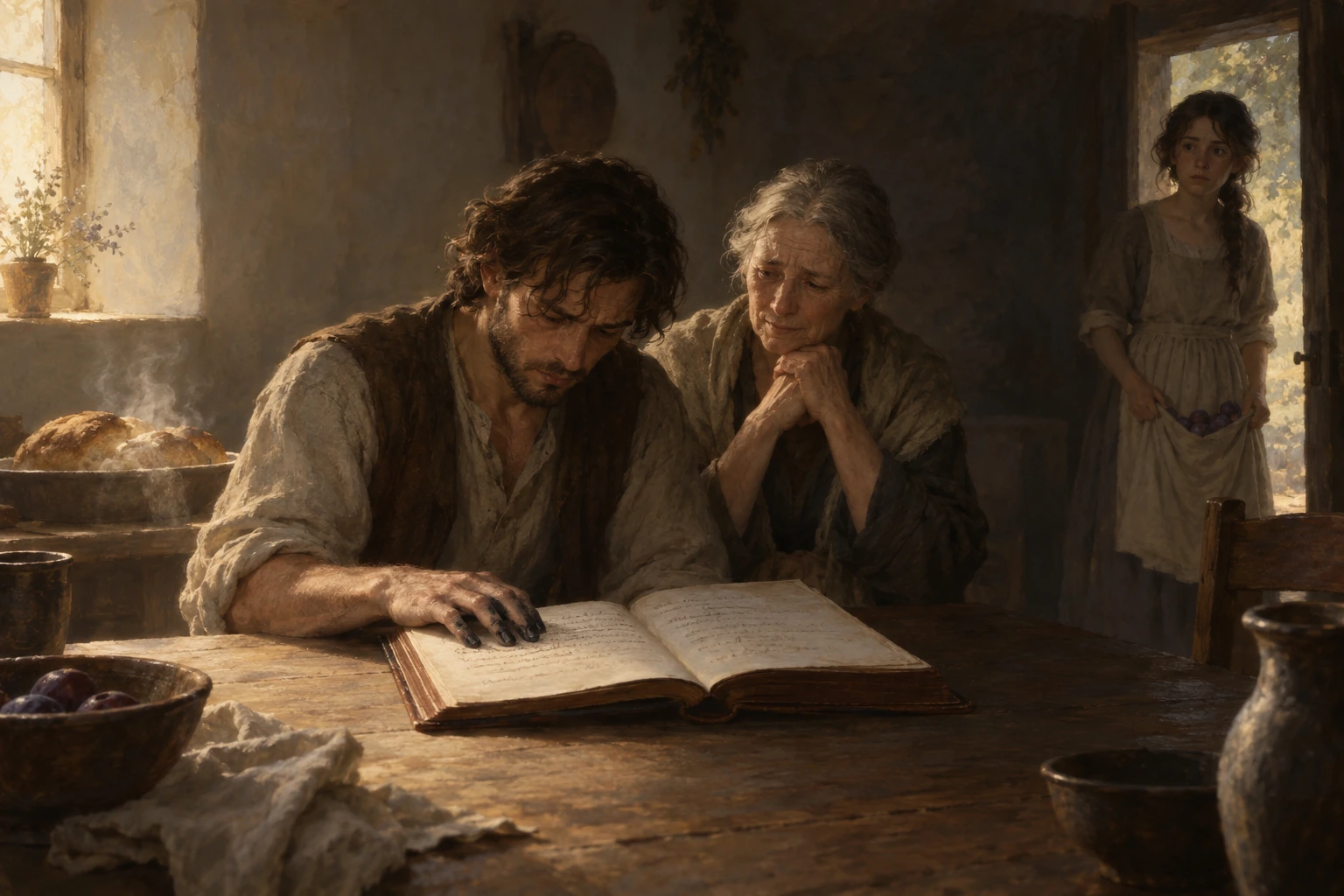
The Keeper's Charge
Wren came up from the bee-yard a little before noon and knew before she reached the door that something in the house had changed its shape.
It was nothing she could have named to a stranger. The good chairs — the two with the carved arms that came out only for the midwinter supper and for nobody's birthday in particular, being kept, Granna Tansy always said, against the day they were wanted — stood drawn up by the hearth as though a small council had been called. The kettle was singing low on its hook, filled and set on before its hour. And Granna Tansy herself was seated very upright at the table, with her hair put up properly, combed and pinned as she wore it for market and for nothing else. Her hands were folded on the table before her, with the particular stillness of a woman keeping them from doing anything else.
"You've done your hair," Wren said, setting down the honey-basket.
"I have."
"Is somebody coming?"
"Somebody is coming," said Granna Tansy, and went on sitting with her hands folded, looking not at Wren but at the door. It was, Wren thought, the look of a woman who had been looking at that door, off and on, for the better part of sixty years, and was simply doing it a little more plainly today than most.
Wren went to wash the honey from her hands and did not ask again. There are questions that get smaller the longer you leave them unasked, and this was not one of those. Today of all days was not the day to go poking at it with a stick.
Dorrit arrived at midday with a basket of the first plums and the settled air of a woman who intends to stay to see what happens, and took one look at the good chairs and the pinned hair and said, "Somebody's died, or somebody's marrying, or the Crown itself is walking up the west road," and was told, by a look from Granna Tansy that had silenced louder women than Dorrit Fallowmere, to put the kettle to steep and mind her own plums.
He came at the turn of the afternoon, on foot, the grey cloak brushed and his stick swinging light in his hand. He stopped at the gate to knock it twice against the post before he set it, upright, against the wall by the door — not carried in, not leaned where a body might trip on it, but put by, as a man puts by a thing when he means to be a guest and not merely a caller.
"Master Alder," said Granna Tansy, rising, and there was nothing in her voice but the ordinary welcome a house gives a week's acquaintance from the inn. Wren watched her grandmother's hands smooth themselves once down the front of her apron before they were still again: something in the old woman had been waiting — not for this week, and not even for this year, but for the whole shape of her life, the way a hive waits through a slow wet spring for the one warm morning that finally lets it fly.
"Mistress Fallowmere." He bowed the small bow he had given her in the bee-yard three evenings past, and then, seeing Dorrit at the hearth with the kettle, "and — I don't believe I've had the honor."
"Dorrit," said Dorrit. "I keep the garden and I keep an eye. Sit down, you're letting the door stand open and the flies in."
He sat, and for the better part of an hour was nothing more than what he had been all week at the inn: a courteous stranger with a good appetite and better manners, who took bread and honey and praised it honestly rather than lavishly, who let Dorrit tell him at length about the plums and the trouble with codling-moth this year. He did not once let his eyes go to the shelf by the chimney-breast. But Wren, who had begun by then to watch him as closely as she watched a hive gone quiet, saw that he knew exactly where that shelf was and exactly what stood on it, and was leaving it alone the way a man leaves an unopened letter alone at another man's table.
They talked of the weather, properly, before anything else was said: whether the second cutting would come in dry, whether the bees were flying far or staying close, what the miller's knee had to say for the coming week; and the top pasture, which had come up green a fortnight earlier this year than last, and earlier again the year before that, and which Dorrit said was worth nothing to anybody, since no flock in Dall would graze it, and blamed the ground. Only when the cups were drunk down and the plate of bread gone to crumbs did Granna Tansy set her hands flat on the table, as she did before naming a sum, and say, "You'll have a name beyond Alder, I think, for an errand beyond asking after roads."
He set his own cup down.
"Alderin," he said. "Called Alder, these thirty years, by everyone who has found the whole of it more than the occasion required. Warden of the College of Roads."
"Alderin," said Granna Tansy, and then, in a voice that changed shape around the word the way water changes shape around a stone, so that for a moment it was not quite Dall speech at all, "Aildren."
The room went very still. Wren saw something move behind the man's eyes that had not moved at any word said to him all week — not surprise exactly, or not only surprise, but the look of a man hearing, in a strange house, a name spoken correctly that he had not told anyone how to speak.
"You have the old form," he said carefully, "for a title none living give it."
"I have a good many things I never asked the use of," said Granna Tansy, and something in her voice this time was very close to laughter, and very close to its opposite, and did not quite manage to be either. "I'll tell you truly, Master Alder, I have wondered the whole of my life whether it would be a young man come up that road one day, or an old one, and whether I should know him for what he was before he'd said a word, or only after — and I find I am no wiser for the waiting, for you look to me like neither one thing nor the other, but only a tired man who has walked a great distance and is glad of the bread. Which I daresay is closer to the truth of it than any story I was given."
"I have found that to be the case with most stories," Alder said, "in my trade."
"And your trade," said Granna Tansy, "brings you to my table."
"It does." He folded his ink-stained fingers together on the cloth, and Wren saw Dorrit, for once in her life, go quiet without being told to. "I'll say it straight out, since you've been waiting a plain word longer than I like to think about. The Frost is drawing back. Not all at once, and not everywhere, and the College has been slow to credit it — we are a slow institution, by design and by temperament both — but the shepherds of three valleys south of here have brought down the same tale this year that your own Cob Hedley brought down from the high pastures a fortnight since: green where there was none, and passes standing open later into the year than any within memory of them. It was believed in the south before it was believed in Dall, and it is believed in Dall now, I think, whether the word has been said aloud or not."
"It has not," said Granna Tansy, "been said aloud. But it has been thought."
"The Crown and the College between them have chartered a Survey," Alder went on, "to walk the western roads again, as far as they can be walked, and see what may be seen of what lies beyond them. And every map east of the mountains that answers to Meddan is either lost outright or copied so many times from other copies that it has gone thin as a rumor — I have seen the College's own, and I would not trust one to find me a well. There is a tale older than the College's own founding, and disbelieved by most who have heard it, of a Surveyor's road-ledger that came east ahead of the passes closing, in the hands of a family that kept it rather than sold it or burned it or let it go to dust. I did not come to Dall certain such a tale was true. I came because a man in my trade learns to walk toward the small, stubborn, unlikely stories rather than the large certain ones, and because it seemed to me a thing that ought to be asked slowly, if it were to be asked at all — not shouted up a valley from an inn table."
"You spent a week," said Granna Tansy, "not asking."
"I spent a week," Alder agreed, "learning what sort of house I might be asking it of. I find that tells a man a great deal, before he ever says the question aloud."
Granna Tansy looked at him a moment longer — the long, level, arithmetic look Wren had seen her give a scale of honey when the weight seemed a fraction wrong. Then she rose, with the small hitch in her rising that had been there, Wren knew, since the winter she was widowed, and crossed to the shelf beside the chimney-breast, between the clock and her great-grandfather's unsmoked pipe. She took down the book that had stood there the whole of Wren's life, and a great many lives before it.
She dusted it with the flat of her sleeve, out of habit, before she set it on the table — a small, unthinking, housewifely motion, dusting a book before company as she would dust a good plate. And it was that ordinariness, more than anything, that made the enormousness of what she had just done settle over the room like a change in the weather.
"The Waybook," she said. "Kept in this house eleven generations, and never opened for anyone outside it, nor spoken of beyond the door. I'll not pretend to you it was kept for love of an old book. It was kept because it was given to be kept, and because a thing kept ought to be kept properly, whatever anybody thinks it might be for."
Alder did not reach for it.
He looked at it a long moment instead — the chestnut leather gone soft and dark with generations of the same oil, the brass clasp turned green at the hinge — with a stillness Wren had not seen in him all week. Not at the fair, not over the quoits he played so cheerfully badly, not even in the bee-yard at dusk.
"May I open it," he said.
"You may."
His hands, when they went to the clasp, were not quite steady. And it was that — more than anything he had said, more than the old form of his own name coming back to him out of an old woman's mouth — that told Wren what manner of thing he had walked so far and so long to find.
He turned the first leaves slowly: the close small writing she had known since she could read at all, the roads drawn in fine grey strokes, the hills shaded in the manner some long-dead Fallowmere hand had settled on and every hand after had kept from respect rather than instruction. And here and there, crowding the margins, the spikier writing in the old western tongue that nobody living in that room could read.
"Wystan Fallowmere," Alder said, very quietly, to no one, tracing one line of the spiky hand without touching the page. "I know the name from a College roll three centuries dead, and never thought to hear it in a kitchen with the bread still warm."
Wren heard her own name said back to her out of eleven generations. The hand in the margins was her own blood's hand, and the book on the table had been waiting for this room the whole time the room had been waiting for it.
He turned another leaf, and stopped.
Then he turned it back, and forward again, more slowly, and Wren saw the color of the page beneath his hand change as she watched — not vanish, not blacken nor burn nor do anything so violent as either, but pale, the way frost-haze pales a morning field. The ink of road and hill and margin thinned by degrees to something cold and grey and nearly gone, as if the page itself were breathing out.
Alder lifted it and held it to the window, and the room went as quiet as a room goes when a lamp gutters low — no wind in it, no thunder, nothing but the kettle ticking as it cooled. The ordinary afternoon light fell through the ordinary glass onto a page that was fading, steady and entirely without malice, like the last color going out of the sky at the end of a long fine day.
He closed the book, carefully, both hands flat upon the cover, and was silent long enough that Dorrit opened her mouth to say something and was stopped by Wren's hand on her arm.
Then Alder laughed — once, quiet and warm, the laugh of a man told, at the very end of a long search, the oldest joke of his own trade, the one he had heard a hundred times as a boy and never believed would be told to his own face. "They warned us of this in the first year of training," he said, "and I confess I set it down with the rest of the pretty stories. A Surveyor's binding does not open for strangers. I had thought that meant a lock. I had not thought it meant the ink itself would know me for one."
He pushed the book back across the table, to Granna Tansy, and where his hands had held it grey the ink lay dark and clear as the day it was drawn.
"Try it," he said to Wren, gently, "if your grandmother permits it."
Granna Tansy nodded, and Wren opened the book where he had left it, and found the roads dark and plain and legible under her own hands, the margin-hand as spiky and unreadable as ever it had been, but there, entirely there, ink and not frost. And she looked up to find her grandmother's face doing something Wren had never, in three-and-twenty years, seen it do: holding relief and grief so evenly balanced between them that neither could be said to have won, like two weights come at last to rest on either pan of a scale that had stood untrue a very long time.
"It can be carried," Alder said, into the quiet, "but it cannot be given — not sold, not lent, not passed by any hand but its own keeper's, or the ink goes as you have seen it go, and stays gone, they tell me, for good. It was made in an age when the wrong book in the wrong stranger's hand could see a hundred people dead on a road they trusted. It travels with its keeper, or it does not travel at all."
"Then hear the whole of what was given," said Granna Tansy, and her voice when she said it was flat and plain, the voice she used for grading honey, for saying a scale was true or was not, for nothing that admitted of argument. "Keep it against the thaw; and when the road opens, the book goes home. Nine keepers before me had those words, mother to child, and never said them past this door. I have carried them since I was nineteen years old like a stone in my apron pocket, not knowing the day would come I'd set the stone down. I find now that it has."
The plain arithmetic of it sat in the room now like a fifth person at the table, and nobody said aloud what it came to.
It was Wren who spoke first, and she had not meant to speak at all, and what came out of her was not the thing anybody at that table was braced for.
"Against the thaw," she said.
Her grandmother turned and looked at her.
"It's what the words say. Not against fire, or damp, or thieves, or the roof coming in. Against the thaw." She heard her own voice go slow and careful, the way it went when she was working a thing out while she said it. "Whoever gave that charge wasn't telling his daughter to look after a book. He was telling her when it would be wanted. He knew the cold would come off again. Three hundred years before any of us, and he knew it, and he set it down like a date for a lambing."
It was Alder who moved first, and all he did was lay his hand flat on the table beside the book, as a man does when he wants something steady under his palm.
"I have been a week in this valley," he said, "telling myself I had come for a ledger." He was quiet a moment. "I would give a great deal to know what else he thought would want doing, when it came off."
"He didn't say," said Granna Tansy.
"No," Alder agreed. "They rarely do."
It was Dorrit, in the end, who said the other thing, the practical one, because saying what everyone else was tiptoeing round had always been Dorrit's particular office in that house.
"Well, somebody has to walk it, then," she said. "The book goes home, he says. Somebody from this house walks to the mountains with it."
"I am the keeper," said Granna Tansy, "and I will go."
She said it without heat and without drama, in the same flat voice she had used for the charge itself. And it was that flatness, more than any protest could have, that let the room see the whole shape of what she had just offered: a woman of seventy-nine years, with a hip that had not been sound since the winter she was widowed, proposing to walk a road that had been closed since before living memory and left, by all report, precious little stair to climb where it began.
Alder did not laugh at her, and did not do her the injury of pretending the offer, and everything it would cost her, had passed him by unnoticed.
"The charter allows a keeper's own choosing," he said instead, gently, "in this as in all else touching the book. Nobody need answer today. I have waited a great many years to sit at this table; I can wait out an afternoon."
And with that the matter was, for the moment, let alone, as a pot is let alone once it has boiled and been drawn back from the fire — not cooled, not forgotten, but no longer asking to be watched every minute.
He stayed a while longer over a second cup, and let Dorrit finish her account of the codling-moth. He thanked the house properly when at last he rose to go, in the full, unstinting manner of a man who has been given something no ordinary thanks could match and knows better than to try. At the door he took up his stick from where it leaned against the wall, and turned to Granna Tansy. The two of them exchanged some few words, too low and too brief for Wren, coming up behind with the empty plate, to catch more than the shape of — no more than two sentences between them. Then he was down the path and onto the west road, his stick finding its rhythm, gone round the first bend while the afternoon was still bright behind him.
Wren washed the good cups herself, at the stone sink, while Dorrit dried. Granna Tansy sat a while longer at the table with her hands folded — not on top of anything now, simply folded, resting as hands rest when a long-carried weight has been set down beside them rather than lifted away. The book went back to its shelf between the clock and the unsmoked pipe. Wren, dusting it once more herself before she set it there, caught on her own fingers the ghost of the wax-and-tallow dressing that still clung, very faintly, to her grandmother's hands — the smell of good boots kept oiled against a winter that had not, until today, seemed to be coming for anyone in particular.
She went out to the bees before the light went, because a full head wanted the bees. She stood a while at the end of the row where the three old skeps kept their quiet corner, and laid her palm flat against the nearest hive the way her father had taught her, feeling for the low, even murmur that meant all was well within. And it was there — the shelf and the clock and the smell of the dressing still faint upon her own hands from her grandmother's, and the ordinary gold going long and low across the yard, exactly as it had every evening of her life — that the day set itself down at last, gently, the way a full frame sets into its box when the carrying is done.