The Argument
The sound reached them from behind, up the long fold of the beacon road, before anyone thought to ask what could be making it, because in nine days nothing had come up that road behind them, and there had been no particular reason to expect that anything ever would.
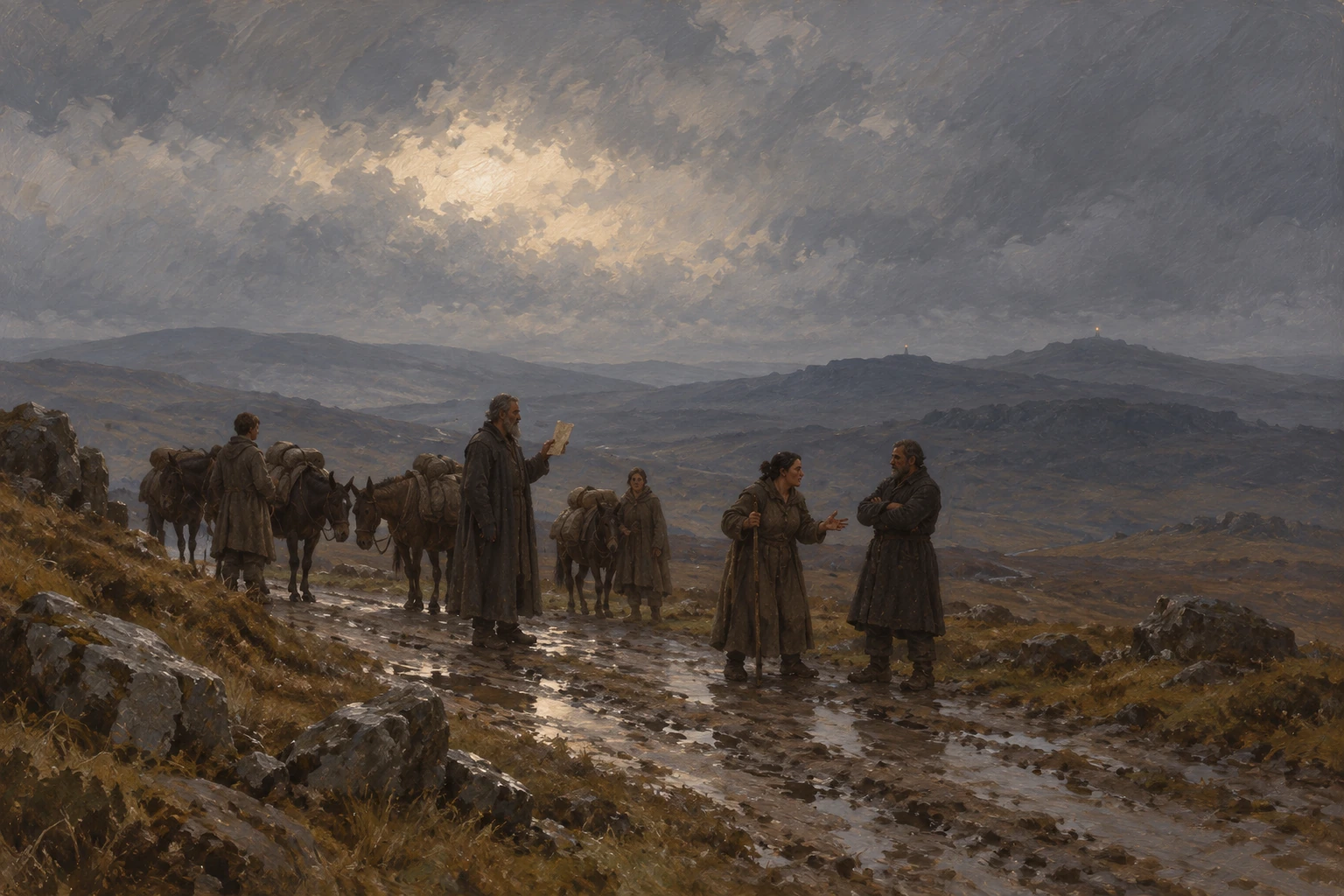
Bracken heard it first — hooves, and more urgency in the gait than a horse that far along a bad road should still have had left to give — and put an arm out flat against the air, an old habit that had nothing to do with command and everything to do with forty years of walking in front of people who trusted his ears before their own. The line stopped where it stood, mud past the ankle on every boot in it, and turned to look back down the fold of the hill at nothing yet visible.
Rain had held off since dawn, though the sky over the western ridge carried the flat grey look of a day that meant to change its mind about that before evening, and the ground underfoot had the particular treachery of two-month-old thaw-mud, letting a boot down slow and then holding it fast one stride and letting it go too easily the next. Nine days of beacon country past Wakelow had settled into its own working rhythm — mules loaded, packs checked, the day's miles walked and the evening's watch stood — and a rhythm like that does not ask to be spoken over.
The rider came round the shoulder of the hill at a labouring canter that told most of its own story before the woman riding it said a word: a horse blown hard and long past the point where a rider pushes an animal for anything but need, lather standing pale at the girth and along the neck, its head low and its stride shortening with every length of ground it covered. She sat forward over the withers as a person sits who has stopped trusting the saddle to do any of the work for her, mud to the thigh, one glove lost some miles back, her face scoured raw along one cheek where the weather had been at her all day from the same quarter. She pulled up twenty strides short and let the horse walk the rest of the distance in, because even a message that could not wait was not worth killing an animal for in the last hundred yards of delivering it, and that alone told Bracken something about whoever had trained her.
Wren watched the horse cover the last of the distance and felt, before any letter had entered into it at all, only the plain and rather foolish gladness of a relay actually working — a chain of borderland riders and a line of hilltop fires that seven strangers had built two winters back, carrying a folded page across the whole width of a war to find, at the far end of it, seven particular people on an unmarked stretch of road that did not even have a name worth putting on a map. Iyene wore the same look for exactly as long as it lasted and no longer: the look of a woman watching a system she had helped design do, for the first time under real weight, precisely what it had been built to do.
The rider found her voice before she had properly got her breath back, and asked for "the Cartographer-Royal" in the flat, over-rehearsed phrase of someone who had said the same four words to herself the last several miles so as not to lose them, and when Iyene stepped forward the rider reached inside her coat and brought out an oilskin packet gone soft and dark with damp at every fold, sealed twice over in wax the colour of old rust. "Willem's relay," she said. "Over the Stair, and down every hand between there and here. I'm the last of them." She did not dismount to see it opened. She turned the horse's head back the way she had come, walked it a dozen strides to let it blow properly, and was gone again down the fold of the road before Iyene had the second seal broken, because there were more packets under that coat bound for other places, and the day was not getting any longer for her waiting on this one.
Iyene broke the wax with a thumbnail, without ceremony, the way she opened every sealed thing, and read the first line to herself before anybody else's — her habit, unquestioned by the rest of them for two years now. Something crossed her face and was put away again almost as fast as it had arrived. She held the sheet out to Alder, because his voice carried further in open country than hers did, and this was plainly a thing that wanted carrying.
Alder read it the way he read anything that mattered, once through in silence, and only then aloud, and something in his own face had already changed by the time he started, so that everyone standing in the mud around him could see, before the first word left him, that this would want the standing still for.
"To the Survey, on the west road, wherever this finds you," he read. "I am writing this a good while after the night I am about to set down, because I wanted the count settled before I put any of it on paper for you. Three came up out of the pass in the dark, in clothes cut this generation. Two wore the Watch's own weave. The third wore a courier's coat, narrow through the shoulder, and it was Fossick's, and I knew the coat before I knew the man in it. I ended that one myself and went back to the wall.
"Nine dead. Held till dawn. Burned before evening. I will not put their names in a letter that may never reach anyone who knew them.
"I sent Dill east to Merrow at first light, the word written plain and told to say it besides in his own voice. I have had nothing back from him. There is one road east. I do not know where he is on it, and I will not pretend to you that I do.
"The Watch holds. It held that night and it has held every night since, and I mean to see that it goes on holding, whatever that is worth to seven people walking the other way.
"Below us: the Steading Lamp is gone. Tam Rush is gone. Maren is gone with him. I have this from the road itself, because nothing has come down from that direction since, and I do not expect that anything ever will again that a person would want to meet.
"Of the river country past it, and the Ford, I can tell you nothing at all, because nobody has come up from there to tell me, and I no longer look for anybody to.
"One good thing, since a letter like this one owes you at least one. Corr Ashwell stands this wall now, who served under Yarrow when Bracken Hale did, and knew Bracken Hale's name across the yard before I had finished saying it myself, and asks to be remembered to him, in exactly those words.
"— Harrol."
Alder's voice held level through all of it, the same level it held for march orders and for burial rites alike, and it came off that level only once, very slightly, on the word Maren, whose table he had sat at twice in three years, and it cost him half a breath he did not trouble to hide.
Bracken did not move at all through the reading of it, which was its own kind of motion in a man rarely still on principle, and at Corr Ashwell's name something crossed his face that nobody standing near that fire could have named cleanly as either gladness or grief, because it was plainly both at once and had nowhere else to go.
Wren heard Maren's name the way a person hears a thing they already knew was coming and had done nothing whatever to ready themselves for regardless, and went on standing exactly where she had been standing when Alder said it, through the rest of the letter, her face giving the moment nothing that anyone thought worth remarking on.
Iyene took the letter back once Alder had finished, refolded it along its own crease, and said only, "The hand is hers. I have seen enough of her ledgers at the College to know it anywhere" — which was the whole of her verifying it, offered in the same voice she gave a bearing she had already checked twice.
The company had been standing in the mud long enough already that Suet had begun, without instruction, to graze at the verge, which was as good a sign as any that the day intended to go on whether the seven of them were ready for it.
It was Bracken who broke the standing first, and broke it badly. "That's men I trained," he said, to the road in general and to no particular feature of it, and when no answer came — because there was nothing yet in it to answer — he said it again, worse. "Corr Ashwell couldn't hold a line straight when I had him. He can now. I taught him that. And he's on that wall, and I'm four hundred miles the wrong side of it, walking away from the one fight in this whole war I actually know how to win." His voice did not rise. It did the opposite, going flatter and quieter with every word, which was worse to hear than shouting would have been from a man who did not shout.
Dorrit rounded on him first, and not gently. "You want to go stand a wall for men who don't need another sword, Bracken, that's your grief and I'll grieve it with you same as I would anything else about you. But don't you call it the one fight that matters, when there's a whole county south of it doing the actual dying." Her hands had gone to her hips in the particular way they went when an argument in her stopped asking her permission. "Dall's east," she said. "My family's east. So's Wren's. I said that in the autumn and got walked past, and I am not being walked past a second time, because now we know the road, and we know roughly the month, and it isn't an if anymore, it's a when, and none of you seem inclined to say that word out loud."
Iyene answered before anyone else could, in the same voice she gave a bearing that would not change no matter how many times a person wished it would. "Ten this year," she said. "Twenty within the season. Forty after that. By two winters we are not speaking of tens any longer, and we are not speaking of one valley. We are speaking of a country. Going east buys one town a season. Going west closes the thing doing the killing, everywhere it stands, at once. I have given you these figures twice before, and they have not changed since, because the arithmetic does not care which of us it is easier to say them to."
Dorrit turned that fury on her next. "You make it sound like a column of numbers, Iyene. That's my great-aunt. That's Wren's grandmother. You don't get to turn a person's whole life into a—" She did not finish it.
Iyene did not let the figure stand. "Tansy Fallowmere," she said, and the name came out of her without any of the flatness the number had had. "I know whose it is, Dorrit. I have known whose it is every week I have written it." She did not say the figure again.
Then Dorrit turned to Wren, and the fury did not empty out of her voice, it only changed direction. "And you," she said. "You already know how long she has. You did the sum yourself, three weeks back, sitting right there with the book on your knee — not less than six months, not more than ten, you wrote it down in your own hand like a delivery date, and you didn't so much as press the pen harder when you finished it. So don't stand there now looking torn up about it in front of the rest of us. You settled this in your own book before any of us opened our mouths."
Nobody got to answer that, because it was exactly then that Barrow decided, with the settled conviction of a mule who had never in his life cared for moving water, that the plank bridge across the swollen beck ahead of them was not a thing he intended to cross, and planted all four feet on the near bank in a way that ended every conversation on it more thoroughly than any person there could have managed.
It took the four of them nearest him — Bracken, Dorrit, Pip, and Wren, because an animal that has decided something does not care in the least who is arguing with whom — the better part of ten minutes to get Barrow onto the planks at all, blindfolded with somebody's own scarf and led rather than driven, and by the time he was over and shaking the water off his hocks on the far bank, the argument had gone exactly where arguments go when a mule interrupts them: nowhere, and everywhere, carried forward instead of settled.
They walked the rest of that morning in a scatter along the beacon road that had nothing to do with the terrain and everything to do with who could stand being near whom. Bracken took Barrow's lead rope himself for the whole stretch, well past the point anyone would have asked him to, and worked with the exactness of a man proving something.
At the midday halt he unloaded Gable to check a girth that had not in fact slipped, found nothing wrong with it, and loaded him again anyway — and set the near-side pannier a hand's width out of true, the kind of small correctable error his own hands had not made in eleven years, so that Gable stood lopsided at the lead until Dorrit, passing, reached out and shifted the strap herself an inch, and went on without waiting to be thanked for it or blamed for interfering, and did not slow her step to see which one he'd have chosen.
Pip found Bracken at the edge of that same halt, sitting apart on a rock with his bad knee out straight in front of him, and came and sat down on the next rock over with his sketch-case still shut on his own knees, and stayed there through the whole of the halt without opening it, which was as near as Pip had ever come to telling anyone anything.
Later, where the road widened enough for two abreast, Dorrit fell in beside Luel and asked her plainly, the anger in her voice worn down now to something closer to pleading. "You've watched three hundred years of people deciding things like this. Which way is right, Luel? You must know."
Luel's eyes went to the high line of country ahead of them, west, where the last of the snow still sat along a ridge none of the company had yet learned the name of, and stayed there for the length of the question, and it was Nettle, three lengths back and objecting to a boggy stretch of track, who finally pulled her eyes down again. "I have watched people decide it every way there is," Luel said, which answered nothing Dorrit had actually asked her, and something in the set of her shoulders afterward had not been there before it.
At some point past noon — no clean line marked when the walk stopped being seven people near each other in various states of not speaking and became a conversation again — Alder gave his own piece, plainly and without spending long on it: that the ward at the world's western root did not merely delay the thing killing people in the east, it stopped it, wherever it stood, in the same hour it closed, which was not a thing any number of soldiers on any single wall could ever do for the country behind them. It was, on its own terms, the better argument, and most of the road had very likely worked out the shape of it already without needing him to say it aloud, and it landed on people with no room left that day to carry a true thing: heard, weighed, and set back down beside everything else they were already carrying.
The rain that had been threatening since dawn finally came on in the early afternoon, not hard, but steady and cold and exactly the kind that finds its way past a collar however carefully it is closed, and it settled the whole company into the flat, wordless labour that weather like that always asks of a walking party — heads down, packs re-slung against the wet, the mules picking their own footing more carefully than any hand on a lead could have chosen it for them. The quiet that came with the rain was not the same quiet the argument had left behind, though from outside the two might have looked alike to anybody who had not been walking in the middle of either one.
It came up again that evening, after the tents were half-pitched and the fire not yet properly caught, when Alder asked him, in perfect innocence, how many days it would take a rider to carry word from their own next beacon back down to the Watch if it ever needed carrying. Bracken straightened up from the picket line he was driving and said, "However many days it takes, it'll be too many, because there won't be a rider to send, because we walked the only one of us who could actually hold that wall four hundred miles past the point where holding it does any good," and this time his voice did not go quiet at all. It went the other way, up and hard and close to breaking, and it was worse than the first time precisely because everyone near the fire could hear what it was costing him to say even that much. Then he drove the last picket stake in with one blow harder than the wood wanted, and went back to work as though the wood next in line needed exactly that same force and no more.
He was, for the rest of that evening, the best quartermaster the Survey had ever had. Every knot he tied got tied twice. Every buckle was checked against a strap that had never failed. He recounted the grain a second time though his first count was never wrong, and split kindling smaller and more evenly than the fire actually wanted, and it was this, more than anything he had said standing at the picket line, that told the rest of the company exactly how much of him had gone somewhere else for the night.
Wren went down to the beck alone once the fire had settled to something that did not need feeding every few minutes, telling nobody in particular that she wanted water and taking rather longer over it than fetching water required. She knelt on the bank in the last grey light and unbuckled the flat lower pocket of her pack where the filled books rode, wrapped two together in oiled cloth against the wet, heavier now than the current one by a considerable margin, because a life gets heavier the longer a person keeps writing it down.
She found the right volume by the wear of the cloth before she found it by anything on the cover — the second book of the whole Survey, its spine gone soft the way old spines go soft — and opened it not at the back, where her hand usually knew to start, but somewhere nearer the front, turning pages with a thumb that had done this exact motion perhaps a thousand times without ever once looking for this particular one among them.
She found it on the sixth or seventh try. The date sat there in her own younger hand, rounder than her hand had since become, and beneath the date a short entry about a guest-book and a founding volume and a margin figure that had meant something to nobody but her, and near the bottom of it, among the ordinary business of an ordinary evening, one line she had copied down at the time because it had seemed worth keeping, and had turned out to matter more than that.
The beck ran loud enough beside her that she had to hold the page close to hear herself think over it, though there was nothing on the page that made any sound at all, and the paper itself had gone soft and slightly rippled at one corner, from some rain a year or more back that she no longer remembered falling on it.
"You keep the filled ones," it read. "Someone always comes wanting a name."
Below it, in the same hand, the name of the woman who had said it to her, spelled the way Wren had always spelled it, with the two r's set close together the way Maren herself had once written it in the Steading Lamp's own travelers' book, for anyone who ever cared to check.
Wren read the line twice, and then the name once more on its own, and closed the book along its own worn crease, and sat a while longer on the cold bank than filling a flask required, and then filled the flask, and went back up to the fire.
By the time she came into the firelight the camp had settled into the particular quiet of people doing separate small jobs rather than any one shared task — Dorrit stirring a pot that did not yet need stirring, Bracken over-checking a strap he had already checked twice, Iyene writing by the last of the light with her lens hanging forgotten against her collarbone, Luel simply still, Pip feeding the fire in careful small increments that kept him from having to look at any one person for long. Alder was the only one who looked up when she came into the light, and he offered no word, and it was the one silence all day that felt like it was giving her something rather than keeping it from her.
Wren set her water down, and said what she had already known, coming up the bank, that she would say, without sitting first and without asking whether anyone was ready to hear it.
"We go on west," she said. "Past the eaves, past Kelder, all the way to the mountain, same as it was decided in the autumn. Nothing tonight changes the road. It only changes what we know the road is costing. Now we know it, and we go on anyway."
Bracken looked at the fire and not at her, and gave the smallest motion that could still be called a nod. Iyene closed her own book without looking up and said only, "Understood," which from Iyene was not agreement so much as acknowledgment that a decision now existed and could be entered into a record. Dorrit went on stirring the pot that did not need it, her back saying more than anything she might have said aloud, and offered nothing beyond that, not even the small nod Bracken had managed. Luel inclined her head, the old courteous half-bow she gave to weather and to hard news alike, and gave no more than that. Pip fed the fire another stick and did not look up either, which was, from Pip, exactly as much as anyone should have expected.
Alder watched her across the fire, and after a while reached over and moved the kettle two inches nearer the flame, which wanted doing anyway.
Nobody at that fire had a grandmother sitting on the far side of this particular decision the way Wren did, and every one of them knew it, and the knowing sat in the circle with the rest of them for the remainder of that evening, taking up its own share of the fire's light.
The rain that had followed them the day before had blown itself out sometime in the night, and the morning came up hard, bright, and cold in its wake — the kind of clear that lets a person see exactly how much country still lies ahead of them, and exactly how much, already walked, lies behind.
They broke camp the next morning in the order they always broke camp, packs going onto the same backs in the same sequence, straps drawn tight in the same rotation, because a company that has walked far enough together does most of its mornings on a kind of memory that asks nothing of anybody's mood. Suet took the grain. Barrow, still faintly resentful of the beck, took the lighter loads and was allowed to. Nettle bit somebody out of habit rather than any particular opinion about the day before, and Gable stood patient under whatever went on his back, as he always did.
Dorrit walked the whole of that morning near the front of the line, Suet's lead in her hand though the lead had asked for no keeper, and Wren walked near the back with Gable, and the gap between them down the length of the beacon road was not one that either of them closed by midday. It was the kind of distance a narrow road makes easy to keep and a wide one would have made a person work at, and this stretch, cresting now toward whatever country lay past it, was narrow enough that keeping it cost nobody any effort at all.
Bracken checked every buckle on every mule twice before they moved, the same as the evening before, and did not once that whole morning turn his head toward the low saddle of hill to the east where the road down to the Watch would have run, if any of them had been walking it instead. Alder walked near Wren without crowding her, the same as he had on a hundred mornings that had nothing at all to do with grief, and did now on the one that did. Iyene took her bearing off a landmark none of the rest of them could have named, and wrote it down. Pip walked near Bracken again, a stride back and to the left, close enough to matter and not close enough to be remarked on.
Nobody raised the letter again that morning. The road itself had already taken up the argument and was carrying it forward the only way a road ever settles anything — by being walked, one mile at a time, toward whatever end it actually had, whether or not the seven people on it had yet agreed what that end was worth.
The company came up over the last rise of that stretch by midmorning, into a stiffening wind and a line of country none of them had walked before, and kept going.